Sirach 26
Few things shape a life as quietly and as completely as the people we live beside. Sirach 26 turns to that nearest of all bonds, the marriage and the household, and begins with a blessing: "Happy is the husband of a good wife." Ben Sira writes in the candid voice of ancient wisdom, naming both the joy a faithful companion brings and the sorrow a divided home can carry. But the weight of the chapter falls on praise.
A good wife, he says, is a portion given by God to those who fear Him, a gift no one earns and everyone who receives it should treasure. She lengthens his days, steadies his peace, and makes his house beautiful the way the rising sun makes the world beautiful.
Tap any highlighted phrase to jump to the commentary that unpacks it.
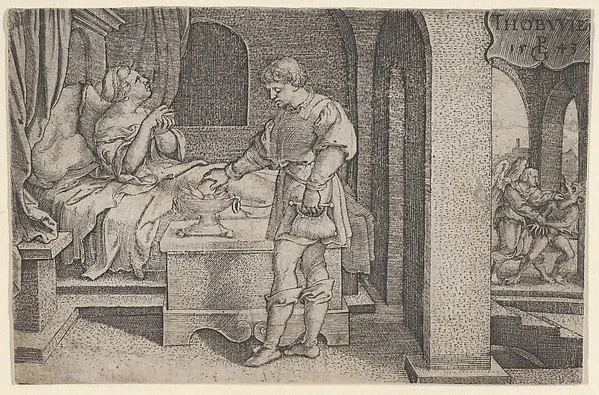
Sirach 26:1-4Happy Is the Husband of a Good Wife
1Happy is the husband of a good wife: for the number of his years is double. 2A virtuous woman rejoiceth her husband: and shall fulfill the years of his life in peace.
The chapter opens with a blessing, and the blessing is concrete. A good wife, Ben Sira says, doubles the number of a man's years. He does not mean she lengthens his calendar so much as she fills his days, so that a life shared in peace is worth twice a life lived alone in strife. A "virtuous woman" gladdens her husband and carries him through his years in peace, the rare and steady peace that comes from being truly companioned.
The wisdom books return again and again to this truth: the people closest to us shape the texture of our days more than wealth or rank ever could.
3A good wife is a good portion, she shall be given in the portion of them that fear God, to a man for his good deeds. 4Rich or poor, if his heart is good, his countenance shall be cheerful at all times.
The word "portion" carries the freight of the whole Old Testament. A portion was the inheritance, the share of land a family received as a gift from God when Israel entered the promised land. To call a good wife "a good portion" is to name her an inheritance, something received rather than achieved, "given in the portion of them that fear God." She is not a prize a man wins by cleverness; she is a gift granted to a reverent life.
This frames the entire chapter. The good that comes to a household is held with open, grateful hands, never grasped as an entitlement.
Verse 4 widens the blessing past marriage to the inner life that makes any blessing possible. "Rich or poor, if his heart is good, his countenance shall be cheerful at all times." The face reflects the heart. A settled, generous heart wears a settled, generous face, and it does so whether the purse is full or empty. The wisdom tradition keeps insisting that the deepest well-being is not arranged by circumstances but carried within, in a heart at peace with God. This is the soil in which a happy home grows.
Sirach 26:5-12The Things My Heart Has Feared
5Of three things my heart hath been afraid, and at the fourth my face hath trembled: 6The accusation of a city, and the gathering together of the people: 7And a false calumny, all are more grievous than death.
The sage pauses to confess his own fears, using a "three things, four things" pattern beloved in Hebrew poetry, a way of saying "here is a list, and the last is the heaviest." What makes his heart tremble are not natural disasters but social ruin: the public accusation of a city, the gathering of a mob, and worst of all "a false calumny," a slander that is not even true. These, he says, are "more grievous than death."
To be destroyed by a lie, to have one's name torn down in front of everyone, is a particular kind of agony. It is striking that an ancient wisdom teacher names reputation and falsehood, the wounds of the tongue, among the most fearful things a person can face.
8A jealous woman is the grief and mourning of the heart. 10As a yoke of oxen that is moved to and fro, so also is a wicked woman: he that hath hold of her, is as he that taketh hold of a scorpion.
Having praised the peace a good companion brings, the chapter speaks with equal candor about the sorrow a divided home can carry, in the blunt imagery of ancient proverb. Jealousy, the corrosive suspicion that poisons trust, is named "the grief and mourning of the heart." The sage reaches for vivid pictures, a restless yoke that will not pull straight, the sting of a scorpion, to convey how a household torn by strife wounds those bound to it.
The wisdom books do not pretend that every home is at peace. They tell the truth about how heavy a broken bond can be, and in doing so they make the earlier blessing all the more precious.
Sirach 26:13-18Her Discipline Is the Gift of God
16The grace of a diligent woman shall delight her husband, and shall fat his bones. 17Her discipline is the gift of God.
After the warnings, the chapter returns to praise and stays there. "The grace of a diligent woman shall delight her husband, and shall fat his bones." The phrase "fat his bones" is an ancient idiom for deep, settled flourishing, the kind of health that reaches the marrow. A grace that is also diligent, beauty joined to faithful work, does more than please for a moment. It nourishes a whole life from within. The wisdom tradition prizes exactly this union of inner character and steady devotion, the quiet excellence that wears well over years.
Then comes a short, luminous line: "Her discipline is the gift of God." The Greek behind "discipline" means formation, the training that shapes a soul, the same root that gives us the schooling of a child. To call such formation "the gift of God" is to say that a well-ordered character is not a human achievement alone but something granted from above, grace working in and through a person's discipline. This is the heart of the chapter's praise.
The most admirable things about a person are gifts of God at work, and they call for gratitude rather than mere applause.
18Such is a wise and silent woman, and there is nothing so much worth as a well instructed soul.
The verse rises to a claim that reaches beyond marriage to every human being: "there is nothing so much worth as a well instructed soul." Here the chapter shows its hand. All the praise of grace and beauty has been climbing toward this, the supreme worth of a soul rightly formed and taught. Nothing money can buy compares to it. A soul instructed in wisdom and the fear of God is the most valuable thing the chapter can name, more precious than any outward gift, because it is the part of us that endures and that God most delights to shape.
Sirach 26:19-24No Price Is Worthy of a Faithful Soul
19A holy and shamefaced woman is grace upon grace. 20And no price is worthy of a continent soul.
A holy and modest woman, the chapter says, is "grace upon grace," beauty layered on beauty, one good gift heaped upon another. The phrase is almost the same one John would use of Christ, "grace for grace," the sense of a fullness that keeps overflowing. Holiness joined to humility does not subtract from a person's loveliness; it multiplies it. The reverent soul has a beauty the world cannot manufacture, because it comes from God and reflects Him.
Then the chapter states its deepest conviction outright: "no price is worthy of a continent soul." A soul that is self-possessed, faithful, governed by the fear of God, is literally beyond price. No sum of money could buy it, because it does not belong to the order of things money measures. This is the same truth that runs through the wisdom books and out into the Gospel: the things that matter most cannot be purchased. A faithful soul is worth more than all the silver and gold in the world, and the person who carries one carries a treasure.
21As the sun when it riseth to the world in the high places of God, so is the beauty of a good wife for the ornament of her house. 24As everlasting foundations upon a solid rock, so the commandments of God In the heart of a holy woman.
The chapter gathers its praise into a string of radiant images. A good wife is like the rising sun, lighting her house the way dawn lights the world from "the high places of God." She is a lamp on the holy lampstand, golden pillars on bases of silver, firm feet that do not stumble. Each picture lifts ordinary domestic beauty into something almost liturgical, as if the well-ordered home were a small sanctuary and the faithful life within it a kind of light. Goodness, the sage is saying, is luminous; it shines.
The series reaches its summit in the last and greatest image: "As everlasting foundations upon a solid rock, so the commandments of God in the heart of a holy woman." Here the chapter tells us what all the beauty has been resting on. Beneath the grace, the diligence, the radiance, lies the bedrock of God's commandments written on the heart. A life looks luminous from the outside because, on the inside, it is built on rock.
This is the foundation Jesus Himself would describe, the house that stands through every storm because it is founded on the word of God taken to heart and obeyed.
Sirach 26:25-28The Callings Most Exposed to Sin
27And he that passeth over from justice to sin, God hath prepared such an one for the sword. 28Two sorts of callings have appeared to me hard and dangerous: a merchant is hardly free from negligence: and a huckster shall not be justified from the sins of the lips.
The chapter widens from the home to the wider world, and the sage names what grieves him there. The sharpest grief is the person "that passeth over from justice to sin," one who knew the right road and chose to leave it. To abandon justice deliberately, after having walked in it, is a graver thing than never having known it. The wisdom books take such turning seriously because a life is a direction, and the direction we choose carries us somewhere.
The warning is sober, and it is meant to make a wavering heart stop and turn back before the drift becomes a destination.
Ben Sira closes with a clear-eyed look at the marketplace. Two callings strike him as "hard and dangerous," the merchant who can scarcely avoid carelessness and the trader who "shall not be justified from the sins of the lips," the small dishonesties of buying and selling. He is not condemning honest work; he is naming where each kind of work is most tempted. Every calling has its own door through which sin slips in, and the wise person knows where theirs is.
The book that has praised the home now sends the reader out to the place they earn their bread with the same wisdom: walk uprightly even where it is hardest.
Where this echoes in Scripture
Happy Is the Husband of a Good Wife
- Proverbs 18:22Whoso findeth a wife findeth a good thing, and obtaineth favour of the LORD.A good spouse is favour from the LORD, the same gift Sirach calls a portion.
- Proverbs 19:14House and riches are the inheritance of fathers: and a prudent wife is from the LORD.Houses are inherited, but a prudent wife is given directly by God.
- James 1:17Every good gift and every perfect gift is from above, and cometh down from the Father of lights.The good portion of this chapter is one more good gift from the Father.
The Things My Heart Has Feared
- Exodus 20:16Thou shalt not bear false witness against thy neighbour.The commandment behind the sage's fear of false calumny.
- Proverbs 22:1A good name is rather to be chosen than great riches, and loving favour rather than silver and gold.Why slander wounds so deeply: a good name is worth more than wealth.
- James 3:5-6Behold, how great a matter a little fire kindleth! And the tongue is a fire.The tongue's power to ruin is exactly what this passage dreads.
Her Discipline Is the Gift of God
- Proverbs 31:30Favour is deceitful, and beauty is vain: but a woman that feareth the LORD, she shall be praised.The same turn from outward charm to the soul that fears God.
- Mark 8:36For what shall it profit a man, if he shall gain the whole world, and lose his own soul?Jesus weighs the soul above the whole world, as Sirach weighs it above all worth.
- 1 Peter 3:4But let it be the hidden man of the heart, in that which is not corruptible, even the ornament of a meek and quiet spirit.The imperishable inner self, prized above outward adornment.
No Price Is Worthy of a Faithful Soul
- Matthew 7:24-25Whosoever heareth these sayings of mine, and doeth them, I will liken him unto a wise man, which built his house upon a rock.Jesus' image of the life founded on rock, echoing Sirach's closing line.
- John 1:16And of his fulness have all we received, and grace for grace.The overflowing "grace upon grace" that this chapter glimpses, fulfilled in Christ.
- Matthew 16:26For what is a man profited, if he shall gain the whole world, and lose his own soul?Christ prices the soul beyond the world, as Sirach prices it beyond all wealth.
The Callings Most Exposed to Sin
- Proverbs 11:1A false balance is abomination to the LORD: but a just weight is his delight.The honesty in trade that the sage knows is so easily lost.
- Luke 9:62No man, having put his hand to the plough, and looking back, is fit for the kingdom of God.The peril of turning back from the road once chosen, as in passing from justice to sin.
- 1 Timothy 6:10For the love of money is the root of all evil: which while some coveted after, they have erred from the faith.The marketplace temptation Ben Sira names, traced to its root.