Song of Solomon 8
People in this chapter
The Song of Solomon comes to its close, and the closing is its peak. Through eight chapters the book has held up married love - the seeking and the finding, the praise of the beloved's beauty, the ache of separation and the joy of reunion - as something good, strong, and worth guarding. The opening verses of this last chapter sound that note one more time: the Bride wishes she could show her love openly, without shame, as freely as one would greet a brother in the street (vv. 1-2), and she repeats for the third and final time her charge to the daughters of Jerusalem: that ye stir not up, nor awake my love, until he please (v. 4).
Love is not to be rushed or forced; it is to be honored and let to ripen in its time.1
Tap any highlighted phrase to jump to the commentary that unpacks it.
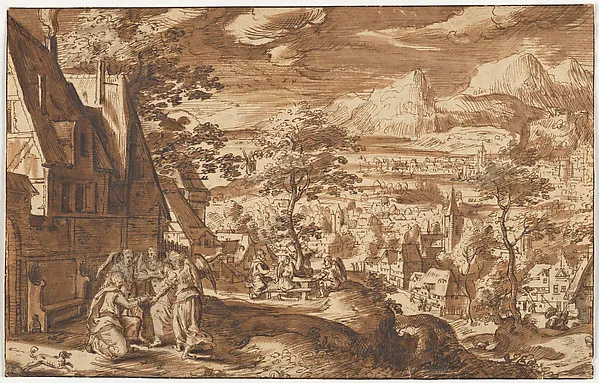
Song of Solomon 8:1-4That I Might Love Thee Openly
1O that thou wert as my brother, that sucked the breasts of my mother! when I should find thee without, I would kiss thee; yea, I should not be despised. 2I would lead thee, and bring thee into my mother’s house, who would instruct me: I would cause thee to drink of spiced wine of the juice of my pomegranate. 3His left hand should be under my head, and his right hand should embrace me. 4I charge you, O daughters of Jerusalem, that ye stir not up, nor awake my love, until he please.
The Bride opens the final chapter with a wish that sounds strange to modern ears until we hear what is underneath it: O that thou wert as my brother… when I should find thee without, I would kiss thee; yea, I should not be despised (v. 1). In her world, affection between a man and a woman in public was hedged about with caution; a sister could greet a brother openly in the street with no shame, but a young woman could not so freely embrace the man she loved.
So her wish is not for him to actually be her brother - it is a longing for a love she could show without fear of scorn, a love as unguarded in the open as it is in private. She imagines leading him home, into my mother's house (v. 2), the safest and most honored of places, and there giving him the best she has: spiced wine of the juice of my pomegranate. What she wants is not something hidden and furtive but something whole and unashamed - love that can stand in the daylight.
There is a quiet dignity in the wish. True love does not want to skulk; it wants to be known.2
Verse 3 repeats, almost word for word, a line from earlier in the Song: His left hand should be under my head, and his right hand should embrace me. The repetition is not accidental. This image of being held - supported beneath, encircled around, secure on every side - has become a kind of refrain for the rest the Bride finds in her beloved's love. It is the posture of complete safety: cradled, embraced, at peace.
After all the seeking and the separations the Song has recorded, the desire underneath every verse is simply this - to be held by the one she loves and to rest there. It is worth noticing that this is how the chapter that will define love as strong as death begins: not with intensity or drama, but with the quiet picture of two people at rest in each other's arms. The strength of love and the gentleness of love are not opposites.
The same love that is fierce as fire is also tender enough to be a place of rest.
For the third and last time the Bride turns to the daughters of Jerusalem with a charge she has spoken twice before: that ye stir not up, nor awake my love, until he please (v. 4). The repetition gives the whole book one of its steadying refrains. Love, the Bride insists, has its own proper time, and it must not be forced or hurried or roused before it is ready. There is a wisdom here that runs against the grain of every age that treats desire as something to be seized the moment it stirs.
Love that is awakened too soon, pressed before its season, is cheapened and often wounded. The Bride - who knows the heights this love can reach, and is about to describe them - is the very one who counsels patience. She is not against the fire; she is the one most eager to protect it from being lit carelessly. Let love wake in its own time, she says, and it will be worth the wait. Rush it, and you may put it out before it has truly caught.
Song of Solomon 8:5-7Love Is Strong as Death
5Who is this that cometh up from the wilderness, leaning upon her beloved? I raised thee up under the apple tree: there thy mother brought thee forth: there she brought thee forth that bare thee. 6Set me as a seal upon thine heart, as a seal upon thine arm: for love is strong as death; jealousy is cruel as the grave: the coals thereof are coals of fire, which hath a most vehement flame. 7Many waters cannot quench love, neither can the floods drown it: if a man would give all the substance of his house for love, it would utterly be contemned.
The section opens with a question that an unseen voice calls out as the couple draws near: Who is this that cometh up from the wilderness, leaning upon her beloved? (v. 5). The picture is tender and telling. She comes up out of the wilderness - the hard, dry, lonely country - and she does not come alone, and she does not come unsupported. She comes leaning upon the one she loves, her weight resting on him, the two of them moving together out of the waste and toward home.
This is what the whole book has been moving toward: not two separate people who happen to admire each other, but a love so settled that she can lean the whole of herself upon him. Then a voice - most likely the Bride's, speaking to her beloved - recalls where their love was first awakened: I raised thee up under the apple tree: there thy mother brought thee forth. Love is rooted in real places and real history; it has a birthplace, a story, a past it remembers.
They are not strangers to each other. They have come a long way together, out of the wilderness, leaning the whole time.
Now comes the verse the entire Song has been ascending toward: Set me as a seal upon thine heart, as a seal upon thine arm (v. 6). In the ancient world a seal was among a person's most precious and personal possessions - a signet ring or an engraved stone, pressed into wax or clay to mark a document as authentic, to claim ownership, to make a thing binding and beyond dispute. A seal was identity itself; it was carried always, often worn against the body on a cord at the neck or a band on the arm.
So the Bride's plea is breathtaking in what it asks. Make me your seal - bind me to you so closely that I am pressed upon your very heart, worn upon your arm, carried with you always, the mark of who you are. The heart is the seat of the inner life, the place of love and thought and will; the arm is the seat of strength and action. She asks to be held in both - in his affection and in his strength, in who he is and in what he does.
It is not a request for a fleeting feeling. It is a request for a permanent, unbreakable bond - to belong to him as a seal belongs to its owner, never set aside.1
And then she says why such a bond is worth asking for, in words that have never been improved upon: for love is strong as death; jealousy is cruel as the grave (v. 6). Stop at the comparison, because it is the most daring thing the book says. Death is the one power that no one resists; it takes whom it will, it cannot be bargained with or turned aside, it is utterly final. To say love is strong as death is to say love possesses that same unyielding, irresistible force - that it grips as tightly, holds as surely, and will not let go.
And jealousy here is not the petty, suspicious thing the word often means for us; it is love's fierce refusal to share the beloved, its insistence on exclusive devotion - cruel as the grave, which is to say as relentless and uncompromising as the grave that yields nothing back. This is not lukewarm sentiment. It is love as a force of nature, as serious and as strong as the last enemy itself. The Bible does not treat married love as a pleasant decoration on life.
It treats it as one of the strongest powers a human being will ever know.
The verse climbs higher still. The coals of this love are coals of fire, which hath a most vehement flame (v. 6) - and then: Many waters cannot quench love, neither can the floods drown it (v. 7). Picture it: an ordinary fire is helpless against water; a flood puts out any flame. But this fire cannot be drowned. Let the many waters come - every hardship, every hostility, every flood of trouble and opposition and time that would try to put it out - and still the fire burns.
Love of this kind is not extinguished by difficulty; it is proved by it. And then the last claim: if a man would give all the substance of his house for love, it would utterly be contemned (v. 7). Pile up all the wealth of an entire household and offer it as the purchase price of love, and the offer would be met not with interest but with contempt - because love is not a commodity.
It cannot be bought, sold, traded, or earned. It can only be given and received. To try to buy it is to insult it. Three things, then, this love defeats: it defeats death by its strength, it defeats the flood by its fire, and it defeats wealth by its very nature. Nothing can overpower it, nothing can drown it, nothing can purchase it.
Song of Solomon 8:8-12A Wall and a Vineyard of Her Own
8We have a little sister, and she hath no breasts: what shall we do for our sister in the day when she shall be spoken for? 9If she be a wall, we will build upon her a palace of silver: and if she be a door, we will inclose her with boards of cedar. 10I am a wall, and my breasts like towers: then was I in his eyes as one that found favour. 11Solomon had a vineyard at Baalhamon; he let out the vineyard unto keepers; every one for the fruit thereof was to bring a thousand pieces of silver. 12My vineyard, which is mine, is before me: thou, O Solomon, must have a thousand, and those that keep the fruit thereof two hundred.
After the summit, the Song comes back down to ordinary, practical love - and it does so by talking about a younger sister: We have a little sister, and she hath no breasts: what shall we do for our sister in the day when she shall be spoken for? (v. 8). These are most likely the words of the Bride's brothers, the family voices, looking ahead to the day their young sister will be old enough to be courted (“spoken for”).
It is a question every loving family asks: how do we prepare and protect the ones in our care for the love that is coming to them? And their answer (v. 9) is given in the language of building: if she be a wall, we will build upon her a palace of silver: and if she be a door, we will inclose her with boards of cedar. The two images are a gentle contrast. A wall stands firm, keeps its integrity, does not let just anyone through - and such strength deserves to be honored and adorned, crowned like a tower with silver.
A door can be opened to anyone - and a door that swings too freely needs to be reinforced, enclosed with strong cedar, protected until it learns its own strength. Love, the family knows, must be both guarded and built up; the young are to be cherished and made strong for the day their own love comes.
The Bride answers the family's wondering about the little sister by speaking of herself, and her answer is one of quiet maturity: I am a wall, and my breasts like towers: then was I in his eyes as one that found favour (v. 10). She has become the wall the brothers hoped their sister would be. She is no longer the unformed girl; she is grown, settled, whole - a woman of integrity, secure in who she is, not a door swinging open to every passerby but a wall that stands.
And notice what that maturity brought: then was I in his eyes as one that found favour. The word translated favour is, in the Hebrew, the word for peace - she became, in her beloved's eyes, one who brings peace, one with whom there is wholeness and rest. Here is a truth the modern imagination often misses: her strength did not make her less desirable to him; it made her precious to him. He did not want a dependent who had no self of her own.
He found favour in a woman who was a wall - whole, strong, at peace, and freely his. To be strong and to be loved are not at odds. The Bride is both.
The last image before the closing exchange is a vineyard, and it carries a quiet assertion of the Bride's freedom: Solomon had a vineyard at Baalhamon; he let out the vineyard unto keepers; every one for the fruit thereof was to bring a thousand pieces of silver. My vineyard, which is mine, is before me (vv. 11-12). The contrast is pointed. Solomon, the great king, owned a vast vineyard he rented out for a fortune - a thousand pieces of silver from each keeper, wealth flowing in from a property managed at a distance by hired hands.
But the Bride sets her own vineyard beside his and stakes a different claim: my vineyard, which is mine, is before me. Earlier in the Song she had lamented that she had not kept her own vineyard; now it is hers, present to her, under her own care. And she disposes of it freely: thou, O Solomon, must have a thousand, and those that keep the fruit thereof two hundred. She is no man's property to be rented out for silver.
Her vineyard - herself, her love, the fruit of who she is - is hers to give, and she gives it not because she is owned but because she chooses to. Love that is real cannot be commanded or purchased, even by a king. It can only be freely given by one who is free.2
Song of Solomon 8:13-14Make Haste, My Beloved
13Thou that dwellest in the gardens, the companions hearken to thy voice: cause me to hear it. 14Make haste, my beloved, and be thou like to a roe or to a young hart upon the mountains of spices.
The book ends with two short verses, one from each voice, and the Beloved speaks first: Thou that dwellest in the gardens, the companions hearken to thy voice: cause me to hear it (v. 13). The Bride dwells in the gardens - the place of beauty and growth and fragrance that has been the setting of so much of the Song - and others, her companions, listen for her voice. But the Beloved wants what they have: cause me to hear it. Of all the voices he could attend to, hers is the one he longs for.
There is something deeply moving in this as the book's second-to-last word. After everything - the seeking, the praise, the great declaration that love is strong as death - what the Beloved asks for at the end is simply the sound of her voice. Not her beauty catalogued one more time, not a grand gesture, but her voice, speaking to him. Love at its most mature does not crave spectacle. It wants the ordinary, irreplaceable nearness of the beloved's voice.
Let me hear you.
And the Bride answers with the very last words of the Song - not a settling down, but a calling out: Make haste, my beloved, and be thou like to a roe or to a young hart upon the mountains of spices (v. 14). It is striking that the book does not end with the lovers finally at rest, the story closed, desire satisfied and quieted forever. It ends with the Bride urging her beloved to come - quickly, with the speed and vigour of a young stag bounding over the hills, toward the mountains of spices, the fragrant high places of love and delight.
The longing that has run through every chapter is not extinguished at the end; it is still burning, still reaching, still saying come. This is the truest note on which such a book could close. Love that is alive is never finished wanting the beloved. It is a fire that, having been lit, does not go out but keeps reaching upward. The Song ends with an open door and a voice calling through it: make haste. Come.
The last word of the love-song is not goodbye but come quickly.
Research trail
Sources & further study
These references support the historical, linguistic, manuscript, and contextual notes in this chapter. Scripture remains the primary text; external sources are provided so readers can inspect the research directly.
- Song of Solomon 8 - Translators' NotesThe NET Bible's detailed footnotes on Song of Solomon 8 - the wish for unashamed love in verses 1-2, the refrain charging the daughters of Jerusalem (v. 4), the seal and the famous comparison of love to death and fire (vv. 6-7), and the much-discussed final syllable of the word translated “most vehement flame.”
- Song of Songs 8 · Hebrew + classical Jewish commentaryThe Hebrew text of Song of Songs 8 with classical commentators side by side - useful for chotam (v. 6, the “seal”), for the clause azzah ka-mavet ahavah (“love is strong as death”), and for the unusual word shalhevetyah (v. 6, the “most vehement flame”), whose final syllable is read by many as the divine name itself.
- Song of Solomon 8 ↔ Romans 8 · Ephesians 1 · Revelation 22Traces the threads tying this chapter to the rest of Scripture - love strong as death and unquenchable by many waters (vv. 6-7) read alongside the love from which nothing, not death, can separate us (Rom. 8:35-39); the plea to be made a seal read beside being sealed with that holy Spirit of promise (Eph. 1:13); and the closing Make haste, my beloved (v. 14) beside Even so, come, Lord Jesus (Rev. 22:20).
Where this echoes in Scripture
That I Might Love Thee Openly
- Song of Solomon 2:6His left hand is under my head, and his right hand doth embrace me.The same picture of being held that verse 3 repeats - the rest the Bride finds in her beloved's love.
- Song of Solomon 2:7I charge you, O daughters of Jerusalem... that ye stir not up, nor awake my love, till he please.The refrain of verse 4 sounded earlier - love not to be roused before its time.
- Matthew 11:28-29Come unto me, all ye that labour and are heavy laden, and I will give you rest.The rest and refuge the Bride longs for in verse 3 - held secure, at peace.
- Ecclesiastes 3:1To every thing there is a season, and a time to every purpose under the heaven.The wisdom behind the charge in verse 4 - that love, too, has its proper time.
Love Is Strong as Death
- Romans 8:38-39neither death, nor life... shall be able to separate us from the love of God, which is in Christ Jesus our Lord.The love of God answering verses 6-7 - strong as death, unquenchable, from which nothing can separate us.
- John 15:13Greater love hath no man than this, that a man lay down his life for his friends.Love strong as death (v. 6) shown to the full - a love that goes into death itself.
- Ephesians 1:13in whom also after that ye believed, ye were sealed with that holy Spirit of promise.The Bride's plea to be made a seal (v. 6) answered - God seals His own as His.
- Haggai 2:23I... will make thee as a signet: for I have chosen thee, saith the LORD of hosts.The seal of verse 6 as the mark of God's choosing - held close, claimed, never set aside.
- 1 Peter 1:18-19ye were not redeemed with corruptible things, as silver and gold... but with the precious blood of Christ.The love that cannot be bought (v. 7) - not purchased with wealth, but freely given at the highest cost.
A Wall and a Vineyard of Her Own
- Song of Solomon 1:6mine own vineyard have I not kept.The vineyard she once neglected, now hers and cared for (vv. 11-12) - the Bride come into her own.
- Proverbs 4:23Keep thy heart with all diligence; for out of it are the issues of life.The wisdom behind being a wall (v. 10) - the strength of a guarded, whole heart.
- 1 Kings 4:25every man under his vine and under his fig tree... all the days of Solomon.Solomon's vast holdings (v. 11) set beside the Bride's one vineyard that is freely her own.
- 2 Corinthians 9:7every man according as he purposeth in his heart... not grudgingly, or of necessity: for God loveth a cheerful giver.The free giving of the Bride's vineyard (v. 12) - love and gift offered freely, not under compulsion.
Make Haste, My Beloved
- Revelation 22:17And the Spirit and the bride say, Come. And let him that heareth say, Come.The Bride's cry make haste (v. 14) become the prayer of the whole Church at the end of all things.
- Revelation 22:20Surely I come quickly. Amen. Even so, come, Lord Jesus.The last words of Scripture answering the Song's last words - the beloved's come and the promise I come quickly.
- Song of Solomon 2:17be thou like a roe or a young hart upon the mountains of Bether.The same closing image as verse 14 - the beloved called to come swiftly over the hills.
- Philippians 3:20For our conversation is in heaven; from whence also we look for the Saviour, the Lord Jesus Christ.The eager watching of verse 14 - a people who keep longing and looking for the One they love.