Song of Solomon 2
People in this chapter
After the opening exchanges of chapter 1, the two lovers go on answering each other, and chapter 2 begins with three pictures handed back and forth. The bride names herself a wildflower - I am the rose of Sharon, and the lily of the valleys (v. 1) - not a rare hothouse bloom but the ordinary, lovely flower of the open country. The beloved takes her own image and lifts it: As the lily among thorns, so is my love among the daughters (v. 2).
And she returns the compliment in kind - he is as the apple tree among the trees of the wood, the one tree worth sitting under in a whole forest, and his fruit was sweet to my taste (v. 3). The Song does not blush at any of this. It treats the delight of two people who belong to one another as a thing wholly good, set down in Scripture without apology.1
Tap any highlighted phrase to jump to the commentary that unpacks it.
Song of Solomon 2:1-7His Banner Over Me Was Love
1I am the rose of Sharon, and the lily of the valleys. 2As the lily among thorns, so is my love among the daughters. 3As the apple tree among the trees of the wood, so is my beloved among the sons. I sat down under his shadow with great delight, and his fruit was sweet to my taste. 4He brought me to the banqueting house, and his banner over me was love. 5Stay me with flagons, comfort me with apples: for I am sick of love. 6His left hand is under my head, and his right hand doth embrace me. 7I charge you, O ye daughters of Jerusalem, by the roes, and by the hinds of the field, that ye stir not up, nor awake my love, till he please.
The chapter opens with three images of flower and tree, tossed back and forth between the two lovers like a game. First the bride: I am the rose of Sharon, and the lily of the valleys (v. 1). She does not claim to be exotic. Sharon was a broad coastal plain, and the flowers that grew there were the common wildflowers of the open country - not the rare bloom of a king's garden but the lily anyone might find in a valley.
There is a lovely, unforced confidence in it: she knows she is beautiful, and the beauty she claims is the ordinary beauty of a field in bloom. The beloved answers by taking her own picture and lifting it higher: As the lily among thorns, so is my love among the daughters (v. 2). Set every other woman beside her, he says, and they are thorns and she is the single flower. It is the way love actually sees - not pretending the beloved is the only lovely thing in the world, but finding that, to this one set of eyes, she outshines them all.
The Song is teaching, in its own indirect way, how love looks at its object: it does not inflate, it simply prefers, and the preferring makes the beloved singular.
The bride returns the compliment in the same key: As the apple tree among the trees of the wood, so is my beloved among the sons (v. 3). He answered her flower with a flower; she answers his lily with a tree. In a whole forest of ordinary trees, he is the one that bears fruit and casts shade - the one worth coming to and worth staying under. And then the verse turns warm and unhurried: I sat down under his shadow with great delight, and his fruit was sweet to my taste. Notice the three things in that line.
There is shade - shelter, a place out of the heat, rest. There is fruit - nourishment, something given and received. And there is delight and sweetness - sheer enjoyment, the simple gladness of being where she most wants to be. This is what the beloved is to her: shelter, provision, and joy, all at once. The Song is not embarrassed to say that love is enjoyable, that the body and its senses are part of the gift, that two people belonging to each other is meant to be sweet.
It sets that gladness down in Scripture plainly, as a good thing among the good things God has made.
The beloved raises such a standard over this woman, and its name is one word: love. She is claimed openly, publicly, gladly; anyone who looks can see whose she is and what holds her. It is not a banner of conquest or ownership-as-control. It is love itself lifted high over her like a flag. To be brought into the house of joy and set under that ensign is the picture the verse leaves us with: belonging that is announced rather than hidden, and that declares, for all to see, she is loved.
The bride's next words show how strong this love runs: Stay me with flagons, comfort me with apples: for I am sick of love. His left hand is under my head, and his right hand doth embrace me (vv. 5-6). To be sick of love is not the modern phrase of being tired of it - it is the old sense of being faint, overcome, weak in the knees with the force of it.
Love here is not a mild preference but something that takes hold of the whole person, body and all, so that she asks to be propped up and steadied. And the answer to that swooning is not distance but nearness: his arms are around her, his left hand under my head, and his right hand doth embrace me. The Song keeps insisting that this love is bodily as well as inward - held in the arms, faint with longing, real and physical and good.
Far from treating desire as something to be ashamed of, the chapter treats it as one of the strong, glad things of being alive. The proper home of such love is, the whole book assumes, the covenant of a husband and a wife; and within that home, the Song says without flinching, this overwhelming, embodied gladness is exactly as it should be.
The scene closes with a charge the Song will repeat: I charge you, O ye daughters of Jerusalem, by the roes, and by the hinds of the field, that ye stir not up, nor awake my love, till he please (v. 7). The bride turns from her beloved to the young women around her and lays a solemn oath on them - sworn, tenderly, by the wild gazelles and deer of the open field, the shyest and gentlest of creatures.
And the thing she guards is the timing of love itself: do not stir up or awake love before it is ready. There is a wisdom in this that runs against the grain of how we often treat desire. Love, the Song says, has its own right hour; it is not to be forced into waking, rushed, or roused before its time. Something so strong is also something tender, easily harmed by being hurried. The refrain stands as a quiet guardrail around the very passion the chapter has been celebrating - not to dampen it, but to protect it, so that love comes fully awake in its own good season rather than being dragged out half-grown.
The Song can praise desire so freely precisely because it also knows desire must be handled with care.
Song of Solomon 2:8-13Rise Up, My Love · The Winter Is Past
8The voice of my beloved! behold, he cometh leaping upon the mountains, skipping upon the hills. 9My beloved is like a roe or a young hart: behold, he standeth behind our wall, he looketh forth at the windows, shewing himself through the lattice. 10My beloved spake, and said unto me, Rise up, my love, my fair one, and come away. 11For, lo, the winter is past, the rain is over and gone; 12The flowers appear on the earth; the time of the singing of birds is come, and the voice of the turtle is heard in our land; 13The fig tree putteth forth her green figs, and the vines with the tender grape give a good smell. Arise, my love, my fair one, and come away.
The scene changes and the energy lifts: The voice of my beloved! behold, he cometh leaping upon the mountains, skipping upon the hills (v. 8). She hears him before she sees him - that glad cry, the voice of my beloved! - and then watches him come, not trudging but bounding, taking the hills the way a young deer does. The next verse fills out the picture: My beloved is like a roe or a young hart: behold, he standeth behind our wall, he looketh forth at the windows, shewing himself through the lattice (v. 9).
All the words are words of eagerness. He has covered the distance fast and lightly; now he is at the wall, at the windows, peering in through the lattice, wanting to be seen, wanting her to come. There is nothing reluctant in this love. The beloved does not have to be coaxed across the miles; he comes leaping, and arrives looking for her face. The Song keeps showing love as something that moves - that crosses ground, that seeks, that shows up at the window glad to have come.
The watchfulness at the lattice is not the watching of a stranger but of one who has hurried a long way and now waits at the threshold for the door to open.
Then comes the summons the whole chapter has been moving toward: My beloved spake, and said unto me, Rise up, my love, my fair one, and come away (v. 10). Hear the shape of it. It is an invitation, not an order - he calls her my love, my fair one in the same breath that he calls her out. And it is a call to rise and to come: to get up from where she has been sitting, to leave the indoors, to move toward him and out into the world he is offering her.
The reason follows immediately and is all one bright sentence: For, lo, the winter is past, the rain is over and gone (v. 11). Everything turns on those words. The cold season of bare branches and shut doors and grey skies is finished. The long rains have stopped. What kept her inside is over. The call to come away is not a summons into hardship but out of it - out of winter, into a world that has begun, all at once, to bloom.
And the same call is repeated at the end of the passage like a refrain pressed twice: Arise, my love, my fair one, and come away (v. 13). The beloved is not content to admire her through the lattice. He wants her up, out, and beside him in the open air of spring.
Between the two calls to come away, the Song unrolls one of the most beautiful catalogues of spring in all of literature: The flowers appear on the earth; the time of the singing of birds is come, and the voice of the turtle is heard in our land; the fig tree putteth forth her green figs, and the vines with the tender grape give a good smell (vv. 12-13). Read it slowly, because every line is a different sense waking up.
There is sight - the flowers appear on the earth, color returning to bare ground. There is sound, twice over - the time of the singing of birds, and the voice of the turtle, the turtledove whose return was the sure sign that spring had truly come. There is the slow promise of the harvest - the fig tree putteth forth her green figs. And there is fragrance - the vines with the tender grape give a good smell, the scent of the vineyard in flower carried on the warm air.
The whole earth is named coming back to life: seen, heard, tasted in promise, smelled. And this is the world the beloved is calling her out into. The summons is not abstract. He is saying: the dead season is over, the living one has begun, the birds are already singing it - come and be part of the world waking up. Love and springtime are set side by side, each the natural home of the other.
Song of Solomon 2:14-17My Beloved Is Mine, and I Am His
14O my dove, that art in the clefts of the rock, in the secret places of the stairs, let me see thy countenance, let me hear thy voice; for sweet is thy voice, and thy countenance is comely. 15Take us the foxes, the little foxes, that spoil the vines: for our vines have tender grapes. 16My beloved is mine, and I am his: he feedeth among the lilies. 17Until the day break, and the shadows flee away, turn, my beloved, and be thou like a roe or a young hart upon the mountains of Bether.
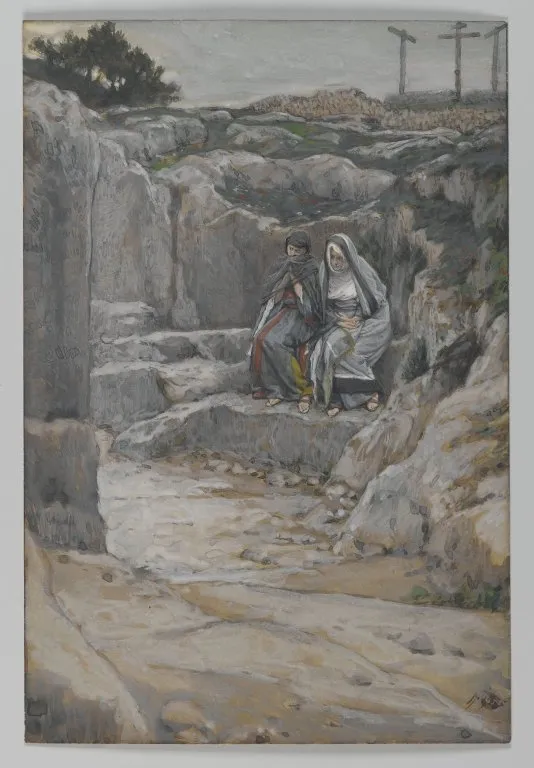
The beloved's call grows tender as it goes on: O my dove, that art in the clefts of the rock, in the secret places of the stairs, let me see thy countenance, let me hear thy voice; for sweet is thy voice, and thy countenance is comely (v. 14). He names her his dove - gentle, faithful, the bird that mates for life - and pictures her tucked away in the clefts of the rock, in the hidden, sheltered places of the high cliffs where doves nest.
There is something a little shy in the image, as if she has half-withdrawn into a safe and secret place, and he is coaxing her out. And the way he coaxes is worth noticing: he does not demand, he asks, and what he asks for is simply to see her and hear her. Let me see thy countenance, let me hear thy voice. He wants her face and her voice for their own sake - sweet is thy voice, and thy countenance is comely. This is love that delights in the plain presence of the other: not what she can do or give, but her face turned toward him and the sound of her speaking.
To be wanted like that - for your countenance, for your voice, for simply being there and being seen - is one of the deepest things the human heart longs for, and the Song sets it down as a glory of love, not a small thing.
Into the middle of all this tenderness drops a short, almost proverbial line: Take us the foxes, the little foxes, that spoil the vines: for our vines have tender grapes (v. 15). It comes like a sudden practical note in a love song, and that is part of its wisdom. The threat named is not some great catastrophe but the little foxes - small creatures that slip into a vineyard and nibble the buds and gnaw the roots, so that the vines never come to fruit.
And the reason they matter is given plainly: our vines have tender grapes - the fruit is young, just setting, exactly when it is most easily ruined. The verse turns outward, too: take us the foxes - this is work the two of them do together, side by side, guarding their shared vineyard. There is a quiet realism here that keeps the chapter honest. Even in the bloom of spring, even under the banner of love, something can creep in and spoil the fruit before it ripens - and it is usually not one large disaster but a host of small, unguarded things.
The Song does not pretend love makes a couple invulnerable. It says, rather, that love worth keeping is also love worth guarding, and that the guarding is a thing done together and done early, while the grapes are still tender.
Then comes the line that gathers the whole chapter into seven words: My beloved is mine, and I am his: he feedeth among the lilies (v. 16). It is the Song's great refrain of belonging, and the order of it is the point. It runs both directions at once - he is mine, and I am his - a mutual, equal possession in which each gives the self to the other and each receives the other in return.
This is not possession as control or ownership; it is the belonging of love freely answered by love, two people who have handed themselves over to each other and rest in being one another's. There is a deep security in the words. After all the seeking and calling and coming away, the chapter sets down its quiet anchor: whatever else is true, my beloved is mine, and I am his. The last clauses keep the pastoral, peaceful tone - he feedeth among the lilies, and, until the cool of evening when the shadows flee away, she bids him return to her like the swift young deer of the morning (v. 17).
The chapter that opened among wildflowers closes among lilies, with the lovers belonging wholly to each other and the day turning gently toward its rest.
Research trail
Sources & further study
These references support the historical, linguistic, manuscript, and contextual notes in this chapter. Scripture remains the primary text; external sources are provided so readers can inspect the research directly.
- Song of Solomon 2 - Translators' NotesThe NET Bible's detailed footnotes on Song of Solomon 2 - the wildflower images of verses 1-3, the much-discussed “banner” of verse 4, the catalogue of spring in verses 11-13, and the proverb of the little foxes in verse 15.
- Song of Songs 2 · Hebrew + classical Jewish commentaryThe Hebrew text of Song of Songs 2 with Rashi and other classical commentators side by side - useful for degel (v. 4, the “banner” raised over the bride), for tor (v. 12, the “turtle,” the turtledove whose return announces spring), and for the chain of springtime images in verses 11-13.
- Song of Solomon 2 ↔ Romans 6 & 8 · 2 Corinthians 5 · Hosea 2Traces the threads tying Song of Solomon 2 to the rest of Scripture - the summons out of winter into life (vv. 10-13) read beside walk in newness of life (Rom. 6:4) and all things are become new (2 Cor. 5:17), and the refrain of mutual belonging (v. 16) read beside the covenant promise I will be their God, and they shall be my people (Jer. 31:33).
Where this echoes in Scripture
His Banner Over Me Was Love
- Ephesians 5:25Husbands, love your wives, even as Christ also loved the church, and gave himself for it.The married love the Song celebrates, named as the very image of Christ's love for His people.
- Romans 8:38-39nor any other creature, shall be able to separate us from the love of God, which is in Christ Jesus our Lord.The banner of verse 4 - love lifted over us, sure and unremovable.
- Isaiah 62:5and as the bridegroom rejoiceth over the bride, so shall thy God rejoice over thee.The bridal joy of this scene, read as the joy of God over His own.
- John 15:4-5Abide in me, and I in you... he that abideth in me, and I in him, the same bringeth forth much fruit.The bride resting in her beloved's shade and tasting his fruit (v. 3) - the life found in abiding near.
- Genesis 1:31And God saw every thing that he had made, and, behold, it was very good.The goodness the Song assumes - the body, desire, and married love among the things God made and called good.
Rise Up, My Love · The Winter Is Past
- 2 Corinthians 5:17if any man be in Christ, he is a new creature: old things are passed away; behold, all things are become new.The winter-past, all-things-new movement of verses 10-13, in the language of the Gospel.
- Romans 6:4like as Christ was raised up from the dead by the glory of the Father, even so we also should walk in newness of life.The call to rise (v. 10) echoed - rising out of death into a new life.
- Ephesians 5:14Awake thou that sleepest, and arise from the dead, and Christ shall give thee light.The summons of verses 10-13 - rise up, come away, the long night is over.
- Song of Solomon 2:11-12the winter is past, the rain is over and gone; The flowers appear on the earth; the time of the singing of birds is come.The chapter's own springtime - the reason given for the call to come away.
- Isaiah 35:1The wilderness and the solitary place shall be glad for them; and the desert shall rejoice, and blossom as the rose.The wintered ground bursting into bloom - the same renewal the beloved announces in verses 11-13.
My Beloved Is Mine, and I Am His
- Song of Solomon 6:3I am my beloved's, and my beloved is mine: he feedeth among the lilies.The refrain of verse 16 sounded again, turned around - the belonging that runs both ways.
- Jeremiah 31:33I will be their God, and they shall be my people.The two-directional belonging of verse 16, in the words of the covenant God makes with His people.
- Hosea 2:19And I will betroth thee unto me for ever; yea, I will betroth thee unto me in righteousness... and in mercies.The mutual belonging of verse 16 as a betrothal - God binding His people to Himself in love.
- John 10:28and they shall never perish, neither shall any man pluck them out of my hand.The security under the refrain of verse 16 - held fast by the One to whom His own belong.
- 1 Corinthians 6:19-20ye are not your own... For ye are bought with a price.“I am his” (v. 16) - the half of the refrain that says we belong to the One who loves us.