Tobit 8
People in this chapter
By the time Tobias enters Sara's bridal chamber, the reader already knows what waits there. Seven husbands have gone in before him, and a demon named Asmodeus has killed all seven on the wedding night. Sara has prayed for death rather than endure the grief again. And yet here is Tobias, walking into the room that has been a tomb for seven men. The difference is that he does not come alone and he does not come on his own terms.
He carries the counsel of the angel who has traveled with him, and he carries a deeper instinct: before this marriage gives him anything, he will give it to God.
Tap any highlighted phrase to jump to the commentary that unpacks it.
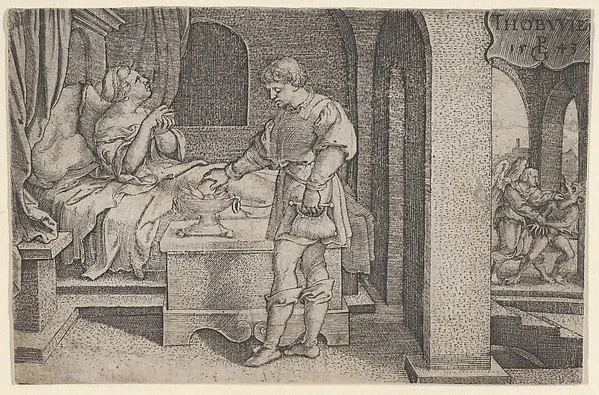
Tobit 8:1-3The Liver on the Coals, the Demon in the Desert
1And after they had supped, they brought in the young man to her. 2And Tobias remembering the angel’s word, took out of his bag part of the liver, and laid it upon burning coals. 3Then the angel Raphael took the devil, and bound him in the desert of upper Egypt.
The first thing Tobias does in that dreaded room is remember. He recalls the word the angel gave him on the road and acts on it, laying part of the fish's liver on the coals. This is the quiet center of the whole scene. Faith here looks like obedience to a word already spoken, carried out in the exact moment of greatest fear. Tobias does not understand the mechanics of what he is doing; he simply trusts the instruction he was given and follows it.
The smoke that rises is the sign of a man taking God at His word when everything in the room argues for panic.
Then heaven acts. The angel Raphael, who has walked beside Tobias the whole journey disguised as a kinsman, seizes the demon and binds him far away in the desert of upper Egypt. The deliverance does not come from the liver itself, as though it were a charm. It comes from God, working through His messenger, at the moment His servant obeys. Notice how thoroughly the evil is removed: not merely subdued in the room but bound and carried off to a distant wilderness, the way Scripture again and again pictures the powers of darkness being driven out and shut away.
What had killed seven men is rendered powerless by a single command from heaven.
Tobit 8:4-5Children of Saints, Not Joined Like the Heathen
4Then Tobias exhorted the virgin, and said to her: Sara, arise, and let us pray to God today, and tomorrow, and the next day: because for these three nights we are joined to God: and when the third night is over, we will be in our own wedlock. 5For we are the children of saints, and we must not be joined together like heathens that know not God.
With the demon gone and the room finally safe, Tobias does the last thing the moment seems to call for. He asks his bride to get up and pray. Before the marriage is consummated, he wants it consecrated. He proposes that they spend these nights joined first to God, giving the marriage to the Lord before they give themselves to each other. This is a man who refuses to let even a good and longed-for gift be taken before it is blessed.
The marriage bed is not treated as something to be seized but as something to be received, and reverence comes before everything.
Tobias names what makes the difference: "we are the children of saints, and we must not be joined together like heathens that know not God." He is conscious of belonging to a holy people, an inheritance of faith handed down to him, and he means to act like it. To be a child of saints is to live as though the God of your fathers is real and present in your most private moments. The contrast he draws is not against any particular nation but against a way of living that leaves God out, that takes what it wants without ever lifting its eyes.
Tobias lifts his eyes first.
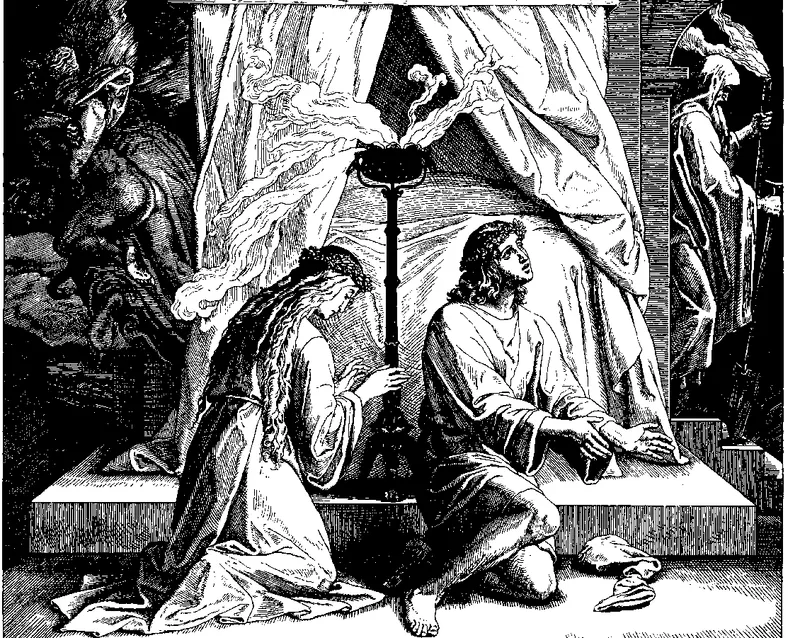
Tobit 8:6-10The Prayer: From Adam and Eve to Mercy and Long Life
6So they both arose, and prayed earnestly both together that health might be given them, 8Thou madest Adam of the slime of the earth, and gavest him Eve for a helper. 9And now, Lord, thou knowest, that not for fleshly lust do I take my sister to wife, but only for the love of posterity, in which thy name may be blessed for ever and ever. 10Sara also said: Have mercy on us, O Lord, have mercy on us, and let us grow old both together in health.
They arise and pray "earnestly both together." This is the first act of their shared life, a husband and wife kneeling side by side, their voices joined before God asks anything else of them. The prayer that follows is one of the tender high points of the book. It begins not with their own need but with God, blessing Him as Maker of heaven and earth and sea, of the fountains and rivers and every living thing.
Before they ask, they worship. They set their small marriage inside the vast frame of all that God has made, so that their request rises from a heart already full of praise.
Tobias reaches all the way back to the beginning: "Thou madest Adam of the slime of the earth, and gavest him Eve for a helper." He grounds his own marriage in the first marriage, the one God Himself arranged in the garden. Marriage, he is saying, is not a human invention to be handled however we please; it is something God established when He formed the first man from the dust and gave him a companion.
By recalling Eden, Tobias places his union under the same blessing God spoke over the first, drawing a straight line from the garden to this guarded room. What God instituted at the dawn of the world, He is trusted to bless again tonight.
The honesty of the next line is striking: "not for fleshly lust do I take my sister to wife, but only for the love of posterity, in which thy name may be blessed." Tobias lays bare his motive before God. He marries not to consume his wife for his own appetite but to build a family through which God's name will be praised for generations. He even calls Sara his "sister," an old term of covenant tenderness that frames her as kin and beloved before she is anything else.
This is desire ordered toward love and life, a longing that wants the good of the other and the glory of God, not merely the satisfaction of the self.
Then Sara prays, and her words are simple and unforgettable: "Have mercy on us, O Lord, have mercy on us, and let us grow old both together in health." After seven weddings that ended in death, she does not ask for grandeur. She asks for mercy, twice, and for the ordinary blessing of a long life shared. There is a whole history of grief packed into that doubled cry for mercy. Her hope is modest and human and holy all at once: simply to grow old beside the man she has married.
It is the prayer of someone who has learned that the plainest gifts, a home, a partner, years together, are mercies that only God can give.
Tobit 8:11-18The Empty Grave and the Blessing at Dawn
11And it came to pass about the cockcrowing, Raguel ordered his servants to be called for, and they went with him together to dig a grave. 15So she sent one of her maidservants, who went into the chamber, and found them safe and sound, sleeping both together. 17And said: We bless thee, O Lord God of Israel, because it hath not happened as we suspected. 18For thou hast shewn thy mercy to us, and hast shut out from us the enemy that persecuted us.
While the newlyweds sleep in peace, Sara's father is awake in the dark. About the time the cock crows, Raguel quietly orders his servants to dig a grave. He is so certain Tobias has met the same fate as the seven before him that he wants the burial finished before daylight, before the neighbors can see and the shame can spread. It is a heartbreaking picture of a love so scarred by repeated grief that it can no longer hope.
Raguel is not faithless so much as bruised; he has buried too many sons-in-law to expect anything but death. He prepares for the worst because the worst is all he has known.
The maidservant is sent into the chamber to confirm the death, and instead she finds Tobias and Sara "safe and sound, sleeping both together." The grave is dug; the body it was meant for is breathing softly in peace. This is the turn the whole chapter has been moving toward. The fear that gripped the household, the dread that has shadowed Sara for seven weddings, meets the simple, astonishing fact of a couple asleep and alive.
God's mercy does not arrive with thunder here. It arrives as the ordinary miracle of a husband and wife resting safely through the night that was supposed to kill him.
When the news comes back, Raguel and his wife bless the Lord at once: "We bless thee, O Lord God of Israel, because it hath not happened as we suspected." Their first response to deliverance is praise. They do not credit luck or the strength of Tobias; they turn immediately to God and bless His name. There is something deeply human in the relief of fearing the worst and finding it has not come. And there is something deeply faithful in what they do with that relief: they hand it straight back to God as worship, recognizing His mercy in the simple fact that this time, the grave stays empty.
They name exactly what God has done: "thou hast shewn thy mercy to us, and hast shut out from us the enemy that persecuted us." The demon that had haunted this family is now spoken of as a defeated foe, shut out by the hand of God. What no human effort could stop, no precaution and no mourning, God has ended. The family that had learned to expect only death now confesses a God who shuts the door on the enemy and opens the way to life.
Their grief is not erased, but it is answered, and the answer is mercy.
Tobit 8:19-24The Feast That Replaced the Funeral
19And thou hast taken pity upon two only children. Make them, O Lord, bless thee more fully: and to offer up to thee a sacrifice of thy praise, and of their health, that all nations may know, that thou alone art God in all the earth. 20And immediately Raguel commanded his servants, to fill up the pit they had made, before it was day. 22He caused also two fat kine, and four wethers to be killed, and a banquet to be prepared for all his neighbours, and all his friends.
Raguel's prayer widens past his own family to the whole world. He asks that this mercy lead his children to bless God "more fully," and that the deliverance become a testimony "that all nations may know, that thou alone art God in all the earth." A private rescue in one household is meant to declare something universal about who God is. This is how the book understands every act of God's faithfulness: it is never merely personal.
The God who saved one couple in one room is the God of all the earth, and His mercies are meant to be told, so that His name is known far beyond the walls where the mercy first arrived.
Then comes one of the most quietly joyful commands in Scripture: Raguel orders the servants to fill up the grave before daybreak. The pit dug for a corpse is filled back in with no corpse to put in it. The very hole that was prepared for death is erased before the morning light can find it. There is a deep symbolism in the image, the grave undone, the place of burial closed up empty, the expectation of death reversed.
What the night had prepared as a tomb, the dawn turns back into ordinary ground, and the only thing buried is the family's long fear.
In the place of a funeral, Raguel throws a feast. He has cattle and rams killed and a banquet spread for all his neighbors and friends, the very people he had hoped would not see a burial now invited to celebrate a life. The chapter that opened in dread closes in festivity. Raguel even binds Tobias to stay two weeks and gives him half of all he owns. The sorrow that had defined this house gives way to generous, overflowing joy.
This is the signature of God's deliverance throughout Scripture: mourning is turned into dancing, and the table that might have held a wake is heaped instead for a wedding.
Where this echoes in Scripture
The Liver on the Coals, the Demon in the Desert
- Psalm 91:11For he shall give his angels charge over thee, to keep thee in all thy ways.The angel who guards Tobias is the kind of guardian this psalm promises.
- James 4:7Submit yourselves therefore to God. Resist the devil, and he will flee from you.The demon flees not from Tobias's strength but from God's power answering obedience.
- Luke 10:17Lord, even the devils are subject unto us through thy name.Evil is bound and cast out not by technique but by heaven's authority.
Children of Saints, Not Joined Like the Heathen
- Ephesians 5:25-26Husbands, love your wives, even as Christ also loved the church, and gave himself for it; That he might sanctify and cleanse it.Marriage is hallowed by self-giving love that sanctifies, the pattern Tobias reaches toward.
- Hebrews 13:4Marriage is honourable in all, and the bed undefiled.Tobias treats the marriage bed as something honourable, to be kept holy before God.
- 1 Corinthians 6:19Know ye not that your body is the temple of the Holy Ghost which is in you?To live as a child of saints is to honor God even in the most private moments.
The Prayer: From Adam and Eve to Mercy and Long Life
- Genesis 2:18And the LORD God said, It is not good that the man should be alone; I will make him an help meet for him.Tobias prays from the garden, where God first gave Eve to Adam.
- Genesis 2:7And the LORD God formed man of the dust of the ground, and breathed into his nostrils the breath of life.The prayer recalls God forming Adam from the earth, the root of all marriage.
- Psalm 123:3Have mercy upon us, O LORD, have mercy upon us: for we are exceedingly filled with contempt.Sara's doubled cry for mercy echoes the simplest, deepest prayer of God's people.
The Empty Grave and the Blessing at Dawn
- Psalm 30:5Weeping may endure for a night, but joy cometh in the morning.Raguel's night of dread gives way to a dawn of blessing.
- Psalm 126:1When the LORD turned again the captivity of Zion, we were like them that dream.The relief of deliverance that feels almost too good to be real.
- 2 Corinthians 1:10Who delivered us from so great a death... in whom we trust that he will yet deliver us.God shuts out the enemy and becomes the One the family learns to trust.
The Feast That Replaced the Funeral
- Psalm 30:11Thou hast turned for me my mourning into dancing... and girded me with gladness.The funeral becomes a feast, the very turn this psalm celebrates.
- Isaiah 25:6And in this mountain shall the LORD of hosts make unto all people a feast of fat things.God's deliverance ends at a banquet, a foretaste of the feast He prepares for all peoples.
- Luke 15:23-24And bring hither the fatted calf, and kill it; and let us eat, and be merry: For this my son was dead, and is alive again.A fatted calf killed because the feared death gave way to life, as in Raguel's house.