Tobit 9
People in this chapter
A young man is caught between two loves. Tobias has just been married to Sara in the house of her father Raguel, and the joy of it has bound him to a wedding feast that custom will not let him leave. Yet back in Nineveh his blind father sits and counts the days, and Tobias knows that every day he lingers wounds the old man who is waiting. There is also a debt to be settled, silver left long ago with a man named Gabelus in a distant city.
So Tobias does the only thing he can. He turns to the companion he trusts, the man he calls Brother Azarias, and asks him to go in his place. He does not know, and will not know until the book is nearly over, that the friend he is sending is the angel Raphael, sent by God to walk beside him the whole way.
Tap any highlighted phrase to jump to the commentary that unpacks it.
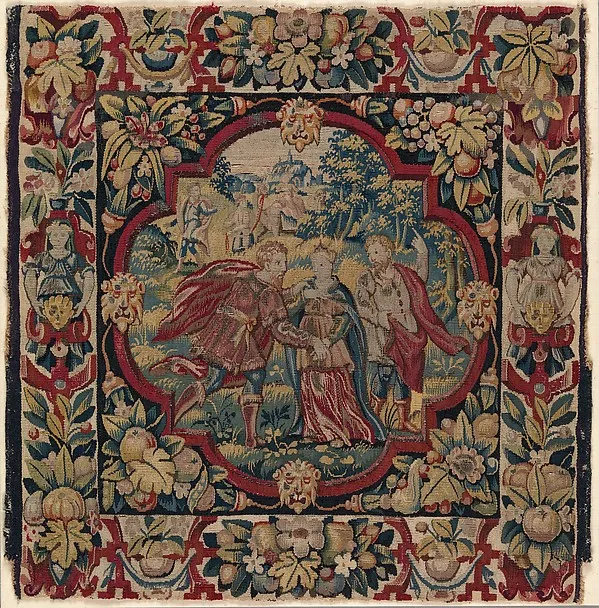
Tobit 9:1-5Brother Azarias, Go in My Place
1Then Tobias called the angel to him, whom he took to be a man, and said to him: Brother Azarias, I pray thee hearken to my words: 2If I should give myself to be thy servant I should not make a worthy return for thy care.
The chapter opens on a quiet line that the reader understands far better than Tobias does. He calls his companion to him, "whom he took to be a man," and speaks to him as a trusted friend, "Brother Azarias." We know what Tobias does not: this is the angel Raphael, sent by God to guard the journey and bring it home. The whole scene gains its weight from that gap. Tobias is leaning on help he cannot identify, trusting a guide whose true nature is hidden from him.
It is a picture of how grace so often works, near and active and unrecognized, doing for us what we could never arrange for ourselves while we go on thinking an ordinary friend has simply been kind.
Before he asks for anything, Tobias confesses that he cannot repay what he has already received. "If I should give myself to be thy servant I should not make a worthy return for thy care." This is gratitude in its truest form, the recognition that some kindness is simply beyond paying back. He has been guided, protected, and helped at every turn, and he knows it. A heart that begins by admitting it owes more than it can ever return is a heart already being shaped well.
Tobias does not take the help for granted; he names it as a gift too large to settle, and only then does he dare to ask for more.
3However, I beseech thee, to take with thee beasts and servants, and to go to Gabelus to Rages the city of the Medes: and to restore to him his note of hand, and receive of him the money, and desire him to come to my wedding. 4For thou knowest that my father numbereth the days: and if I stay one day more, his soul will be afflicted.
The errand is precise. Tobias asks the angel to journey to Gabelus in Rages, to hand back the "note of hand," the written bond that recorded the silver entrusted to him long before, and to receive the money in return. This was a debt held across years and distance, the kind of arrangement that could so easily have dissolved into dispute or denial. Tobias wants it done rightly and fully, the bond honored on both sides.
There is something fitting in a wedding being surrounded by the settling of old accounts and the keeping of old promises. The joy of the new is built on faithfulness to what was pledged before.
Here is the deepest reason for the errand, and it is tender. Tobias cannot leave the feast, yet he cannot bear to make his father wait. "Thou knowest that my father numbereth the days: and if I stay one day more, his soul will be afflicted." He can see, across all the miles, the blind old man counting, and the picture pierces him. This is a son who carries his father in his heart even at his own wedding, who measures his joy against his father's ache.
The honoring of father and mother that runs through the law is alive here as pure love, a young man arranging the whole errand around the sorrow of a parent he refuses to forget.
5And indeed thou seest how Raguel hath adjured me, whose adjuring I cannot despise.
Tobias is held by two bonds at once, and he honors both. His father-in-law Raguel has solemnly pressed him to stay for the full wedding feast, and Tobias will not treat that appeal lightly: "whose adjuring I cannot despise." So he is caught between an oath of hospitality that holds him here and a son's love that pulls him home. He does not break either. He keeps faith with Raguel by staying, and keeps faith with his father by sending the angel ahead.
This is the quiet wisdom of a man who will not solve one duty by trampling another, and who finds, in the help God has placed beside him, a way to honor them both.
Tobit 9:6The Errand Done, the Silver Restored
6Then Raphael took four of Raguel’s servants, and two camels, and went to Rages the city of the Medes: and finding Gabelus, gave him his note of hand, and received of him all the money.
For the first time in the chapter the text names him by his true name. Tobias asked "Brother Azarias," but it is "Raphael" who takes the servants and the camels and sets out for Rages. The reader is let in on the secret the characters do not share. The one running the errand is the very angel of God, and what looks from the table like a friend doing a favor is in fact heaven's own messenger completing the mission he was sent to accomplish.
The journey is described in plain, unhurried words, four servants, two camels, a road to the city of the Medes, and that plainness is the point. God's great help often arrives looking entirely ordinary.
The transaction is clean and complete. Raphael finds Gabelus, gives him back the bond, and receives "all the money," every coin of what had been entrusted years before. There is no haggling, no shortfall, no excuse. A debt that had waited across long distance and long time is honored in full and without dispute. In a book so concerned with integrity, this small detail shines: faithfulness with what belongs to another, kept over years, settled at last without a word of quarrel.
The God who sends His messenger to recover the silver is the same God who delights in promises kept and accounts made right.
Tobit 9:7-9Gabelus Weeps and Blesses the God of Israel
7And he told him concerning Tobias the son of Tobias, all that had been done: and made him come with him to the wedding. 8And when he was come into Raguel’s house he found Tobias sitting at the table: and he leaped up, and they kissed each other: and Gabelus wept, and blessed God,
Gabelus is brought to the feast, and the moment he sees Tobias at the table he cannot contain himself. He leaps up, they kiss in greeting, and then this man weeps and blesses God. The tears are striking because Gabelus has every reason to be thinking about the silver he has just handed over, and instead his heart goes straight to joy and praise. The reunion is not about the money at all. It is about meeting, face to face, the son of a man he has loved and admired from afar.
Real godliness lives in moments like this, where the first instinct upon receiving good is not to count the gain but to bless the God who gave it.
9And said: The God of Israel bless thee, because thou art the son of a very good and just man, and that feareth God, and doth almsdeeds:
Gabelus blesses Tobias not for anything Tobias himself has yet done, but for whose son he is: "the son of a very good and just man, and that feareth God, and doth almsdeeds." The father's long life of righteousness has gone ahead of the son like a fragrance, and a man in a distant city honors the boy on the strength of it. Here is one of the quiet truths this book keeps pressing: a life of goodness, the fear of God, and works of mercy leaves a name that blesses those who come after.
Tobit's charity to the poor and the dead, so costly and so unnoticed in its own day, now returns as honor poured out on his child.
Tobit 9:10-12A Blessing on Children, and a Feast in the Fear of God
10And may a blessing come upon thy wife and upon your parents. 11And may you see your children, and your children’s children, unto the third and fourth generation: and may your seed be blessed by the God of Israel, who reigneth for ever and ever.
Gabelus's blessing widens to take in the whole family and reaches forward across time. He asks blessing on the bride, on the parents, and then on the long line still to come: "may you see your children, and your children's children, unto the third and fourth generation." To see one's grandchildren and beyond was held to be among the richest of God's favors, the sign of a life carried on and a covenant kept through the years.
The wish is not for wealth or power but for the gift of generations, the continuance of a faithful household. It is the deep hope of the whole book, that the line of the righteous endures and that the joy of this wedding will ripple down through children not yet born.
The blessing rises at its close to the One who makes any blessing sure: "may your seed be blessed by the God of Israel, who reigneth for ever and ever." Every good wished on this family is anchored at last in God Himself, the everlasting King whose reign outlasts every generation it touches. This is the grammar of true blessing throughout Scripture. It is never a charm or a mere good wish; it is a turning of the heart toward the eternal God and a placing of the beloved into His hands.
The promise that traces back to Abraham, that his seed would be blessed, breathes again here over a young couple at the start of their life together.
12And when all had said, Amen, they went to the feast: but the marriage feast they celebrated also with the fear of the Lord.
The whole company says "Amen" to the blessing, and only then do they go to the table. The final line is the one to carry away: "the marriage feast they celebrated also with the fear of the Lord." Here is joy and reverence held together, gladness that does not forget God and worship that is not afraid to feast. The fear of the Lord does not freeze the celebration; it crowns it, keeping the joy honest and turning the whole gathering toward the Giver.
This is the picture the book holds up of a life lived well, eating and rejoicing and giving thanks all at once, every blessing received as from the hand of God and every feast kept in awe of Him.
Where this echoes in Scripture
Brother Azarias, Go in My Place
- Exodus 20:12Honour thy father and thy mother: that thy days may be long upon the land which the LORD thy God giveth thee.Tobias arranges the whole errand around his father's ache, the commandment alive as love.
- Hebrews 13:2Be not forgetful to entertain strangers: for thereby some have entertained angels unawares.Tobias trusts the very angel he cannot recognize, help dressed as an ordinary friend.
- Psalm 91:11For he shall give his angels charge over thee, to keep thee in all thy ways.The unseen guard walking every mile of the journey beside him.
The Errand Done, the Silver Restored
- Colossians 2:14Blotting out the handwriting of ordinances that was against us... and took it out of the way, nailing it to his cross.A bond handed back and cancelled, the debt against us made good.
- 1 Peter 1:18-19Ye were not redeemed with corruptible things, as silver and gold... but with the precious blood of Christ.A debt recovered here with silver; ours redeemed at a price beyond price.
- Luke 16:10He that is faithful in that which is least is faithful also in much.The clean settling of a long-held debt is faithfulness in the small things.
Gabelus Weeps and Blesses the God of Israel
- Proverbs 22:1A good name is rather to be chosen than great riches, and loving favour rather than silver and gold.Tobit's good name goes ahead of his son into a distant city.
- Psalm 112:1-2Blessed is the man that feareth the LORD... his seed shall be mighty upon earth: the generation of the upright shall be blessed.The righteous father's life becomes a blessing on the child.
- Acts 10:4Thy prayers and thine alms are come up for a memorial before God.Tobit's almsdeeds, like Cornelius's, rise up and return as honor.
A Blessing on Children, and a Feast in the Fear of God
- Genesis 22:17-18In blessing I will bless thee... and in thy seed shall all the nations of the earth be blessed.The Abrahamic promise that the seed of the faithful shall be blessed breathes again here.
- Psalm 128:5-6The LORD shall bless thee out of Zion... yea, thou shalt see thy children's children, and peace upon Israel.The very blessing Gabelus speaks, children's children to the third and fourth generation.
- 1 Corinthians 10:31Whether therefore ye eat, or drink, or whatsoever ye do, do all to the glory of God.A feast kept in the fear of the Lord, every joy turned toward the Giver.