Tobit 10
People in this chapter
A son is late coming home, and the silence is unbearable. Tobit 10 opens inside the fear of two parents who do not know whether their only child is alive. Tobias has gone to a distant land to collect a debt, has found a wife along the way, and has stayed for the wedding celebration, but his father and mother know none of this. All they know is that the day appointed for his return has come and gone.
The chapter lets us sit with them in that dread, with a blind old father reasoning aloud about what might have delayed his boy, and a mother who can no longer be comforted and goes out each day to search the roads.
Tap any highlighted phrase to jump to the commentary that unpacks it.
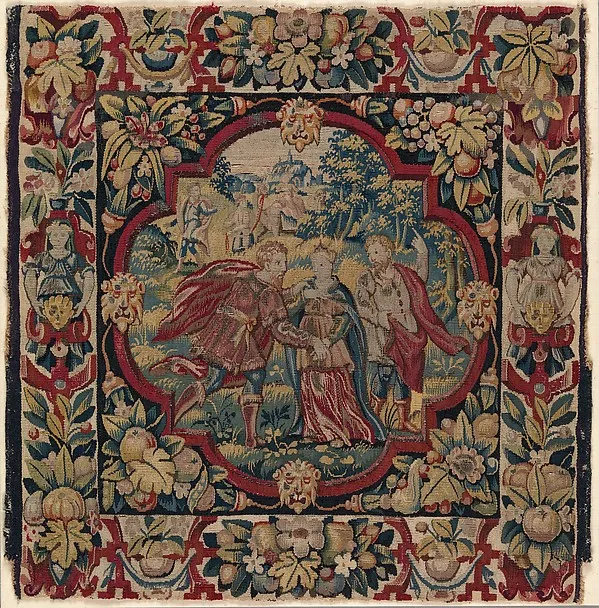
Tobit 10:1-3The Day Appointed Comes and Goes
1But as Tobias made longer stay upon occasion of the marriage, Tobias his father was solicitous, saying: Why thinkest thou doth my son tarry, or why is he detained there? 3And he began to be exceeding sad, both he and Anna his wife with him: and they began both to weep together: because their son did not return to them on the day appointed.
The old man cannot see, and so his anxiety has nowhere to go but words. He turns the delay over and over, asking why his son tarries, what could be keeping him, whether the debtor has died and left no one to repay. This is the helpless arithmetic every waiting parent knows, the mind running through every possibility because it cannot run out to the road and look. Tobit is the same man who in earlier chapters bore blindness and loss with patience, and here that patience is tested in a new way.
It is one thing to suffer in your own body. It is another to fear for a child who is out of your reach.
Notice the small, tender detail: husband and wife weep together. Grief can isolate two people inside the same house, each retreating into a private dread, but here their sorrow draws them into one. The cause is named plainly, that their son did not return on the day appointed. A deadline had been set, a date circled, and its passing turns hope into fear. The chapter does not rush past this. It lets the reader feel the weight of an empty road and a calendar that has run out, because the ache of love delayed is part of what the whole book is about.
Tobit 10:4-5The Light of Our Eyes, the Staff of Our Age
4But his mother wept and was quite disconsolate, and said: Woe, woe is me, my son; why did we send thee to go to a strange country, the light of our eyes, the staff of our old age, the comfort of our life, the hope of our posterity? 5We having all things together in thee alone, ought not to have let thee go from us.
Anna's lament is one of the most moving speeches in the book, and it pours out in images. Her son is the light of her eyes, the staff that holds up her old age, the comfort of her life, the hope of everything that will come after them. Each phrase says the same thing from a different angle: this one child carries the whole weight of their love and their future. There is something almost unbearable in a parent naming aloud how much a child means, because to say it is to confess how much could be lost.
Her grief is not weakness. It is the size of her love made audible.
The blindness that has fallen on Tobit gives the phrase "the light of our eyes" a piercing edge. The father literally cannot see, and the son was the light that gave their darkened house its meaning. When Anna says they had all things together in him alone, she speaks the truth of every parent of an only child, where one life holds all the hope. Her regret, that they ought never to have let him go, is the voice of love second-guessing itself in the dark.
Readers who have ever blamed themselves for a risk taken on behalf of someone they love will hear their own hearts in her words.
Tobit 10:6-7Daily She Went Out to Watch the Road
6And Tobias said to her: Hold thy peace, and be not troubled, our son is safe: that man with whom we sent him is very trusty. 7But she could by no means be comforted, but daily running out looked round about, and went into all the ways by which there seemed any hope he might return, that she might if possible see him coming afar off.
The old father tries to steady his wife with a conviction he cannot prove. "Our son is safe," he says, "that man with whom we sent him is very trusty." The reader of the book knows something Tobit does not: the traveling companion is the angel Raphael, and the boy truly is safe under a guardianship far greater than Tobit imagines. The father speaks better than he knows. His trust in the unseen guide turns out to be entirely warranted, even though from where he sits he is simply choosing to believe the best in the dark.
Faith often looks like this, holding to the goodness of a guide you cannot see.
Anna cannot reason her way to peace, so she does what love does: she goes out and watches. Every day she runs to look around, walks down every road that holds any hope, straining to catch sight of her son while he is still far off. It is a portrait of love that refuses to give up the watch. There is something both heartbreaking and beautiful in a mother who keeps returning to the empty road.
She is not faithless for being unable to sit still. Her restless watching is its own kind of hope, the hope that cannot stop scanning the horizon for the one it loves.
Tobit 10:8-9I Know My Father and Mother Count the Days
8But Raguel said to his son in law: Stay here, and I will send a messenger to Tobias thy father, that thou art in health. 9And Tobias said to him: I know that my father and mother now count the days, and their spirit is grievously afflicted within them.
The scene cuts to the other household, where the problem is the opposite of grief: a father-in-law who loves the young couple and wants them to stay. Raguel offers a reasonable compromise, to send a messenger ahead so the parents know their son is well while the celebration continues. But Tobias answers with a son's knowledge of his parents' hearts. He can feel, across all that distance, that they are counting the days and that their spirits are afflicted within them.
He will not trade his own comfort and a longer feast for their prolonged anguish. This is honor in action, a grown child who weighs his parents' pain as heavier than his own pleasure.
Tobit 10:10-11Half His Substance, and the Angel Be With You
10And when Raguel had pressed Tobias with many words, and he by no means would hearken to him, he delivered Sara unto him, and half of all his substance in menservants, and womenservants, in cattle, in camels, and in kine, and in much money, and sent him away safe and joyful from him. 11Saying: The holy angel of the Lord be with you in your journey, and bring you through safe, and that you may find all things well about your parents, and my eyes see your children before I die.
When Raguel sees that Tobias will not be persuaded, he does not cling or sulk. He yields, and his yielding is lavish. He gives his daughter into her husband's care and sends with them half of everything he owns, servants and livestock and camels and money, a fortune to establish the new household. There is a generosity here that refuses to let go grudgingly. Raguel loves the young couple too much to hold them back, so he pours out his goods to speed them on.
He sends Tobias away "safe and joyful," which is what love wants for the one it releases, not safety alone, and not joy alone, but both together.
Raguel's farewell is a prayer, and it is full of unintended truth. "The holy angel of the Lord be with you in your journey," he says, "and bring you through safe." He does not know that the angel of the Lord already walks beside Tobias as his guide; he simply prays the thing that is, unknown to him, already so. His blessing reaches toward the very protection that is in fact escorting his daughter home.
Then he names his deepest hope, that his eyes might see their children before he dies, the longing of an aging parent to glimpse the future, to know that love will go on past his own life into grandchildren he prays to hold.
Tobit 10:12-13They Kissed Her, and Let Her Go
12And the parents taking their daughter kissed her, and let her go: 13Admonishing her to honour her father and mother in law, to love her husband, to take care of the family, to govern the house, and to behave herself irreprehensibly.
The chapter closes on a parting kiss. Sara's parents take their daughter, kiss her, and let her go, and in that single sentence the whole cost of love is gathered up. To kiss and to release in the same breath is what parents do when a child marries and leaves, holding close and opening the hand at once. Sara has known deep sorrow in her own story, and now she is sent out toward a new life and a new household with the blessing of the home that raised her.
The tenderness of the moment is the tenderness of every threshold where one chapter of a family ends and another begins.
Their parting words to her are a kind of wisdom for a new household. They charge her to honor her husband's parents as her own, to love her husband, to care for the family, to keep the home, and to live in a way that no one could rightly fault. These are not cold instructions but a loving inheritance, the distilled counsel of parents who want their daughter to flourish where she is going.
Beneath the specific duties lies a deeper principle: that a home is built by people who give themselves to one another in honor, love, and faithful care. Sara is sent out not only with goods but with the wisdom to make a new house into a true home.
Where this echoes in Scripture
The Day Appointed Comes and Goes
- Luke 15:20But when he was yet a great way off, his father saw him, and had compassion, and ran, and fell on his neck, and kissed him.Another father watching the road for a son who is far from home.
- Genesis 42:36And Jacob their father said unto them, Me have ye bereaved of my children... all these things are against me.A father's fear for a missing child, voiced in the same helpless way.
- Psalm 56:8Thou tellest my wanderings: put thou my tears into thy bottle: are they not in thy book?The tears wept in this house are not unseen by God.
The Light of Our Eyes, the Staff of Our Age
- Genesis 37:35And all his sons and all his daughters rose up to comfort him; but he refused to be comforted.Jacob, like Anna, inconsolable over a son he believes is lost.
- 2 Corinthians 1:3-4The Father of mercies, and the God of all comfort; who comforteth us in all our tribulation.The comfort Anna found in a son is, at its source, the comfort of God Himself.
- Matthew 5:4Blessed are they that mourn: for they shall be comforted.A promise spoken over exactly the kind of mourning this mother pours out.
Daily She Went Out to Watch the Road
- Luke 15:20And he arose, and came to his father. But when he was yet a great way off, his father saw him.The father who is already watching the road is how Jesus pictures God.
- Psalm 130:6My soul waiteth for the Lord more than they that watch for the morning.The aching watchfulness of love, turned toward God.
- Isaiah 40:31But they that wait upon the LORD shall renew their strength.A promise for the heart worn thin by watching and waiting.
I Know My Father and Mother Count the Days
- Exodus 20:12Honour thy father and thy mother: that thy days may be long upon the land.Tobias lives out the commandment by counting his parents' pain as his own.
- Philippians 2:4Look not every man on his own things, but every man also on the things of others.The same instinct: weighing another's burden above your own ease.
- 1 Timothy 5:4Let them learn first to shew piety at home, and to requite their parents.Honoring parents in practical, sacrificial ways is named a first duty of faith.
Half His Substance, and the Angel Be With You
- Genesis 24:60And they blessed Rebekah, and said unto her, Thou art our sister, be thou the mother of thousands of millions.A family sends a daughter to a far country with the same kind of parting blessing.
- Numbers 6:24-26The LORD bless thee, and keep thee... and give thee peace.The blessing-and-keeping Raguel prays over the journey is rooted in the priestly blessing.
- Hebrews 1:14Are they not all ministering spirits, sent forth to minister for them who shall be heirs of salvation?Raguel prays for angelic protection that is, unknown to him, already at work.
They Kissed Her, and Let Her Go
- Genesis 2:24Therefore shall a man leave his father and his mother, and shall cleave unto his wife.The leaving-and-joining that Sara's parting embodies as she goes to a new home.
- Ruth 1:16Whither thou goest, I will go... thy people shall be my people, and thy God my God.A woman binding herself in love to a new family, as Sara is charged to do.
- Colossians 3:14And above all these things put on charity, which is the bond of perfectness.Love is the thread that holds together the household Sara is sent to build.