Tobit 11
People in this chapter
Some prayers are answered so slowly that we stop expecting them. Tobit had gone blind, had grown old in his grief, had even prayed once to die. His son Tobias had been sent on a long and dangerous errand, and his mother Anna had spent the waiting days watching the road, certain something terrible had happened. This chapter is what it looks like when the long-delayed answer finally arrives. The travelers come back over the hills toward Nineveh, and the household that has carried its sorrow in faith is about to be flooded with more joy than it knows how to hold.
Tap any highlighted phrase to jump to the commentary that unpacks it.
Tobit 11:1-6The Watch on the Hill
4And as this their going pleased him, Raphael said to Tobias: Take with thee of the gall of the fish, for it will be necessary. So Tobias took some of that gall and departed.
The healing begins long before the eyes are touched. Earlier on the journey the companion had told Tobias to keep the gall of a great fish, with no explanation of why, and now its purpose is revealed. There is a lesson hidden in the timing. The provision was given before the need was understood, set aside in obedience and carried for miles before anyone knew what it was for. So often God prepares the answer before we can see the question, asking only that we keep what He gives and trust that it will be necessary.
The one who guided this journey knew the end of it from the beginning.
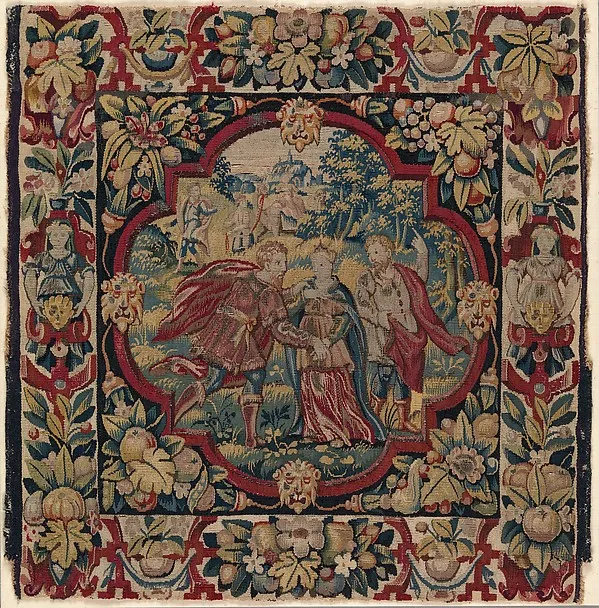
5But Anna sat beside the way daily, on the top of a hill, from whence she might see afar off. 6And while she watched his coming from that place, she saw him afar off, and presently perceived it was her son coming: and returning she told her husband, saying: Behold thy son cometh.
There is no more tender picture in the book than this. Anna climbs the same hill every single day and sits beside the road, straining her eyes toward the horizon for any sign of the son she fears she has lost. A mother's grief keeps a faithful watch that nothing can talk it out of. Day after day she goes up, and day after day the road is empty, and still she returns the next morning. The verse honors the long, unglamorous patience of love that keeps looking even when looking has so far brought only disappointment.
And then, one day, the watching is rewarded. She sees a figure far off, and a mother's heart knows before her eyes can be certain: it is him. She does not wait to be sure; she runs to tell her husband, "Behold thy son cometh." It is the cry of grief turning to joy in a single breath. The waiting that seemed endless is over in an instant, and the first thing she does with the good news is carry it to the one who shares her sorrow. Joy, like grief, wants to be shared.
Tobit 11:7-12A Blind Father Runs to the Road
7And Raphael said to Tobias: As soon as thou shalt come into thy house, forthwith adore the Lord thy God: and giving thanks to him, go to thy father, and kiss him. 8And immediately anoint his eyes with this gall of the fish, which thou carriest with thee. For be assured that his eyes shall be presently opened, and thy father shall see the light of heaven, and shall rejoice in the sight of thee.
Before the embrace, before the healing, the companion gives one instruction: when you come into the house, first adore the Lord your God and give Him thanks. The order is deliberate and worth pausing over. The very moment of arriving home, the rush of reunion, is to begin with worship. Gratitude is to come before everything, even before the longed-for kiss of a father. The chapter teaches by its sequence that the first response to God's mercy is not to seize the gift but to bless the Giver, and that thanksgiving is the doorway through which every blessing is meant to be received.
The promise is spoken plainly in advance: your father shall see the light of heaven. The phrase is more than a description of recovered eyesight. For a man who has sat in darkness through long years, the return of light is nothing less than the return of the world, of his son's face, of the daylight he had given up ever seeing again. Scripture loves this image, where light stands for the presence and favor of God breaking into a place that despair had darkened.
The healing of the body here becomes a window onto a deeper hope, that the God who opens blind eyes is the God who scatters every darkness.
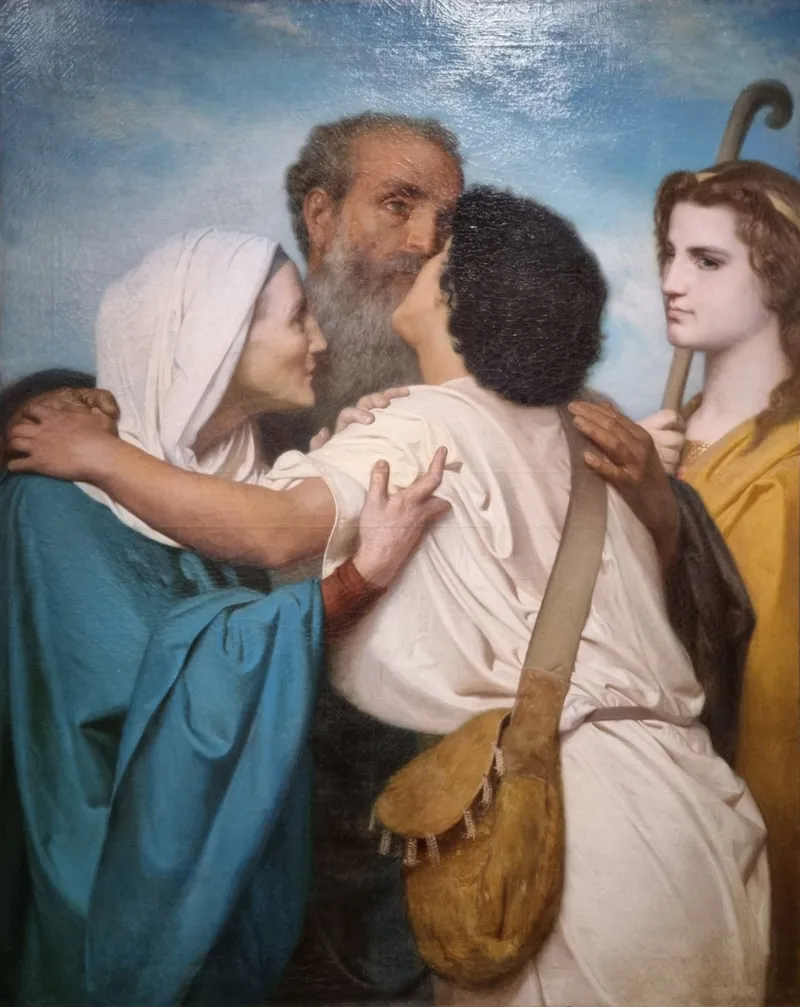
9Then the dog, which had been with them in the way, ran before, and coming as if he had brought the news, shewed his joy by his fawning and wagging his tail. 10And his father that was blind, rising up, began to run stumbling with his feet: and giving a servant his hand, went to meet his son. 11And receiving him kissed him, as did also his wife, and they began to weep for joy.
A small, beloved detail: the dog that had gone with them the whole journey runs ahead and arrives wagging its tail, as if it carried the good news itself. It is the kind of homely, true touch that gives the story its warmth. Even the household animal shares in the gladness of the homecoming. Joy this large spills over the edges of the human heart and fills the whole house, down to the dog at the door, and the writer is not too solemn to notice.
Here is one of the most moving images in all the book. The old blind man, hearing that his son has come, cannot wait where he sits. He rises and begins to run, stumbling, unable to see where his feet are going, reaching out a hand to a servant to be led toward the boy he loves. Love does not wait for the safe or dignified path. The father who cannot see the road still runs down it, because his son is at the end of it.
It is the picture of a heart that has waited so long that it can no longer hold still, and it anticipates the father in the parable Jesus would later tell, who saw his returning son a great way off and ran.
They reach each other, and the chapter dissolves into tears, but these are tears of joy. The father kisses his son, the mother does the same, and the household weeps the way people weep when a grief they thought was permanent is suddenly, wholly undone. This is the deepest note the book has sounded yet. There is a sorrow so heavy that only joy this overwhelming can answer it, and when the answer comes, even the body must respond.
The God who keeps account of our tears is here turning them, in a single embrace, into the tears of the redeemed.
Tobit 11:13-17The Film Lifts, and He Sees
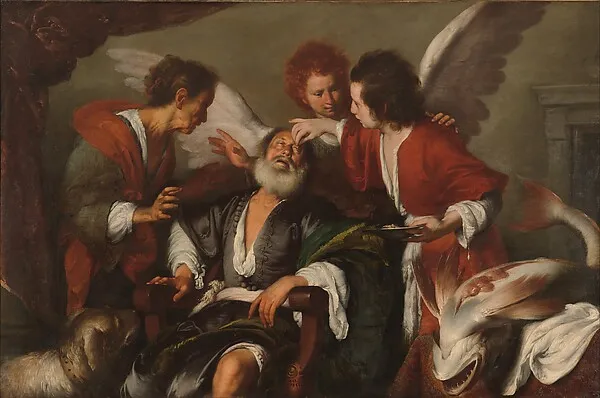
13Then Tobias taking of the gall of the fish, anointed his father’s eyes. 14And he stayed about half an hour: and a white skin began to come out of his eyes, like the skin of an egg. 15And Tobias took hold of it, and drew it from his eyes, and immediately he recovered his sight.
The son becomes the instrument of his father's healing. With his own hands he spreads the gall on the eyes that have not seen him in years. There is a beautiful reversal in it. The father who once cared for the helpless child now receives sight at the hand of that grown child, and the love between them completes a circle. The means are humble, the gesture is tender, and through it the long darkness is about to end.
God works His wonders here not by spectacle but through the patient hands of a faithful son doing exactly what he was told.
The writer describes the moment with vivid, unforgettable concreteness: a white film like the skin of an egg lifts from the old man's eyes, and Tobias takes hold of it and draws it away. The detail is so physical you can almost feel it. The darkness that had covered everything is shown to be a thing that can be peeled back and removed. What had seemed a permanent affliction turns out to be a veil, and behind the veil the light was waiting all along.
It is a parable in miniature of how God so often works, lifting away what we thought could never be undone.
16And they glorified God, both he and his wife and all that knew them. 17And Tobias said: I bless thee, O Lord God of Israel, because thou hast chastised me, and thou hast saved me: and behold I see Tobias my son.
The first thing the healed man does with his new sight is glorify God, and the joy is so large it cannot stay private. Not only he and his wife but all who knew them join in praising God for what He has done. A mercy this great becomes a public testimony; the neighbors who had watched a household sink into grief now watch it lifted, and they cannot help but give glory. This is how God's works are meant to ripple outward, drawing in the whole circle of a person's life until the praise belongs to everyone who witnessed the wonder.
The old man's first words with open eyes are a blessing, and they hold a striking honesty: "thou hast chastised me, and thou hast saved me." He does not pretend the years of darkness never happened, nor does he resent them. He sees them now within the whole arc of God's dealing, a discipline that did not crush him and an affliction out of which God has brought salvation. To bless God for both the wounding and the healing, in the same breath, is the voice of a faith that has been through the fire and come out trusting.
And then the simplest, most joyful words of all: "behold I see Tobias my son."
Tobit 11:18-21The House Filled with Blessing
19And he told his parents all the benefits of God, which he had done to him by the man that conducted him.
With his father seeing again, Tobias sits down and tells the whole story, recounting all the benefits of God shown to him through the man who had guided him on the road. He gives the credit where it belongs, to God, and notices that the help had come through this remarkable companion whose true nature the family does not yet fully know. The instinct here is one Scripture commends everywhere: to retell the goodness of God, to count the mercies one by one out loud so they are not forgotten.
A blessing recounted is a blessing doubled, and the household that names what God has done builds a memory that will steady it for years to come.
20And Achior and Nabath the kinsmen of Tobias came, rejoicing for Tobias, and congratulating with him for all the good things that God had done for him. 21And for seven days they feasted and rejoiced all with great joy.
The joy keeps widening. The kinsmen come and rejoice with the family, congratulating them for all the good things God has done. What began on a lonely hill with one watching mother has become the gladness of a whole extended household. This is the shape of God's restoring work: it does not stay contained in the one who first received it but draws in family, neighbors, and friends until the whole community is caught up in the praise. Grief had isolated this house; mercy reconnects it, and the table fills with people who came to share the joy.
The chapter closes the way the deepest joys in Scripture so often close, with a feast. For seven full days they feast and rejoice together with great joy. The number seven carries the sense of completeness, of a thing brought to its fullness, and the long celebration says that this is not a fleeting happiness but a settled, overflowing gladness. A story that opened in darkness and tears ends at a table heaped with thanksgiving.
It is a foretaste of the great feast Scripture promises at the end of all things, where God wipes away every tear and the long-watched-for joy never ends.
Where this echoes in Scripture
The Watch on the Hill
- Luke 15:20But when he was yet a great way off, his father saw him, and had compassion, and ran, and fell on his neck, and kissed him.A parent who watches the road and runs to the returning child, as Anna does here.
- Psalm 130:6My soul waiteth for the Lord more than they that watch for the morning.The faithful watching that strains toward dawn, like Anna on her hill.
- Lamentations 3:25The LORD is good unto them that wait for him, to the soul that seeketh him.The goodness that meets patient waiting, which this chapter pours out.
A Blind Father Runs to the Road
- Psalm 126:5They that sow in tears shall reap in joy.The grief of the watching turned, as here, into tears of joy.
- John 11:35Jesus wept.The Lord who shares our tears at the grave and then turns them, as joy answers grief in this house.
- 1 Thessalonians 5:18In every thing give thanks: for this is the will of God in Christ Jesus concerning you.The thanksgiving Tobias is told to offer first, before the embrace.
The Film Lifts, and He Sees
- Isaiah 35:5Then the eyes of the blind shall be opened, and the ears of the deaf shall be unstopped.The promised healing of blindness that this chapter previews and Christ fulfills.
- John 9:25One thing I know, that, whereas I was blind, now I see.The healed man's testimony, the same wonder the old father gives glory for.
- Psalm 30:5Weeping may endure for a night, but joy cometh in the morning.The night of affliction giving way to morning joy, as the veil lifts.
The House Filled with Blessing
- Psalm 107:2Let the redeemed of the LORD say so, whom he hath redeemed from the hand of the enemy.The instinct to retell God's benefits aloud, as Tobias does for his parents.
- Luke 15:23-24And bring hither the fatted calf, and kill it; and let us eat, and be merry... and they began to be merry.The feast of joy over a son restored, the same gladness that ends this chapter.
- Revelation 21:4And God shall wipe away all tears from their eyes; and there shall be no more death, neither sorrow.The final feast where the tears of this chapter give way to unending joy.