Painter of the Bible
Annibale Carracci
Annibale Carracci was, with his brother Agostino and his cousin Ludovico, the founder of the Bolognese reform of Italian painting at the end of the sixteenth century — the move away from late-Mannerist artifice toward di…

Their faith
Why Annibale Carracci painted Christ
Annibale Carracci was deeply rooted in his Christian faith, which profoundly influenced his artistic vision. He, along with his brother Agostino and cousin Ludovico, established the Accademia degli Incamminati in Bologna, a community dedicated to the pursuit of artistic excellence grounded in a reverence for both classical and spiritual themes. Carracci's commitment to his faith is evident in his approach to painting, where he sought to depict biblical narratives with sincerity and emotional depth. His works often reflect the teachings of the Gospel, embodying a spirit of devotion that resonates with viewers, inviting them to contemplate the divine.
Carracci's faith is particularly evident in his religious works, such as the 'Pietà' and 'Saint Roch Distributing Alms.' In these pieces, he captures the essence of compassion and sacrifice, portraying the characters with profound humanity and grace. The 'Assumption of the Virgin,' painted for the Cerasi Chapel, stands as a testament to his ability to merge the sacred with the sublime, showcasing a vibrant interplay of light and color that elevates the viewer's spirit. Carracci’s dedication to portraying Christ and the saints with authenticity continues to inspire and uplift those who encounter his art, reminding us of the beauty and depth of faith expressed through creativity.
Life & work
Annibale Carracci was, with his brother Agostino and his cousin Ludovico, the founder of the Bolognese reform of Italian painting at the end of the sixteenth century — the move away from late-Mannerist artifice toward direct observation, classical figural construction, and a renewed engagement with the High Renaissance examples of Raphael, Correggio, and the Venetian school. Born in Bologna in 1560 to a tailor's family, trained in Bologna with his cousin Ludovico, and active there in the academy the three Carracci founded together (the Accademia degli Incamminati, "of those embarked on the right path") through the 1580s and into the early 1590s, he was summoned to Rome by Cardinal Odoardo Farnese around 1595 and worked there for the rest of his career. He died in Rome in 1609.
His central monument is the great gallery ceiling of the Farnese Palace in Rome — the Loves of the Gods cycle, painted between roughly 1597 and 1608 — a sustained classical-mythological program that takes Michelangelo's Sistine Chapel ceiling as its compositional starting point and absorbs the Venetian color of Titian and Veronese into a freshly Roman synthesis. The ceiling defined the Italian Baroque grand-manner and was studied by every major painter who came to Rome over the next century and a half, from Bernini and Pietro da Cortona to Mengs and David.
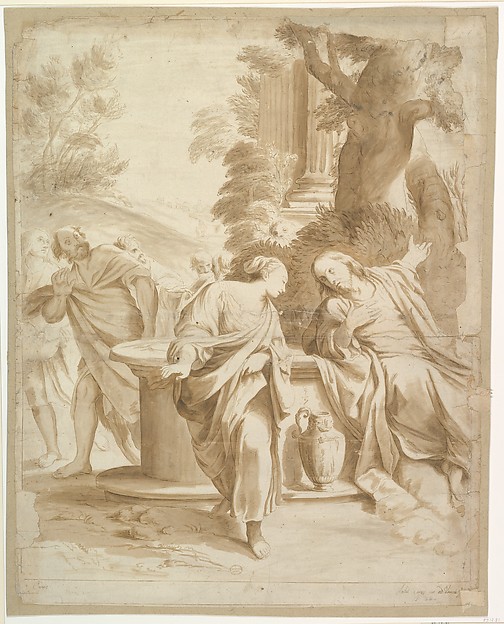
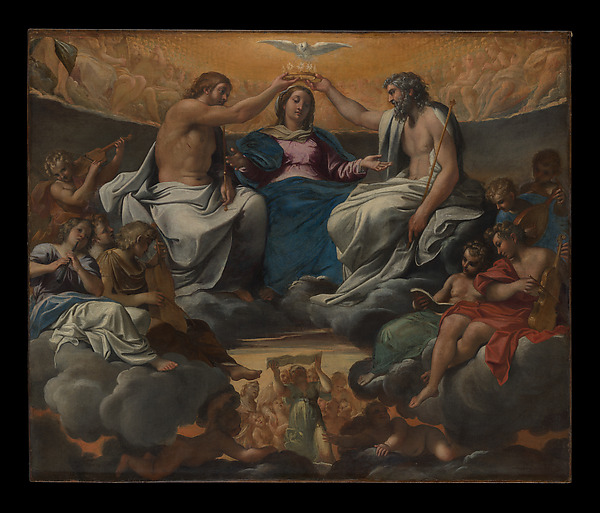
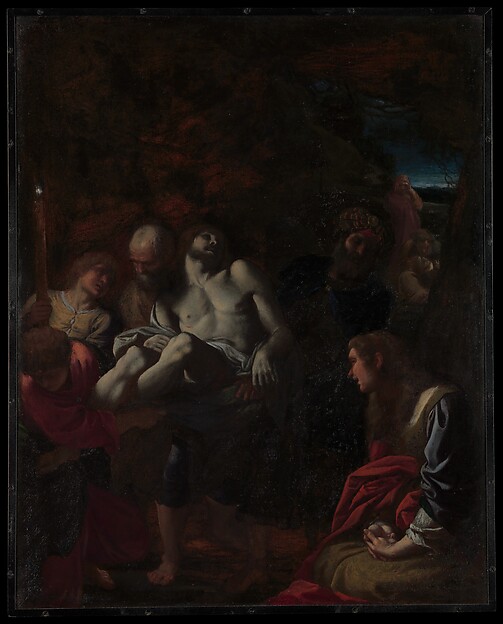
His Christian religious work runs in parallel with the secular ceiling. The Bolognese altarpieces of the 1580s and early 1590s — the Saint Roch Distributing Alms (Dresden, 1588), the Pietà (Capodimonte, 1599), the Almsgiving of Saint Roch — show the Carracci reform program applied to religious narrative. The Roman religious commissions include the Madonna with Saint John the Evangelist and Saint Catherine (Bologna), the Pietà (Capodimonte), the Quo Vadis (London), the Lamentation (London), and the great Cerasi Chapel altarpiece (Santa Maria del Popolo, 1601) — the Assumption of the Virgin painted directly across from Caravaggio's Crucifixion of Saint Peter and Conversion of Saint Paul, the most famous direct juxtaposition of the two opposing tendencies of early Baroque Roman religious painting.
A late depression — variously attributed to overwork, dissatisfaction with his Farnese pay, and possibly a small stroke — limited his output in his last years. He was buried, at his own request, in the Pantheon, beside Raphael.