Painter of the Bible
Hans Memling
Hans Memling was the most successful Bruges painter of the second half of the fifteenth century.

Their faith
Why Hans Memling painted Christ
Hans Memling was a devout Christian whose faith profoundly influenced his artistic vision. Living during a time when the Catholic Church was a central aspect of daily life, Memling's works reflect a deep reverence for scripture and the teachings of Christ. His training in the workshop of Rogier van der Weyden, a renowned master of religious art, likely instilled in him a commitment to portraying sacred subjects with devotion and precision. Memling's paintings often served not only as artistic expressions but as spiritual reflections, inviting viewers into a deeper contemplation of their faith. His dedication to the Church is evident in the numerous altarpieces and devotional works he created for various religious institutions, particularly the Hospital of Saint John in Bruges, where many of his masterpieces still reside today.
The impact of Memling's faith is vividly illustrated in his renowned works, such as the "Last Judgment Triptych" and the "Passion of Christ" panel. In the "Last Judgment Triptych," Christ is depicted in glory, presiding over the weighing of souls, a powerful reminder of divine justice and mercy. The intricate scenes in the "Passion of Christ" panel, which compress multiple Gospel narratives into a single panoramic view, showcase his ability to convey the depth of Christ's suffering and sacrifice. Through these works, Memling not only captured the essence of biblical events but also inspired viewers to reflect on their own spiritual journeys. His art continues to resonate with audiences today, serving as a bridge between the sacred and the viewer, inviting all to experience the beauty of faith through the lens of his devotion to Christ.
Life & work
Hans Memling was the most successful Bruges painter of the second half of the fifteenth century. Born around 1430 in Seligenstadt am Main in the Rhineland, he probably trained in Cologne in his teens before moving to Brussels, where he is generally believed to have worked in Rogier van der Weyden's workshop in the late 1450s and early 1460s. He arrived in Bruges by 1465, became a citizen there in 1465, and ran a large workshop in the city until his death in 1494. By the end of his life he was one of the wealthiest taxpayers in Bruges.
The work that defined his early career was the Last Judgment Triptych in the National Museum in Gda≈Ñsk, painted around 1467–71 for the Florentine banker Angelo Tani and seized by a privateer en route to Italy — one of the most famous early-Netherlandish panels never to reach its intended chapel. The central panel sets Christ in glory above Saint Michael weighing souls; the wings open to Paradise on the left and a glassy, terraced Hell on the right. The Passion of Christ panel in the Galleria Sabauda in Turin, painted in the early 1470s, compresses eight separate Gospel scenes — entry into Jerusalem, Last Supper, Garden of Gethsemane, betrayal, trial, scourging, road to Calvary, and Crucifixion — into a single panoramic Jerusalem cityscape, like a Passion play laid out in a model city.
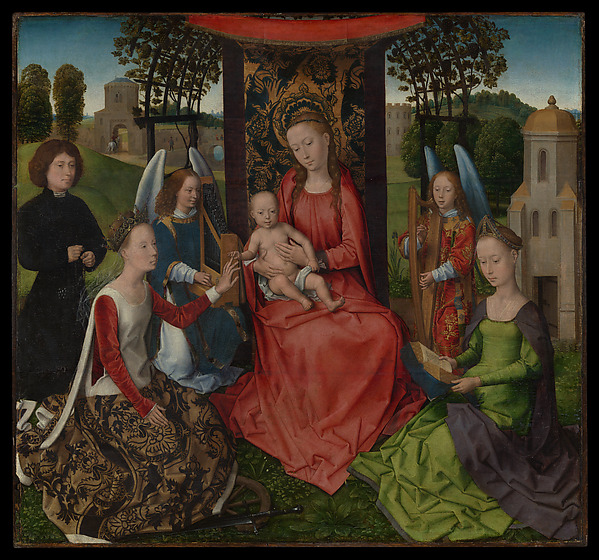
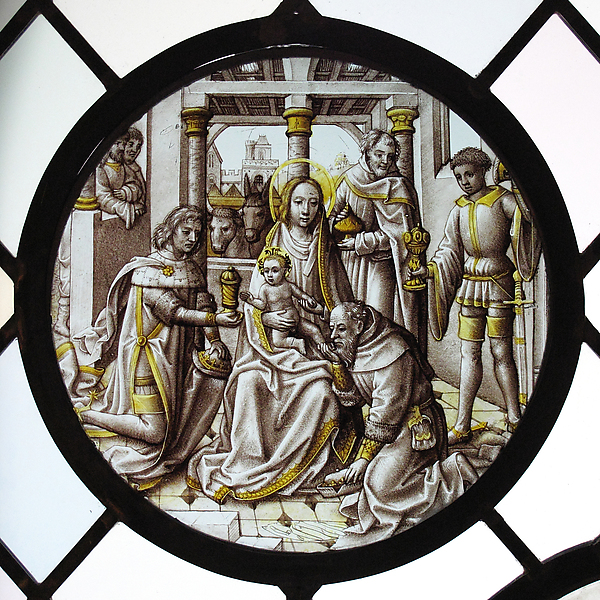
For the Hospital of Saint John in Bruges, where his largest single body of work still hangs, he painted the Triptych of the Mystic Marriage of Saint Catherine (1479), the Triptych of the Adoration of the Magi, the Diptych of Maarten van Nieuwenhove (1487), and the Saint Ursula Shrine (1489), a small painted reliquary box covering the legendary martyrdom of Saint Ursula and the eleven thousand virgins in eight Bruges-eye-view scenes. The Memling Museum in the former hospital remains one of the most concentrated single-painter installations in any European city.
His Madonnas — the Donne Triptych (London), the Diptych of Martin van Nieuwenhove (Bruges), and a long sequence of smaller devotional panels — set the Burgundian quiet domestic Madonna type that Quentin Massys, Gerard David, and the early sixteenth century would carry forward.
Notable works in detail
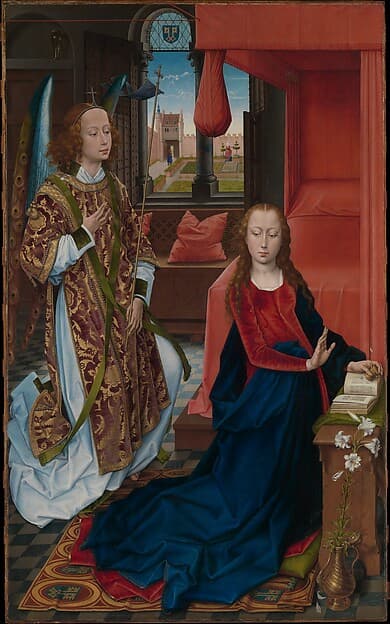
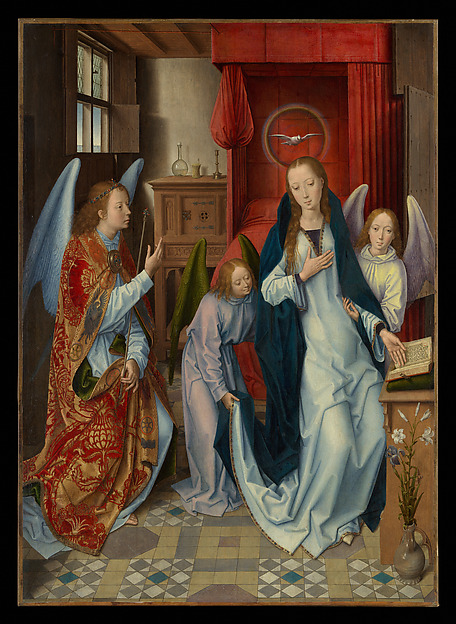
The Annunciation, painted by Hans Memling around 1465–1475 in oil on panel and now in the Metropolitan Museum of Art in New York, is one of the surviving Memling Annunciations and a defining statement of his soft, jewel-bright late-Bruges manner. The composition shows the Virgin standing in a small interior chamber, her prayer book open on a table at her side, the angel Gabriel kneeling on the floor beside her in the act of greeting; the Holy Spirit descends as a dove on a single beam of golden light through the open window in the upper left. Memling's characteristic chromatic palette — deep ultramarine, soft rose, pale grey-green — and his patient observation of textiles, woodwork, and the small furnishings of the Marian chamber are at full mature statement here. The panel entered the Metropolitan in 1917 from the J. Pierpont Morgan collection.
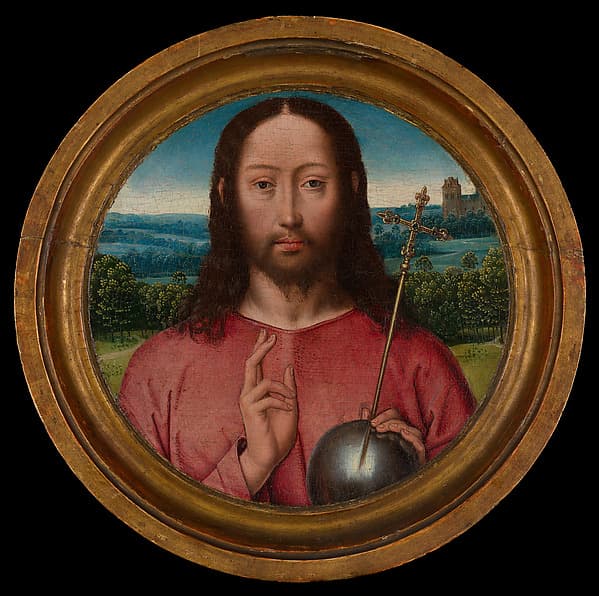
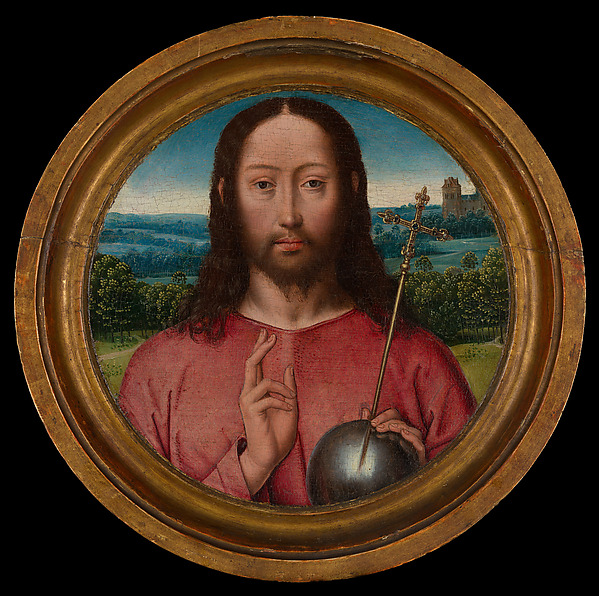
Salvator Mundi (Christ Saviour of the World), painted by Hans Memling around 1475–1480 in oil on panel and now in the Metropolitan Museum of Art in New York, is among the most reproduced Memling devotional images. The composition shows the half-length figure of Christ raising his right hand in benediction and holding a transparent crystal globe surmounted by a small cross in his left — the orb representing the world over which Christ exercises spiritual sovereignty. The dark neutral background and the close-cropped half-length format derive from the Bruges devotional tradition descending from Jan van Eyck and Rogier van der Weyden; Memling produced multiple versions of the Salvator Mundi composition in his Bruges workshop, and the type circulated widely through the late fifteenth and early sixteenth centuries as a standard small-format household devotional image. The panel entered the Metropolitan in 1932.
%2520%25E2%2580%2594%2520right%2520wing%2520(30970533506).jpg%3Fwidth%3D800&w=2048&q=75)
Saint John on Patmos (St John Altarpiece, right wing)
Saint John on Patmos is the right interior wing of the Saint John Altarpiece, painted by Hans Memling between 1474 and 1479 for the Hospital of Saint John in Bruges where it remains in continuous display in the Memlingmuseum on the original site. The panel shows the apostle John seated on the rocky island of Patmos receiving the apocalyptic visions recorded in Revelation; the entire vision sequence — the elders around the throne of God, the seven seals, the four horsemen, the seven trumpets, the woman clothed with the sun, the dragon, the great whore of Babylon — is rendered as a continuous panoramic landscape unfolding behind and above the seated apostle. The compression of the entire Book of Revelation into a single small painted panel is one of the supreme achievements of Early Netherlandish small-scale narrative composition and a defining work of Memling's mature Bruges manner.
memling-bathsheba
Bathsheba, painted by Hans Memling around 1485 in oil on panel and now in the Staatsgalerie in Stuttgart, illustrates the moment from 2 Samuel 11 when King David, walking on the roof of his palace at evening, sees Bathsheba bathing and sends for her — the first scene in the long unfolding of the David-and-Bathsheba narrative that ends in the murder of her husband Uriah. Memling stages the scene in a small Bruges merchant interior with carved wooden beams and tiled floors; Bathsheba steps from the bath onto a folded white cloth held by a servant, while the king watches from a small distant window in the upper-right background. The composition is among the most reproduced Memling treatments of an Old Testament narrative and a defining statement of his ability to combine quiet domestic observation with the textural precision that defined the late Early Netherlandish school.
Bible scenes Hans Memling painted
Luke
Revelation
Romans
John
Matthew

%20%E2%80%94%20right%20wing%20(30970533506).jpg?width=800)