
- Starting price
- Free to join, ~£20/mo to message
- Free tier
- Yes
- Platforms
- Web · iOS · Android
- Developer
- Widernet Communications Ltd.
- Launched
- 2000
- Updated
- May 24, 2026


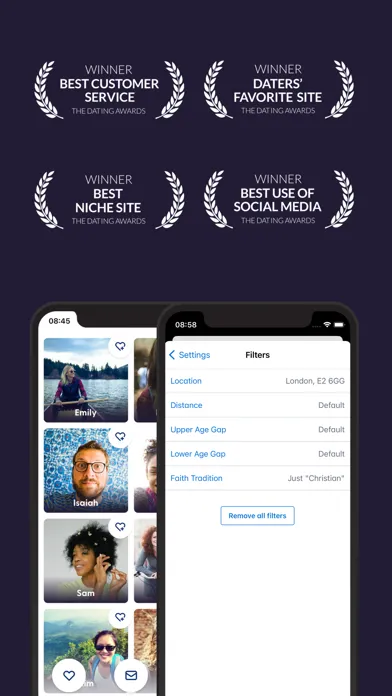
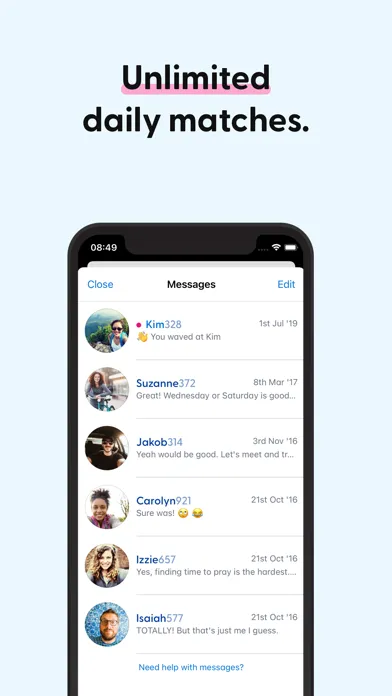
The verdict
Christian Connection is the default Christian dating app for the UK, Ireland, Australia, and New Zealand - and it earns the spot. The interface is slower and more text-led than the US giants, but for grown-up Christian singles who want to read a profile before swiping on a face, that’s the entire point.
Try Christian Connection ↗Opens christianconnection.com
Christian Connection has quietly become the default dating site for UK and Anglosphere Christians the same way a good local pub becomes the default - by being there for 25 years, by treating its regulars like adults, and by not chasing every shiny trend the bigger places do. Founded in 2000 by Jackie Elton, it predates Match.com’s UK launch, predates Tinder by more than a decade, and predates the entire current generation of US faith-based dating apps. It is, by a wide margin, the longest-running Christian dating service in the Anglosphere.
It is not a swipe app. It doesn’t reward fast judgments. It doesn’t hide profiles behind a daily deck. It doesn’t throw a coin economy at you. Instead you get a searchable directory of Christian singles in your region, full-length profiles with multiple prompts, a denomination filter that actually works, and a messaging system designed for people who can write a paragraph. For Christians in the UK, Ireland, Australia, New Zealand, and to a smaller degree Canada and South Africa, it remains the place where serious Christian dating happens online.
The product is decidedly less flashy than US giants like Christian Mingle or the Match-owned Upward - currently the two best-funded Christian dating apps in the world - and the user count is smaller. But "smaller" here means "the only place where you can reasonably expect to meet a churchgoing Anglican in Surrey or a Pentecostal nurse in Auckland." For the right user in the right region, that’s not a niche. That’s the whole market.
✓ The good
- Dominant in the UK and Anglosphere - by far the deepest pool of Christian singles in the UK, Ireland, Australia, and New Zealand
- Profile-first UX - full bios, multiple prompts, faith questions, and photos are weighted equally rather than face-first like swipe apps
- Denomination filter that actually works - Anglican, Catholic, Baptist, Pentecostal, Methodist, non-denom, and more, with church-attendance and faith-importance fields beside it
- 25 years of trust - long enough that thousands of marriage testimonials are documented, and most British churches recognise the brand
- Genuine community moderation - a small in-house team manually reviews profiles and acts on member reports, which keeps the bot-and-catfish ratio noticeably lower than mass-market apps
- Forums and events still exist - singles-and-mingles meetups, retreats, and an active blog, which most modern apps abandoned years ago
- Same flat subscription across all features - no coin-pack upsells, no "boost" mini-purchases, no super-likes you have to ration
✗ Watch out
- Subscription wall is real - you can browse and read messages free, but to reply or initiate you need a paid plan (around £20/mo or $25/mo in the US)
- Smaller pool in the US and Canada - fine for the UK, thin in many North American cities compared to Christian Mingle or Upward
- Interface looks its age - the web app is functional but visibly 2018-era, and the mobile apps lag behind the iteration speed of US-based competitors
- No advanced matching algorithm - search is closer to a directory than a recommender, which the right user loves and the wrong user finds slow
- Limited video / voice features - no in-app video dates, no voice prompts, no live audio rooms (yet)
Best for
- UK, Irish, Australian, and New Zealand Christian singles
- Adults 30+ who want profile-driven dating rather than swipe-driven dating
- Practising churchgoers who care about denomination and faith level
- People burned out on US-style swipe apps who want something calmer
Avoid if
- You live somewhere with a thin Christian Connection user base (most US cities, much of Canada)
- You want a swipe-deck experience with daily matches served to you
- You want short-form video profiles or in-app live calls
- You’re looking for a casual dating app rather than a marriage-minded one
What Christian Connection is
Christian Connection is a subscription-based Christian dating site and app aimed at single adult Christians in the UK and broader Anglosphere. You build a written profile, set search filters (location, age, denomination, church attendance, faith importance, lifestyle), browse matches as a searchable directory, and message people who interest you. Free members can do almost everything except reply to messages or initiate new ones, which is gated behind the paid plan.
It is broadly Christian rather than tied to a single tradition. The denomination dropdown includes Anglican, Catholic, Baptist, Methodist, Pentecostal, Orthodox, non-denominational, Latter-day Saint, and others - and you can search by it or ignore it. The platform takes no position on which denomination is "right"; it just lets users filter by what matters to them. That stance is part of why it has stayed the broad-tent UK default for so long.
Why UK and Anglosphere Christians use Christian Connection
The single biggest practical difference between Christian Connection and the US giants is geography. If you live in Manchester or Cork or Brisbane and you want to date another committed Christian, Christian Connection is where the pool is. Christian Mingle and Upward are dominant in the US, but in the UK, Ireland, Australia, and New Zealand they’re thin enough that even paying members complain about empty inboxes. Christian Connection is the inverse - a deep, regionally concentrated user base in exactly the markets the US apps under-serve.
The second reason is the format. The product was built before the swipe paradigm existed and never converted to it. You don’t get a deck of faces. You get a searchable directory of full profiles, and messaging is framed as the start of a real conversation rather than a reward for mutual swipes. For a meaningful slice of Christian singles - particularly in their thirties and forties, particularly those who’ve already done a few rounds on Hinge and Bumble - that slower, more deliberate format is exactly what they’re looking for and exactly what nothing else in the category offers.
UK and Anglosphere market focus: the differentiator nobody else can buy
Christian Connection has been the dominant Christian dating site in the UK for two decades, with a meaningful secondary presence in Ireland, Australia, New Zealand, and Singapore. That’s not a marketing claim - it’s a network effect. Most UK churches and parachurch ministries that recommend Christian dating online recommend this one. Most British Christians who’ve tried a dating site have tried this one. The result is a user base concentrated in exactly the cities where the US apps are thinnest: London, Manchester, Edinburgh, Belfast, Dublin, Sydney, Melbourne, Auckland.
For users in those markets, the difference is decisive. On a US-built Christian dating app in London you’ll typically see a few hundred active members; on Christian Connection you’ll see thousands. That ratio compounds - more active users means more replies, faster responses, more events, more local meetups, more chances the person you’re messaging is somewhere real and reachable rather than three time zones away. The site’s smallness globally is its bigness locally, and that’s the trade nobody has been able to undo for 25 years.
Profile + message UX: dating without the swipe
Where almost every modern dating app trains you to judge a face in a second and swipe on, Christian Connection trains you to read. Profiles are long-form by default - name, age, location, church background, denomination, church attendance, faith importance, lifestyle answers, "about me" essay, several prompts about what you’re looking for, photos as supporting evidence rather than headline. The discovery UX is a searchable directory; you set filters, you scroll, you read, you message. There is no deck, no timer, no daily allotment.
Messaging is the same - once you pay, you can write a real opening note rather than a one-line ice-breaker, and the platform expects you to. The cultural norm on the site, reinforced by 25 years of regulars, is paragraphs over pickup lines. For users tired of "hey" inboxes on swipe apps, it’s a structural change rather than a stylistic one - the format itself filters for people willing to put in a sentence or two. Most users who stay past month one cite this exact difference as the reason.
The 25-year brand: a quiet kind of trust
Christian Connection launched in 2000. The site has been continuously operated by the same small UK company (Widernet Communications) the entire time, and founder Jackie Elton ran it for over two decades before stepping back. That continuity matters in a category where most apps are 3-4 years old, owned by venture-backed parents, and reorganised every funding round. Christian Connection has thousands of public marriage testimonials going back to the early 2000s, an active blog, in-house moderation, and the kind of slow institutional knowledge - what scams to watch for, what kind of profile gets reported, how to handle a sensitive complaint - that newer apps are still learning in real time.
It also means the brand is recognised inside churches. Vicars, priests, and pastors across the UK regularly mention it from the pulpit or include it in newcomer resources. That recognition lowers the social cost of joining - most British Christians know someone who met their spouse there, which is roughly the highest bar a dating product can clear. The product is not glossy and it is not loud, but its reputation in its core market is the kind that money cannot quickly buy.
Pricing
Free
£0
Create a profile, browse other members, see who liked you, and read messages you receive. You cannot reply or initiate without a paid plan.
1 month
~£29.95
Full messaging, unlimited search, advanced filters. Useful for testing the waters or pausing between commitments.
3 months
~£59.85 (≈£19.95/mo)
The most common plan - long enough to actually meet people, short enough not to over-commit. Includes the full feature set.
6 months
~£89.70 (≈£14.95/mo)
Best per-month price. Sensible if you’ve seen there’s an active pool in your region and you’re settling in for the long-form approach.
Christian Connection is free to join and free to browse. You can build a full profile, run searches, see who has liked or favourited you, and read messages other paying members send you - all without paying. The wall comes when you want to reply to a message or initiate one yourself. At that point you need a plan.
Pricing as of writing sits at around £29.95 for one month, £59.85 for three months (≈£19.95/mo), and £89.70 for six months (≈£14.95/mo). US members are billed in dollars at roughly the same level - about $25/mo at the entry tier, dropping into the high-teens per month on longer plans. There are no coin packs, no premium tiers above the base subscription, no boosts to buy.
The three-month plan is the one most users land on. One month is too short - most matches take a few weeks of back-and-forth to turn into an actual date, and you’ll burn the month learning the interface. Six months makes sense only if you’ve confirmed there’s an active pool in your area and you’re settling in. The platform discounts longer plans steeply, so the per-month cost on six months is roughly half what it is on one.
Auto-renewal is on by default - set a calendar reminder if you don’t want the next cycle. The cancellation flow is straightforward (account settings, not buried in support tickets), but the platform will not pro-rate a refund on an unused chunk, which is standard for the category.
Where Christian Connection falls behind
No swipe deck and no algorithmic match feed. If your dating instincts have been trained by Hinge and Bumble, the directory-and-search UX feels slow and the lack of a daily "here are your matches" feed feels empty. The product is built on the assumption you’ll do the searching yourself, which the right user reads as freedom and the wrong user reads as work.
No in-app video dates or voice prompts. Christian Mingle and Upward have both added in-app video calling and short-form voice or video profile clips. Christian Connection has not (yet). Conversations are text-led until you swap numbers, and many users say that’s fine - but it’s a real gap compared to the US giants.
Thin pool in many North American markets. The site is global on paper, but in practice the deep user base is UK, Irish, Australian, and New Zealand. In most US cities the active count is a fraction of Christian Mingle’s, and in mid-sized US markets the gap is large enough that a US-based user is usually better served by a US-built app and using Christian Connection as a secondary.
Visual design lag. The web app is functional but visibly older than the latest US Christian dating apps, and the mobile apps iterate at a slower cadence. Nothing is broken - it just doesn’t look like a 2026 product, and for users who weight polish, that registers.
No advanced matching algorithm. The filters are good and the search is fast, but there is no Hinge-style "we think these eight people will work for you" feed. The platform’s position is that adult Christians can pick their own matches given good filters, which is philosophically defensible and operationally slower than the alternative.
Christian Connection vs. Christian Mingle vs. Upward
Different strengths. Christian Connection is the UK and Anglosphere default - deepest pool in London, Manchester, Dublin, Sydney, Auckland, profile-and-message format, broad-tent denominational acceptance, 25-year brand. Christian Mingle is the US Christian dating heavyweight, owned by Spark Networks, with a heavier swipe-and-feed UX and a much larger US user base. Upward, owned by Match Group, is the youngest of the three, the most swipe-native, and pitched at a younger US audience - it feels like Hinge with a faith filter.
For a UK or Irish user, Christian Connection is the obvious first choice and the other two are thin. For a US user, Christian Mingle generally has the deepest pool and Upward has the closest UX to the secular apps a younger user already knows. For an Australian or New Zealand user, Christian Connection is again the deepest, with the other two thin enough that paying is hard to justify.
Subscription pricing is broadly comparable across the three (≈$20-30/mo at entry, cheaper on longer plans), and all three gate messaging behind the paid wall. The real choice is not price. It’s geography (which app has more active members where you live), format (do you want a directory or a swipe deck), and age bracket (Christian Connection skews 30+, Upward skews 20s, Christian Mingle is in between).
The bottom line
Christian Connection is not the right choice for everyone. If you’re a US user in a mid-sized market or you want a swipe-and-feed UX with daily matches served up like Instagram, Christian Mingle or Upward will probably serve you better. But if you’re a Christian single in the UK, Ireland, Australia, or New Zealand - or you’re anywhere and you want profiles you actually read, messages you actually write, and a 25-year-old brand churches already trust - Christian Connection is still the one. The interface looks its age and the pool is uneven outside the Anglosphere, but those are real gaps worth knowing about going in rather than dealbreakers.
Alternatives to Christian Connection
 Christian MingleThe US Christian dating heavyweight - much larger US user base, more swipe-and-feed UX, similar subscription pricing. The default first choice for American Christian singles.
 UpwardMatch Group’s younger, swipier Christian dating app. Closest UX to Hinge, strongest in the US, best for users in their 20s and early 30s.
 Higher BondPremium, vetted Christian dating app with a more curated feed and a sharper marriage-minded posture. US-focused, pricier than the mainstream apps.
 SaltNewer Christian dating app pitched at younger users with a video-and-voice-prompt format. Smaller pool, fresher UX, US-leaning.
Frequently asked questions
Is Christian Connection only for UK users?
No, anyone in the world can join, and there are active members in the US, Canada, South Africa, and beyond. But the deepest pools are in the UK, Ireland, Australia, and New Zealand, and that’s where the app shines. In smaller US markets the pool can be thin compared to US-built apps like Christian Mingle or Upward.
How much does Christian Connection cost in 2026?
You can join, build a profile, and read incoming messages for free. To reply or initiate, you need a paid plan - around £29.95 for one month, £59.85 for three months (≈£19.95/mo), or £89.70 for six months (≈£14.95/mo). US members pay in dollars at roughly equivalent rates (about $25/mo at the entry tier).
What denominations does Christian Connection accept?
Broadly Christian across denominations - the denomination dropdown includes Anglican, Catholic, Baptist, Methodist, Pentecostal, Orthodox, non-denominational, Latter-day Saint, and others. The platform doesn’t take a position on which tradition is "right"; it just lets users filter by what matters to them and message who they choose.
How is it different from Christian Mingle?
Geography and format. Christian Connection is the UK and Anglosphere default with the deepest pool in London, Dublin, Sydney, and Auckland; Christian Mingle is the US heavyweight with a larger American user base. Christian Connection is profile-and-message led; Christian Mingle leans more swipe-and-feed. Pricing is broadly similar.
Is it safe? How does moderation work?
Christian Connection has been operated continuously by the same small UK company since 2000 and runs an in-house moderation team that manually reviews profiles and acts on member reports. Bot and catfish prevalence is noticeably lower than on mass-market dating apps, though the standard advice - verify in a video call before meeting, meet in public, tell a friend - still applies.
Does Christian Connection have a swipe deck?
No. The discovery UX is a searchable directory rather than a swipe deck. You set filters (location, age, denomination, church attendance, lifestyle), scroll through profiles, read them, and message who you choose. Some users love this; users trained by Tinder, Hinge, and Bumble sometimes find it slow.
Is it marriage-minded or more casual?
It skews strongly marriage-minded - most users are adults in their late 20s through 50s looking for a long-term Christian partner. It’s not pitched at casual dating, and the slower profile-and-message format quietly filters for users who treat dating as relationship-formation rather than entertainment.
Sources & further reading
More Christian Dating Apps
 HolyA Christian dating and friendship app run by a married couple in New York, where a person reviews every application and checks your selfie against your photos before you are let in. It carries 33,121 App Store votes at 4.7, one of the largest samples in the category - and its own support centre explains why the smallest distance filter you can set is 60 miles.SALTA Christian dating app that quietly turned into a community app - and that hybrid is the whole point.UpwardThe Christian dating app that looks and feels like Hinge, built for a younger marriage-minded crowd - with all the upside and friction that implies.Higher BondHigher Bond has quietly become the favorite of single Christians who are tired of swipe culture and want a marriage-intent app with actual quality control - smaller pond, much better water.Christian MingleChristian Mingle is the granddaddy of Christian dating sites - and after 25 years it has the loyal members, the brand recognition, and the user fatigue you would expect.
 B1 ChurchA genuinely free, open-source church platform - app, website, giving and check-in on one database - run by an Oklahoma nonprofit. The catch is not the price - it is that the vendor own docs call the native app deprecated.