Resource Review12 min read

Upward

4.3App Store rating · 157K ratings

The Christian dating app that looks and feels like Hinge, built for a younger marriage-minded crowd - with all the upside and friction that implies.

Starting price
Free, then Upward Premium around $29.99/mo
Free tier
Yes
Platforms
iOS · Android
Developer
Match Group
Launched
2021
Updated
May 24, 2026

The verdict

Upward has quietly become the default Christian dating app for Gen Z and younger Millennials - the swipe UX is modern, the faith prompts actually surface what you want to know, and the user base is large enough that matches happen quickly. The Match-owned monetization model is the asterisk.

Try Upward

Opens upward.com

Upward is the most-downloaded Christian dating app in the under-35 bracket, and once you spend an hour inside it the reason is obvious. The interface is essentially Hinge with a cross on it - the same card stack, the same prompt-driven profiles, the same tap-to-like-a-specific-photo-or-answer mechanic - but the prompts have been swapped out for things like favorite Bible verse, denomination, and how often you attend church. For a generation that grew up swiping, that familiarity matters more than any feature spec sheet.

It is not a niche app. It does not feel like a niche app. It does not behave like a niche app. Upward is owned by Match Group - the same parent company behind Tinder, Hinge, and Match.com - which means the engineering, the matching infrastructure, the moderation tooling, and the App Store presence all benefit from a level of investment most Christian dating startups cannot touch. That is the upside. The downside, predictably, is that the monetization playbook is also the Match Group playbook: a free tier that works but nudges hard, and a premium subscription that costs roughly what Hinge Premium costs.

For young Christians who want a dating app that looks modern, fills with profiles within an hour of signup, and actually filters for shared faith without feeling like a 2008 forum, Upward is the clearest answer on the market right now. For users who want a fundamentally different model - slower, less swipe-driven, more vetted - Higher Bond and Salt are doing different things. This review walks through what Upward gets right, where the Match Group DNA shows up in ways users complain about, and how the app stacks up against the rest of the Christian dating field.

✓ The good

  • Best-in-class UX in Christian dating - the swipe and prompt experience is borrowed straight from Hinge and it feels current, not like a 2015 dating app trying to add Bible verses
  • Large active user base in the 22-35 range - matches show up within minutes of signup in most US metros, which is rare for a faith-niche app
  • Faith prompts that actually filter - denomination, church attendance frequency, and favorite verse are baked into the profile in a way that does the work of a long bio
  • Marriage-intent leaning - the app’s framing and prompt selection skew the user base toward people looking for a serious relationship rather than casual dating
  • Cross-denominational by design - accepts Catholic, Protestant, Latter-day Saint, Orthodox, and non-denominational users without forcing a tradition lens on the experience
  • Match Group infrastructure - verification, photo moderation, block-and-report tooling, and account recovery all work the way you would expect from a major platform
  • No mandatory long questionnaire - onboarding takes minutes, not the 45-minute personality test some competitors require

✗ Watch out

  • Match Group monetization - the same paywall pressure users complain about on Tinder and Hinge shows up here, with key visibility features locked behind Premium
  • Premium pricing is steep for the category - around $29.99/mo is in line with Hinge but high for a faith-specific app where alternatives cost less
  • Faith verification is self-reported - no pastor reference, no church confirmation, no doctrinal screening (which is by design but worth knowing)
  • Skews young - if you are over 40, the user pool thins out quickly outside major metros
  • Limited search and filter granularity in the free tier - you can filter by denomination but cannot do much beyond the basics without paying
  • No web app - iOS and Android only, with no desktop login or browser-based experience

Best for

  • Gen Z and younger Millennial Christians who want a modern swipe UX
  • Users in US metros where a large active pool matters more than a small vetted one
  • Daters who want shared faith filtering without a tradition-specific app
  • Anyone who has tried Hinge and wished it had a Christian filter built in

Avoid if

  • You want a heavily vetted or pastor-referenced user base
  • You are 45+ and live outside a major metro
  • You object to subscription-based dating monetization on principle
  • You want desktop or browser access to your matches

What Upward is

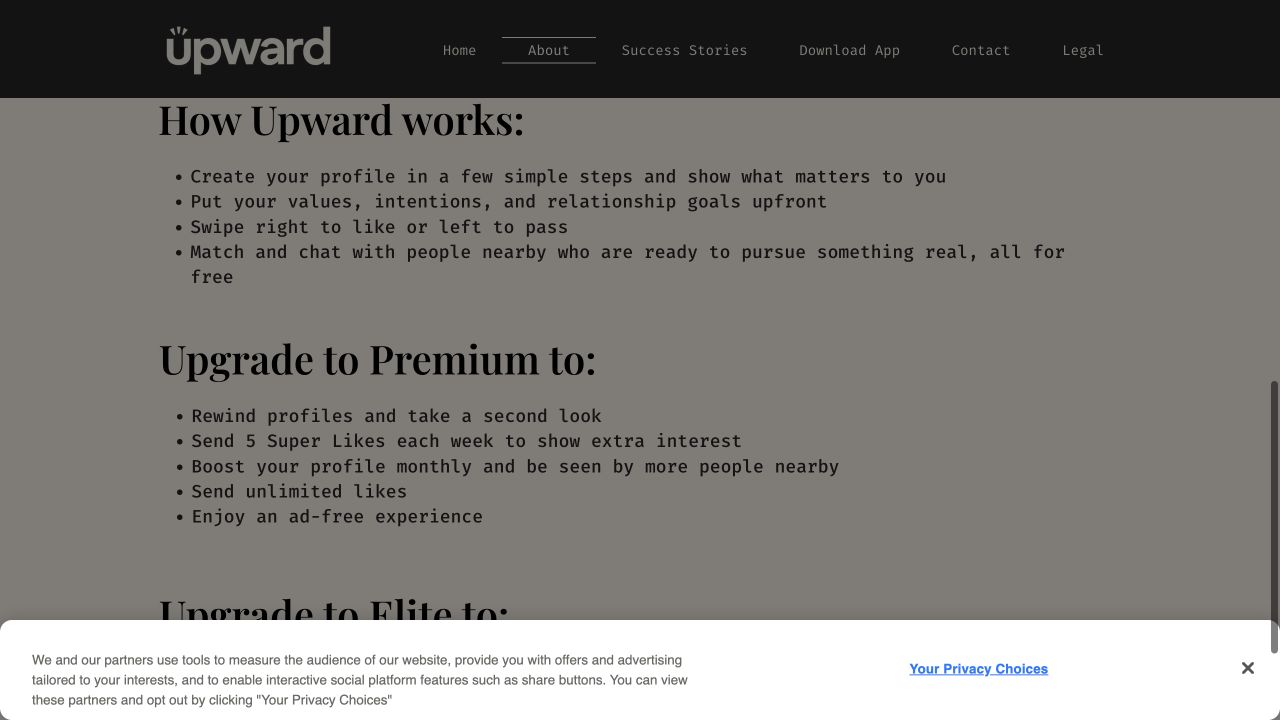
Upward is a Christian-focused mobile dating app built and operated by Match Group, the parent company of Tinder, Hinge, and Match.com. Launched in 2021, it has grown into the most-downloaded Christian dating app among users under 35 in the United States. The product runs on iOS and Android only - there is no web version - and uses a swipe-and-prompt interface modeled directly on Hinge, with profile prompts and filters reworked around faith.

The pitch is simple. Take the dating app interface that Gen Z and younger Millennials already know how to use, swap the conversation-starter prompts for things like favorite Bible verse and what church taught you growing up, and add denomination and church-attendance filters. The result is a dating app that feels like a mainstream product but functions as a faith-filtered one - a different bet than the older Christian dating sites that asked users to learn a separate, often clunky, interface.

Why younger Christians use Upward

The reason Upward dominates the under-35 Christian dating bracket is not the prompts. It is the fact that the prompts live inside a UX that already feels native to anyone who has used a modern dating app. Opening Upward for the first time produces zero friction - the card stack works the way you expect, liking a specific photo or prompt works the way you expect, and the matching flow works the way you expect. That sounds like a small thing. In practice it is the entire reason the app has the user base it has.

The faith prompts then do the real work. A profile with favorite Bible verse, denomination, how often you attend church, and one or two faith-shaped conversation starters tells you more about whether someone is a fit than a long written bio ever would. Combined with a filterable denomination field - which lets Catholic users find Catholic users, Latter-day Saint users find Latter-day Saint users, and Protestants narrow to a tradition if they want to - Upward delivers what users actually came for: a shared-faith filter that does not require reading every profile carefully to figure out where someone stands.

Faith-specific profile prompts: the differentiator that does the work

Upward’s profile system is built around prompts the user picks from a list, the same model Hinge popularized. The prompt library has been rebuilt around faith - favorite Bible verse, what church taught you growing up, how your faith shows up day to day, what you are praying for this season, the church you attend now, and so on - alongside standard get-to-know-you prompts about hobbies and travel. Each prompt answer becomes a tappable card on your profile that another user can like or comment on directly, which gives matches a real opening line instead of the dreaded blank-message screen.

The reason this matters more than it sounds: it does the filtering work that long bios used to do, and it does it without requiring either user to write much. A favorite-verse prompt and a church-attendance answer together tell you whether someone is serious about their faith, what tradition they come from, and how they think about scripture - all before you have exchanged a single message. For a user base that is short on patience and long on swipe fatigue, surfacing this information up front is a meaningful product decision, not a cosmetic one.

Swipe UX and matching: Hinge with a faith filter

The matching experience is essentially Hinge - a card stack with one profile at a time, like-or-pass mechanics that act on a specific photo or prompt answer, and a match confirmation when both users like each other. Upward inherits Match Group’s underlying recommendation infrastructure, which means the profile ordering is driven by a learned algorithm rather than simple geographic distance. In practice this produces a queue that gets noticeably better over the first week as the system learns what kind of profiles you respond to.

The trade-off is the one every Match Group app makes. The free tier gives you a limited number of likes per day and hides the list of users who have already liked you behind the Premium paywall. Upward Premium unlocks unlimited likes, the see-who-liked-you list, advanced filters, and read receipts. Whether that subscription is worth roughly $29.99 a month depends on how serious you are about the app - for users actively dating in a major metro it usually pays for itself in match volume, and for casual browsers it usually does not.

Marriage-intent demographic: a deliberately skewed user base

Upward’s marketing, prompt library, and feature set are all tilted toward users looking for a serious relationship that leads to marriage. There is no explicit casual-dating mode, the prompts lean toward life-stage and values questions rather than nightlife questions, and the app’s public framing consistently emphasizes long-term intent. The result is a user base that, while not exclusively marriage-minded, skews meaningfully in that direction compared to a general-purpose dating app filtered by religious affiliation.

This is the practical reason a lot of users move from Hinge or Bumble to Upward even though the underlying UX is similar. Filtering Hinge by Christian preference still produces a feed dominated by users who treat dating as a casual activity. Filtering Upward by anything produces a feed that already self-selected for the kind of dating you are doing. It is not a guarantee of seriousness - no app can verify intent - but the population-level skew is real, and it is the single most under-appreciated thing about the product.

Pricing

Free

$0

Full profile creation, swipe and match, send a limited number of likes per day, basic denomination and distance filters. Most of the core app works without paying.

Upward Premium (monthly)

around $29.99/mo

Unlimited likes, see who liked you before you swipe, advanced filters, profile boosts, and read receipts. The standard upgrade tier.

Best value

Upward Premium (6-month)

around $14.99/mo billed every 6 months

Same Premium features at a roughly half-off effective rate. The plan most committed users land on.

À la carte boosts

varies

One-time boosts that surface your profile to more users for a short window, plus Super Likes. Useful occasionally, easy to overspend on.

Upward is free to download and free to use in a meaningful way - the free tier is not a demo. You can build a full profile, swipe, match, and have conversations without paying. That said, the app does what every Match Group app does: it caps daily likes, hides the see-who-liked-you list, and gates the most useful filters behind Premium.

Upward Premium runs around $29.99 a month on the monthly plan, with a six-month plan that drops the effective rate to roughly $14.99 a month - the plan most committed users end up on. This is in line with Hinge Premium and Bumble Premium pricing, and noticeably higher than what some faith-specific competitors charge.

There are also à la carte boosts and Super Likes available as one-time purchases. These can be useful in moderation - a boost during a high-traffic evening can produce a noticeable bump in match volume - but they are easy to overspend on and most users do not need them.

Most users do not need Premium right away. The free tier is enough to figure out whether the app has the right user base in your area, and the six-month Premium plan is the right upgrade target if you decide to commit, not the monthly tier.

Where Upward falls behind

No faith verification of any kind. Every profile is self-reported - denomination, church attendance, favorite verse, all of it. There is no pastor reference, no church confirmation, no theological screening. For some users this is fine and matches how they would expect a mainstream dating app to work. For users who want a vetted pool, Higher Bond’s pastor-referenced model is a fundamentally different product.

No desktop or web access (yet). Upward is mobile-only on iOS and Android, with no browser login. If you prefer typing on a real keyboard or want to scroll matches on a laptop, you are out of luck.

Thin user base outside the under-35 demographic. The app skews heavily young, and while it works fine in the 35-45 range in major metros, the pool thins quickly above that. Older Christian daters consistently report better results on Christian Mingle or Match.

Match Group monetization friction. This is the most common user complaint and it is structural, not a bug. The same paywall pressure that drives complaints about Hinge - the visibility gating, the boost upsell, the like-cap - is present here, because it is the same playbook from the same parent company.

Limited free-tier filtering. The free version lets you filter by denomination and distance and not much else. Height, age range refinements, and other advanced filters require Premium, which is consistent with the category but worth knowing going in.

Upward vs. Higher Bond vs. Christian Mingle

Three meaningfully different products, three different bets on what Christian dating should look like. Upward is the mainstream-app bet - take a Hinge-shaped product, swap the prompts for faith ones, and let scale and UX do the work. Higher Bond is the vetting bet - slow the experience down, require references, and trade user volume for a more curated pool. Christian Mingle is the legacy bet - a long-running site with a multi-generational user base, a more traditional profile-and-search model, and a footprint that goes well beyond the under-35 bracket Upward dominates.

Different strengths. Upward is better for users who want the largest active under-35 Christian dating pool and a UX they already know. Higher Bond is better for users who want a smaller, more vetted experience and are willing to pay more for it and wait longer between matches. Christian Mingle is better for users over 35, users who want a desktop experience, and users who prefer search-driven dating over swipe-driven dating.

Pricing-wise, Upward Premium at around $29.99/mo monthly (or roughly $14.99/mo on the six-month plan) sits in the middle. Higher Bond runs more on its committed tiers. Christian Mingle is comparable to Upward but with a different feature mix. None of the three is obviously the right answer for every user - the question is which model fits how you want to date.

The bottom line

Upward is the clearest default in modern Christian dating for users under 35. The UX is current, the user base is large enough to matter, the faith prompts surface what they need to, and the marriage-intent skew is real. The Match Group monetization model is the asterisk - the same paywall friction that drives Hinge complaints is present here, because it is the same playbook from the same parent company. For users who want a different bet - vetted, slower, more curated - Higher Bond is a different product entirely. But if you want a Christian dating app that feels like a dating app you would have downloaded anyway, this is it.

Alternatives to Upward

Frequently asked questions

Is Upward really owned by the same company as Tinder?

Yes. Upward is a Match Group product, which is the parent company of Tinder, Hinge, Match.com, OkCupid, and several other major dating apps. That ownership is the source of both its strengths - engineering, infrastructure, scale - and its most common user complaints around monetization.

Is Upward only for Protestants, or can Catholics and Latter-day Saints use it?

Upward is broadly Christian and accepts users from across traditions, including Catholic, Protestant, Latter-day Saint, Orthodox, and non-denominational backgrounds. The denomination field on each profile lets you filter for the tradition you are looking for, so the app works as a cross-denominational pool with built-in filtering rather than a single-tradition product.

How much does Upward Premium cost?

As of writing, Upward Premium is around $29.99 a month on the monthly plan, with a six-month plan that drops the effective rate to roughly $14.99 a month. There are also à la carte boosts and Super Likes available as one-time purchases. Pricing can shift, so check the current rate in the app.

Does Upward verify that users actually attend church?

No. Every faith-related field on Upward is self-reported, including denomination, church attendance, and favorite verse. There is no pastor reference system, no church confirmation, and no theological screening. Users who want a vetted user base typically look at Higher Bond instead.

Is Upward only for marriage-minded users?

Not exclusively, but the app’s framing and prompt selection are tilted toward long-term relationship intent rather than casual dating. The user base, in practice, skews meaningfully toward users looking for marriage compared to a general-purpose dating app filtered by religious preference.

Is there a web or desktop version of Upward?

No. Upward is mobile-only on iOS and Android. There is no browser login or desktop experience, so all swiping, messaging, and account management has to happen on a phone.

How does Upward compare to Hinge with the Christian filter set?

The UX is similar by design, but the user base is different. Filtering Hinge for Christian users still produces a feed dominated by casual-dating intent. Upward’s user base self-selected for a faith-filtered, more marriage-leaning experience from the start, which is the practical reason a lot of users switch over even though the underlying app design is comparable.

More Christian Dating Apps

Try Upward