1 Kings 10
People in this chapter
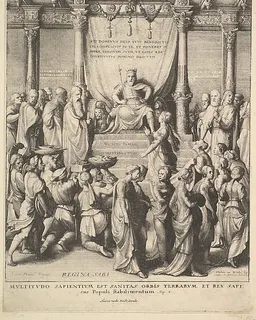
A queen from the far end of the known world hears about a king and cannot let it rest. She loads her camels with gold and spice and crosses a desert to see for herself. The Queen of Sheba comes to Solomon with hard questions, and he answers every one. Then she looks at the house, the table, the order of it all, and the breath goes out of her. “The half was not told me.”1
Tap any highlighted phrase to jump to the commentary that unpacks it.
1 Kings 10:1-3The Queen of Sheba Comes
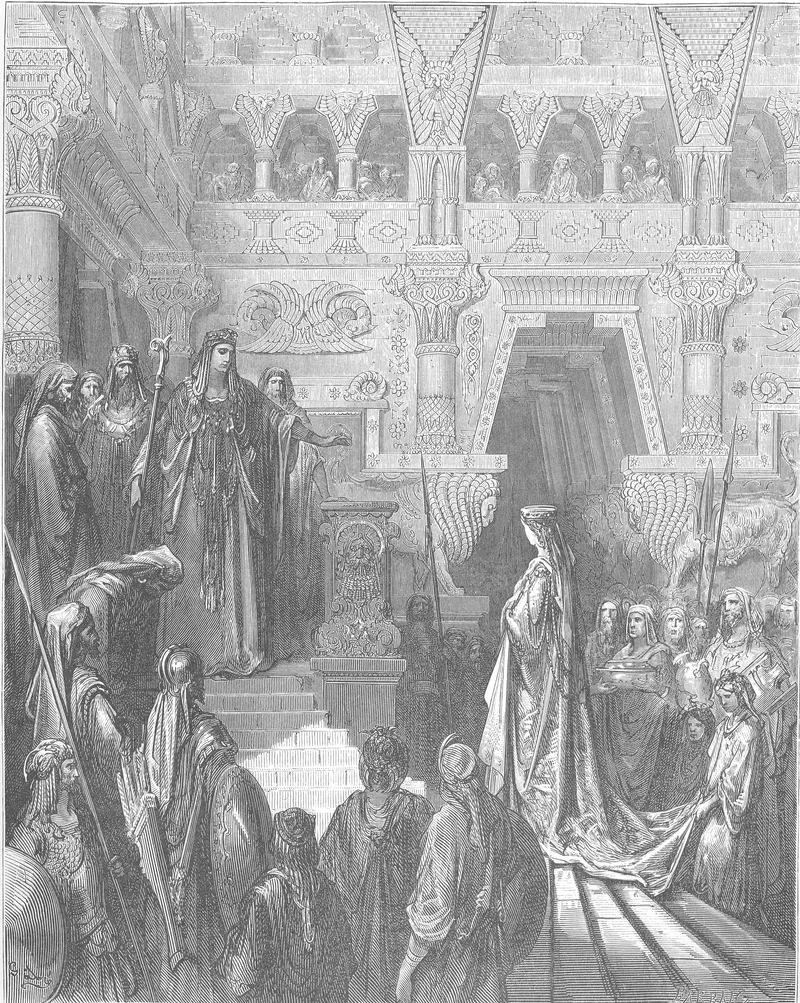
1And when the queen of Sheba heard of the fame of Solomon concerning the name of the LORD, she came to prove him with hard questions. 2And she came to Jerusalem with a very great train, with camels that bare spices, and very much gold, and precious stones: and when she was come to Solomon, she communed with him of all that was in her heart. 3And Solomon told her all her questions: there was not any thing hid from the king, which he told her not.
The Queen of Sheba heard the fame of Solomon "concerning the name of the Lord." This is key: his reputation is that of a man known for his connection to the God of Israel, something deeper than riches or military power. She comes to encounter wisdom - and her long journey (likely thousands of miles from what is now Arabia or Ethiopia) shows the power of report, the reach of testimony. Word travels. And it travels about wisdom213.
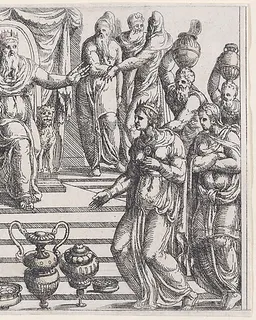
She comes with a caravan fit for a royal embassy: camels bearing spices (the most valuable commodity of the ancient Near East, worth their weight in gold), "very much gold," and precious stones. These are gifts of a peer, a queen seeking to honor another ruler. She comes ready to engage in the great conversation of wisdom.
She "communed with him of all that was in her heart." The Hebrew conveys that she spoke about everything she was thinking, everything she wondered about - genuine questions from a seeking mind. And Solomon "told her all her questions" - he answered fully, without deflecting or withholding. In this exchange, wisdom begets trust.
1 Kings 10:4-6No More Spirit In Her
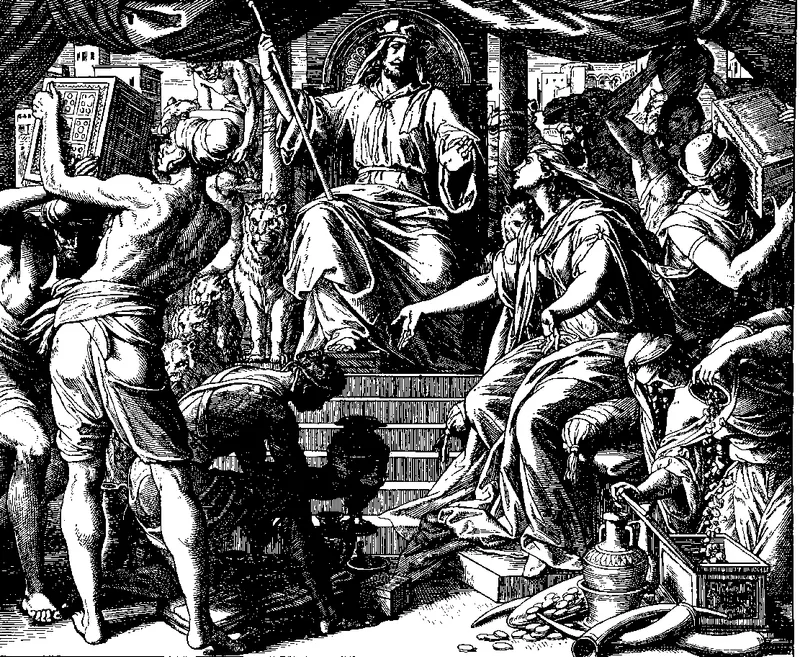
4And when the queen of Sheba had seen all Solomon’s wisdom, and the house that he had built, 5And the meat of his table, and the sitting of his servants, and the attendance of his ministers, and their apparel, and his cupbearers, and his ascent by which he went up unto the house of the LORD; there was no more spirit in her. 6And she said to the king, It was a true report that I heard in mine own land of thy acts and of thy wisdom.
She had braced herself for an exaggeration and found an understatement instead. The reports she had crossed a desert to test turned out to undersell the thing. The throne, the table, the ranks of servants, the very stairway up to the Lord's house - each detail carried an order and a coherence no traveler's story could hold. Some things you have to stand inside before you believe them. You can hear about grace your whole life and still be undone the day it is finally in front of you.
The Hebrew says the breath left her. Not the breath of dismay - the breath of awe, the involuntary stillness of someone who walked in ready to argue and forgot what they came to say. She had told herself she believed none of it. Now she stood in the middle of it. Wisdom and the favor of God, made visible enough to silence a queen.
1 Kings 10:7-9"The Half Was Not Told Me"
7Howbeit I believed not the words, until I came, and mine eyes had seen it: and, behold, the half was not told me: thy wisdom and prosperity exceedeth the fame which I heard. 8Happy are thy men, happy are these thy servants, which stand continually before thee, and that hear thy wisdom. 9Blessed be the LORD thy God, which delighted in thee, to set thee on the throne of Israel: because the LORD loved Israel for ever, therefore made he thee king, to do judgment and justice.
Her blessing of Solomon's God is the culmination of her journey. She blesses the Lord thy God who "delighted in thee, to set thee on the throne." She has recognized that the God who chose Solomon is the true source of his greatness. She has become a witness to the faith of Israel. This is what draws the nations: the perception of God's faithfulness, God's favor, made visible in the fruit of faithfulness.
1 Kings 10:10-13The Exchange of Gifts
10And she gave the king an hundred and twenty talents of gold, and of spices very great store, and precious stones: there came no more such abundance of spices as these which the queen of Sheba gave to king Solomon. 11And the navy also of Hiram, that brought gold from Ophir, brought in from Ophir great plenty of almug trees, and precious stones. 12And the king made of the almug trees pillars for the house of the LORD, and for the king’s house, harps also and psalteries for singers: there came no such almug trees, nor were seen unto this day. 13And king Solomon gave unto the queen of Sheba all her desire, whatsoever she asked, beside that which Solomon gave her of his royal bounty. So she turned and went to her own country, she and her servants.
The Queen of Sheba gives 120 talents of gold and an "abundance of spices" - the gifts of a peer, one sovereign honoring another. These are treasures that will be remembered: "there came no more such abundance." In the economy of the ancient world, such a gift is a recognition of value, a knitting together of realms.
The almug (or algum) trees brought by Hiram's navy from distant Ophir are precious wood - rare, beautiful, fit for the temple and the king's house. Solomon uses them to make pillars, harps, and psalteries - instruments of song and worship. The wood becomes part of the house of the Lord. Even wealth and distant treasure find their purpose in the worship of God.
She asked, and Solomon did not simply match her - he handed over everything she desired and then opened the royal treasury on top of it. That is what a secure king does. His abundance is deep enough that giving costs him nothing he feels. And here the wealth is doing exactly what wealth is for: moving outward, toward someone.
1 Kings 10:14-22The 666 Talents: Wealth and Shadow
14Now the weight of gold that came to Solomon in one year was six hundred threescore and six talents of gold, 15Beside that he had of the merchantmen, and of the traffick of the spice merchants, and of all the kings of Arabia, and of the governors of the country. 16And king Solomon made two hundred targets of beaten gold: six hundred shekels of gold went to one target. 17And he made three hundred shields of beaten gold; three pound of gold went to one shield: and the king put them in the house of the forest of Lebanon.
The camera pans slowly across the gold now, target by target, shield by shield. Take in how much there is. Then remember none of it kept the kingdom whole.
18Moreover the king made a great throne of ivory, and overlaid it with the best gold. 19The throne had six steps, and the top of the throne was round behind: and there were stays on either side on the place of the seat, and two lions stood beside the stays. 20And twelve lions stood there on the one side and on the other upon the six steps: there was not the like made in any kingdom. 21And all king Solomon’s drinking vessels were of gold, and all the vessels of the house of the forest of Lebanon were of pure gold; none were of silver: it was nothing accounted of in the days of Solomon. 22For the king had at sea a navy of Tharshish with the navy of Hiram: once in three years came the navy of Tharshish, bringing gold, and silver, ivory, and apes, and peacocks.
One year's gold, weighed out: six hundred sixty-six talents. A reader who knows where Scripture ends feels the floor tilt, because the number surfaces once more in the last book - the mark of a power that rises on its own ambition and bows to no one (Revelation 13:18). There is nothing cursed in the figure itself. The unease is the company it keeps here: the moment wealth becomes the way a kingdom measures itself, it has quietly changed gods. The chapter records the height. It never calls it the goal.
The great throne of ivory, overlaid with the best gold, flanked by standing lions and ringed by twelve lions on the steps - this is a throne designed to awe, to intimidate, to display power. The detail that "there was not the like made in any kingdom" underscores that Solomon has surpassed all other rulers. Yet a throne is a seat from which judgment should flow. Has the display become more important than the justice?
There is a strange line buried in the inventory: silver was worth nothing in Solomon's day. Silver - the metal a poorer Israel had weighed out carefully for generations - now counted for nothing, because there was simply too much of it. Abundance does that. It does not just fill your hands; it dulls them. When every cup is gold, gold stops meaning anything, and you can lose the capacity to be grateful long before you ever run short.
1 Kings 10:23-29The Horses from Egypt: Disobedience and Decline
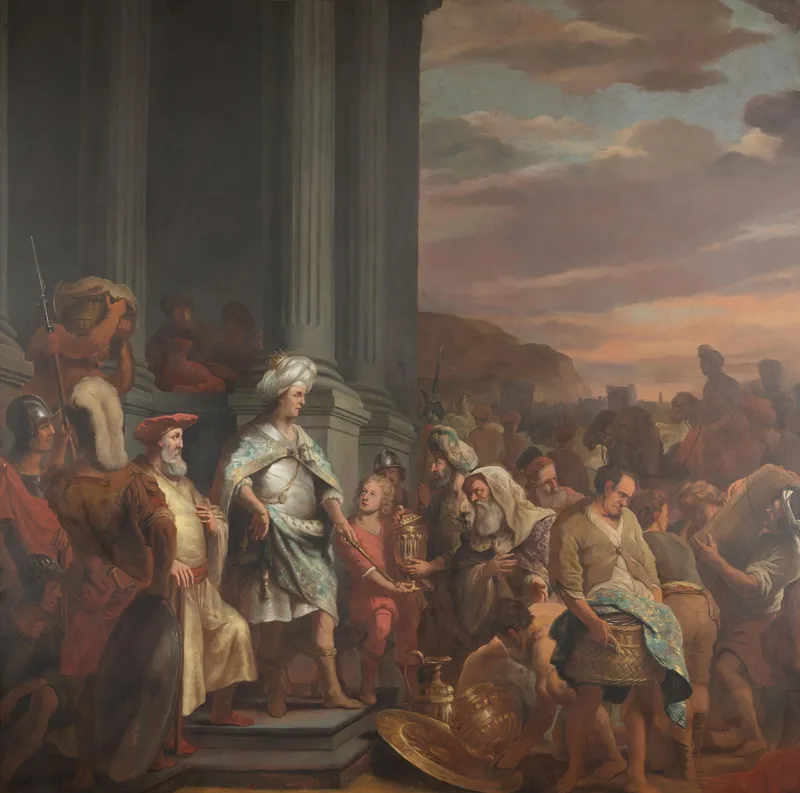
23So king Solomon exceeded all the kings of the earth for riches and for wisdom. 24And all the earth sought to Solomon, to hear his wisdom, which God had put in his heart. 25And they brought every man his present, vessels of silver, and vessels of gold, and garments, and armour, and spices, horses, and mules, a rate year by year.
The whole earth files past with gifts in hand, year after year. It looks like pure triumph. Hold that picture; the same paragraph is about to name where the trouble starts.
26And Solomon gathered together chariots and horsemen: and he had a thousand and four hundred chariots, and twelve thousand horsemen, whom he bestowed in the cities for chariots, and with the king at Jerusalem. 27And the king made silver to be in Jerusalem as stones, and cedars made he to be as the sycomore trees that are in the vale, for abundance. 28And Solomon had horses brought out of Egypt, and linen yarn: the king’s merchants received the linen yarn at a price. 29And a chariot came up and went out of Egypt for six hundred shekels of silver, and an horse for an hundred and fifty: and so for all the kings of the Hittites, and for the kings of Syria, did they bring them out by their means.
This is the summit. Kings honor him, the whole earth comes asking after the wisdom God put in his heart, and every visitor arrives with a gift in hand - silver, gold, armor, spices, horses, mules, year after year. Solomon is the center of the world's attention, and the text lets you feel how complete it is. Then it tells you where the horses came from.
Egypt. Of all the places to source his cavalry, the one named is the one the law fenced off. Long before there was a king, the king's charter was written: he shall not multiply horses, “nor cause the people to return to Egypt… Ye shall henceforth return no more that way” (Deuteronomy 17:16). Israel had been carried up out of that land by the bare arm of God. Now its wisest king is sending merchants back down for its horsepower. The verb is quiet. The direction is everything.
1,400 chariots and 12,000 horsemen - vast military power. But power acquired through disobedience to God's law carries a hidden cost. Solomon has begun to lean on chariots and horses, turning his trust away from the Lord. The text does not condemn this outright, but the reader who knows Deuteronomy 17:16 understands: this is the beginning of the fall.
1 Kings 10The End of the Beginning
This chapter is the high-water mark of the united monarchy. The Queen of Sheba comes and recognizes God's favor. The nations bring tribute. Wisdom and wealth flow together. And yet, in the record itself, the seeds of decline are sown: 666 talents, horses from Egypt, the breaking of the law. The chapter closes with a notice that "the rest of the acts of Solomon" are written in "the book of the acts of Solomon" - the kind of transition that signals: from this point forward, it is all downhill.
The pattern outlives the king. A wise ruler whose fame pulls the nations in, whose realm gives the world a taste of order and justice - that promise does not die with Solomon. It waits for a greater King. Jesus said the Queen of Sheba would stand up on the last day and testify against a generation that had something better than Solomon in front of them and would not cross the room for it. She crossed a desert on a rumor.
The greater wisdom is not at the end of a caravan route now. It is standing in the road, asking you to stop and listen.
Research trail
Sources & further study
These references support the historical, linguistic, manuscript, and contextual notes in this chapter. Scripture remains the primary text; external sources are provided so readers can inspect the research directly.
- The Queen of Sheba Visits SolomonThe diplomatic and commercial encounter between Solomon and the Arabian queen.
- Queen of Sheba in Ancient SourcesArchaeological and textual evidence for the Queen of Sheba from South Arabian inscriptions.
- Sheba and Ancient Trade RoutesSheba's position on Arabian trade routes bringing spices and gold to the ancient Near East.
Where this echoes in Scripture
The Horses from Egypt: Disobedience and Decline
- Matthew 12:42The queen of the south shall rise up in the judgment with this generation, and shall condemn it… for she came to hear the wisdom of Solomon; and, behold, a greater than Solomon is here.Jesus names this chapter directly and sets Himself above its king.
- John 18:36Jesus answered, My kingdom is not of this world: if my kingdom were of this world, then would my servants fight.The greater King refuses the chariots-and-horsemen kind of power Solomon piled up.
- Matthew 26:53Thinkest thou that I cannot now pray to my Father, and he shall presently give me more than twelve legions of angels?Available might, deliberately not summoned - the opposite of v. 26.
- Deuteronomy 17:16He shall not multiply horses to himself, nor cause the people to return to Egypt… Ye shall henceforth return no more that way.The royal law Solomon quietly breaks in vv. 28-29.
- Psalm 20:7Some trust in chariots, and some in horses: but we will remember the name of the LORD our God.The choice the chapter dramatizes, named outright.