1 Maccabees 14
People in this chapter
For most of 1 Maccabees the page is loud with armies, sieges, and the deaths of brothers. Then comes chapter 14, and the noise stops. A foreign king is taken captive far to the east, and in the small land of Judea something almost forgotten returns: rest. The chapter steps back from the battlefield to paint a single sustained picture of peace under Simon, the last of the Maccabee brothers. The fields bear fruit, the cities are provisioned, the harbor at Joppa opens the nation to the sea, and the ancient phrase comes true again, that every man sits under his vine and under his fig tree, and there is none to make them afraid.
Tap any highlighted phrase to jump to the commentary that unpacks it.
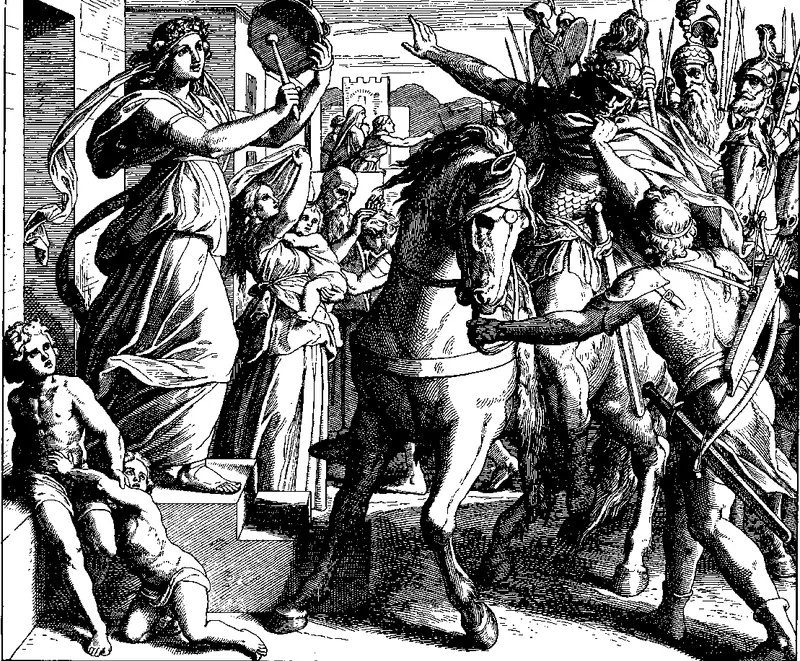
1 Maccabees 14:1-7The Land at Rest in the Days of Simon
1In the year one hundred and seventy-two, king Demetrius assembled has army, and went into Media to get him succours to fight against Tryphon. 3And he went and defeated the army of Demetrius: and took him, and brought him to Arsaces, and he put him into custody.
The chapter opens far from Judea, on the wide stage of empire. King Demetrius marches east to gather reinforcements and is captured and imprisoned by the Persian king. For the small nation of the Jews, this distant defeat is a gift. One of the great powers that had pressed and bargained over their land is suddenly removed from the board. The writer notices what is easy to miss in the rush of events: the rise and fall of kings, even kings who never set foot in Judea, shapes the breathing room of an ordinary people.
A door closes in Media, and a window opens in Jerusalem.
4And all the land of Juda was at rest all the days of Simon, and he sought the good of his nation: and his power, and his glory pleased them well all his days. 6And he enlarged the bounds of his nation, and made himself master of the country.
Here is the verse the whole chapter turns on: the land was at rest all the days of Simon, and he sought the good of his nation. The phrase "sought the good" is the measure of his rule. He poured his power into serving. After his father Mathathias began the revolt and his brothers Judas and Jonathan led it and fell, Simon is the one who lives to see the harvest. The text says his glory pleased the people well, and it is worth pausing on why.
A ruler whose glory is for himself wearies a people. A ruler whose glory is spent on their good becomes a thing they are glad to live under.
7And he gathered together a great number of captives, and had the dominion of Gazara, and of Bethsura, and of the castle: and took away all uncleanness out of it and there was none that resisted him.
Simon's work is not only military. He gathers back captives, takes hold of the strongholds that had threatened Jerusalem, and cleanses them of defilement. The cleansing matters as much as the conquest. The struggle of the Maccabees was never only for a patch of ground; it was for a way of life in which the holy places could be kept holy and the people could worship without a foreign garrison overlooking the temple. To take away the uncleanness is to make the land fit to be a home for the worship of God.
Security and holiness move together in this account, two halves of the same peace.
1 Maccabees 14:8-15Every Man Under His Vine and Fig Tree
8And every man tilled his land with peace: and the land of Juda yielded her increase, and the trees of the fields their fruit. 9The ancient men sat all in the streets, and treated together of the good things of the land, and the young men put on them glory, and the robes of war.
The writer slows down to let us see the peace as a scene, not merely as a treaty signed. Farmers work ground that no army will trample. The old men, who had lived through the worst of the war, sit out in the open streets and talk over the good things of the land, the surest sign of safety there is, for the frightened do not linger in the open. The young men wear glory and the splendid garments of soldiers, their strength no longer swallowed by mere survival.
A whole society is pictured at peace, each generation restored to what is proper to it: the elders to their counsel, the young to their vigor.
11He made peace in the land, and Israel rejoiced with great joy. 12And every man sat under his vine, and under his fig tree: and there was none to make them afraid.
Three short words carry the weight of a generation: he made peace. For decades peace had been the thing prayed for and bled for and never quite held. Now it is simply stated as fact, and Israel rejoices with great joy. The writer wants us to feel how rare and costly this sentence is. Peace here is the settled, ordered life of a whole people under a faithful leader, a life in which worship, work, and family can go forward unmolested. After so much loss, joy is the only fitting response, and the people give themselves to it.
The picture of every man under his vine and his fig tree is one of the oldest images of peace in all of Scripture. It was the description of Israel's golden rest in the days of Solomon, and the prophets reached for it to paint the peace of the age to come, when nations would beat their swords into plowshares and sit unafraid. To hear that phrase land again in the days of Simon is to feel the deep music of the Bible sounding through this later book.
The vine and the fig tree are not grandeur; they are home, food, shade, and the quiet certainty that no one will take them. That is what the long war was finally for.
14And he strengthened all those of his people that were brought low, and he sought the law, and took away every unjust and wicked man. 15He glorified the sanctuary, and multiplied the vessels of the holy places.
Beneath the prosperity lies the root of it. Simon strengthened the lowly, sought the law, and put away the wicked, and he glorified the sanctuary. The order is telling. The peace of the land rests on justice for the weak and on a leader who himself submitted to the law of God, placing himself under it. A nation can have full barns and an unguarded temple and still be hollow; here the harvest and the holy place flourish together because the same faithfulness tends both.
Simon's care for the sanctuary, enriching it with vessels for worship, says that the rest he won was meant to make room for God at the center of the people's common life.
1 Maccabees 14:16-24Letters Across the Sea: Rome and Sparta
17But when they heard that Simon his brother was made high priest in his place, and was possessed of all the country, and the cities therein: 18They wrote to him in tables of brass, to renew the friendship and alliance which they had made with Judas, and with Jonathan his brethren.
The peace at home is matched by standing abroad. Word travels as far as Rome and Sparta that Jonathan has died and Simon now leads, and these distant powers write to renew the friendship and alliance first made with his brothers. A small nation that had been a pawn among empires is now treated as a partner worth keeping. The renewed alliances are a kind of recognition: the line of the Maccabees has held, and the world takes notice.
What began as a desperate rising in the hill country has become a recognized people with whom kingdoms across the sea wish to keep faith.
20The princes and the cities of the Spartans to Simon the high priest, and to the ancients, and the priests, and the rest of the people of the Jews their brethren, greeting. 21The ambassadors that were sent to our people, have told us of your glory, and honour, and joy: and we rejoice at their coming.
The Spartans address the Jews as "their brethren," and the word is striking coming from a Greek city to a people who had so recently fought Greek rule for the right to remain themselves. The letter rejoices at the news of Judea's glory and honor and joy. There is something quietly hopeful in it: a nation that held fast to its own God and its own law, that refused to be dissolved into the wider world, is welcomed and called kin. Faithfulness to one's deepest identity earned Judea a respect that mere conformity could never have purchased.
24And after this Simon sent Numenius to Rome, with a great shield of gold the weight of a thousand pounds, to confirm the league with them. And when the people of Rome had heard
Simon sends an envoy to Rome bearing a great golden shield to confirm the league. The gift is grand, but the gesture beneath it is the point. Peace, even peace as hard-won as this, has to be tended. Alliances are renewed, ambassadors are sent, friendships across the sea are confirmed and reconfirmed. The writer shows a leader who does not assume that yesterday's deliverance guarantees tomorrow's. He works to keep the peace as diligently as his brothers fought to win it.
There is wisdom here for anything precious: what was gained at great cost is kept only by continued care.
1 Maccabees 14:25-40Written in Brass: A People Remembers
25These words, they said: What thanks shall we give to Simon, and his sons? 26For he hath restored his brethren, and hath driven away in fight the enemies of Israel from them: and they decreed him liberty, and registered it in tables of brass, and set it upon pillars in mount Sion.
The people ask a beautiful question: what thanks shall we give to Simon and his sons? Gratitude that stays only a feeling soon fades, so they answer their question with an act. They resolve to record what he has done, to engrave it on tablets of brass and set it on pillars in mount Sion where it cannot be lost or quietly forgotten. There is a deep instinct here, one Scripture honors again and again.
Deliverance must be remembered, written down, set in a public place, lest the next generation enjoy the peace and forget what it cost. A people that forgets its rescuers will not long understand its own peace.
29And Simon the son of Mathathias of the children of Jarib, and his brethren have put themselves in danger, and have resisted the enemies of their nation, for the maintenance of their holy places, and the law: and have raised their nation to great glory.
The decree remembers the cost in plain words: Simon and his brothers put themselves in danger and resisted the enemies of their nation for the sake of the holy places and the law. It names the family that bled, Mathathias the father who began it, the brothers who carried it, and it names what they fought for: the freedom to keep the worship of God and to live by His law. The memorial in brass is, at heart, a confession that this peace was purchased by people who loved God and His house more than their own safety, and that such a price must never be treated as cheap.
35And the people seeing the acts of Simon, and to what glory he meant to bring his nation, made him their prince, and high priest, because he had done all these things, and for the justice, and faith, which he kept to his nation, and for that he sought by all means to advance his people.
Why did the people raise Simon up? The decree gives the reason without flattery: for the justice and the faith he kept to his nation. He was just, dealing rightly, and he was faithful, keeping faith and never betraying the trust placed in him. Authority here was granted by a people in answer to a life they had watched. They had seen his acts over many years and knew the kind of man he was before they set him over them. Simon earned a trust that the people freely gave, and they gave it because he had proven faithful.
37And he placed therein Jews for the defence of the country, and of the city, and he raised up the walls of Jerusalem.
Simon raises up the walls of Jerusalem. The image carries an echo that any reader of Scripture will feel, for the rebuilding of Jerusalem's walls had long stood as a sign of a people restored and a covenant renewed. To raise the walls is to declare that the city is a home again, defensible, whole, no longer at the mercy of every passing army. It is the physical sign of everything else the chapter celebrates: the captives gathered, the sanctuary glorified, the land at rest.
Stone by stone, Simon builds the visible shape of a peace that the people had only dreamed of through the long years of war.
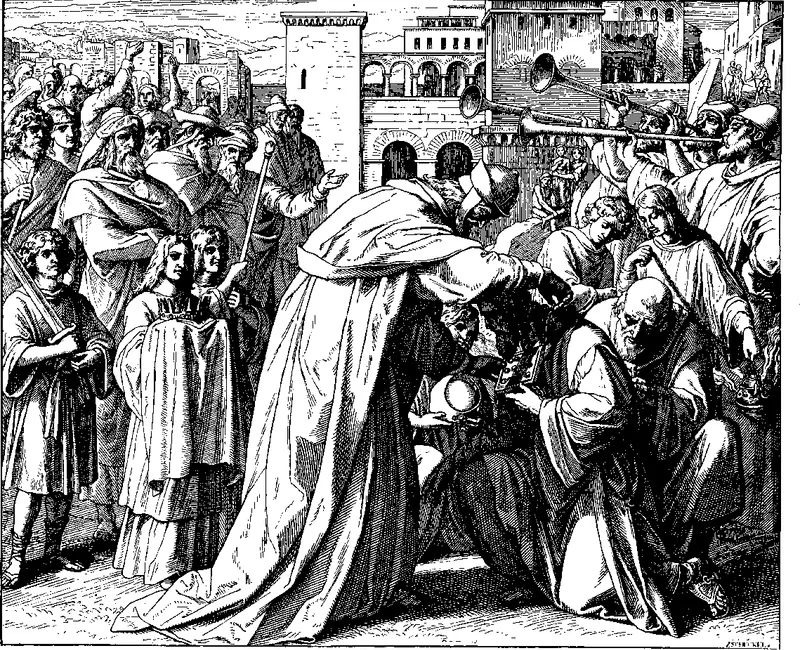
1 Maccabees 14:41-49Until There Should Arise a Faithful Prophet
41And that the Jews, and their priests, had consented that he should be their prince, and high priest for ever, till there should arise a faithful prophet: 43And that he should have care of the holy places: and that he should be obeyed by all, and that all the writings in the country should be made in his name: and that he should be clothed with purple, and gold:
At the height of the decree comes a phrase of remarkable humility and hope. Simon is to be leader and high priest, but only "till there should arise a faithful prophet." The people grant him real and lasting authority, yet they hold it open, marking it as a provision for the present and not the last word. They were living in a time when, by their own reckoning, no prophet was speaking in Israel, and they ached for the day a true prophet would come again.
So they do not close the door. They settle the present under Simon while keeping their eyes lifted toward a coming word from God that would carry an authority higher than any decree of theirs. It is the posture of a people who know their arrangements are not final, and who wait, watching, for God to speak.
42And that he should be chief over them, and that he should have the charge of the sanctuary, and that he should appoint rulers over their works, and over the country, and over the armour, and over the strong holds.
The decree gathers into Simon's hands what had been divided and contested for a generation: charge of the sanctuary, command of the strongholds, oversight of the country and its defenses. In one man, the offices of leader and high priest are joined, and the people consent to it gladly. The arrangement is unusual, and the writer does not hide that it is. After the chaos of competing claimants and foreign-appointed rulers, the people choose unity and stability under one they trust.
They are weary of division. The concentration of authority reads as the answer of an exhausted nation longing for one steady hand to keep the peace they had bled for.
46And it pleased all the people to establish Simon, and to do according to these words. 48And they commanded that this writing should be put in tables of brass, and that they should be set up within the compass of the sanctuary, in a conspicuous place:
The whole decree is to be engraved in brass and set up within the sanctuary itself, in a conspicuous place, with a copy laid up in the treasury. Where they place it is the final word. This covenant between Simon and the people is set down in the house of God, as if to call God Himself to witness the promises being made. The peace, the leadership, the gratitude, all of it is laid before the Lord at the center of the nation's worship.
It pleased all the people, the chapter says, and they sealed their will in metal in the holiest place they had. A nation's deepest commitments belong before God, and that is precisely where Judea chose to put this one.
Where this echoes in Scripture
The Land at Rest in the Days of Simon
- Mark 10:43-44Whosoever will be great among you, shall be your minister: and whosoever of you will be the chiefest, shall be servant of all.The measure of greatness Jesus gives is exactly what "he sought the good of his nation" describes.
- Proverbs 29:2When the righteous are in authority, the people rejoice: but when the wicked beareth rule, the people mourn.Why Simon's glory "pleased them well": righteous rule gladdens a people.
- Jeremiah 29:7And seek the peace of the city whither I have caused you to be carried away captives.To seek the good of the nation is the calling Scripture lays on those who lead.
Every Man Under His Vine and Fig Tree
- 1 Kings 4:25And Judah and Israel dwelt safely, every man under his vine and under his fig tree... all the days of Solomon.The very image revived under Simon, first the picture of Israel's golden rest.
- Micah 4:4But they shall sit every man under his vine and under his fig tree; and none shall make them afraid.The prophets make the same phrase the picture of the peace of the age to come.
- John 14:27Peace I leave with you, my peace I give unto you: not as the world giveth, give I unto you.The wholeness this chapter celebrates finds its deepest source in the peace Christ gives.
Letters Across the Sea: Rome and Sparta
- Proverbs 16:7When a man's ways please the LORD, he maketh even his enemies to be at peace with him.Faithfulness to God draws even distant nations to seek peace, as Rome and Sparta do here.
- Romans 12:18If it be possible, as much as lieth in you, live peaceably with all men.Simon's diligent tending of alliances embodies the call to pursue peace as far as one is able.
- Daniel 6:25-26Then king Darius wrote unto all people... I make a decree, That in every dominion of my kingdom men tremble and fear before the God of Daniel.A faithful people again wins the recognition of a watching foreign power.
Written in Brass: A People Remembers
- Joshua 4:6-7That this may be a sign among you... that ye may tell your children... and these stones shall be for a memorial unto the children of Israel for ever.The same instinct: set up a public memorial so deliverance is never forgotten.
- Nehemiah 6:15-16So the wall was finished... and all the heathen that were about us... perceived that this work was wrought of our God.The raising of Jerusalem's walls as the sign of a people restored, which Simon revives.
- Luke 22:19This do in remembrance of me.The deepest remembrance: Christ asks His people to keep the memory of His costly deliverance.
Until There Should Arise a Faithful Prophet
- Deuteronomy 18:15The LORD thy God will raise up unto thee a Prophet from the midst of thee, of thy brethren, like unto me; unto him ye shall hearken.The promised faithful prophet the people awaited, fulfilled in Christ.
- Hebrews 7:17Thou art a priest for ever after the order of Melchisedec.Simon's joined offices of priest and prince are held perfectly and forever in Christ.
- Hebrews 12:28Wherefore we receiving a kingdom which cannot be moved, let us have grace.The unshakable kingdom that Simon's fragile, hard-won peace could only foreshadow.