1 Maccabees 16
People in this chapter
Every long story has to end, and 1 Maccabees ends the way the whole struggle began: with one family standing for its people when standing was costly. Simon is the last of the brothers now. Judas fell in battle, Jonathan was taken by treachery, and Simon has carried Israel for years. In this final chapter he is old, and the threat at the border belongs to a younger man's strength. So he calls his two eldest sons and gives them the war.
What he hands them is not only an army but a confession he has lived by his whole life: "the help from heaven be with you." That sentence is the hinge of everything that follows.
Tap any highlighted phrase to jump to the commentary that unpacks it.
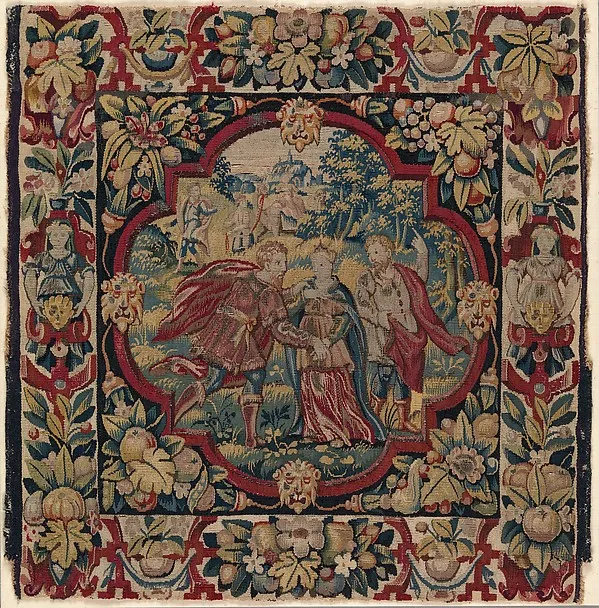
1 Maccabees 16:1-3I and My Father's House Have Fought; Now Go
1Then John came up from Gazara, and told Simon his father what Cendebeus had done against their people. 2And Simon called his two eldest sons, Judas and John, and said to them: I and my brethren, and my father’s house, have fought against the enemies of Israel from our youth even to this day: and things have prospered so well in our hands that we have delivered Israel oftentimes.
The chapter opens in motion. John has come up from Gazara, the fortified town his family holds, to bring his father word that Cendebeus is harrying the people again. This is the same restless pressure the whole book has chronicled: the foe withdraws, regroups, and presses in once more. Deliverance in 1 Maccabees is rarely a single decisive day. It is a long faithfulness across a generation, a refusal to let the people be ground down, sustained battle by battle and year by year.
Simon's words gather the whole book into one sentence. He and his brothers and his father's house have fought "from our youth even to this day." Behind that line stand the dead: Judas, who fell at the head of his men, and Jonathan, taken by deceit. Simon is the last brother left, and he speaks not as a conqueror boasting but as an old man counting the cost. The deliverances were real, given again and again into their hands.
Yet the sentence carries weariness as much as triumph. A whole life has been poured out so that Israel could remain Israel.
3And now I am old, but be you instead of me, and my brethren, and go out, and fight for our nation: and the help from heaven be with you.
This is the heart of the chapter and, in a sense, the heart of the book. Simon is old; the strength for the next battle is not in his arm. So he sends his sons in his place with the one inheritance that matters: "the help from heaven be with you." Throughout 1 Maccabees the family never claims that their swords are enough. Every real victory is traced upward, to Heaven, the reverent way these writers name God Himself.
The torch Simon passes is not merely command of an army. It is the conviction that the outcome belongs to God, and that those who fight for their people fight under His help or not at all.
1 Maccabees 16:4-8He Went Over First, and the Trumpets Sounded
5And they arose in the morning, and went into the plain: and behold a very great army of footmen and horsemen came against them, and there was a running river between them. 6And he and his people pitched their camp over against them, and he saw that the people were afraid to go over the river, so he went over first: then the men seeing him, passed over after him.
The scene is set with the precision of an eyewitness. John's twenty thousand have come down into the open plain, and across from them a "very great army" of foot and horse waits, with a swollen river running between the two forces. The river is both an obstacle and a moment of truth. To cross it is to give up the bank and advance, in the open, against a larger and stronger enemy whose cavalry outnumbers your own. Everything in the soldiers' bodies says wait, hold, do not go down into that water.
Here the narrative gives us a portrait of leadership in a single line. John sees that the people are afraid to cross, and he goes over first. The fear does not vanish; it is overcome by a leader who steps into the danger before he asks anyone to follow. "Then the men seeing him, passed over after him." Courage proves contagious when it is embodied at the front. The crossing that terrified them becomes possible the moment someone they trust is already in the water, calling them on by his own exposed back.
8And they sounded the holy trumpets: and Cendebeus and his army were put to flight: and there fell many of them wounded, and the rest fled into the strong hold.
They sound the holy trumpets, and the enemy breaks. These are not mere battle signals; they are the sacred trumpets of Israel, the same instruments Numbers commands the people to blow when they go to war, "and ye shall be remembered before the LORD your God, and ye shall be saved from your enemies." The trumpet blast is a prayer made audible, a way of crying out to Heaven in the moment of crisis. The rout that follows is told without boasting of John's tactics.
The trumpets sound, and Cendebeus flees. The victory is laid, as always in this book, at the feet of the God who remembers His people when they call.
1 Maccabees 16:11-17He Rendered Evil for Good
11Now Ptolemee the son of Abobus was appointed captain in the plain of Jericho, and he had abundance of silver and gold, 13And his heart was lifted up, and he designed to make himself master of the country, and he purposed treachery against Simon, and his sons, to destroy them.
The story turns from the open field to the shadows of the heart. Ptolemy is Simon's own son-in-law, married into the family, set over the rich plain of Jericho, with silver and gold in abundance. He has everything except contentment. "His heart was lifted up," and from that pride grows a plan: to seize the whole country for himself. The book has shown us the enemy outside the gates many times. Now it shows the deadlier enemy, the ambition that swells inside a man who is already trusted, already provided for, already family.
The lifted-up heart is where the betrayal is born long before any sword is drawn.
15And the son of Abobus received them deceitfully into a little fortress, that is called Doch which he had built: and he made them a great feast, and hid men there. 16And when Simon and his sons had drunk plentifully, Ptolemee and his men rose up and took their weapons, and entered into the banqueting place, and slew him, and his two sons, and some of his servants.
Every detail sharpens the horror. Ptolemy builds a fortress and names it; he prepares a great feast; he hides armed men in the walls. The setting of a shared table, the deepest sign of trust and welcome in the ancient world, is turned into a weapon. To eat at a man's table was to be under his protection. Ptolemy inverts that sacred bond. He uses hospitality itself as the bait, so that the very kindness Simon extends in coming becomes the means of his death.
There is a long biblical memory here of the betrayer who dips his hand in the same dish and then strikes.
The blow falls when the guests are most defenseless, after they have drunk freely, trusting their host. Simon, the last of the brothers who freed Israel, is cut down at a banquet table by family, together with two of his sons. The man who survived every battlefield falls to a feast. After all the open warfare of the book, the founder of the line dies by ambush and broken faith at a banquet table. It is a grief the narrator lets land in full.
The cost of treachery is measured in the blood of the very people who delivered the nation.
17And he committed a great treachery in Israel, and rendered evil for good.
The narrator names the deed with a phrase Scripture reserves for the deepest kind of wrong: he "rendered evil for good." Simon had given Ptolemy a place, a marriage, a trust. Ptolemy returned murder. To repay good with evil is to violate something more basic than law; it is to poison the bonds that hold a people together. The Psalms cry out against exactly this betrayal - "they rewarded me evil for good" - and the cry rises again here.
Yet the very naming of the sin is a kind of judgment. The book will not let the reader admire the man who clawed his way toward a crown over the bodies of his own family. His gold and his fortress cannot buy him an honored name.
1 Maccabees 16:18-24A Runner Outpaced the Killers, and the Book Closed
19And he sent others to Gazara to kill John: and to the tribunes he sent letters to come to him, and that he would give them silver, and gold, and gifts. 21Now one running before, told John in Gazara, that his father and his brethren were slain, and that he hath sent men to kill thee also.
Ptolemy's plot is total. He sends assassins to Gazara to kill John, the last surviving son, dispatches bribes of silver and gold to buy the army's officers, and sends men to seize Jerusalem and the temple mount itself. In a single stroke he means to erase the whole house and take everything. But the story turns on one unnamed figure: a runner who outpaces the killers. He reaches John first and tells him the terrible news - your father and brothers are dead, and the men coming behind me are sent to kill you.
A nameless messenger, faster than murder, becomes the thin thread on which the survival of the line hangs.
22But when he heard it he was exceedingly afraid: and he apprehended the men that came to kill him, and he put them to death: for he knew that they sought to make him away.
The book is honest about John's heart in the moment: he "was exceedingly afraid." This is no marble hero who feels nothing. He has just learned that his father and brothers are murdered and that he is next. And in his fear he acts, seizing the assassins before they can strike and putting them to death. The same young man who went first across the river now stands as the last of his house, frightened and resolute at once.
Fear and faithfulness are not opposites in this story. The man who trembles can still do what must be done, and the line of deliverers does not end in the dark.
23And as concerning the rest of the acts of John, and his wars, and the worthy deeds, which he bravely achieved, and the building of the walls, which he made, and the things that he did: 24Behold these are written in the book of the days of his priesthood, from the time he was made high priest after his father.
The book ends the way the chronicles of Israel's kings end: "the rest of the acts of John... behold these are written in the book of the days of his priesthood." John succeeds his father not on a throne but as high priest, the line carrying both the sword that defended the people and the altar that served their God. The closing words deliberately echo the refrain of Kings and Chronicles, setting these recent deliverers in the long story of God's dealings with His people.
The narrator lays down his pen mid-stride, with John's deeds still being written elsewhere. The struggle is not finished; it is handed forward, and the reader is left holding the question of where it all leads.
Where this echoes in Scripture
I and My Father's House Have Fought; Now Go
- Deuteronomy 31:7-8Be strong and of a good courage... and the LORD, he it is that doth go before thee; he will be with thee.Moses, old like Simon, hands the battle to Joshua with the same promise: God goes with you.
- Psalm 121:1-2I will lift up mine eyes unto the hills... My help cometh from the LORD, which made heaven and earth.Simon's "help from heaven" put to song: the rescue comes from the Maker of heaven, who made heaven and earth.
- 2 Timothy 2:2The things that thou hast heard of me... the same commit thou to faithful men, who shall be able to teach others also.The aging mentor entrusting the work forward, that it might outlast him.
He Went Over First, and the Trumpets Sounded
- Numbers 10:9Then ye shall blow an alarm with the trumpets; and ye shall be remembered before the LORD your God, and ye shall be saved from your enemies.The very command John's men obey: the holy trumpets are a cry to be remembered and saved.
- Joshua 3:15-17As they that bare the ark were come unto Jordan... the waters which came down from above stood and rose up upon an heap.Another fearful river crossing where God opens the way before His people advance.
- 1 Corinthians 15:52In a moment, in the twinkling of an eye, at the last trump... the dead shall be raised incorruptible.The trumpet that signals deliverance points to the final trumpet and the raising of the dead.
He Rendered Evil for Good
- Psalm 41:9Yea, mine own familiar friend, in whom I trusted, which did eat of my bread, hath lifted up his heel against me.The betrayal at the table, the friend who shares your bread and then strikes.
- Proverbs 17:13Whoso rewardeth evil for good, evil shall not depart from his house.The exact charge against Ptolemy, and its long shadow.
- Luke 22:48But Jesus said unto him, Judas, betrayest thou the Son of man with a kiss?The deepest betrayal at a table, where Christ both fulfills and answers this dark pattern.
A Runner Outpaced the Killers, and the Book Closed
- 2 Kings 20:20And the rest of the acts of Hezekiah, and all his might... are they not written in the book of the chronicles?The closing formula 1 Maccabees borrows, setting John in the long line of Israel's recorded kings.
- Jeremiah 31:31Behold, the days come, saith the LORD, that I will make a new covenant with the house of Israel.The covenant this family fought to preserve was straining toward the new covenant yet to come.
- Hebrews 11:32-34Time would fail me to tell of... who through faith subdued kingdoms... out of weakness were made strong, waxed valiant in fight.Faithful, frightened deliverers like John, named among the great cloud of witnesses.