1 Maccabees 2
People in this chapter
When the whole world is bowing to a lie, what does one faithful person do? In the last chapter, the armies of Antiochus stripped Jerusalem, defiled the temple, and made obedience to the law of God a capital crime. Resistance looked impossible and surrender looked reasonable. Into that moment steps Mathathias, an aging priest who has retired from the holy city to the small town of Modin, and who carries in his chest a grief so deep he asks why he was ever born to see his people ruined.
When the king's officers offer him gold and royal friendship to be the first to forsake the law, his answer rings out: though every nation on earth obey the king, "I and my sons, and my brethren will obey the law of our fathers."
Tap any highlighted phrase to jump to the commentary that unpacks it.
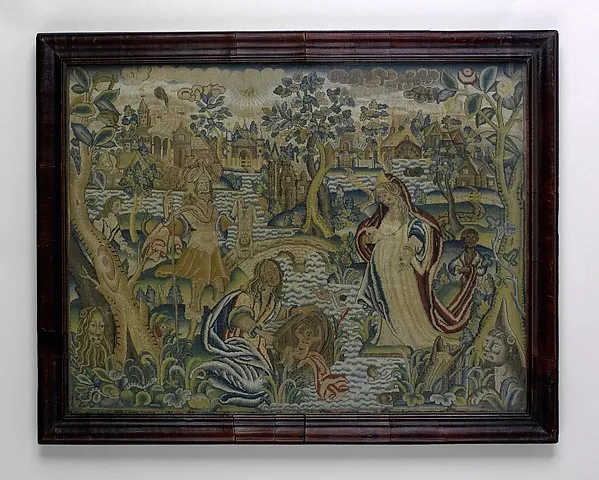
1 Maccabees 2:1-13A Priest Mourns a Ruined City
1In those days arose Mathathias the son of John, the son of Simeon, a priest of the sons of Joarib, from Jerusalem, and he abode in the mountain of Modin.
The deliverance of God's people begins with one aging priest in a country town. Mathathias is descended from the priestly courses that once served in Jerusalem, but he has withdrawn to Modin, a modest village in the hills northwest of the city. The narrator lingers on his lineage on purpose. He is a man rooted in the worship of Israel, a keeper of the altar who now watches that altar profaned from a distance. When everything official has collapsed, faithfulness survives in an ordinary household far from the centers of power.
6These saw the evils that were done in the people of Juda, and in Jerusalem. 7And Mathathias said: Woe is me, wherefore was I born to see the ruin of my people, and the ruin of the holy city, and to dwell there, when it is given into the hands of the enemies? 8The holy places are come into the hands of strangers: her temple is become as a man without honour.
Mathathias and his five sons "saw" what was happening, and the word carries weight. They did not look away or numb themselves to it. To see clearly the desecration of what is holy, and to let it wound you rather than harden you, is the beginning of every faithful response. The temptation in a time of ruin is to grow accustomed to the ruin. This family refuses that anesthesia and feels the full grief of it.
The priest's lament is among the most human cries in the book. He does not begin with strategy or defiance; he begins with sorrow so deep it questions the worth of his own life. "Wherefore was I born to see the ruin of my people?" He grieves over the temple as one would grieve over a person who has lost all honor. This is holy mourning, the ache of someone who loves what God loves and cannot bear to watch it trampled.
Scripture knows this grief well; it is the same lament Jeremiah poured out over the same city, and it is never far from the prophets who carried the burden of a people's sin.
The lament reaches its lowest point in a single question: if everything that gave our life meaning has been desecrated, why go on living? It is a cry of despair, and the chapter does not rush past it. Yet this is the very bottom from which the whole rescue will rise. Often the turning point comes precisely here, at the place where a person stops protecting themselves and asks what their life is finally for. Mathathias's despair will not have the last word; within a few verses it becomes the courage that changes everything.
1 Maccabees 2:15-26I and My Sons Will Obey the Law of Our Fathers
15And they that were sent from king Antiochus came thither, to compel them that were fled into the city of Modin, to sacrifice, and to burn incense, and to depart from the law of God. 16And many of the people of Israel consented, and came to them: but Mathathias and his sons stood firm.
The persecution was not content to forbid worship; it demanded participation in idolatry. The king's men came to Modin to make the people prove their submission by an act of false sacrifice, a public renunciation of the God of Israel. This is the sharpened edge of the trial. It is one thing to be prevented from doing good; it is another to be ordered to do evil under threat of death. Many complied, and the text states it plainly and without contempt. The pressure was real, and the cost of refusal was everything.
Against the tide of those who consented, four words stand like a rock: "Mathathias and his sons stood firm." There is no speech yet, no army, only a family that will not move. Courage at this scale rarely looks dramatic in the moment. It looks like one household quietly declining to do what everyone else is doing. The whole revolt that follows is built on this unspectacular foundation, the simple refusal of a few to bow when bowing was the sensible thing to do.
18Therefore come thou first, and obey the king’s commandment, as all nations have done, and the men of Juda, and they that remain in Jerusalem: and thou, and thy sons, shall be in the number of the king’s friends, and enriched with gold, and silver, and many presents.
The officers know Mathathias is a man of honor and influence, so they aim higher than threat: they offer reward. Be the first to comply, they say, and you will be counted among the king's friends, showered with silver and gold. This is the subtler face of the same trial. Persecution that only threatens can be resisted by the brave; persecution that flatters and enriches can buy off the strong. They are inviting Mathathias to lead his people into compromise and to be paid handsomely for it.
The deepest test of his faith is not the sword but the bribe.
20I and my sons, and my brethren will obey the law of our fathers. 21God be merciful unto us: it is not profitable for us to forsake the law, and the justices of God: 22We will not hearken to the words of king Antiochus, neither will we sacrifice, and transgress the commandments of our law, to go another way.
Mathathias answers with a loud voice so that everyone can hear. Though every nation on earth bows to the king, he and his house will hold to the law of their fathers. Notice that he frames it as faithfulness to an inheritance, a covenant handed down, something not his to surrender. He is the steward of his people's faith, and a steward cannot sell what belongs to God. The bribe assumed everything has a price. His answer reveals that some things do not.
Even at the height of his defiance, Mathathias prays. "God be merciful unto us." His courage is a deep dependence. He knows the path he is choosing is dangerous, and he does not pretend his family has the strength to walk it alone. This small prayer keeps the whole revolt from becoming mere human bravado. The strength to stand is asked for, and that asking is what keeps zeal tethered to God.
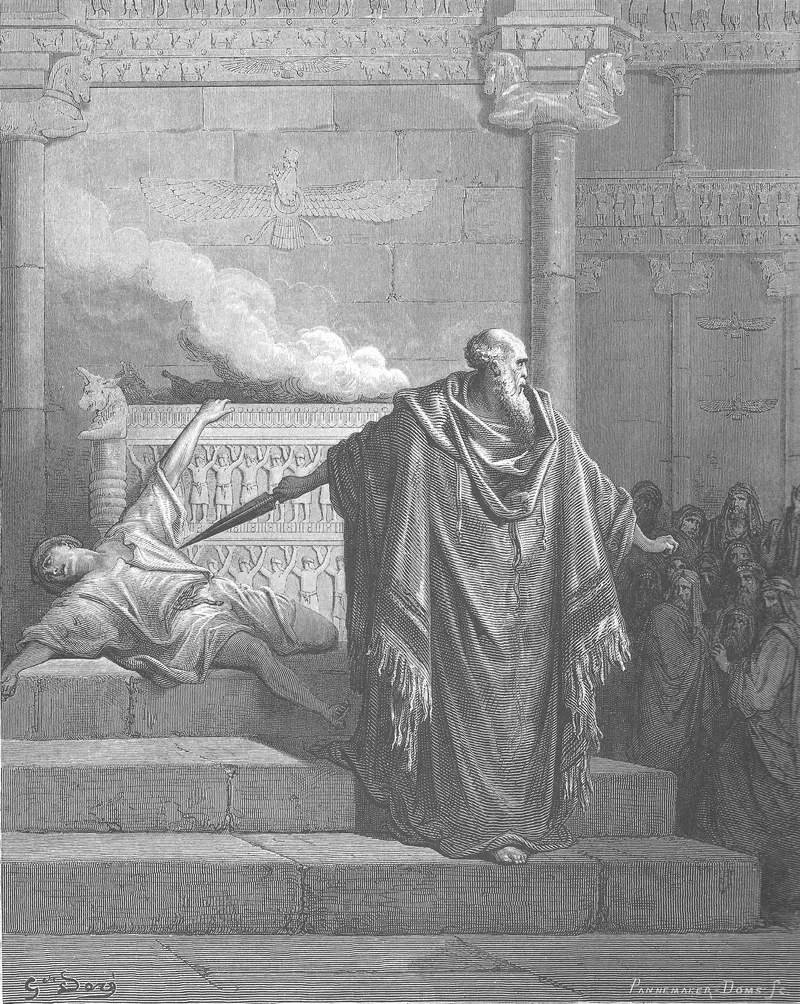
24And Mathathias saw and was grieved, and his reins trembled, and his wrath was kindled according to the judgment of the law, and running upon him he slew him upon the altar: 26And shewed zeal for the law, as Phinees did by Zamri the son of Salomi.
When a man of Israel steps forward to offer the forbidden sacrifice in plain view, something breaks loose in Mathathias. The text is careful about the order of it: first grief, then a trembling deep within, then a kindled anger "according to the judgment of the law." This is the response of a heart that loves God so fiercely that public betrayal of Him is unbearable. The narrator presents the act inside the world of the law of Moses and its severest sanctions, and within that frame it is told as faithfulness to the covenant.
The chapter names the pattern Mathathias is following: he "shewed zeal for the law, as Phinees did." In the book of Numbers, when Israel was being seduced into idolatry, the priest Phinees acted decisively and turned away God's wrath, and for it he was granted a covenant of lasting priesthood. By invoking Phinees, the narrator places Mathathias in that priestly line of jealous love for God's honor. The point being held up for the reader is the zeal itself, a devotion that counts nothing too costly when the holiness of God is at stake.
That burning love is the engine of everything that follows.
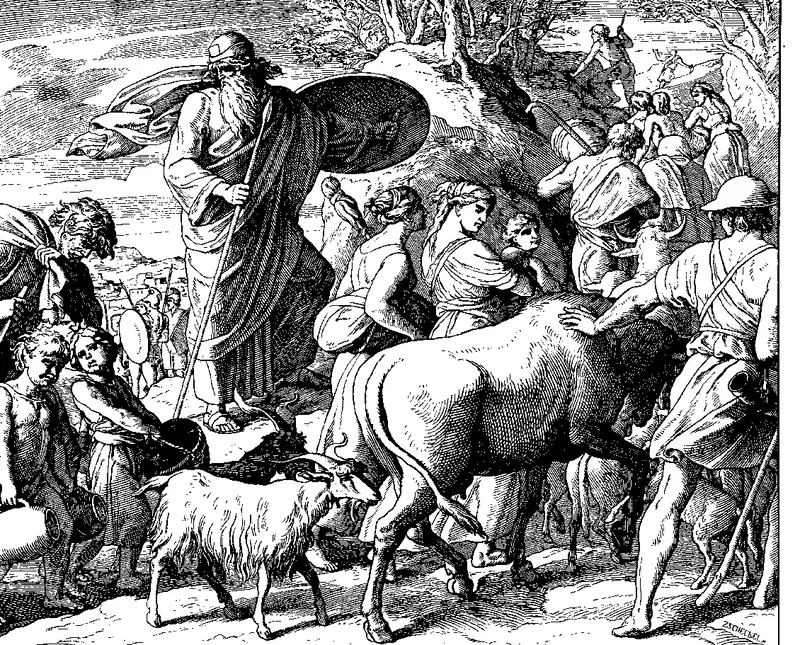
1 Maccabees 2:27-41Let Him Follow Me: The Remnant and the Sabbath
27And Mathathias cried out in the city with a loud voice, saying: Every one that hath zeal for the law, and maintaineth the testament, let him follow me. 28So he, and his sons fled into the mountains, and left all that they had in the city.
From grief to a rallying cry. Mathathias does not raise an army by conscription; he issues an invitation. Whoever loves the law and means to keep the covenant, come. And then he and his sons abandon everything they own and flee to the hills. The call costs the caller first; he leaves his home before he asks anyone to leave theirs. This is the shape of every true summons to follow. It is led from the front, and it begins with letting go of what cannot be carried into the wilderness.
29Then many that sought after judgment, and justice, went down into the desert: 30And they abode there, they and their children, and their wives, and their cattle: because afflictions increased upon them.
The faithful go down into the wilderness, the same wilderness where Israel was first formed into a people after Egypt. There is a long pattern in Scripture of the desert becoming a refuge, a place stripped of everything but God. These families give up homes and security to keep their faith intact, choosing hardship over compromise. The wilderness is not where God's people are abandoned; again and again it is where the remnant is preserved and prepared.
32And forthwith they went out towards them, and made war against them on the sabbath day, 34And they said: We will not come forth, neither will we obey the king’s edict, to profane the sabbath day. 37Saying: Let us all die in our innocency: and heaven and earth shall be witnesses for us, that you put us to death wrongfully.
The enemy attacks on the Sabbath, knowing the devout will not fight on the day of rest. The keeping of the Sabbath was one of the boundary markers Antiochus had outlawed, so the very faithfulness these people are defending becomes the lever used against them. Here is the cruel logic of the persecution laid bare: their obedience is turned into the trap that destroys them. The scene asks an agonizing question that the next verses will force the survivors to face.
The devout in the caves make their choice with terrible clarity: "Let us all die in our innocency." They will not lift a hand, will not even block the entrances, but call heaven and earth to witness that they are being killed unjustly. A thousand of them perish, with their wives, their children, and their flocks. The narrator records it as a wound. These are the deaths of people so devoted to God's command that they would rather die keeping it than live by breaking it.
Their blood becomes a testimony, and the cry "heaven and earth shall be witnesses" is the cry of every innocent sufferer whose vindication rests with God alone.
41And they determined in that day, saying: Whosoever shall come up against us to fight on the sabbath day, we will fight against him: and we will not all die, as our brethren that were slain in the secret places.
Faced with annihilation, Mathathias and his companions reach a hard resolution: they will defend themselves if attacked on the Sabbath, choosing survival so the covenant may endure. The text presents this as a weighty decision made in grief, a reckoning with the true heart of the law. They are wrestling, in real time and at real cost, with how to honor God in an impossible situation, how to keep the covenant alive when rigid keeping of one command would mean the death of all who keep it.
Scripture lays the dilemma before us in its full difficulty and lets us feel the weight of it, the way Jesus would later remind His hearers that the Sabbath was made for man, and that mercy and the saving of life belong to its true keeping.
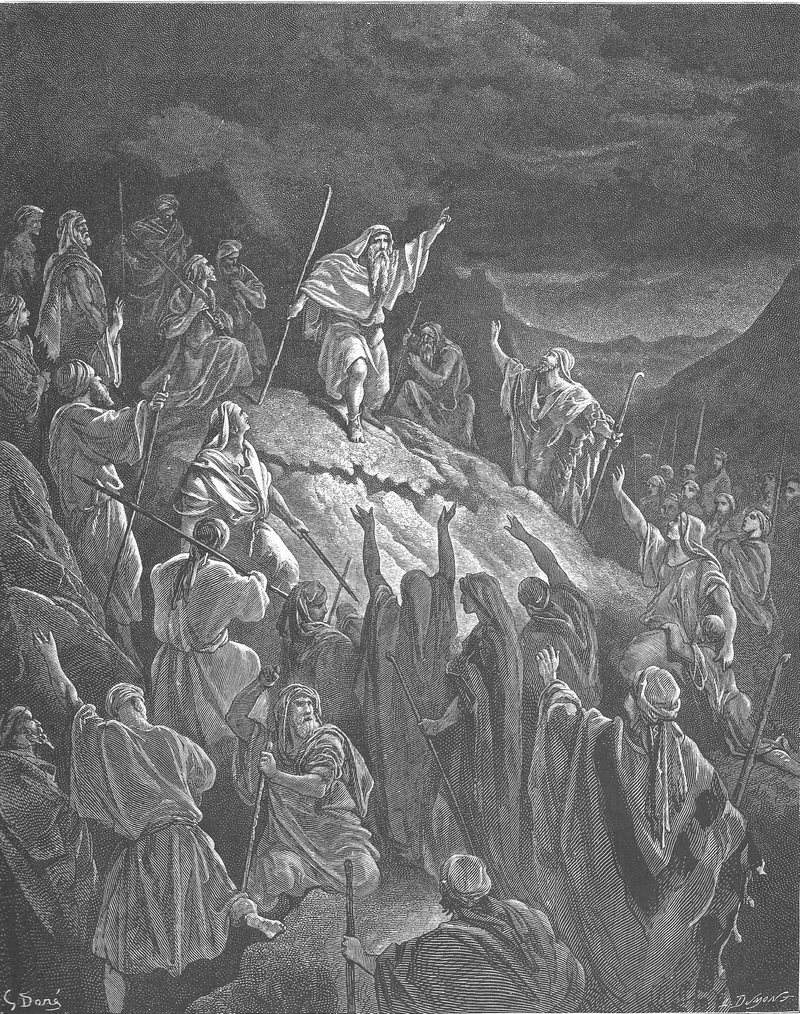
1 Maccabees 2:49-64Call to Remembrance the Works of the Fathers
50Now therefore, O my sons, be ye zealous for the law, and give your lives for the covenant of your fathers. 51And call to remembrance the works of the fathers, which they have done in their generations: and you shall receive great glory, and an everlasting name.
As his death draws near, Mathathias gathers his sons for a final charge, and it is all of a piece with his life: be zealous for the law, and be willing to give your very lives for the covenant. He is handing down the one treasure he has, the same inheritance he refused to sell to the king. A dying parent reveals what they believe matters most, and for Mathathias it is faithfulness to God passed on intact to the next generation. He is leaving them a cause worth dying for.
The heart of his charge is memory. "Call to remembrance the works of the fathers." Mathathias knows that courage is sustained by remembering, that a people who forget what God has done lose the nerve to trust Him now. So he turns his sons' eyes backward over the whole story of Scripture, name by name, to steady them for what lies ahead. The promise attached, "great glory, and an everlasting name," is the hope held out to those who stay faithful, the assurance that a life poured out for God is remembered forever.
What that lasting reward fully means, the chapter leaves in God's hands.
52Was not Abraham found faithful in temptation, and it was reputed to him unto justice? 53Joseph in the time of his distress kept the commandment, and he was made lord of Egypt. 54Phinees our father, by being fervent in the zeal of God, received the covenant of an everlasting priesthood.
The roll call begins with Abraham, "found faithful in temptation," whose faith "was reputed to him unto justice." Mathathias reaches back to the moment Abraham was tested and held fast, and recalls that God counted his faith as righteousness. This same line about Abraham becomes one of the load-bearing texts of the New Testament, where Paul returns to it again and again. The pattern set here, faith proved through trial and honored by God, is the thread Mathathias traces through every name that follows.
Each hero is remembered for one thing: in the hour of testing, they trusted God and did not let go.
57David by his mercy obtained the throne of an everlasting kingdom. 59Ananias and Azarias and Misael by believing, were delivered out of the flame. 60Daniel in his innocency was delivered out of the mouth of the lions.
The list gathers speed and reads like a hall of remembrance: Joseph faithful in distress and raised to rule Egypt; Phinees fervent and given a lasting priesthood; Jesus son of Nave, who is Joshua, made a leader; Caleb rewarded for his witness; David granted an everlasting throne; Elias taken up to heaven; the three young men preserved in the furnace; Daniel shut safely among the lions. Some of these were delivered out of death and some, like the prophets, were honored through faithfulness unto the end.
Mathathias is not promising his sons they will all survive. He is showing them that across every generation, the God who is trusted proves trustworthy.
61And thus consider through all generations: that none that trust in him fail in strength. 62And fear not the words of a sinful man, for his glory is dung, and worms: 63Today he is lifted up, and tomorrow he shall not be found, because he is returned into his earth; and his thought is come to nothing.
Here is the conclusion the whole roll call has been building toward, and it is the beating heart of the chapter: "none that trust in him fail in strength." This is the lesson of every name, the through-line of all the generations. Not one person who has truly leaned the weight of their life on God has been finally put to shame. It is a staggering claim, and Mathathias stakes his sons' future on it.
The point of remembering the past is to be able to trust God in the present, and the verdict of the past is unbroken: God does not fail those who hope in Him.
Against that towering faithfulness of God, Mathathias sets the emptiness of the tyrant. Do not fear the words of a sinful man, he says, for all his glory is dung and worms. Today he is exalted; tomorrow he is gone back to the dust, and his schemes come to nothing. Antiochus seemed unstoppable, but the priest sees through the illusion of his power to its end. The contrast is total: the trusting soul is held up by a God who never fails, while the proud oppressor, for all his present strength, is already on his way to being forgotten.
1 Maccabees 2:65-70He Blessed Them, and Was Joined to His Fathers
65And behold, I know that your brother Simon is a man of counsel: give ear to him always, and he shall be a father to you. 66And Judas Machabeus who is valiant and strong from his youth up, let him be the leader of your army, and he shall manage the war of the people.
With his last strength Mathathias orders the future wisely. He names Simon as the counselor, the brother of steady judgment to whom the rest should listen as to a father, and Judas, called Machabeus, as the leader in battle, valiant from his youth. The old priest knows that a cause needs more than zeal; it needs counsel and courage working together, each son serving where he is strong. His foresight blesses his family by freeing them from rivalry and pointing each one to his place.
This is what it looks like to lead even from a deathbed, ordering things so the work can go on without you.
69And he blessed them, and was joined to his fathers. 70And he died in the hundred and forty-sixth year: and he was buried by his sons in the sepulchres of his fathers in Modin, and all Israel mourned for him with great mourning.
Mathathias dies as the patriarchs died, blessing his children and then "joined to his fathers." The phrase places him in the great company that has gone before, gathered to his people in death the way Abraham and the patriarchs were said to be. He has spent his final breath on his sons, leaving them a blessing. A life that began this chapter asking "wherefore was I born?" ends having given that life entirely away for God and for the generation coming after him. The despairing lament has become a benediction.
He is buried in Modin, the small town where it all began, in the tomb of his fathers, and all Israel mourns him with great mourning. The country priest who once wept alone over his people is now wept over by his whole people. The man who would not be the first to forsake the law became the first to take his stand for it, and his courage outlived him in his sons and in the deliverance still to come.
The grief that opened the chapter is answered by a grief of honor, the tears of a nation for the one who would not bend.
Where this echoes in Scripture
A Priest Mourns a Ruined City
- Lamentations 1:1How doth the city sit solitary, that was full of people! how is she become as a widow!Jeremiah's lament over the same Jerusalem, the grief Mathathias inherits.
- Psalm 79:1O God, the heathen are come into thine inheritance; thy holy temple have they defiled.A psalm that prays the very desolation Mathathias mourns.
- Nehemiah 1:4When I heard these words, that I sat down and wept, and mourned certain days, and fasted, and prayed.Another leader whose rescue of his people began with mourning over its ruin.
I and My Sons Will Obey the Law of Our Fathers
- Numbers 25:11-13Phinehas... hath turned my wrath away... Behold, I give unto him my covenant of peace... the covenant of an everlasting priesthood.The act of zeal Mathathias deliberately echoes.
- Daniel 3:18Be it known unto thee, O king, that we will not serve thy gods, nor worship the golden image which thou hast set up.The same refusal to sacrifice to an idol under a king's command.
- Matthew 4:9-10All these things will I give thee, if thou wilt fall down and worship me. Then saith Jesus... Get thee hence, Satan.Christ too is offered the kingdoms of the world for one act of false worship, and refuses.
Let Him Follow Me: The Remnant and the Sabbath
- Hebrews 11:38Of whom the world was not worthy: they wandered in deserts, and in mountains, and in dens and caves of the earth.The faithful driven into the wilderness, honored rather than pitied.
- Mark 2:27-28The sabbath was made for man, and not man for the sabbath: Therefore the Son of man is Lord also of the sabbath.Jesus on the very tension the remnant wrestles with here.
- Revelation 6:10How long, O Lord, holy and true, dost thou not judge and avenge our blood on them that dwell on the earth?The innocent slain crying for the vindication only God can give.
Call to Remembrance the Works of the Fathers
- Hebrews 11:8-12By faith Abraham, when he was called... obeyed... These all died in faith, not having received the promises, but having seen them afar off.The New Testament's own roll call of the faithful, built on the same names.
- Romans 4:20-24He staggered not at the promise of God through unbelief... And therefore it was imputed to him for righteousness.Paul takes up Abraham 'reputed unto justice' and opens it to all who believe.
- Romans 10:11For the scripture saith, Whosoever believeth on him shall not be ashamed.Mathathias's 'none that trust in him fail' spoken as gospel promise.
He Blessed Them, and Was Joined to His Fathers
- Genesis 49:33And when Jacob had made an end of commanding his sons... he yielded up the ghost, and was gathered unto his people.The patriarch's death Mathathias's passing deliberately echoes.
- 2 Timothy 4:6-7I am now ready to be offered... I have fought a good fight, I have finished my course, I have kept the faith.Another faithful death that hands a charge to those who follow.
- Psalm 112:6Surely he shall not be moved for ever: the righteous shall be in everlasting remembrance.The "everlasting name" Mathathias promised, granted to the faithful.