Lamentations 1
Lamentations is a small book of enormous grief - five poems mourning the fall of Jerusalem to Babylon in 586 BC, when the city was besieged, starved, broken open, and burned, and its people carried into exile. The first four poems are acrostics: their verses march in order down the Hebrew alphabet, from the first letter to the twenty-second, as though grief itself were being spelled out from A to Z, given a shape so it can be carried.
Chapter 1 opens on the word that names the whole book in Hebrew - How - the cry of a mourner: How doth the city sit solitary, that was full of people! how is she become as a widow! she that was great among the nations, and princess among the provinces, how is she become tributary! (v. 1). The city is pictured as a woman: once a princess, now a widow; once crowded, now alone.1
Tap any highlighted phrase to jump to the commentary that unpacks it.
Lamentations 1:1-6How Doth the City Sit Solitary
1How doth the city sit solitary, that was full of people! how is she become as a widow! she that was great among the nations, and princess among the provinces, how is she become tributary! 2She weepeth sore in the night, and her tears are on her cheeks: among all her lovers she hath none to comfort her: all her friends have dealt treacherously with her, they are become her enemies. 3Judah is gone into captivity because of affliction, and because of great servitude: she dwelleth among the heathen, she findeth no rest: all her persecutors overtook her between the straits. 4The ways of Zion do mourn, because none come to the solemn feasts: all her gates are desolate: her priests sigh, her virgins are afflicted, and she is in bitterness. 5Her adversaries are the chief, her enemies prosper; for the LORD hath afflicted her for the multitude of her transgressions: her children are gone into captivity before the enemy. 6And from the daughter of Zion all her beauty is departed: her princes are become like harts that find no pasture, and they are gone without strength before the pursuer.
The poem begins with a sob: How - one Hebrew word, eikhah, the sound a mourner makes standing over the dead. Everything that follows hangs from it. How doth the city sit solitary, that was full of people! how is she become as a widow! she that was great among the nations, and princess among the provinces, how is she become tributary! (v. 1). The grief works entirely by contrast, then and now laid side by side until the loss is unbearable.
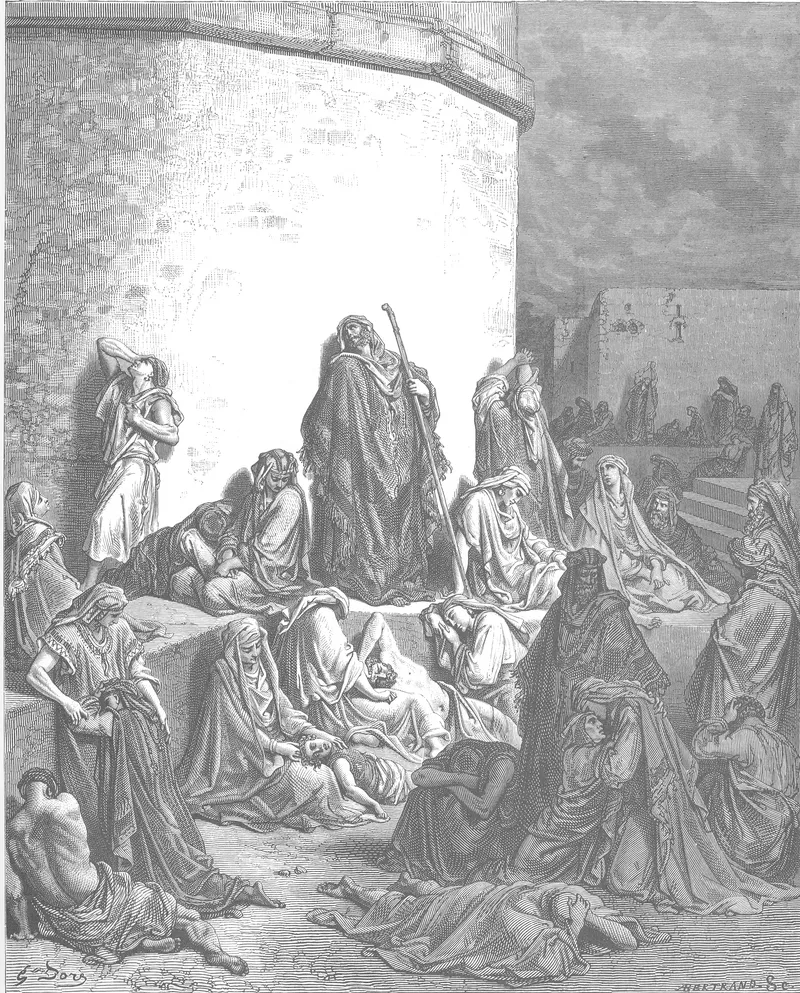
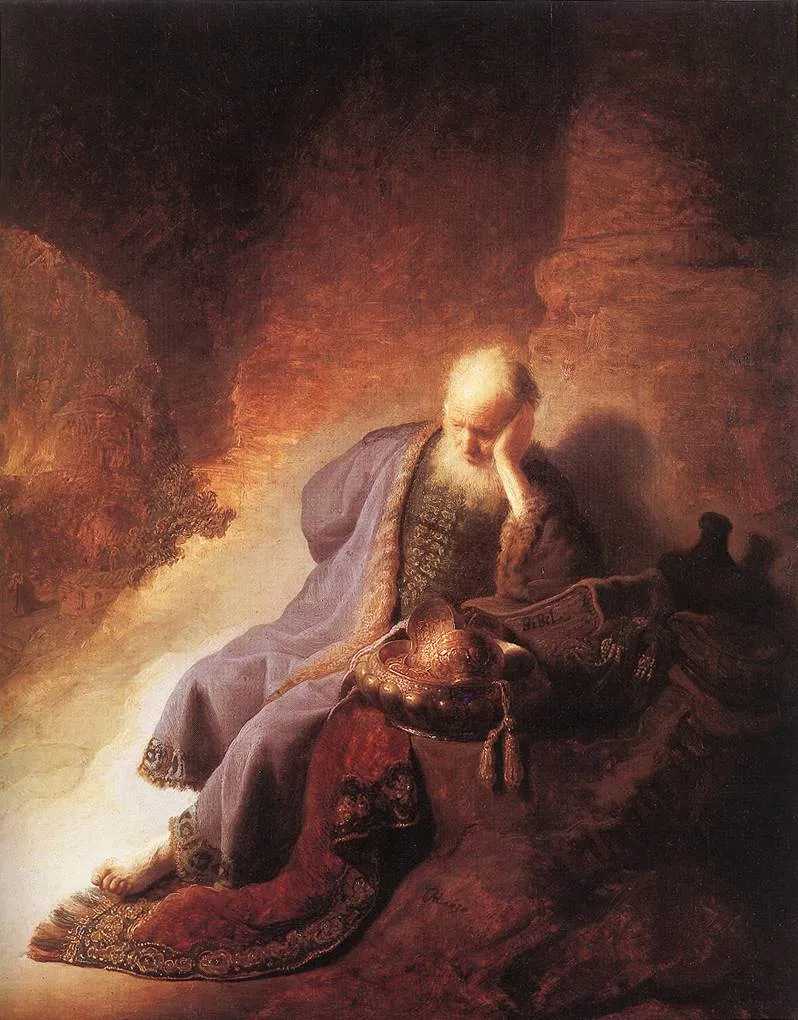
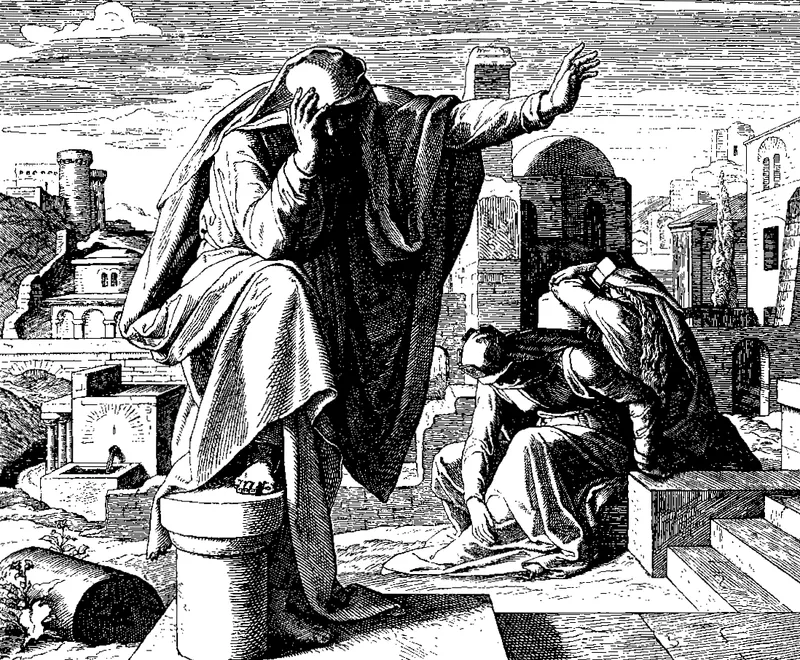
The city was full of people - now she sits solitary. She was great among the nations, a princess among the provinces - now a widow, stripped of the husband who was her protection and her standing, reduced to tributary, paying tax to the conquerors who own her. Jerusalem is pictured throughout as a woman, and the image is deliberate and tender: not a fortress fallen but a person bereaved, sitting alone in the dark. The word sit matters too - it is the posture of mourning, the bowed and motionless grief of someone with nowhere to go and nothing left to do but weep.
The second verse introduces the line that will toll through the whole chapter like a funeral bell: She weepeth sore in the night, and her tears are on her cheeks: among all her lovers she hath none to comfort her (v. 2). Five times in this poem the same ache returns - none to comfort (vv. 2, 9, 16, 17, 21) - and it is the deepest wound of all. The city does not merely suffer; she suffers alone. The lovers are the nations Jerusalem courted for safety, the alliances she trusted instead of trusting God; they promised protection and have all proved false, turning from friends into enemies. So she weeps in the night, when there is no one to see and no one to hold her.
The verses widen the desolation outward in every direction: the ways of Zion themselves mourn because the pilgrim crowds no longer climb them to the feasts (v. 4); the gates stand empty, the priests sigh, the young women grieve. A city is its people, its worship, its festivals, its noise - and all of it has gone silent. The poem will not let us rush past this. It holds the reader in the empty streets.
Woven into the grief is a confession the poem makes without bitterness: this did not simply happen to Jerusalem - the LORD hath afflicted her for the multitude of her transgressions (v. 5). The dirge never pretends the catastrophe is an accident or an injustice. It names the hand behind it as God's, and names the cause as the city's own long rebellion. This is part of what makes Lamentations so honest: it refuses both of the easy roads.
It will not say the suffering is meaningless and undeserved, and it will not say it does not hurt. It holds the two together - we brought this on ourselves, and it is agony - and grieves anyway. Verse 6 gathers the loss into one quiet image: from the daughter of Zion all her beauty is departed. Whatever made her glorious - her freedom, her dignity, the presence that set her apart - has drained away, and her leaders flee like harts that find no pasture, exhausted and undone before the pursuer. Strength is gone; beauty is gone; only the weeping remains.
Lamentations 1:7-11See, O LORD, and Consider
7Jerusalem remembered in the days of her affliction and of her miseries all her pleasant things that she had in the days of old, when her people fell into the hand of the enemy, and none did help her: the adversaries saw her, and did mock at her sabbaths. 8Jerusalem hath grievously sinned; therefore she is removed: all that honoured her despise her, because they have seen her nakedness: yea, she sigheth, and turneth backward. 9Her filthiness is in her skirts; she remembereth not her last end; therefore she came down wonderfully: she had no comforter. O LORD, behold my affliction: for the enemy hath magnified himself. 10The adversary hath spread out his hand upon all her pleasant things: for she hath seen that the heathen entered into her sanctuary, whom thou didst command that they should not enter into thy congregation. 11All her people sigh, they seek bread; they have given their pleasant things for meat to relieve the soul: see, O LORD, and consider; for I am become vile.
This middle movement turns on a painful kind of memory: Jerusalem remembered in the days of her affliction and of her miseries all her pleasant things that she had in the days of old (v. 7). Part of the cruelty of loss is that it makes you remember. In the ruins, the mind keeps reaching back to the days of old, to the pleasant things now gone - and every memory of the good is a fresh cut.
Worse, the enemy turns even the holy things to mockery: the adversaries saw her, and did mock at her sabbaths (v. 7). The very rhythms of worship that once marked her as God's are now occasions for scorn. And the poem does not soften the reason for it all: Jerusalem hath grievously sinned; therefore she is removed (v. 8). Twice in these verses her exposure is described as a kind of shameful nakedness - they have seen her nakedness - the humiliation of one whose hidden failures are now public, who can no longer keep up appearances.
There is no self-justification here. The city does not argue that she has been wronged. She agrees with the verdict against her, even as she weeps under it.
For the second time the bell tolls: she had no comforter (v. 9). And then, in the middle of that same verse, something breaks open - the description suddenly becomes a prayer. Until now the poem has spoken about Jerusalem in the third person; here, for the first time, a voice turns and speaks directly to God: O LORD, behold my affliction: for the enemy hath magnified himself (v. 9). This is the hinge of the whole chapter.
The mourner, who has been narrating her grief to the air, finally addresses it to Someone. She does not yet ask for rescue; she asks only to be seen. Behold my affliction. It is the most basic cry of the suffering: “look at me, do not pass me by, do not let my pain be invisible.” The chapter has insisted there is none to comfort; but here it quietly tests whether there is at least One who will look. And the grief that turns into prayer, even a prayer this bare, has already taken a step that mere despair never takes.
It has decided that God is still there to be spoken to.
The deepest violation of all is named in verse 10: she hath seen that the heathen entered into her sanctuary, whom thou didst command that they should not enter into thy congregation. The enemy has not only taken the city's treasures - spread out his hand upon all her pleasant things - he has walked into the holy place itself, the one space on earth set apart for the presence of God, where the nations were forbidden to go.
For the people of Jerusalem this was the unthinkable wound: the sanctuary that was meant to be inviolable has been trampled. And the prayer that follows is the cry of the truly desperate, of a people reduced to hunger: All her people sigh, they seek bread; they have given their pleasant things for meat to relieve the soul: see, O LORD, and consider; for I am become vile (v. 11). The siege has stripped them to the bone - trading their last treasures for a scrap of food to stay alive.
And again the prayer is not for vengeance or even, yet, for rescue. It is the same plea, deepened: see… and consider. Look at what I have become. The lowest a person can be brought is to say, I am become vile - and to say it, still, to God.
Lamentations 1:12-22Is It Nothing to You, All Ye That Pass By?
12Is it nothing to you, all ye that pass by? behold, and see if there be any sorrow like unto my sorrow, which is done unto me, wherewith the LORD hath afflicted me in the day of his fierce anger. 13From above hath he sent fire into my bones, and it prevaileth against them: he hath spread a net for my feet, he hath turned me back: he hath made me desolate and faint all the day. 14The yoke of my transgressions is bound by his hand: they are wreathed, and come up upon my neck: he hath made my strength to fall, the LORD hath delivered me into their hands, from whom I am not able to rise up. 15The LORD hath trodden under foot all my mighty men in the midst of me: he hath called an assembly against me to crush my young men: the LORD hath trodden the virgin, the daughter of Judah, as in a winepress.
Now the city's own voice rises to its most piercing pitch, in a verse that has echoed down the centuries: Is it nothing to you, all ye that pass by? behold, and see if there be any sorrow like unto my sorrow, which is done unto me, wherewith the LORD hath afflicted me in the day of his fierce anger (v. 12). She calls out to the people walking past - travelers on the road, the indifferent who glance at a ruin and keep going - and her cry is a protest against being overlooked.
Is it nothing to you? Does my agony register at all, or am I just scenery on your way to somewhere else? Behold, and see. She is not asking for pity so much as for acknowledgment: that a sorrow this great should not be passed by as though it were nothing. There is a profound loneliness in great suffering - the sense that the world is carrying on, untroubled, while your whole life has caved in.
Verse 12 gives that loneliness words. And it names the source of the affliction plainly: this came in the day of his fierce anger. The poem does not flinch from saying the suffering is from the LORD's hand; but it also refuses to suffer it silently. It demands to be witnessed.
The verses that follow pile image upon image to convey a suffering that is total. From above hath he sent fire into my bones, and it prevaileth against them (v. 13) - the pain is not on the surface but deep in the frame, burning where it cannot be reached. He hath spread a net for my feet - she is trapped, caught, unable to move freely. She is desolate and faint all the day, worn down hour after hour with no relief.
Then the cause returns, and the image is heavy: The yoke of my transgressions is bound by his hand: they are wreathed, and come up upon my neck (v. 14). Her own sins have become a yoke, braided together like cords and laid across her neck, bending her down under a weight she cannot throw off. This is the chapter's sober realism about consequence: sin is pictured as a yoke that genuinely presses, braided tight and bearing down on the neck.
He hath made my strength to fall… from whom I am not able to rise up. And verse 15 lands the most violent image of all - the Lord has trodden the virgin, the daughter of Judah, as in a winepress, the young city crushed underfoot like grapes until everything pours out. The poem holds nothing back; it lets the full horror of the judgment be felt.
16For these things I weep; mine eye, mine eye runneth down with water, because the comforter that should relieve my soul is far from me: my children are desolate, because the enemy prevailed. 17Zion spreadeth forth her hands, and there is none to comfort her: the LORD hath commanded concerning Jacob, that his adversaries should be round about him: Jerusalem is as a menstruous woman among them. 18The LORD is righteous; for I have rebelled against his commandment: hear, I pray you, all people, and behold my sorrow: my virgins and my young men are gone into captivity. 19I called for my lovers, but they deceived me: my priests and mine elders gave up the ghost in the city, while they sought their meat to relieve their souls.
At the heart of the chapter stands its most tearful verse, and its deepest diagnosis of the wound: For these things I weep; mine eye, mine eye runneth down with water, because the comforter that should relieve my soul is far from me (v. 16). The doubling - mine eye, mine eye - is the sound of someone who cannot stop crying, the words breaking apart under the weeping. And she names exactly why she weeps: not only because of the ruin, but because the comforter… is far from me. Here the chapter's recurring ache - none to comfort - reaches its rawest expression.
The deepest pain is facing the loss alone, with no one near to relieve the soul. Verse 17 underscores it: Zion spreadeth forth her hands - the gesture of one reaching out, pleading, begging to be held - and there is none to comfort her. She reaches, and grasps only empty air. The chapter is, at its core, a cry into an absence. And it is precisely this God-shaped, comforter-shaped absence that makes the rest of Scripture's answer so piercing - for the whole hope of the Gospel gathers around the promise of a Comforter who is not far off but draws near and stays.
Even at the bottom of her grief, the city says something remarkable - she clears God of any wrong: The LORD is righteous; for I have rebelled against his commandment (v. 18). This is the theological backbone of the whole lament. In all her anguish she does not accuse God of injustice. She does not say He has been cruel or arbitrary. She holds the line: the LORD is righteous, and the fault is her own - I have rebelled. This is the rare and costly honesty that real repentance requires: to confess, while still in the pain, that the One who allowed it has done no wrong.
And then, even having owned her guilt, she does not stop pleading to be seen: hear, I pray you, all people, and behold my sorrow. Confession and lament are not at odds here; she does both at once. She admits the judgment is deserved and insists the sorrow is real. Verse 19 returns once more to the bitter discovery about the lovers she had trusted: I called for my lovers, but they deceived me. Everything she leaned on instead of God has failed her.
The allies are gone, the priests and elders have perished in the famine; the props are all knocked away. There is, in the end, no one left to turn to but the LORD she rebelled against - and, astonishingly, she turns to Him.
20Behold, O LORD; for I am in distress: my bowels are troubled; mine heart is turned within me; for I have grievously rebelled: abroad the sword bereaveth, at home there is as death. 21They have heard that I sigh: there is none to comfort me: all mine enemies have heard of my trouble; they are glad that thou hast done it: thou wilt bring the day that thou hast called, and they shall be like unto me. 22Let all their wickedness come before thee; and do unto them, as thou hast done unto me for all my transgressions: for my sighs are many, and my heart is faint.
The chapter ends as it has gone all along - in prayer, in pain, and without a tidy resolution. Behold, O LORD; for I am in distress: my bowels are troubled; mine heart is turned within me (v. 20). The grief is described as something physical, felt in the body: the insides churning, the heart overturned. This is not abstract sorrow but the bodily anguish anyone who has truly grieved will recognize - the way deep distress is felt in the gut, the chest, the whole frame.
And the trap she is in is total: abroad the sword bereaveth, at home there is as death. Step outside and the sword is waiting; stay inside and there is famine and dying - death in every direction, with nowhere safe to stand. The closing verses turn to her enemies, who are glad at her ruin, and ask God to deal with their wickedness as He has dealt with hers (vv. 21-22). It is the cry of one who can no longer act, only appeal - handing even her sense of injustice over to God and leaving the reckoning there.
And the very last words of the chapter are not triumph but exhaustion: my sighs are many, and my heart is faint. The poem stops there, in the ash heap, still weeping. It will not pretend otherwise. The chapter trusts the reader - and trusts God - enough to end honestly, leaving the comfort it longs for still ahead.
Research trail
Sources & further study
These references support the historical, linguistic, manuscript, and contextual notes in this chapter. Scripture remains the primary text; external sources are provided so readers can inspect the research directly.
- Lamentations 1 - Translators' NotesThe NET Bible's detailed footnotes on Lamentations 1 - the acrostic structure that orders the grief alphabetically, the personification of the city as a bereaved widow (v. 1), the force of the dirge-cry “how” that opens the poem, and the difficult, anguished imagery of the city's confession in verses 12-22.
- Lamentations 1 · Hebrew + classical Jewish commentaryThe Hebrew text of Lamentations 1 with Rashi, Ibn Ezra, and the classical commentators side by side - useful for eikhah (v. 1, “how,” the dirge-cry that is the book's Hebrew title), for badad (v. 1, “solitary,” the word for one set utterly apart), and for the repeated menachem (vv. 2, 9, 16, 17, 21, “comforter”), whose absence is the chapter's deepest ache.
- Lamentations 1 ↔ Isaiah 53 · Luke 19 · John 14Traces the threads tying Lamentations 1 to the rest of Scripture - the sorrow none can match (v. 12) read beside the man of sorrows (Isa. 53:3) and the crowd that passing by reviled the crucified (Matt. 27:39), the weeping over the city (v. 16) beside the Christ who wept over it (Luke 19:41), and the missing comforter (v. 16) beside the promised Comforter who comes to stay (John 14:16).
Where this echoes in Scripture
How Doth the City Sit Solitary
- Luke 19:41-42And when he was come near, he beheld the city, and wept over it, saying, If thou hadst known... the things which belong unto thy peace!The same city, the same grief - the Maker come in the flesh weeping the “how” of verse 1 over Jerusalem.
- 2 Samuel 1:19The beauty of Israel is slain upon thy high places: how are the mighty fallen!David's dirge opens on the same cry - eikhah, “how” - the lament over the fallen of verse 1.
- Isaiah 1:21How is the faithful city become an harlot! it was full of judgment; righteousness lodged in it; but now murderers.The same opening cry over the same city - the “how” of what once was great and now is ruined.
- Deuteronomy 28:43-45The stranger that is within thee shall get up above thee very high... because thou hearkenedst not unto the voice of the LORD thy God.The affliction of verse 5 foretold - the covenant's own warning of what rebellion would bring.
- Jeremiah 13:17But if ye will not hear it, my soul shall weep in secret places for your pride; and mine eye shall weep sore... because the LORD's flock is carried away captive.A prophet's tears over the same captivity - grief that the judgment of verses 3-5 had to come.
See, O LORD, and Consider
- Genesis 16:13And she called the name of the LORD that spake unto her, Thou God seest me.The God who answers the cry of verses 9 and 11 - the One who sees the afflicted in the wilderness.
- Exodus 2:24-25And God heard their groaning... And God looked upon the children of Israel, and God had respect unto them.The “see, O LORD” of verse 11 answered before - God beholding His people in their affliction.
- Psalm 25:18Look upon mine affliction and my pain; and forgive all my sins.The very prayer of verses 9-11 - asking God both to see the pain and to deal with the sin.
- Luke 15:20But when he was yet a great way off, his father saw him, and had compassion, and ran.The God who does not pass the broken by - the seeing of verse 11 answered with running mercy.
- Psalm 79:1O God, the heathen are come into thine inheritance; thy holy temple have they defiled; they have laid Jerusalem on heaps.The same wound as verse 10 - the trampling of the sanctuary brought as a grief to God.
Is It Nothing to You, All Ye That Pass By?
- Isaiah 53:3-6He is despised and rejected of men; a man of sorrows, and acquainted with grief... the LORD hath laid on him the iniquity of us all.The sorrow none can match (v. 12) - heard by Christian readers as the Man of Sorrows bearing the sin of the world.
- Matthew 27:39And they that passed by reviled him, wagging their heads.The cry of verse 12 fulfilled - a Sufferer surrounded by those who “pass by” and do not regard His sorrow.
- John 14:16-18I will pray the Father, and he shall give you another Comforter, that he may abide with you for ever... I will not leave you comfortless.The answer to the absence of verses 16-17 - a Comforter who comes near and does not stay far off.
- Isaiah 40:1-2Comfort ye, comfort ye my people, saith your God... that her warfare is accomplished, that her iniquity is pardoned.God's own answer to the missing comforter (vv. 16-17) - the consolation of the very city that here has none.
- Lamentations 3:22-23It is of the LORD's mercies that we are not consumed, because his compassions fail not. They are new every morning: great is thy faithfulness.The hope this chapter withholds - the dawn that comes two chapters later, after the grief is fully spoken.