1 Samuel 28
People in this chapter
Samuel is dead. The Philistine army is massed across the valley, and Saul, watching it, feels his heart shake. He asks the LORD what to do and hears nothing - no dream, no priestly Urim, no prophet. Every honest road is closed. This is the king who once would not heed the word of God when it came plainly. Now he would give anything for it, and it will not come.1
Tap any highlighted phrase to jump to the commentary that unpacks it.
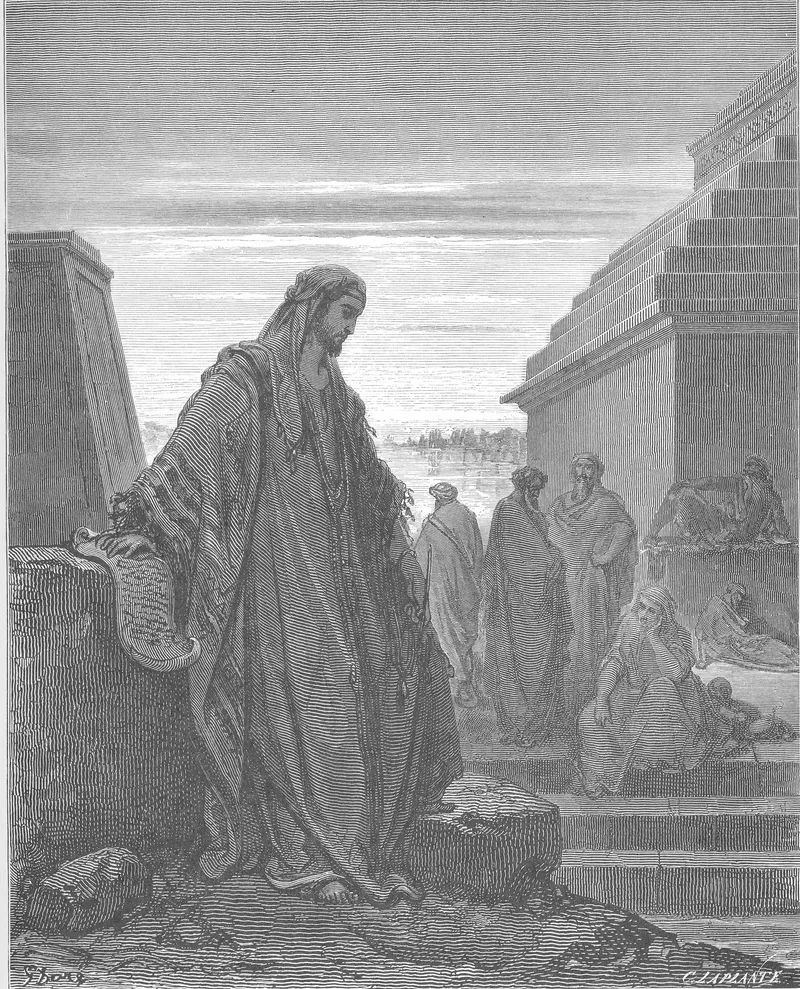
1 Samuel 28:3-7The God Who Would Not Answer
3Now Samuel was dead, and all Israel had lamented him, and buried him in Ramah, even in his own city. And Saul had put away those that had familiar spirits, and the wizards, out of the land. 4And the Philistines gathered themselves together, and came and pitched in Shunem: and Saul gathered all Israel together, and they pitched in Gilboa. 5And when Saul saw the host of the Philistines, he was afraid, and his heart greatly trembled. 6And when Saul enquired of the LORD, the LORD answered him not, neither by dreams, nor by Urim, nor by prophets. 7Then said Saul unto his servants, Seek me a woman that hath a familiar spirit, that I may go to her, and enquire of her. And his servants said to him, Behold, there is a woman that hath a familiar spirit at Endor.
Before the scene can move, the narrator lays down two facts, and they are set side by side on purpose. The first: Samuel was dead, and all Israel had lamented him. The prophet through whom the word of the LORD had come to Saul - who anointed him, who rebuked him, who told him plainly that the kingdom was torn away - is gone, buried in Ramah, mourned by the nation. The living voice of God to the king is silent in the grave.
The second fact is set against it like a mirror: Saul had put away those that had familiar spirits, and the wizards, out of the land. This was the right thing. The law of the LORD had condemned every form of consulting the dead and the hidden powers, and Saul, in a better day, had cleared the land of them. He knew the law; he had even enforced it. That is what makes the next move so dark.
Saul is not a man who stumbles into the forbidden in ignorance. He is a man who knows exactly where the line is - who drew it himself - and who is about to step over it with his eyes open.
The armies gather, and the king who once stood head and shoulders above the people looks out on the Philistine host and breaks. When Saul saw the host of the Philistines, he was afraid, and his heart greatly trembled. This is dread, a heart quaking beneath the armour. And the fear has a deeper source than the size of the army across the valley. Saul is alone. The Spirit of the LORD had long since departed from him; Samuel is dead; David, the man he has hunted for years, is gone over to the very enemy now arrayed before him.
Everything Saul once leaned on has been stripped away, and in the moment he most needs an anchor, he finds he has none. The trembling heart in verse 5 is the outward sign of an inward truth he has spent years building toward: a man who has cut himself off from God, and now must face the worst day of his life with nothing to hold.
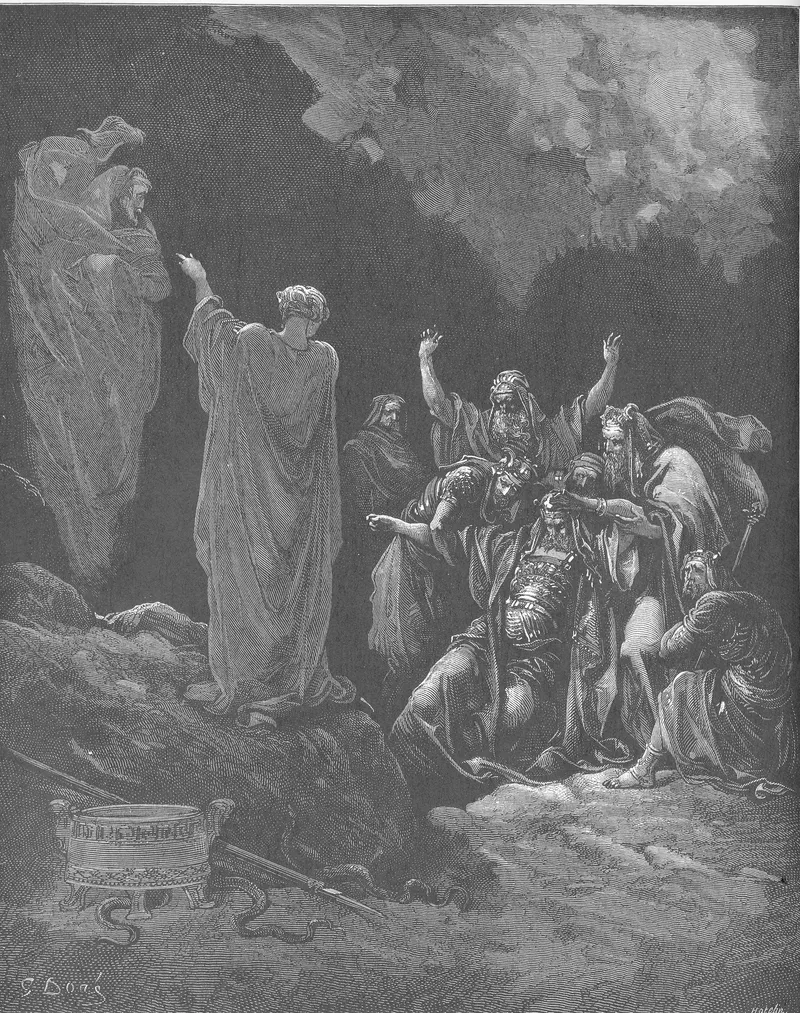
1 Samuel 28:8-14The King at Endor
8And Saul disguised himself, and put on other raiment, and he went, and two men with him, and they came to the woman by night: and he said, I pray thee, divine unto me by the familiar spirit, and bring me him up, whom I shall name unto thee. 9And the woman said unto him, Behold, thou knowest what Saul hath done, how he hath cut off those that have familiar spirits, and the wizards, out of the land: wherefore then layest thou a snare for my life, to cause me to die? 10And Saul sware to her by the LORD, saying, As the LORD liveth, there shall no punishment happen to thee for this thing. 11Then said the woman, Whom shall I bring up unto thee? And he said, Bring me up Samuel.
Everything about how Saul comes to Endor confesses what the visit is. He disguised himself, and put on other raiment - the king strips off the marks of his office and hides who he is. He comes by night, with only two men, around the far side of the valley where the Philistine army is camped. A king consulting a prophet would go in the open, before his people; this man slips into the dark to do a thing he does not want to be seen doing.
There is a kind of judgment in the very disguise. The garments come off in shame - the clothing of a man who knows that what he seeks is forbidden, and who would rather not be recognized doing it. And the request, when it comes, is blunt: divine unto me by the familiar spirit, and bring me him up. The man who cleared the mediums out of the land now asks a medium to do the very thing he had outlawed, his fear having won out over his obedience.
The woman's answer is wary and shrewd. Thou knowest what Saul hath done, how he hath cut off those that have familiar spirits… wherefore then layest thou a snare for my life? She does not know she is speaking to Saul himself, but she knows the king's policy well enough to fear a trap. Hers is the caution of someone who has survived a purge. And Saul's reply is one of the bitterest lines in the chapter: As the LORD liveth, there shall no punishment happen to thee for this thing. He swears by the name of the LORD - as the LORD liveth - to guarantee the safety of a woman in the act of doing what the LORD forbids.
He invokes the living God as surety for breaking the living God's law. It is the contradiction Saul has become, compressed into a single oath: still able to speak the holy name fluently, no longer willing to obey the One who bears it. Then he names the one he wants: not just any voice from the dead, but Samuel - the very prophet whose living word he had so often refused. The man who would not hear Samuel when Samuel was alive now demands to hear him from the grave.
12And when the woman saw Samuel, she cried with a loud voice: and the woman spake to Saul, saying, Why hast thou deceived me? for thou art Saul. 13And the king said unto her, Be not afraid: for what sawest thou? And the woman said unto Saul, I saw gods ascending out of the earth. 14And he said unto her, What form is he of? And she said, An old man cometh up; and he is covered with a mantle. And Saul perceived that it was Samuel, and he stooped with his face to the ground, and bowed himself.
The text reports what happens with a striking economy, and it is worth following exactly what it says and no more. When the woman saw Samuel, she cried with a loud voice. Her cry is a shriek of fright, and in the same breath she sees through Saul's disguise: Why hast thou deceived me? for thou art Saul. Something has occurred that she did not stage and did not expect, and in her alarm the king is suddenly unmasked.
The narrative does not pause to explain the mechanics of what she saw, and neither should we; it simply tells us that the woman cried out in terror and knew, all at once, who her visitor was. What is plain on the surface is that she is frightened by what comes up, and she names her client in the same cry.
Saul asks what she sees, and her answer comes in pieces. First, I saw gods ascending out of the earth - she reaches for a word of awe and otherness for something that unsettles her. Then, pressed for the form, she describes it: An old man cometh up; and he is covered with a mantle. The mantle was the prophet's known garment; the description fits Samuel, and at these words Saul perceived that it was Samuel, and he stooped with his face to the ground, and bowed himself. The chapter tells us exactly that much: an old man, covered with a mantle, and Saul's recognition and prostration.
It does not invite us to settle the deep questions that press in here - how the dead stand in relation to the living, what state the departed are in, by what means this came to pass. Those are matters the text leaves alone, and so will we. What the narrative gives us is the bowed figure of the king, his face to the ground before the one prophet whose living voice he had refused - and the word that prophet is about to speak, which the chapter treats as wholly true, will be the answer Saul came for, and the seal of his doom.
1 Samuel 28:15-19The LORD Is Departed, and Become Thine Enemy
15And Samuel said to Saul, Why hast thou disquieted me, to bring me up? And Saul answered, I am sore distressed; for the Philistines make war against me, and God is departed from me, and answereth me no more, neither by prophets, nor by dreams: therefore I have called thee, that thou mayest make known unto me what I shall do. 16Then said Samuel, Wherefore then dost thou ask of me, seeing the LORD is departed from thee, and is become thine enemy?
The first words spoken are a rebuke at being summoned at all. Whatever else this scene is, it is no comfort to Saul. And Saul's answer is, without his meaning it to be, a confession of the whole tragedy: I am sore distressed; for the Philistines make war against me, and God is departed from me, and answereth me no more, neither by prophets, nor by dreams. Hear what he admits. He knows that God has departed.
He knows the answer is no longer coming through the appointed ways. And his response to God is departed from me is not to fall down and seek the God who has departed - it is to seek a word from the dead instead. That is the heart of it. A man who could say God is departed from me might have wept, repented, sought the LORD's face while there was breath in him. Saul, knowing exactly what has happened, looks everywhere but up.
Therefore I have called thee, he says - as if a word from Samuel could undo what the silence of God had already declared.
The reply lands with terrible logic, and it is a question, not an answer. Why ask me, when the LORD has departed from you? If the LORD Himself has turned against Saul, no word from any other quarter - living or dead - can reverse it. There is no appeal above God; to be at odds with Him is to be beyond the help of anyone else. And the phrase is become thine enemy is the bottom of Saul's long fall.
It is not that God was never near him - the Spirit had once come mightily upon him; he had been anointed, given another heart, set over the people. But the man who persistently refuses the One who chose him does not stay in a neutral middle distance. Persistent refusal turns a relationship. The God Saul would not obey has, by Saul's own long resistance, become the God against whom he now stands. This is the most fearful thing the chapter says, and it is said plainly: the help Saul needs and the foe he faces are now one and the same.
There is nowhere left to turn, because the only One who could save him is the One he made his enemy.
17And the LORD hath done to him, as he spake by me: for the LORD hath rent the kingdom out of thine hand, and given it to thy neighbour, even to David: 18Because thou obeyedst not the voice of the LORD, nor executedst his fierce wrath upon Amalek, therefore hath the LORD done this thing unto thee this day. 19Moreover the LORD will also deliver Israel with thee into the hand of the Philistines: and to morrow shalt thou and thy sons be with me: the LORD also shall deliver the host of Israel into the hand of the Philistines.
The word names the wound where it was first opened. The LORD hath rent the kingdom out of thine hand, and given it to thy neighbour, even to David - this is no new sentence but the carrying-out of one already spoken long before, when Saul was told the kingdom would be given to a neighbour of thine, that is better than thou (1 Sam. 15:28). And the reason is set down without softening: Because thou obeyedst not the voice of the LORD, nor executedst his fierce wrath upon Amalek. The root of the whole ruin reaches back to a single act of partial obedience - a day Saul kept what he was told to destroy and spared what he was told to strike, and called it good.
That failure was not an isolated misstep; it revealed a heart that would obey the LORD only so far as it suited him, and reserve the rest. The sentence pronounced over Saul here is not arbitrary. It is the long, consistent outworking of thou obeyedst not the voice of the LORD - the voice that had spoken clearly, that Saul had heard, and that Saul had declined.
Then the final, unhurried blow: To morrow shalt thou and thy sons be with me. Not in some far-off reckoning - to morrow. The battle is the next day, and the word lays it out: Israel delivered into Philistine hands, the army broken, and Saul and his sons fallen. The phrase be with me is the plainest possible way of saying they will be dead, gathered to where Samuel now is. It is the cruelest answer a desperate man could receive - Saul came seeking a way out of his fear, and was handed instead the exact hour of his death and his sons' deaths.
And yet, terribly, the word is true. Everything it says will come to pass on the morrow's battlefield. This is the answer Saul forced; this is what was waiting at the end of the road he chose when he could not bear the silence. There is no comfort in it, no reprieve, no door left open. He demanded a word, and the word he received was doom. Sometimes the silence of God is itself a mercy, because the judgment, once spoken aloud, is heavier than a man can carry.
1 Samuel 28:20-25Bread Before the Last Night
20Then Saul fell straightway all along on the earth, and was sore afraid, because of the words of Samuel: and there was no strength in him; for he had eaten no bread all the day, nor all the night. 21And the woman came unto Saul, and saw that he was sore troubled, and said unto him, Behold, thine handmaid hath obeyed thy voice, and I have put my life in my hand, and have hearkened unto thy words which thou spakest unto me. 22Now therefore, I pray thee, hearken thou also unto the voice of thine handmaid, and let me set a morsel of bread before thee; and eat, that thou mayest have strength, when thou goest on thy way.
The word breaks him completely. He does not stagger or sink to his knees; he falls his full length, flat on the ground, every bit of strength gone out of him. The text gives a second cause for the collapse beside the terror: there was no strength in him; for he had eaten no bread all the day, nor all the night. The king has not eaten, perhaps fasting in his distress, perhaps simply too consumed by dread to take food, and now the words of doom finish what his fear and hunger began.
There is a grim completeness to the picture. The tall king who once stood above all the people now lies stretched out on the floor of a medium's house, emptied of strength, undone by a sentence he forced from the dark. Everything in this scene is the opposite of how a king should meet the eve of battle. He has no word from God, no courage, no food, no strength - only the certainty, now, that tomorrow is his last day.
And here the chapter turns, unexpectedly, toward gentleness - and it comes from the one person in the room with the least reason to give it. The woman sees the broken king on her floor and comes to him. She first reminds him of the risk she took: thine handmaid hath obeyed thy voice, and I have put my life in my hand, and have hearkened unto thy words. She had done the dangerous thing he asked, trusting his oath.
Now she asks him to listen in return: hearken thou also unto the voice of thine handmaid, and let me set a morsel of bread before thee; and eat, that thou mayest have strength. There is something quietly striking in this. The woman whose trade Saul had outlawed, whom his fear had driven into hiding, who had every reason to want this king gone, looks at the man crumpled on her floor and sees only someone who needs to eat.
She offers him sustenance for the road. It is a small human kindness in a scene otherwise full of darkness - mercy arriving from precisely the quarter Saul would least have looked for it.
23But he refused, and said, I will not eat. But his servants, together with the woman, compelled him; and he hearkened unto their voice. So he arose from the earth, and sat upon the bed. 24And the woman had a fat calf in the house; and she hasted, and killed it, and took flour, and kneaded it, and did bake unleavened bread thereof: 25And she brought it before Saul, and before his servants; and they did eat. Then they rose up, and went away that night.
At first Saul refuses - I will not eat. He is past hunger, past the will to be helped; a man told he will die tomorrow has little appetite tonight. But his servants and the woman together urge him, and at last he hearkened unto their voice. So he arose from the earth, and sat upon the bed. There is a sad irony in that small phrase, he hearkened unto their voice. Saul could not, would not, hearken to the voice of the LORD - the obedience God required he withheld - yet here, emptied and broken, he hearkens to the gentle pressing of a medium and two servants over a morsel of bread.
The will that stood rigid against God bends easily now over something small. And the woman's care is real and costly: she has a fat calf in the house, and she does not stint - she kills it, bakes bread, and sets a full meal before the king and his men. It is the kind of provision one makes for an honored guest, not a fugitive in the night. Whatever this woman was, in this moment she feeds a doomed man with the best she has.
And then the chapter ends as quietly and as darkly as it can: they did eat. Then they rose up, and went away that night. No farewell, no resolution - just men rising from a last meal and going out into the dark. Saul came to Endor by night, and he leaves by night, back toward Gilboa and the army and the morning that the word has already sealed against him. The reader knows what he is walking toward.
The bread he has just eaten is strength for a road with one end. There is something almost unbearably gentle and final in that last line - a condemned king, fed in the darkness, rising to go and meet the doom he has been told is coming. The chapter that began with a trembling heart and a silent heaven ends with footsteps going out into the night. Saul sought a word in the place of the dead, and received it; now he goes to make it true.
Research trail
Sources & further study
These references support the historical, linguistic, manuscript, and contextual notes in this chapter. Scripture remains the primary text; external sources are provided so readers can inspect the research directly.
- 1 Samuel 28 - Translators' NotesThe NET Bible's detailed footnotes on 1 Samuel 28 - the three channels of revelation in verse 6, the meaning of the term behind “familiar spirit,” the geography of Shunem, Gilboa, and Endor, and the difficult clause behind the woman's cry that she saw “gods ascending out of the earth” (v. 13).
- 1 Samuel 28 · Hebrew + classical Jewish commentaryThe Hebrew text of 1 Samuel 28 with Rashi, Radak, and other classical commentators side by side - useful for 'ob (v. 7, the “familiar spirit” the law forbids), for the verb sha'al (v. 6, “enquired”) that stands at the root of Saul's own name, and for the long tradition of reading this night at Endor as the seal on Saul's ruin.
- Art of the Ancient Near East · Heilbrunn TimelineThe Met's survey of the ancient Near Eastern world that frames the scene - the place of divination and consulting the dead in the cultures surrounding Israel, the very practices the law set Israel apart from, and the marks of royal rank Saul laid aside when he disguised himself (v. 8).
- 1 Samuel 28 ↔ Isaiah 8 · Luke 24 · 1 Timothy 2 · Hebrews 1Traces the threads tying Saul's turn from the living God to the dead (vv. 6-7) to Should not a people seek unto their God? for the living to the dead? (Isa. 8:19) and Why seek ye the living among the dead? (Luke 24:5), and the silence Saul met to the open access opened in the one Mediator who is Himself the Word God has spoken (1 Tim. 2:5; Heb. 1:1-2).
Where this echoes in Scripture
The God Who Would Not Answer
- Deuteronomy 18:10-11There shall not be found among you… a consulter with familiar spirits, or a wizard, or a necromancer.The law Saul once enforced and now breaks - the forbidden traffic with the dead, named plainly.
- Isaiah 8:19Should not a people seek unto their God? for the living to the dead?The exact inversion Saul commits - seeking the dead instead of the living God who would have answered.
- 1 Chronicles 10:13-14So Saul died… for asking counsel of one that had a familiar spirit, to enquire of it; And enquired not of the LORD.Scripture's own verdict on this night - the asking was right; he asked of the dead and not of God.
- Hebrews 1:1-2God… hath in these last days spoken unto us by his Son.Against the closed heaven Saul met - the full and final word God has spoken, reachable in His Son.
The King at Endor
- Leviticus 19:31Regard not them that have familiar spirits, neither seek after wizards… I am the LORD your God.The command Saul once kept and now breaks - the line he himself had drawn across the land.
- John 3:20For every one that doeth evil hateth the light… lest his deeds should be reproved.The meaning of Saul's disguise and his coming by night - the instinct to hide what conscience condemns.
- 1 Samuel 15:23For rebellion is as the sin of witchcraft… Because thou hast rejected the word of the LORD, he hath also rejected thee.Samuel's own earlier word to Saul - the rejected word now sought back from the grave.
The LORD Is Departed, and Become Thine Enemy
- Luke 24:5-6Why seek ye the living among the dead? He is not here, but is risen.The dawn answer to Saul's midnight - the living Lord, sought among the dead and found risen.
- 1 Samuel 15:28The LORD hath rent the kingdom of Israel from thee this day, and hath given it to a neighbour of thine, that is better than thou.The sentence first spoken by the living Samuel, now repeated from the grave - already being carried out.
- Isaiah 8:20To the law and to the testimony: if they speak not according to this word, it is because there is no light in them.The light Saul forsook for the dark - the word of God set against every search among the dead.
- Galatians 6:7Be not deceived; God is not mocked: for whatsoever a man soweth, that shall he also reap.The long harvest of “thou obeyedst not the voice of the LORD” - the reaping of years of refusal.
- 1 Timothy 2:5For there is one God, and one mediator between God and men, the man Christ Jesus.The access Saul could not find - the living Mediator, risen and reachable, where Saul met only death.
Bread Before the Last Night
- 2 Samuel 1:6Saul leaned upon his spear; and, lo, the chariots and horsemen followed hard after him.Where the road out of Endor ends - the next day's battlefield, exactly as the word had said.
- Proverbs 1:28-29Then shall they call upon me, but I will not answer… for that they hated knowledge, and did not choose the fear of the LORD.The pattern of Saul's silent heaven - the refused word that cannot be summoned back in the crisis.
- Ezekiel 33:11I have no pleasure in the death of the wicked; but that the wicked turn from his way and live.The door that stood open while Saul lived - the repentance he would not seek, even knowing God had departed.