2 Maccabees 11
People in this chapter
Numbers can lie. Lysias, the regent who governs the empire for a boy king, marches into Judea with eighty thousand foot soldiers, all his cavalry, and eighty war elephants, certain that such a force settles the matter before a blow is struck. He intends to take Jerusalem, fill it with foreigners, and turn the temple into a market where the high priesthood is sold to the highest bidder each year. The one thing he never weighs is the power of God.
Against him stands a far smaller band who know exactly where their strength lies, and who go to their knees before they ever draw a sword.
Tap any highlighted phrase to jump to the commentary that unpacks it.
2 Maccabees 11:1-5A Vast Army That Never Reckoned with God
2Gathered together fourscore thousand men, and all the horsemen, and came against the Jews, thinking to take the city, and make it a habitation of the Gentiles: 3And to make a gain of the temple, as of the other temples of the Gentiles, and to set the high priesthood to sale every year:
Lysias is no minor officer. He is the regent who runs the empire for the young king, a man of the first rank, and he comes against Judea with overwhelming force: eighty thousand foot soldiers, the whole body of cavalry, and a line of war elephants. His aim is total. He means to take Jerusalem and resettle it with foreigners, erasing the people along with their faith. When power decides to crush something, it rarely thinks small.
The reader is meant to feel the weight bearing down on a tiny resistance, so that what comes next will be unmistakably the work of God and not of armies.
His plan for the temple lays bare what he worships. He intends to treat the house of God like any pagan shrine, a property to be milked for revenue, and to auction the high priesthood year by year to whoever will pay. The holy place becomes, in his imagination, a line item. This is the deeper assault, deeper than the swords and elephants. It is the attempt to price what is sacred, to reduce the worship of the living God to a transaction.
Throughout Scripture this is the surest sign of a heart at war with heaven: it cannot tell the difference between what is holy and what is for sale.
4Never considering the power of God, but puffed up in mind, and trusting in the multitude of his foot soldiers, and the thousands of his horsemen, and his fourscore elephants.
Here is the hinge of the whole chapter, and the verdict the writer wants us to remember. Lysias is "puffed up in mind," swollen with the size of his own forces, and in all his careful counting he never once considers the power of God. He tallies the soldiers, the horsemen, the elephants, every factor a general weighs, and leaves out the only One who decides the outcome. This is the oldest miscalculation there is.
Pharaoh made it at the sea; Goliath made it in the valley; Sennacherib made it at the gates of Jerusalem. To trust in the multitude and forget the Maker of multitudes is to have already lost a battle you think you cannot lose.
2 Maccabees 11:6-10They Prayed for a Good Angel, and Heaven Answered
6But when Machabeus and they that were with him, understood that the strong holds were besieged, they and all the people besought the Lord with lamentations and tears, that he would send a good angel to save Israel.
This is the heart of the matter, and it is why the smaller side wins. Faced with a force that should have ended them, Judas and the whole people do the one thing Lysias never thought to do: they turn to God. They beseech Him with lamentations and tears, and their prayer is specific. They ask Him to send a good angel to save Israel. They do not ask first for a bigger army or a better strategy.
They ask for heaven to act on their behalf. The contrast with the previous verses could not be sharper. One side counts elephants; the other side weeps before the Lord and asks Him to send His help.
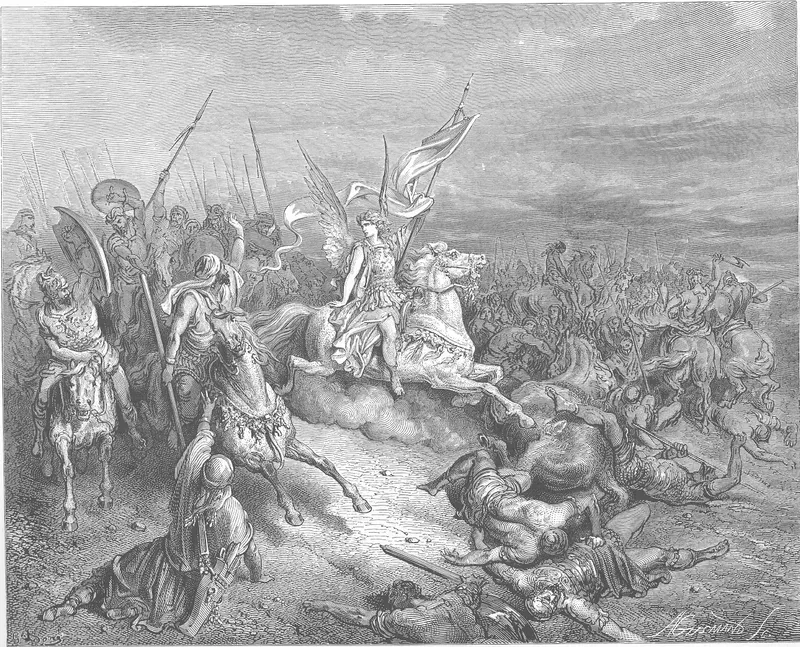
7Then Machabeus himself, first taking his arms, exhorted the rest to expose themselves together with him, to the danger, and to succour their brethren. 8And when they were going forth together with a willing mind, there appeared at Jerusatem a horseman going before them in white clothing, with golden armour, shaking a spear.
Prayer fills Judas with urgency. He is the first to take up his arms, the first to expose himself to danger, and he calls the rest to follow him into the fight for their brethren. They go forth "with a willing mind," ready to spend their lives. This is the shape of real faith in Scripture. It cries to God for deliverance and then steps out as though the answer is already coming, leading from the front.
The prayer for a good angel and the courage to charge are one trust, expressed first on the knees and then on the field.
As they march out, the prayer is answered in front of their eyes. A horseman appears at the head of the army, clothed in white, armed in gold, brandishing a spear, going before them into the danger. This is the good angel they begged for, the visible sign that heaven has taken the field. He does not merely watch from above; he rides at the front, leading the charge. Scripture has shown this figure before, the commander of the Lord's host who appears with a drawn sword as Israel goes into battle, the messenger who fights for God's people when they are too few to win.
The God who was left out of Lysias's count has put His own captain at the front of the line.
9Then they all together blessed merciful Lord, and took great courage, being ready to break through not only men, but also the fiercest beasts, walls of iron. 10So they went on courageously, having a helper from Peaven, and the who shewed mercy to them.
The sight of the heavenly rider makes them brave. They bless the merciful Lord and take such courage that they are ready to break through men, the fiercest beasts, and walls of iron. The elephants that were meant to terrify them no longer hold any power over their hearts. This is what the nearness of God does in a believing people. It does not remove the danger, the army and the beasts are still there, but it changes the soul that faces them, turning fear into a courage that would charge a wall of iron.
The writer states the cause plainly so no one will mistake it: they went on courageously "having a helper from heaven, and the Lord who shewed mercy to them." The victory about to come is credited where it belongs. The genius of Judas and the valor of his men were real, and the Lord who showed them mercy was the decisive power behind them all. The whole episode is built to teach a single lesson by contrast. Lysias trusted the multitude and forgot God. Israel had almost no multitude and remembered God, and a helper from heaven made the difference.
2 Maccabees 11:11-15Lions in the Field, and a Regent Who Learns the Truth
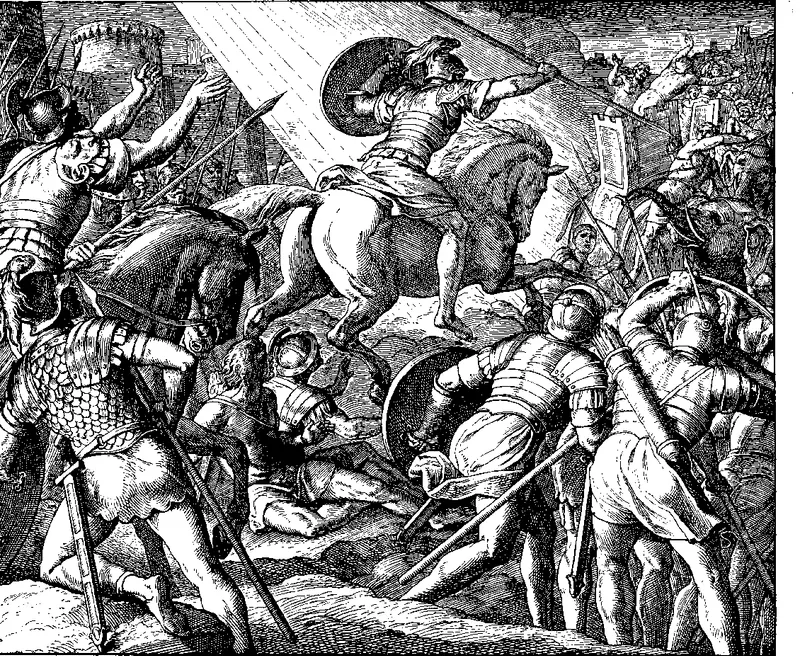
11And rushing violently upon the my, like lions, they slew of them eleven thousand footmen, and one thousand hundred horsemen: 12And put all the rest to flight: many of them being wounded, escaped naked: yea and Lysias himself fled away shamefully, and escaped.
The charge of the small band is described with a single fierce image: they rush upon the enemy like lions. The numbers that follow tell the scale of what happened. Eleven thousand foot soldiers and sixteen hundred horsemen fall, and the rest of that enormous army breaks and runs. The force that came to make Jerusalem a habitation of strangers is shattered by the people it meant to erase. The writer wants the reader to feel the reversal completely, the few become lions, the many become fugitives, and the helper from heaven is the reason.
The humiliation reaches all the way to the top. Lysias, the regent who counted his elephants and never counted God, flees the field "shamefully," running with the remnant of a broken army. The man who came to sell the high priesthood and price the temple escapes with nothing but his life. There is a sober justice in it. The pride that was "puffed up in mind" is deflated in the most public way, on the same field where he expected an easy conquest.
Scripture is full of this pattern: the proud who set themselves against God and His people are brought low in the end, often by the very thing they were so sure of.
13And as he was a man of understanding considering with himself, the loss he had suffered, and perceiving that the Hebrews could not be overcome, because they relied upon the help of the Almighty God, he sent to them: 14And promised that he would agree to all things that are just, and that he would persuade the king to be their friend.
What happens next in Lysias is remarkable. He is called "a man of understanding," and his understanding leads him to the right conclusion. Turning the defeat over in his mind, he perceives the real reason he lost: the Hebrews could not be overcome because they relied on the help of the Almighty God. The pagan regent reads the battle correctly. He sees that the God his enemies trusted was the power that decided it. This is the same lesson the reader has been learning all along, now confessed by the man who came to crush them.
Even those who do not worship the Lord can be made to recognize His hand.
Understanding becomes action. Lysias sends to the Jews, promises to grant everything that is just, and pledges to persuade the king himself to become their friend. The man who marched in to make war now sues for peace and offers to advocate for them at the highest level. The battlefield victory turns into a diplomatic one. God's deliverance is not only the rout of an army; it is the turning of an enemy's heart and the opening of a door to peace that no human negotiation could have forced.
The helper from heaven wins on the field and at the council table alike.
2 Maccabees 11:16-26Letters of Peace and the Temple Given Back
23Our father being translated amongst the gods, we are desirous that they that are in our realm should live quietly, and apply themselves diligently to their own concerns, 24And we have heard that the Jews would not consent to my father to turn to the rites of the Greeks, but that they would keep to their own manner of living, and therefore that they request us to allow them to live after their own laws.
The chapter now shifts from the battlefield to the writing desk, preserving a remarkable cluster of letters. The young king, in whose name Lysias governs, refers to his late father as "translated amongst the gods," the customary court flattery of a culture that deified its dead rulers. The reader hears, just under those words, how far the empire's view of heaven is from the truth Israel confesses. Yet even this king now wants the realm at peace and his subjects free to attend to their own affairs.
The proud machinery that came to crush a people has, in the space of a chapter, decided that letting them live quietly is the wiser course.
The king acknowledges the very thing the persecution had tried to stamp out. The Jews would not consent to abandon the law of their fathers and adopt the rites of the Greeks, and now he grants them leave to live after their own laws. The faithfulness that cost so much, the refusal to give up the worship of the living God even under threat of death, is here vindicated in writing by the empire itself.
What looked like stubbornness to the persecutor is honored as the people's right. Endurance under pressure has won not only a battle but a charter.
25Wherefore being desirous that this nation also should be at rest, we have ordained and decreed, that the temple should be restored to them, and that they may live according to the custom of their ancestors.
Here is the great reversal of the chapter, set down in a royal decree. Lysias marched in to "make a gain of the temple" and sell its priesthood; now the king ordains that the temple be restored to the Jews and that they live according to the custom of their ancestors. The house of God, which the regent meant to price and plunder, is given back by the very throne that threatened it. What was seized is returned; what was profaned is to be holy again.
This is how God often works His deliverance: He does not merely halt the harm but reverses it, restoring to His people what the enemy had set out to take.
2 Maccabees 11:27-38Safe Conduct, and the Watching Nations
30We grant therefore a safe conduct to all that come and go, until the thirtieth day of the month of Xanthicus, 31That the Jews may use their own Bind of meats, and their own laws as before, and that none of them any manner of ways be molested for things which have been done by ignorance.
The king's letter to the people themselves grants a safe conduct, a guarantee of protection, to all who come and go. After the terror of siege and the threat of a city emptied of its own, the people are now promised safety on the roads. The change is total. The empire that sent an army to destroy them now issues a pledge to keep them safe. Peace, in Scripture, is not merely the absence of fighting; it is the gift of being able to live and move without fear.
That gift, won by a helper from heaven, is now written into the king's own hand.
The decree goes further still, granting the Jews the free use of their own food and their own laws as before, and an amnesty so that none of them will be harmed for what was done in the time of conflict. The persecuted are not only spared; they are freed to live fully as the people of God, restored to their customs and shielded from reprisal. This is the wide, generous shape of the deliverance God works.
He opens the way for them to flourish in the open, worshiping as they were given to worship, secure under a peace they could never have demanded.
34The Romans also sent them a letter, to this effect. Quintus Memmius, and Titus Manilius, ambassadors of the Romans, to the people of the Jews, greeting. 35Whatsoever Lysias the king’s cousin hath granted you, we also have granted.
A fourth letter arrives from an unexpected quarter. The Romans, a rising power far beyond Judea, send their own ambassadors to greet the people of the Jews. The deliverance God worked in one small corner has drawn the attention of the watching nations. What began as a local resistance against a regent's army has become a matter noticed at the level of empires. Scripture often shows that when God acts for His people, the news travels; the wider world takes account of the God who fights for them, even when it does not yet know His name.
The Romans confirm everything Lysias has granted and add their own pledge of support, promising to take up whatever should be referred to the king. The small nation that was nearly wiped out now has its rights guaranteed by two powers at once.
From a desperate prayer for a good angel to the protection of empires, the whole movement bears one signature, the help of the Almighty God, whom Lysias forgot to count.
Where this echoes in Scripture
A Vast Army That Never Reckoned with God
- 2 Chronicles 14:11LORD, it is nothing with thee to help, whether with many, or with them that have no power: help us, O LORD our God; for we rest on thee, and in thy name we go against this multitude.Asa names exactly what Lysias forgot: with God, numbers are nothing.
- 1 Samuel 17:45Thou comest to me with a sword, and with a spear, and with a shield: but I come to thee in the name of the LORD of hosts.David counts the one factor Goliath ignored.
- Psalm 20:7Some trust in chariots, and some in horses: but we will remember the name of the LORD our God.The contrast between trusting the multitude and trusting the Lord.
They Prayed for a Good Angel, and Heaven Answered
- Joshua 5:13-14There stood a man over against him with his sword drawn in his hand... as captain of the host of the LORD am I now come.The commander of the Lord's host appears, sword drawn, as Israel goes to battle.
- 2 Kings 19:35And it came to pass that night, that the angel of the LORD went out, and smote in the camp of the Assyrians.A good angel sent against a vast army, the very thing Israel prays for here.
- 2 Kings 6:17And the mountain was full of horses and chariots of fire round about Elisha.The unseen armies of heaven, made visible to those who trust the Lord.
Lions in the Field, and a Regent Who Learns the Truth
- Revelation 19:11And I saw heaven opened, and behold a white horse; and he that sat upon him was called Faithful and True.The Rider in white at the final victory, of whom this horseman is a faint foreshadow.
- Proverbs 21:1The king's heart is in the hand of the LORD, as the rivers of water: he turneth it whithersoever he will.God turns the heart of Lysias from war to a suit for peace.
- 2 Chronicles 32:21And the LORD sent an angel, which cut off all the mighty men of valour... So he returned with shame of face to his own land.A proud commander brought low and sent home in shame, as Lysias is here.
Letters of Peace and the Temple Given Back
- Joel 2:25And I will restore to you the years that the locust hath eaten.God's way of deliverance: not only stopping the harm but restoring what was lost.
- Ezra 6:7Let the work of this house of God alone... let them build this house of God in his place.A pagan king again decreeing that the house of God be restored to His people.
- Daniel 3:28-29Blessed be the God of Shadrach, Meshach, and Abednego... that they might not serve nor worship any god, except their own God.A king moved to honor the faithful who would not abandon their God.
Safe Conduct, and the Watching Nations
- Genesis 50:20But as for you, ye thought evil against me; but God meant it unto good.The long arc by which God turns an assault into deliverance.
- Psalm 126:1-2When the LORD turned again the captivity of Zion... then said they among the heathen, The LORD hath done great things for them.The watching nations take note of what God does for His people.
- Romans 8:31If God be for us, who can be against us?The single truth the whole chapter dramatizes, from siege to safe conduct.