2 Kings 6
People in this chapter
A borrowed axe-head sinks in the Jordan, and Elisha makes iron float. A Syrian army surrounds him at Dothan, and his terrified servant wakes to a hillside packed with horses and chariots of fire. They that be with us are more than they that be with them. The same prophet who recovers a workman's lost tool can see the armies of heaven that no spy network will ever map.1
Tap any highlighted phrase to jump to the commentary that unpacks it.
2 Kings 6:1-7The Floating Axe-Head
1And the sons of the prophets said unto Elisha, Behold now, the place where we dwell with thee is too strait for us. 2Let us go, we pray thee, unto Jordan, and take thence every man a beam, and let us make us a place there, where we may dwell. And he answered, Go ye. 3And one said, Be content, I pray thee, and go with thy servants. And he answered, I will go.
The company of the prophets has grown too large for the place where they meet with Elisha, so they set out together for the Jordan to cut timber for a larger dwelling, and they ask him to come along.213
4So he went with them. And when they came to Jordan, they cut down wood. 5But as one was felling a beam, the axe head fell into the water: and he cried, and said, Alas, master! for it was borrowed. 6And the man of God said, Where fell it? And he shewed him the place. And he cut down a stick, and cast it in thither; and the iron did swim. 7Therefore said he, Take it up to thee. And he put out his hand, and took it.
An axe-head is small, ordinary, a tool for work that slips from tired hands the way tools do. No kingdom turns on it. But watch where Elisha's attention goes. He does not wave the loss away with it is only an axe. He asks where it fell. He acts. He gets it back. The power of God here does not stay up among battles and thrones. It stoops to a borrowed tool and the tears of an honest man.
The word "borrowed" carries moral weight. The man who loses the axe does not own it. He is accountable to another. His cry - "Alas, master!" - is the cry of someone bound by obligation, bound by honesty. And Elisha hears it. God hears the burden of those who have borrowed and lost.
2 Kings 6:8-12The King's Bedchamber is Betrayed
8Then the king of Syria warred against Israel, and took counsel with his servants, saying, In such and such a place shall be my camp. 9And the man of God sent unto the king of Israel, saying, Beware that thou pass not such a place; for thither the Syrians are come down. 10And the king of Israel sent to the place which the man of God told him and warned him of, and saved himself there, not once nor twice. 11Therefore the heart of the king of Syria was sore troubled for this thing; and he called his servants, and said unto them, Will ye not shew me which of us is for the king of Israel? 12And one of his servants said, None, my lord, O king: but Elisha, the prophet that is in Israel, telleth the king of Israel the words that thou speakest in thy bedchamber.
Again and again the trap is laid, and again and again the king of Israel walks clear of it because a prophet two valleys away told him where not to stand. Elisha works in a register no spy network can touch. He names the ambush before the armies have finished pitching camp. The king of Israel is living inside a string of escapes he did nothing to earn and cannot account for - rescued on a margin he never sees coming.
When the king of Syria realizes his plans are always discovered, he does not think first of God. He thinks of traitors. Someone in his household is feeding intelligence to Israel. He summons his servants and demands to know who among them is disloyal. But the truth is far stranger than a spy: a prophet of Israel is hearing the very words spoken in the Syrian king's private chambers.
The word "bedchamber" speaks to the most private, intimate space - where a man speaks to those closest to him, unguarded. It is where he lays bare his strategies, his fears, his schemes. Yet Elisha knows. There is nowhere to hide from the prophet whose ear is attuned to the voice of God. Privacy, in the presence of such a word, becomes a false refuge.
2 Kings 6:13-17The Eyes of the Servant Are Opened
13And he said, Go and spy where he is, that I may send and fetch him. And it was told him, saying, Behold, he is in Dothan. 14Therefore sent he thither horses, and chariots, and a great host: and they came by night, and compassed the city about. 15And when the servant of the man of God was risen early, and gone forth, behold, an host compassed the city both with horses and chariots. And his servant said unto him, Alas, my master! how shall we do? 16And he answered, Fear not: for they that be with us are more than they that be with them. 17And Elisha prayed, and said, LORD, I pray thee, open his eyes, that he may see. And the LORD opened the eyes of the young man; and he saw: and, behold, the mountain was full of horses and chariots of fire round about Elisha.
Two men stand on the same wall and see two different worlds. The servant counts the Syrian host and does the only math fear knows. Elisha is not comforting him with a lie - he never claims the army is absent. He simply refuses to stop counting where the servant stopped. There is a second host on that hill, more real than the one with the spears, and the prophet has been living off that fact all along.
Elisha hands his servant a piece of arithmetic that breaks every rule the eye obeys: they that be with us are more than they that be with them. By the visible count it is plainly false - two men against a army. He says it anyway, and he is right, because he is counting a host the servant has not been shown. The deciding numbers in this scene were never on the slope with the spears. They were on the slope with the fire.
The young man's eyes were never shut. He had been staring at the army all morning; the problem was never his sight but the size of what his sight admitted. So Elisha does not pray for information - he prays for perception, for the veil to lift on what is already standing there. It is worth sitting with how small that prayer is. Not change the situation, only let him see it. The same prayer fits most of your fearful mornings exactly.
The servant's vision is now expanded. He sees what Elisha has known all along: the mountain is full of horses and chariots of fire. These are not Elisha's chariots - they are the chariots of God, the invisible host that surrounds and protects the faithful. The supernatural world is more densely populated than the natural world, and more real.
2 Kings 6:18-23Bread and Water for Enemies
18And when they came down to him, Elisha prayed unto the LORD, and said, Smite this people, I pray thee, with blindness. And he smote them with blindness according to the word of Elisha. 19And Elisha said unto them, This is not the way, neither is this the city: follow me, and I will bring you to the man whom ye seek. But he led them to Samaria. 20And it came to pass, when they were come into Samaria, that Elisha said, LORD, open the eyes of these men, that they may see. And the LORD opened their eyes, and they saw; and, behold, they were in the midst of Samaria. 21And the king of Israel said unto Elisha, when he saw them, My father, shall I smite them? shall I smite them? 22And he answered, Thou shalt not smite them: wouldest thou smite those whom thou hast taken captive with thy sword and with thy bow? set bread and water before them, that they may eat and drink, and go to their master.
When the Syrian army arrives in Samaria, they are still blind. Elisha again prays, and again the Lord opens eyes - this time, the opened eyes see their own vulnerability. They are surrounded by an Israeli army. They have walked into a city they came to conquer, now utterly at the mercy of the king they pursued.
The king has his sword half-drawn before he finishes asking; he says it twice, eager. Every rule of war is on his side - these men marched here to kill him. Elisha overrules all of it with a banquet. Feed them, water them, walk them home to their master untouched. It is an answer from another country entirely, where an enemy at your mercy is a person you can disarm by kindness. The bands of Syria came no more, and a feast of bread ended the raids.
This passage echoes an ancient call in Scripture: "If thine enemy hunger, feed him; if he thirst, give him drink: for in so doing thou shalt heap coals of fire on his head" (Romans 12:20). The mercy here is a radical reckoning. By showing kindness to those bent on your destruction, you transform the encounter. You refuse to meet hatred with hatred. You offer the enemy the opportunity to become something other than an enemy.
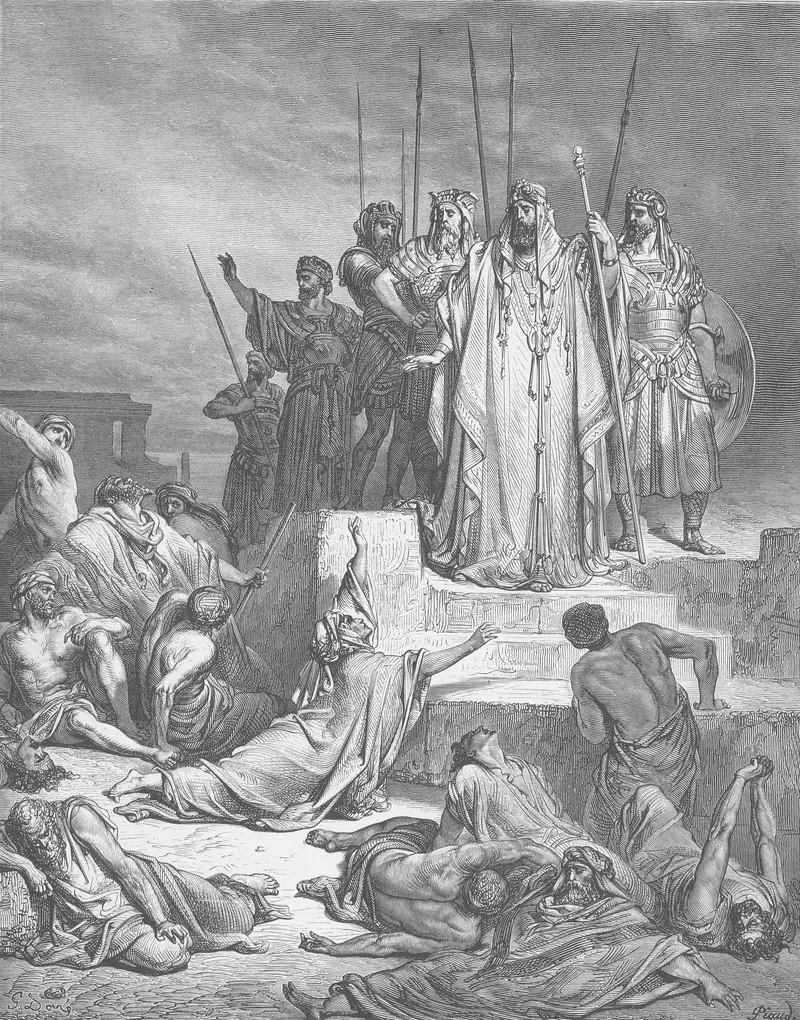
2 Kings 6:24-33The Curse Descends: Famine and Cannibalism
24And it came to pass after this, that Benhadad king of Syria gathered all his host, and went up, and besieged Samaria. 25And there was a great famine in Samaria: and, behold, they besieged it, until an ass’s head was sold for fourscore pieces of silver, and the fourth part of a cab of dove’s dung for five pieces of silver. 26And as the king of Israel was passing by upon the wall, there cried a woman unto him, saying, Help, my lord, O king. 27And he said, If the LORD do not help thee, whence shall I help thee? out of the barnfloor, or out of the winepress?
The siege brings famine; the king tears his clothes - despair rises, but deliverance is on the horizon.
28And the king said unto her, What aileth thee? And she answered, This woman said unto me, Give thy son, that we may eat him to day, and we will eat my son to morrow. 29So we boiled my son, and did eat him: and I said unto her on the next day, Give thy son, that we may eat him: and she hath hid her son. 30And it came to pass, when the king heard the words of the woman, that he rent his clothes; and he passed by upon the wall, and the people looked, and, behold, he had sackcloth within upon his flesh. 31Then he said, God do so and more also to me, if the head of Elisha the son of Shaphat shall stand on him this day. 32But Elisha sat in his house, and the elders sat with him; and the king sent a man from before him: but ere the messenger came to him, he said to the elders, See ye how this son of a murderer hath sent to take away mine head? look, when the messenger cometh, shut the door, and hold him fast at the door: is not the sound of his master’s feet behind him?
The famine is so severe that an ass's head - an animal considered unclean, worthy only for garbage - sells for eighty pieces of silver. Dove's dung, which has no nutritional value, is bought as food. The city has reached a point of absolute want. There is nothing left to eat but the unclean, the worthless, the inedible. The hierarchy of food has collapsed entirely.
Two women make a covenant of desperation: they will boil and eat their own children. One woman does so, feeding her own son to hunger. The next day, she expects the other woman to do the same. But the other woman has hidden her son. The covenant is broken. The first woman cries out to the king for justice against this treachery - as though the crime is the violation of the compact, with no accounting for the child. This is what famine does: it inverts all categories of right and wrong. It makes the unthinkable not merely possible but negotiable.
This horror is not incidental to the 2 Kings 6 narrative. It is the fulfillment of a curse explicitly named in Deuteronomy 28:53-57: "Thou shalt eat the fruit of thine own body, the flesh of thy sons and of thy daughters... thou shalt eat it in the siege, and in the straitness, wherewith thine enemies shall distress thee." The covenant curses have come upon Israel. This is judgment, exactly as promised.
When the king hears the woman's testimony, he tears his clothes. The gesture is the same one David made when he wept for Saul. But here, the tearing is an outward sign of an inward collapse. The king is wearing sackcloth beneath his robes - a sign of mourning, of repentance. Yet his first response to the horror is anger. He blames Elisha. He vows to kill the prophet.
2 Kings 6:32-33The King Seeks the Prophet's Death
32But Elisha sat in his house, and the elders sat with him; and the king sent a man from before him: but ere the messenger came to him, he said to the elders, See ye how this son of a murderer hath sent to take away mine head? look, when the messenger cometh, shut the door, and hold him fast at the door: is not the sound of his master’s feet behind him? 33And while he yet talked with them, behold, the messenger came down unto him: and he said, Behold, this evil is of the LORD; what should I wait for the LORD any longer?
The messenger arrives before the king, carrying news of the siege. His first words reveal despair: "This evil is of the Lord; what should I wait for the Lord any longer?" The king has reached the place of giving up. He cannot see beyond the walls of Samaria. He cannot see beyond the famine. He cannot see beyond his own empty hands.
But Elisha hears. And Elisha speaks. Even in the midst of the king's despair, a word comes: "To morrow about this time shall a measure of fine flour be sold for a shekel." Abundance is coming. The reversal is not far off. But the king cannot hear it yet. A messenger will scoff at this word. An officer will be trampled in the gate. And Israel will learn - again - that the word of the Lord stands, even when all visible hope is gone.
Research trail
Sources & further study
These references support the historical, linguistic, manuscript, and contextual notes in this chapter. Scripture remains the primary text; external sources are provided so readers can inspect the research directly.
- Elisha: Miracles and MinistryElisha's role as prophet in Israel's northern kingdom during the period of decline.
- Elisha the ProphetElisha's ministry of miraculous healing and prophecy succeeding Elijah.
- Archaeology of Northern KingdomExcavation evidence for cities and settlements in the northern kingdom of Israel.
Where this echoes in Scripture
The Eyes of the Servant Are Opened
- John 9:1-7He anointed the eyes of the blind man with the clay… he went his way therefore, and washed, and came seeing.Jesus opens eyes that never worked - the visible sign of the deeper sight He gives.
- Luke 24:30-31And their eyes were opened, and they knew him; and he vanished out of their sight.At Emmaus the risen Christ was present the whole walk before they were given to see Him.
- Acts 9:17-18There fell from his eyes as it had been scales: and he received sight forthwith.Saul, blinded on the Damascus road, is given a new way of seeing along with a new Lord.
- Matthew 5:8Blessed are the pure in heart: for they shall see God.The sight that matters most is promised to the pure in heart.
- 2 Corinthians 4:18While we look… at the things which are not seen: for the things which are seen are temporal; but the things which are not seen are eternal.Paul names the servant's lesson as the ordinary posture of faith.
The King Seeks the Prophet's Death
- Isaiah 55:11So shall my word be… it shall not return unto me void, but it shall accomplish that which I please.God's word carries its own guarantee of arrival, regardless of conditions.
- John 6:10-13Make the men sit down… And Jesus took the loaves; and when he had given thanks, he distributed.The One who is the Bread of life satisfies a crowd before a single loaf is multiplied.
- 2 Kings 7:1-2Thou shalt see it with thine eyes, but shalt not eat thereof.The very next scene shows the word fulfilled overnight - and the scoffer shut out of it.
- Numbers 23:19Hath he said, and shall he not do it? or hath he spoken, and shall he not make it good?A promise from God is treated as already accomplished.