Amos 1
People in this chapter
A shepherd from a hard little village south of Jerusalem opens his mouth, and the first thing out is not an argument but a sound: The LORD will roar from Zion (v. 2). The roar of a lion. Then it falls, nation by nation around the horizon - Damascus, Gaza, Tyre, Edom, Ammon - each with the same verdict: For three transgressions… and for four, I will not turn away the punishment thereof. The crimes are named without flinching. Threshing a conquered people with iron. Trafficking whole towns into slavery. Ripping open pregnant women to widen a border.1
Tap any highlighted phrase to jump to the commentary that unpacks it.
Amos 1:1-5The LORD Will Roar From Zion
1The words of Amos, who was among the herdmen of Tekoa, which he saw concerning Israel in the days of Uzziah king of Judah, and in the days of Jeroboam the son of Joash king of Israel, two years before the earthquake. 2And he said, The LORD will roar from Zion, and utter his voice from Jerusalem; and the habitations of the shepherds shall mourn, and the top of Carmel shall wither. 3Thus saith the LORD; For three transgressions of Damascus, and for four, I will not turn away the punishment thereof; because they have threshed Gilead with threshing instruments of iron: 4But I will send a fire into the house of Hazael, which shall devour the palaces of Benhadad. 5I will break also the bar of Damascus, and cut off the inhabitant from the plain of Aven, and him that holdeth the sceptre from the house of Eden: and the people of Syria shall go into captivity unto Kir, saith the LORD.
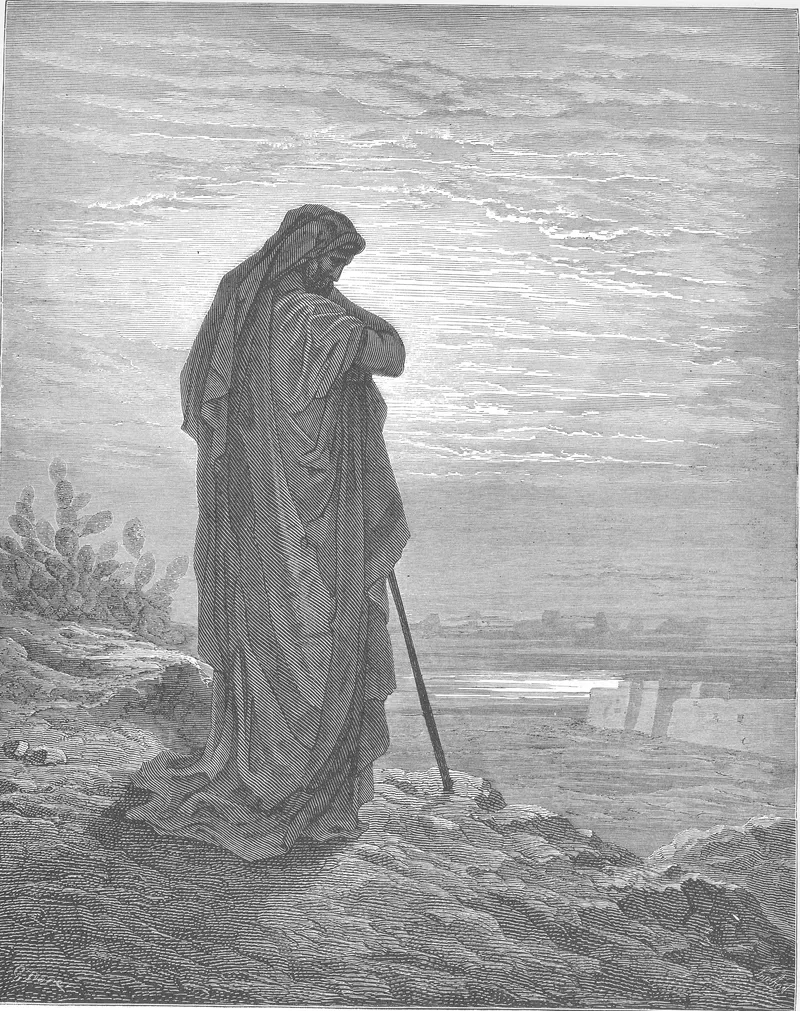
The book introduces its prophet with disarming plainness (v. 1). No royal title, no priestly lineage, just a name and a hometown: Amos, one of the herdmen of Tekoa. Tekoa was a rough town on the edge of the Judean wilderness, south of Jerusalem, where the cultivated land gives way to barren hills and scrub. Amos was no temple official, no member of a prophetic guild - later in the book he will say outright that he was no prophet… nor a prophet's son, but a herdman and a tender of sycomore fruit whom the LORD took from following the flock.
That ordinariness matters. The word he carries does not gain its weight from his pedigree; it gains its weight from the One who gave it. The dating is just as concrete: in the days of Uzziah king of Judah, and in the days of Jeroboam the son of Joash king of Israel, two years before the earthquake. This was a season of prosperity and military success for both kingdoms - exactly the kind of comfortable hour in which a hard word is least welcome.
And the earthquake fixes the moment so firmly in memory that, generations later, the prophet Zechariah still measured time by it. Amos speaks into a confident, well-fed world that has no idea a roar is coming.1
The first word out of the prophet's mouth is not a complaint or a sermon. It is a sound. The verb behind roar (v. 2) is the roar of a lion, and it sets the key for the entire book. A lion's roar is not a request; it is the announcement of a predator already in motion, the sound that freezes everything that hears it. So the LORD's voice goes out from Zion, and the effect runs from one end of the land to the other.
The habitations of the shepherds - the green pastures where flocks graze - turn to mourning; and the top of Carmel, the lush headland by the sea famous for its fertility, withers. From the lowest meadow to the highest fruitful slope, the whole land feels it. There is a quiet irony in a herdman delivering this line: the man who knows what a lion's roar does to a flock is the one announcing that the LORD has begun to roar.
The point is not yet why God roars, but that He does - that the God of Jerusalem is awake, has seen, and is about to speak.
With the third verse the roar takes shape, and the first nation in the circle is Damascus, capital of Syria to the northeast. The charge against her is a war crime described in the language of the threshing floor (v. 3). To thresh grain, a farmer dragged a heavy sledge studded with iron teeth back and forth over the cut stalks until the kernels were beaten loose. Amos says Syria did this to Gilead - to a region full of people.
It is the image of a conquered population crushed under iron deliberately, methodically, as a man threshes a field. The sentence is fire and exile: I will send a fire into the house of Hazael, which shall devour the palaces of Ben-hadad (v. 4), the royal dynasty that had pressed hardest against Israel; I will break… the bar of Damascus, the great beam that locked the city gate, leaving it defenseless; and the people would go into captivity unto Kir (v. 5), uprooted from their land just as they had uprooted others.
The crime was cruelty without mercy; the judgment answers in kind.
Amos 1:6-10Gaza and Tyre · The Brotherly Covenant
6Thus saith the LORD; For three transgressions of Gaza, and for four, I will not turn away the punishment thereof; because they carried away captive the whole captivity, to deliver them up to Edom: 7But I will send a fire on the wall of Gaza, which shall devour the palaces thereof: 8And I will cut off the inhabitant from Ashdod, and him that holdeth the sceptre from Ashkelon, and I will turn mine hand against Ekron: and the remnant of the Philistines shall perish, saith the Lord GOD. 9Thus saith the LORD; For three transgressions of Tyrus, and for four, I will not turn away the punishment thereof; because they delivered up the whole captivity to Edom, and remembered not the brotherly covenant: 10But I will send a fire on the wall of Tyrus, which shall devour the palaces thereof.
The circle swings now to the southwest coast and the Philistine cities, and the charge against Gaza is the slave trade in its coldest form (v. 6). The phrase the whole captivity means entire communities - not soldiers taken in war, but populations rounded up wholesale, men, women, and children together, and sold on to Edom to be trafficked further. Gaza was a hub of this commerce, growing rich by turning human beings into merchandise. The sentence falls on the whole Philistine confederacy, named city by city: fire on the wall of Gaza, the ruler cut off from Ashdod and Ashkelon, the LORD's hand turned against Ekron, until the remnant of the Philistines shall perish (vv. 7-8).
This was a settled industry of cruelty, the deliberate and profitable reduction of people to property. And the word closes with a title the prophet uses with weight: saith the Lord GOD, the Sovereign over every market and every border, who has seen the ledgers in which lives were bought and sold.
Tyre, the great Phoenician trading city to the northwest, is charged with the same trafficking as Gaza - they delivered up the whole captivity to Edom - but with a sharp addition: and remembered not the brotherly covenant (v. 9). This is the crime made worse by broken faith. Tyre and Israel had long enjoyed a relationship of treaty and friendship; in the days of David and Solomon, Hiram king of Tyre had been called a brother, and the two peoples had sworn bonds of mutual goodwill.
To traffic the people of a covenant partner was cruelty deepened by treachery - the betrayal of a sworn brotherhood for profit. Amos names that betrayal precisely: they remembered not the covenant of brothers. There is a particular ugliness in cruelty that violates trust, in turning on those to whom one is bound by promise. God notices not only the act but the broken word behind it. The fire that comes on Tyre's wall (v. 10) answers a people who decided that a sworn bond was worth less than a slaver's payment.
The lesson runs ahead of its setting: faithfulness to one's word, especially toward those one is bound to protect, is something the LORD Himself guards.
Amos 1:11-15Edom and Ammon · Pity Cast Off
11Thus saith the LORD; For three transgressions of Edom, and for four, I will not turn away the punishment thereof; because he did pursue his brother with the sword, and did cast off all pity, and his anger did tear perpetually, and he kept his wrath for ever: 12But I will send a fire upon Teman, which shall devour the palaces of Bozrah. 13Thus saith the LORD; For three transgressions of the children of Ammon, and for four, I will not turn away the punishment thereof; because they have ripped up the women with child of Gilead, that they might enlarge their border: 14But I will kindle a fire in the wall of Rabbah, and it shall devour the palaces thereof, with shouting in the day of battle, with a tempest in the day of the whirlwind: 15And their king shall go into captivity, he and his princes together, saith the LORD.
Of all the nations in the circle, Edom's sin cuts closest to the bone, because Edom and Israel were kin - descended from Esau and Jacob, twin brothers. For three transgressions of Edom, and for four… because he did pursue his brother with the sword, and did cast off all pity, and his anger did tear perpetually, and he kept his wrath for ever (v. 11). Every clause deepens the charge. Edom pursued his brother - hunted his own flesh and blood - with the sword. Worse, he did cast off all pity: deliberately throwing away the compassion that even an enemy might feel, choosing to feel nothing.
And his rage had no end - his anger did tear perpetually, like a beast that will not loose its grip, and he kept his wrath for ever. This is hatred nursed and fed across generations, a grudge that hardened into a way of life. The crime is not a single cruel deed but a settled refusal to relent - the very opposite of the patience God Himself shows in the refrain. Fire is appointed for Teman and Bozrah, Edom's strongholds (v. 12).
A people who would never let their wrath cool will meet the One whose justice, long delayed, finally falls.
The last and most harrowing charge falls on Ammon, across the Jordan: For three transgressions of the children of Ammon, and for four… because they have ripped up the women with child of Gilead, that they might enlarge their border (v. 13). This is the chapter's darkest line, and it should be read slowly and soberly. In the brutal warfare of the ancient world, this atrocity - the killing of pregnant women and the children they carried - was sometimes used as a calculated instrument of terror and conquest, a way of destroying a people's future entire.
Amos names the motive without mercy: that they might enlarge their border. Lives were taken - the most defenseless lives there are, the unborn and those who carried them - for the sake of real estate. It is violence stripped of even the pretense of provocation, cruelty in service of nothing higher than acquisition. Against it the LORD pronounces fire on Rabbah, the Ammonite capital, with the noise of battle and the fury of a whirlwind, and exile for its king and princes together (vv. 14-15).
The God who roars from Zion has looked into the cruelty by which nations expand their maps over the bodies of the helpless - and He has not looked away.
Step back from the individual oracles and notice the shape of the whole. Amos has drawn a circle around Israel - Damascus to the northeast, Gaza to the southwest, Tyre to the northwest, Edom and Ammon to the east - and over each he has spoken the same sentence of judgment. To his first hearers this would have been welcome preaching. Who does not enjoy hearing the crimes of the enemy nations named and their punishment announced?
One can imagine the crowd in Israel nodding along, oracle after oracle, as the noose tightens around the peoples they feared and despised. But the circle is not yet closed. In the verses just beyond this chapter the same refrain - for three transgressions, and for four - will turn at last upon Judah, and then upon Israel itself, and the welcome sermon will become an indictment of the very people cheering it on. That is the genius of the chapter's design, and its warning.
The God who judges the nations is not a weapon Israel can aim at its enemies; He is the Judge of all the earth, and His standard does not stop at a border. A reader who delights in the downfall of the wicked “out there” is being quietly set up to discover that the same searching justice is coming home. The circle drawn here is the LORD's impartiality made visible - and no one inside it is exempt.1
Research trail
Sources & further study
These references support the historical, linguistic, manuscript, and contextual notes in this chapter. Scripture remains the primary text; external sources are provided so readers can inspect the research directly.
- Amos 1 - Translators' NotesThe NET Bible's detailed footnotes on Amos 1 - the herdman's vocation and the dating two years before the earthquake (v. 1), the force of the lion's roar in verse 2, the meaning of the graded numerical formula in verses 3, 6, 9, 11, and 13, and the historical setting of each nation arraigned.
- Amos 1 · Hebrew + classical Jewish commentaryThe Hebrew text of Amos 1 with Rashi, Ibn Ezra, and other classical commentators side by side - useful for the verb sha'ag (v. 2, the lion's “roar”), for the numerical idiom “for three… and for four” that frames every oracle, and for the geography of the nations named from Damascus to Rabbah.
- Amos 1 ↔ Romans 2 · Proverbs 6 · Joel 3 · Revelation 5Traces the threads tying Amos 1 to the rest of Scripture - the roar from Zion (v. 2) echoed in The LORD also shall roar out of Zion (Joel 3:16); the impartial reckoning of the nations (vv. 3-15) read beside God… will render to every man according to his deeds (Rom. 2:6); and the catalogue of cruelties set against the things the LORD hate (Prov. 6:16-19).
Where this echoes in Scripture
The LORD Will Roar From Zion
- Joel 3:16The LORD also shall roar out of Zion, and utter his voice from Jerusalem; and the heavens and the earth shall shake.Nearly the same words as verse 2 - the LORD's voice from Zion as the roar that shakes the nations.
- Amos 3:8The lion hath roared, who will not fear? the Lord GOD hath spoken, who can but prophesy?The prophet's own explanation of the roar of verse 2 - when the Lion speaks, the prophet must.
- Romans 2:6Who will render to every man according to his deeds.The principle behind the oracles of verses 3-15 - a God who repays each according to what was done.
- Romans 2:11For there is no respect of persons with God.Why the roar (v. 2) reaches every nation alike - the Judge of all the earth shows no favorites.
- Revelation 5:5Behold, the Lion of the tribe of Juda, the Root of David, hath prevailed.The roar from Zion (v. 2) answered - the Lion of Judah who takes up the scroll of God's purposes.
- Genesis 18:25Shall not the Judge of all the earth do right?The conviction underneath the whole chapter - that the God of Israel judges all the earth justly.
Gaza and Tyre · The Brotherly Covenant
- Proverbs 6:16-19These six things doth the LORD hate: yea, seven are an abomination unto him... hands that shed innocent blood.The same graded idiom as verse 6, naming the very cruelties Amos arraigns - the things God hates.
- Romans 2:4-5the goodness of God leadeth thee to repentance... treasurest up unto thyself wrath against the day of wrath.The patience folded into “three… and for four” (v. 6) - mercy that waits, and the wrath presumed upon.
- 1 Kings 5:12and there was peace between Hiram and Solomon; and they two made a league together.The treaty behind the charge of verse 9 - the brotherly covenant between Tyre and Israel that Tyre forgot.
- Joel 3:6The children also of Judah and the children of Jerusalem have ye sold unto the Grecians, that ye might remove them far from their border.The same trafficking charged against Gaza and Tyre (vv. 6, 9) - selling whole peoples into far-off slavery.
- 2 Peter 3:9The Lord is... longsuffering to us-ward, not willing that any should perish, but that all should come to repentance.The mercy inside the refrain (vv. 6, 9) - the long patience of God aimed at repentance, not ruin.
- John 13:1having loved his own which were in the world, he loved them unto the end.The faithfulness Tyre lacked (v. 9) - the Son who keeps covenant with His own all the way to the end.
Edom and Ammon · Pity Cast Off
- Obadiah 1:10For thy violence against thy brother Jacob shame shall cover thee, and thou shalt be cut off for ever.The charge of verse 11 enlarged - Edom judged for the violence against his brother that he would not relent.
- Genesis 25:23-24Two nations are in thy womb... and the elder shall serve the younger.The kinship behind verse 11 - Edom and Israel as the descendants of twin brothers, Esau and Jacob.
- 2 Corinthians 5:10we must all appear before the judgment seat of Christ; that every one may receive the things done in his body.The reckoning of verses 11-15 brought home - every deed, good or bad, laid open before the Judge.
- Psalm 137:8-9O daughter of Babylon, who art to be destroyed... Happy shall he be, that rewardeth thee as thou hast served us.The cry of those who suffered atrocities like Ammon's (v. 13) - the longing for the wronged to be answered.
- Amos 2:4-6Thus saith the LORD; For three transgressions of Judah... For three transgressions of Israel.Where the circle of verses 3-15 finally closes - the same sentence turned home upon Judah and Israel.