Sirach 13
Sirach has spent earlier chapters on the family and the fear of the Lord. Now it widens out to the marketplace and the great man's table, and the lesson is about company. "He that toucheth pitch, shall be defiled with it." The image is plain and unforgettable: certain things mark you simply by contact. Pride is one of them. Lean too close to the proud and the powerful, the chapter warns, and you will find their habits clinging to you like tar to the skin.
Ben Sira is not counseling fear of people. He is teaching a clear-eyed awareness of how influence actually works, and of what it costs the small to keep company with the great as though the difference did not matter.
Tap any highlighted phrase to jump to the commentary that unpacks it.
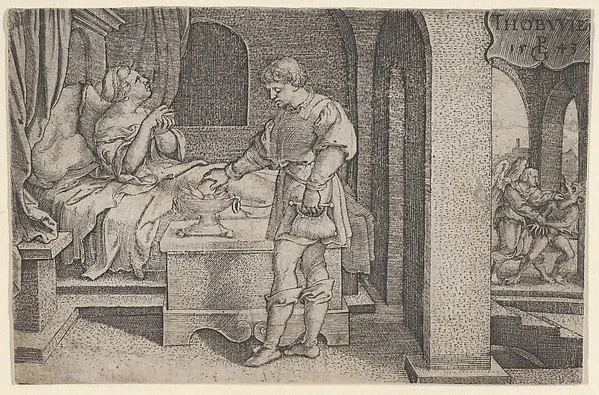
Sirach 13:1-3He That Toucheth Pitch Shall Be Defiled
1He that toucheth pitch, shall be defiled with it: and he that hath fellowship with the proud, shall put on pride.
The chapter opens with one of the most quoted images in all of wisdom literature, and it works because everyone knows it is true. Pitch is sticky and black; handle it and it marks you, whether you meant to be marked or not. Ben Sira applies the picture to the company we keep. To "have fellowship with the proud" is to "put on pride," to wear it like a borrowed garment until it is no longer borrowed.
The verse is not a call to look down on anyone. It is a warning that character is contagious, that we slowly take on the habits of those we draw closest to, and that pride in particular transfers by contact long before we notice it on our own hands.
2He shall take a burden upon him that hath fellowship with one more honourable than himself. And have no fellowship with one that is richer than thyself. 3What agreement shall the earthen pot have with the kettle? for if they knock one against the other, it shall be broken.
The counsel here is not snobbery in reverse but a sober reckoning with imbalance. To bind yourself closely to one far above you in wealth or station is to "take a burden upon" yourself, because the friendship can never be between equals, and the weaker party always carries the heavier load. Ben Sira is not forbidding all dealings with the powerful. He is warning the small against entangling themselves where they have no leverage, where every term will finally be set by the stronger hand. Wisdom counts the cost of a relationship before leaning its weight upon it.
The proverb of the pot and the kettle makes the warning vivid. An earthen jar and a metal cauldron may sit side by side on the same shelf, but let them be jostled together and only one of them survives. The clay shatters; the bronze is unscathed. So it is, the chapter says, when the fragile and the formidable collide. The point is not that the poor are worthless but that they are breakable, and that a bond between such unequal vessels carries a danger the weaker one cannot afford to ignore.
Knowing your own fragility is not weakness; it is the beginning of wisdom about where to stand.
Sirach 13:4-8He Will Make Thee Bare, and Will Not Be Sorry
4The rich man hath done wrong, and yet he will fume: but the poor is wronged and must hold his peace. 5If thou give, he will make use of thee: and if thou have nothing, he will forsake thee.
Ben Sira refuses to pretend the world is fair. The man with power can do the wrong and still bluster with indignation, while the man without it can be wronged and dare not even raise his voice. This is observation, not endorsement; the chapter is describing how the imbalance of wealth actually plays out, the way the strong are permitted an anger the weak are denied. Verse 5 names the engine of the false friendship that follows: while you have something to give, you are useful and therefore wanted, and the moment your usefulness is spent, so is the friendship.
The relationship was never about you. It was about what could be extracted from you.
6If thou have any thing, he will live with thee, and will make thee bare, and he will not be sorry for thee. 7If he have need of thee he will deceive thee, and smiling upon thee will put thee in hope; he will speak thee fair, and will say: What wantest thou?
The portrait sharpens into something almost predatory. As long as there is anything to be had, the rich man will keep close, draw it out, and "make thee bare," stripping the poor man of what little he had, and feeling no grief over the ruin he caused. The chilling phrase is "he will not be sorry for thee." There is no conscience in the transaction, no backward look. Wisdom is teaching the vulnerable to recognize this pattern before they are inside it: warmth that flows only toward what you can provide is not warmth at all, and the absence of any sorrow over your loss is the surest sign of it.
Verse 7 captures the seduction in a single line of dialogue. When the powerful man needs something, the manner turns generous overnight. He smiles, he flatters, he fills the air with hope, and he asks the most disarming question of all: "What wantest thou?" It sounds like kindness. It is bait. The chapter wants the reader to hear how easily flattery counterfeits friendship, how the warm question can be a hook, and how a heart hungry to be valued can be led a long way on words that cost the speaker nothing and mean even less.
8And he will shame thee by his meats, till he have drawn thee dry twice or thrice, and at last he will laugh at thee: and afterward when he seeth thee, he will forsake thee, and shake his head at thee.
The friendship reaches its end exactly where it was always headed. Once the poor man has been drained "twice or thrice," the mask drops entirely; the smiling host now laughs at him, and meeting him later in the street, treats him as a stranger and "shakes his head" in dismissal. The gesture is small and devastating, the body language of contempt for someone who has outlived his use. Ben Sira holds the whole arc up to the light so that no one need walk through it blind.
He is not making his reader cynical. He is making the vulnerable wise, so that they can tell the difference between a friend and a hand reaching for their pocket.
Sirach 13:9-13Humble Thyself to God, and Wait for His Hands
9Humble thyself to God, and wait for his hands. 11Be not lowly in thy wisdom, lest being humbled thou be deceived into folly.
After the long, cold portrait of human friendship comes the turn the whole chapter has been waiting for. There is One before whom humility is never exploited and never regretted. "Humble thyself to God, and wait for his hands." Set against the rich man whose hands strip the poor bare, here are hands worth waiting for, hands that give rather than take. The verse quietly reorders the reader's longing. The hunger to be valued, which the flatterers used as a hook, finds its true and safe home in God, before whom lowliness is not weakness to be preyed upon but the very posture He honors.
To wait for His hands is to trust that what people withhold, He supplies in His own time.
These verses guard against a counterfeit humility. There is a false lowliness that is really just a loss of nerve, a cringing before the powerful that abandons one's own good sense, and Ben Sira warns that a person can be "deceived into folly" precisely by being beaten down. Humbling yourself before God is one thing; groveling before people until you lose your wisdom is another. The chapter holds the two apart with care. True humility bows to God and keeps its head clear; false humility bends to whoever is strongest and loses its footing entirely.
Wisdom knows the difference between reverence and servility.
12If thou be invited by one that is mightier, withdraw thyself: for so he will invite thee the more. 13Be not troublesome to him, lest thou be put back: and keep not far from him, lest thou be forgotten.
The practical counsel about the great man's favor is finely balanced and worldly-wise. Do not press in eagerly when the powerful invite you; a measured reserve commands more respect than a rush to the table. Yet do not hold so far off that you vanish from mind entirely. The chapter is teaching the small how to carry themselves with dignity in the orbit of the great, neither fawning nor sulking, neither grasping at the invitation nor scorning it.
There is a poise here that comes from not needing the great man's approval too badly, which is exactly the freedom that humility before God makes possible.
Sirach 13:14-18By Much Talk He Will Sift Thee
14Affect not to speak with him as an equal: and believe not his many words: for by much talk he will sift thee, and smiling will examine thee concerning thy secrets. 15His cruel mind will lay up thy words: and he will not spare to do thee hurt, and to cast thee into prison.
The warning grows sharper still. The powerful man's flood of friendly words may not be conversation at all but interrogation in disguise. To "sift" is to shake the chaff loose to find the grain, and the chapter pictures the great man doing exactly that with a guest, smiling all the while, drawing out secrets that he stores away. Verse 15 reveals what the stored words are for: not friendship but leverage, ready to be used to "do thee hurt."
Ben Sira is teaching a holy discretion. Not every smiling listener is safe, not every easy question deserves an honest answer, and the wise learn to guard what they reveal to those who hold power over them.
16Take heed to thyself, and attend diligently to what thou hearest: for thou walkest in danger of thy ruin. 18Love God all thy life, and call upon him for thy salvation.
The chapter gathers its warnings into a single charge: "Take heed to thyself." Pay attention, listen carefully, walk awake, because the path among the powerful runs close to the edge of ruin. This is not the counsel of paranoia but of alertness; the wise move through dangerous company with their eyes open, neither naive nor afraid. There is a kind of attentiveness that is itself a form of wisdom, a refusal to drift through life half-asleep to the currents around us.
The reader is being trained to notice, to weigh, to stay conscious of where the ground is firm and where it gives way.
Then, like a clear bell after all the cautions, comes the chapter's positive center: "Love God all thy life, and call upon him for thy salvation." Every warning about the powerful has been clearing the ground for this. When human alliances are this treacherous, the heart needs an allegiance that cannot betray it, and Ben Sira names it plainly. Love God, not for a season but for a lifetime, and call on Him to save.
Here is the one relationship in the chapter where total openness is safe, where you may pour out every secret without fear of being sifted, because the God you call upon seeks your good and not your ruin.
Sirach 13:19-29Every Beast Loveth Its Like
19Every beast loveth its like: so also every man him that is nearest to himself. 21If the wolf shall at any time have fellowship with the lamb, so the sinner with the just.
Ben Sira reaches for a law of nature to explain a law of human life. Every creature is drawn to its own kind; like seeks like, and people gather to those who resemble them. This is offered as simple observation, the gravity that pulls similar souls together. It carries a quiet challenge with it, though: if we naturally drift toward our own kind, then the kind of person we are becoming will increasingly determine the kind of company we keep, and the company we keep will deepen the kind of person we are.
The two move together, each shaping the other, which is why the chapter has cared so much from the start about who we let near.
The proverb turns pointed: a wolf has as much fellowship with a lamb as a sinner has with the just. The image is stark because the natures are opposed; one lives by devouring what the other is. Ben Sira is naming a real gulf between the way of righteousness and the way of cruelty, a difference too deep to be papered over by good manners at a shared table. Yet Scripture does not leave the wolf and the lamb forever at war.
The prophets dreamed of a day when "the wolf also shall dwell with the lamb" (Isaiah 11:6), a peace no natural law could produce, brought about only by the One who changes natures rather than merely separating them.
23The wild ass is the lion’s prey in the desert: so also the poor are devoured by the rich. 25When a rich man is shaken, he is kept up by his friends: but when a poor man is fallen down, he is thrust away even by his acquaintance.
The chapter returns to the gulf between the powerful and the lowly and refuses to soften it. As the lion preys on the wild ass, so the rich devour the poor; and "as humility is an abomination to the proud," so the rich man recoils from the poor man's very presence. That pairing is telling: the proud hate humility itself, the lowly posture the chapter has commended, because it is everything pride is not.
Ben Sira is exposing the heart of pride, which cannot abide the sight of meekness, and in doing so he draws the reader's sympathy and reverence toward the very lowliness the powerful despise.
The injustice is laid bare in a single contrast. When a wealthy man stumbles, friends rush to hold him up; when a poor man falls, even those who knew him push him further away. The world rallies to the strong and abandons the weak at the very moment help is most needed. Ben Sira does not pretend this is right; he reports it so that the reader will see it clearly and refuse to live by it.
The verses that follow drive the point home: the rich man speaks nonsense and the room praises him to the clouds, while the poor man speaks wisely and no one will give his words a place. The chapter mourns a world that weighs words by the wealth of the mouth that speaks them.
Sirach 13:30-32The Heart Changeth the Countenance
30Riches are good to him that hath no sin in his conscience: and poverty is very wicked in the mouth of the ungodly. 31The heart of a man changeth his countenance, either for good, or for evil.
Before the final turn inward, the chapter offers a balancing word. It has spent many verses on the cruelty of the rich, but it does not condemn wealth itself. "Riches are good to him that hath no sin in his conscience." The question was never the money but the heart behind it; wealth held by a clean conscience is a good thing, while it is "in the mouth of the ungodly" that poverty gets called wicked, as though being poor were a sin.
Ben Sira will not let his reader slide from a true critique of the proud rich into a false hatred of wealth as such. What matters, here as everywhere in the chapter, is the state of the heart.
The chapter arrives at the truth it has been circling all along: "The heart of a man changeth his countenance, either for good, or for evil." Everything the chapter has described, the contempt, the flattery, the cruelty, the grasping, the love of God, finally writes itself on the face. The inner life cannot be perfectly hidden; what fills the heart shapes the look of the eyes, the set of the mouth, the whole bearing of a person over time.
After warning at such length about how others may deceive us with smiles, Ben Sira turns the lamp on the reader. The deepest question is not what other faces conceal but what your own heart is slowly making your face become.
32The token of a good heart, and a good countenance thou shalt hardly find, and with labour.
The chapter ends on a sober and searching note. A genuinely good heart, and the good face that flows from it, is a rare thing, found "hardly" and only "with labour." Ben Sira is not being cynical; he is being honest about how uncommon, and how hard-won, true goodness of heart really is. It does not happen by accident or arrive without cost. In a chapter that has watched so many faces wear pride and contempt and calculating warmth, this last line sends the reader looking, against the odds and at real cost, for the rare and beautiful thing: a heart so good that the goodness shines plainly in the face.
Where this echoes in Scripture
He That Toucheth Pitch Shall Be Defiled
- Proverbs 13:20He that walketh with wise men shall be wise: but a companion of fools shall be destroyed.The same law of contagion: company forms character, for good or ruin.
- 1 Corinthians 15:33Be not deceived: evil communications corrupt good manners.Paul states the pitch-on-the-hands principle plainly to the church.
- Proverbs 16:18Pride goeth before destruction, and an haughty spirit before a fall.The very thing Sirach warns rubs off is the thing that ruins a soul.
He Will Make Thee Bare, and Will Not Be Sorry
- Proverbs 19:4Wealth maketh many friends; but the poor is separated from his neighbour.The same hard observation: money draws a crowd that poverty scatters.
- Luke 14:12-14When thou makest a dinner... call not thy friends... lest they also bid thee again... But call the poor, the maimed.Jesus overturns the chapter's table: host the ones who cannot repay you.
- James 2:6But ye have despised the poor. Do not rich men oppress you, and draw you before the judgment seats?James names the very imbalance Sirach lays bare.
Humble Thyself to God, and Wait for His Hands
- 1 Peter 5:6Humble yourselves therefore under the mighty hand of God, that he may exalt you in due time.Almost word for word: humble yourself to God and wait for His hands.
- Psalm 37:7Rest in the LORD, and wait patiently for him: fret not thyself because of him who prospereth in his way.The waiting Sirach commands, set over against the prospering of the powerful.
- James 4:10Humble yourselves in the sight of the Lord, and he shall lift you up.Lowliness before God is the one humility that ends in being raised.
By Much Talk He Will Sift Thee
- Matthew 10:16Be ye therefore wise as serpents, and harmless as doves.The same paired wisdom: alert to danger, yet without malice.
- 2 Corinthians 8:9Though he was rich, yet for your sakes he became poor, that ye through his poverty might be rich.The Rich One who, unlike the rich man here, made Himself poor to enrich the poor.
- Psalm 116:1-2I love the LORD, because he hath heard my voice... therefore will I call upon him as long as I live.The psalmist lives out the command to love God and call on Him all his days.
Every Beast Loveth Its Like
- Isaiah 11:6The wolf also shall dwell with the lamb, and the leopard shall lie down with the kid... and a little child shall lead them.The peace between wolf and lamb that only the coming King can make.
- James 2:2-4If there come... a man with a gold ring... and there come in also a poor man... are ye not then partial?The church warned against the very partiality Sirach exposes.
- Luke 6:20-21Blessed be ye poor: for yours is the kingdom of God. Blessed are ye that hunger now: for ye shall be filled.Jesus blesses the very ones the world here devours and thrusts away.
The Heart Changeth the Countenance
- Proverbs 4:23Keep thy heart with all diligence; for out of it are the issues of life.The heart Sirach says shapes the face is the wellspring to be guarded above all.
- Luke 6:45A good man out of the good treasure of his heart bringeth forth that which is good... for of the abundance of the heart his mouth speaketh.Jesus too traces the visible life back to the hidden treasure of the heart.
- Matthew 5:8Blessed are the pure in heart: for they shall see God.The rare good heart Sirach seeks finds its blessing and its end in seeing God.