Sirach 14
What does a full life feel like from the inside? Sirach 14 answers by showing us its opposite first. It opens with a quiet blessing on the person whose words have not betrayed him and whose conscience does not accuse him, then turns to a man who has everything and enjoys none of it. The covetous and the envious gather wealth and cannot taste it. The miser sits at a heaped table and goes away needy, because his hunger lives in the soul, where bread cannot reach.
It is one of the most piercing studies of greed anywhere in Scripture, and its point reaches past the question of whether riches are good or evil: a shriveled heart cannot be fed by them.
Tap any highlighted phrase to jump to the commentary that unpacks it.
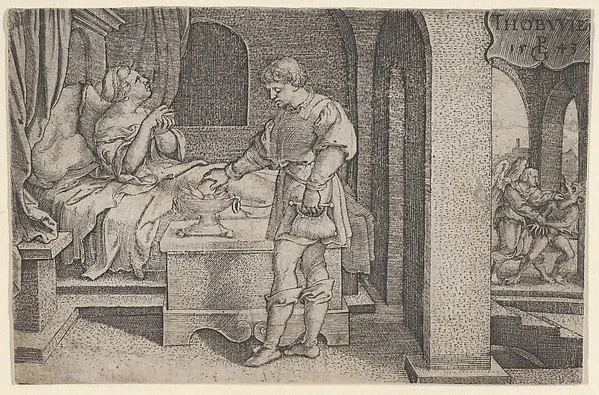
Sirach 14:1-2Blessed Is the Man Whose Conscience Does Not Accuse Him
1Blessed is the man that hath not slipped by a word out of his mouth, and is not pricked with the remorse of sin. 2Happy is he that hath had no sadness of his mind, and who is not fallen from his hope.
The chapter opens with a beatitude, and notice where it begins: with the mouth and the conscience. Blessed is the one who has not slipped by a careless word, who is not "pricked with the remorse of sin." Ben Sira knows how much of our inner peace is quietly stolen by things we have said and things we have done that we cannot take back. To go through a day without a word you wish you could recall, without that small inward sting of regret, is named here as a real and underrated blessing.
The well-guarded tongue and the clear conscience are the foundation the whole chapter will build on.
The second blessing reaches into the mind itself: happy is the one who carries "no sadness of his mind" and "is not fallen from his hope." This is the peace that comes when nothing is gnawing underneath, no buried guilt, no abandoned hope souring into despair. Scripture ties this kind of settled heart to a conscience kept right with God and neighbor. The Psalmist names the same gift from the other side: "Blessed is the man unto whom the LORD imputeth not iniquity, and in whose spirit there is no guile" (Psalm 32:2).
The clear conscience and the unbroken hope belong together.
Sirach 14:3-10The Covetous Eye That Despises Its Own Soul
3Riches are not comely for a covetous man and a niggard, and what should an envious man do with gold? 5He that is evil to himself, to whom will he be good? and he shall not take pleasure in his goods.
Ben Sira makes a sharp observation: wealth simply does not suit the covetous person. Riches in the hands of a greedy, tight-fisted man are like a fine instrument given to someone who will never play it. "What should an envious man do with gold?" The question is almost pitying. The gold can do him no good, because the problem was never a lack of money; it was a heart curved in on itself. The chapter is exposing the kind of soul that cannot be enriched by anything, because it cannot receive.
Here is the strange logic of greed laid bare: the man "evil to himself" will be good to no one, and he "shall not take pleasure in his goods." He withholds even from his own life. We tend to picture the miser as cruel to others, and he is, but Ben Sira sees deeper: his first victim is himself. He owns much and enjoys nothing, guarding a treasure he will not spend even on his own gladness.
It is a kind of self-punishment dressed up as prudence, and the chapter wants us to feel how joyless and self-defeating it is.
8The eye of the envious is wicked: and he turneth away his face, and despiseth his own soul. 9The eye of the covetous man is insatiable in his portion of iniquity: he will not be satisfied till he consume his own soul, drying it up. 10An evil eye is towards evil things: and he shall not have his fill of bread, but shall be needy and pensive at his own table.
The portrait sharpens into something almost frightening. The envious eye is "wicked," and the envious man "turneth away his face, and despiseth his own soul." He cannot look squarely at need or at joy, his own or anyone else's, because envy has soured his sight. The covetous eye is "insatiable," never filled, consuming the soul and "drying it up" like a riverbed in drought. This is what greed does over time: it does not merely fail to satisfy, it slowly empties the person of the capacity to be satisfied at all.
The image lands with terrible irony: the man "shall not have his fill of bread, but shall be needy and pensive at his own table." Picture it. The table is laden, the food is his, and he sits there hungry and anxious, too gripped by the fear of losing to enjoy what he has. This is the deepest truth of the whole passage. Plenty cannot feed a grasping heart. The hunger of greed is a hunger that food was never made to satisfy, and the one who feeds it goes on starving in the middle of abundance.
Sirach 14:11-19Stretch Out Your Hand While You Still Can
11My son, if thou have any thing, do good to thyself, and offer to God worthy offerings. 12Remember that death is not slow, and that the covenant of hell hath been shewn to thee: for the covenant of this world shall surely die. 13Do good to thy friend before thou die, and according to thy ability, stretching out thy hand give to the poor.
After the long shadow of the miser, the chapter opens a window. "If thou have any thing, do good to thyself, and offer to God worthy offerings." This is the answer to greed: a generous use of what you have in place of anxious hoarding, given both toward your own honest gladness and toward God. The phrase "do good to thyself" is striking right after the portrait of the man who would not. To enjoy God's gifts rightly and to give back to Him from them is the freedom the grasping heart has lost.
Then comes the reason underneath the urgency: "Remember that death is not slow... for the covenant of this world shall surely die." Ben Sira sets our generosity against the short horizon of our lives. The world we are clutching is passing; the hand that grips it will one day be opened whether we choose it or not. This is said to free us, not to frighten us. Once you remember how brief the holding is, the case for an open hand becomes obvious. Why starve at the table when you cannot keep the table for long?
"Do good to thy friend before thou die, and... stretching out thy hand give to the poor." The good we mean to do has a deadline we do not get to see. Ben Sira presses both directions of love at once: toward the friend, and toward the poor who can give nothing back. The kindness postponed for a better time may never be done at all. The Lord later urges the same open-handedness toward those who cannot repay (Luke 14:13-14), and promises that such giving is treasured up where it cannot be lost.
14Defraud not thyself of the good day, and let not the part of a good gift overpass thee. 16Give and take, and justify thy soul. 17Before thy death work justice: for in hell there is no finding food.
"Defraud not thyself of the good day." It is a tender and surprising command. The miser of the earlier verses defrauds himself, robs his own life of joy, and Ben Sira tells the reader plainly not to do that. The good day, the simple gladness God scatters through ordinary life, is a gift meant to be received, and to let it "overpass thee" unenjoyed is a quiet kind of loss. There is a holiness in gratitude, in actually tasting the good God gives rather than letting it slip past in worry or in hoarding.
"Give and take, and justify thy soul. Before thy death work justice." The window of action is this life, and the chapter urges us to fill it with doing right while we still can. To "work justice" is to live out our days in active goodness, generosity, and fairness, not saving virtue for a someday that may never come. The phrase "in hell there is no finding food" presses the same point the chapter has made all along: the time to do good is now, in the land of the living, with the hands and the means we have today.
18All flesh shall fade as grass, and as the leaf that springeth out on a green tree. 19Some grow, and some fall off: so is the generation of flesh and blood, one cometh to an end, and another is born.
Ben Sira reaches for one of Scripture's oldest images: "All flesh shall fade as grass, and as the leaf." On a single tree, some leaves are budding green while others are already letting go, and so it is with the generations of human beings, "one cometh to an end, and another is born." There is no panic in the picture, only clear sight. The prophet sang it the same way: "All flesh is grass... the grass withereth, the flower fadeth: but the word of our God shall stand for ever" (Isaiah 40:6-8).
To know we are leaves on a turning year is not despair. It is the wisdom that teaches us to spend our brief green season well.
Sirach 14:20-27Blessed Is the One Who Lodges Near Wisdom's House
20Every work that is corruptible shall fail in the end: and the worker thereof shall go with it. 21And every excellent work shall be justified: and the worker thereof shall be honoured therein. 22Blessed is the man that shall continue in wisdom, and that shall meditate in his justice, and in his mind shall think of the all seeing eye of God.
The chapter draws a line between two kinds of work. What is "corruptible" fails, and "the worker thereof shall go with it," sharing the fate of what he built. But "every excellent work shall be justified," and the one who made it "shall be honoured therein." Here is the answer to the fading grass: not everything we do is swept away. The work done in goodness and wisdom outlasts the hand that did it. Our lives are brief, but a life poured into what is genuinely good is not poured out into nothing.
This closing blessing names its object plainly: "Blessed is the man that shall continue in wisdom." The blessing rests on the one who continues, who stays, who keeps her ways over a lifetime, more than on the one who merely glimpses wisdom once. He "meditates in his justice" and holds before his mind "the all seeing eye of God," the settled life of wisdom lived consciously under the gaze of a God who sees all.
23He that considereth her ways in his heart, and hath understanding in her secrets, who goeth after her as one that traceth, and stayeth in her ways: 25He that lodgeth near her house, and fastening a pin in her walls shall set up his tent nigh unto her, where good things shall rest in his lodging for ever. 26He shall set his children under her shelter, and shall lodge under her branches: 27He shall be protected under her covering from the heat, and shall rest in her glory.
The seeker after wisdom is drawn in a sequence of patient, intimate motions. He considers her ways in his heart, understands her secrets, "goeth after her as one that traceth," like a hunter following a trail, and then "stayeth in her ways." It is a long pursuit that settles at last into a dwelling. He looks in at her windows, listens at her door, lodges near her house, and at last drives a tent-peg into her very wall.
Wisdom is won by those who will not give up the chase and then will not leave once they have found her.
The images turn from pursuit to rest, and they are some of the most beautiful in the book. The seeker pitches his tent beside Wisdom's house, and "good things shall rest in his lodging for ever." He sets his children under her shelter and lodges "under her branches," as under a great tree. He is "protected under her covering from the heat," and finally he "rests in her glory." The chapter that began by exposing the restless, starving heart of the miser ends in shade and rest and permanence.
The home greed could never buy is given freely to the one who dwells with wisdom.
One phrase ties the ending back to the whole chapter: the wise man keeps before his mind "the all seeing eye of God." This is the answer to the "evil eye" of the covetous man who despised his own soul. Where the grudging eye darkened everything it looked upon, the all-seeing eye of God is the gaze under which the wise person joyfully lives, the One who sees what is well made and honors it, who misses no act of generosity done in secret.
To live before that eye is not to live in fear. It is to live in the warmth of being fully known by the One who made us for good.
Where this echoes in Scripture
Blessed Is the Man Whose Conscience Does Not Accuse Him
- Psalm 32:2Blessed is the man unto whom the LORD imputeth not iniquity, and in whose spirit there is no guile.The same blessing: a conscience clear before God and free of inner deceit.
- James 3:2If any man offend not in word, the same is a perfect man, and able also to bridle the whole body.The mouth that does not slip is the mark of a whole and disciplined life.
- 1 Peter 3:10He that will love life, and see good days, let him refrain his tongue from evil, and his lips that they speak no guile.Good days and a guarded tongue are joined, exactly as Ben Sira joins them.
The Covetous Eye That Despises Its Own Soul
- Ecclesiastes 5:10He that loveth silver shall not be satisfied with silver; nor he that loveth abundance with increase: this is also vanity.The same insatiable hunger that wealth can never fill.
- Matthew 6:23But if thine eye be evil, thy whole body shall be full of darkness.Jesus uses the very idiom of the grudging eye that darkens the whole self.
- Luke 12:15Take heed, and beware of covetousness: for a man's life consisteth not in the abundance of the things which he possesseth.Life is not measured by what the covetous man hoards at his table.
Stretch Out Your Hand While You Still Can
- Isaiah 40:6-8All flesh is grass... The grass withereth, the flower fadeth: but the word of our God shall stand for ever.The same image of fading flesh, set against what endures.
- Luke 14:13-14Call the poor, the maimed, the lame, the blind: and thou shalt be blessed; for they cannot recompense thee.The open hand toward those who cannot repay, exactly as Ben Sira urges.
- Galatians 6:10As we have therefore opportunity, let us do good unto all men, especially unto them who are of the household of faith.Do good while the opportunity lasts, before the brief day closes.
Blessed Is the One Who Lodges Near Wisdom's House
- Psalm 91:1He that dwelleth in the secret place of the most High shall abide under the shadow of the Almighty.The same picture of resting under a divine shelter and covering.
- Matthew 11:28-29Come unto me, all ye that labour and are heavy laden, and I will give you rest... and ye shall find rest unto your souls.The rest in Wisdom's shelter offered by the Wisdom of God in person.
- Colossians 2:3In whom are hid all the treasures of wisdom and knowledge.The Wisdom whose house the seeker lodges beside is found fully in Christ.