Sirach 15
People in this chapter
How does a person come to possess wisdom, and who is to blame when a life goes wrong? Sirach 15 answers both questions, and it answers them in that order on purpose. The chapter opens with a tender picture: the one who fears God and lays hold of justice is met by Wisdom herself, who receives him like an honoured mother and a bride, feeds him with the bread of life and the water of understanding, and crowns him with a robe of glory and a name that never fades.
Wisdom is not a prize won by cleverness. She is given to the reverent heart, and she stays far from pride and deceit.
Tap any highlighted phrase to jump to the commentary that unpacks it.
Sirach 15:1-4Wisdom Comes Like a Mother to the One Who Fears God
1He that feareth God, will do good: and he that possesseth justice, shall lay hold on her, 2And she will meet him as an honourable mother, and will receive him as a wife married of a virgin.
The chapter begins by tying two things together that the rest of Scripture also binds: reverence for God and the doing of good. The one who fears God "will do good," and the one who holds justice will "lay hold" of wisdom. Notice the direction. Wisdom is not first an idea to be grasped by the mind; she is laid hold of by a life already turned toward what is right. Reverence comes first, then the doing of good, and into that prepared life Wisdom comes.
This is the same order found throughout the wisdom books, where the fear of the Lord is named as the beginning of knowledge.
Wisdom is pictured as a living person who comes out to meet the seeker, and the images are deeply personal: an honoured mother, a young bride. These are the closest, most welcoming bonds a person knows. Wisdom does not have to be hunted down or cornered; she comes forward to receive the one who fears God, the way a mother receives a returning child. The whole picture overturns the idea that wisdom is cold or distant. She is warm, near, and glad to be found by the heart that reveres her Maker.
3With the bread of life and understanding, she shall feed him, and give him the water of wholesome wisdom to drink: and she shall be made strong in him, and he shall not be moved: 4And she shall hold him fast, and he shall not be confounded: and she shall exalt him among his neighbours.
Wisdom feeds. She gives "the bread of life and understanding" and "the water of wholesome wisdom." Hunger and thirst are the body's most basic needs, and the chapter uses them to say that the soul has needs just as basic, met only by what Wisdom provides. And the result is stability: she is "made strong in him, and he shall not be moved." The person nourished by wisdom is not blown about by every pressure. There is a settledness that comes from being fed at the right table, a steadiness the world cannot give and cannot take away.
Wisdom holds the seeker fast so that he is not put to shame, and she lifts him up among those around him. The honour here is not self-promotion; it is the quiet authority that gathers to a person whose life is grounded in what is true. Others come to trust the counsel of the one Wisdom has fed. This is honour received rather than seized, the natural weight that a reverent and well-grounded life carries among its neighbours.
Sirach 15:5-8A Robe of Glory, and Why the Proud Never Find Her
5And in the midst of the church she shall open his mouth, and shall fill him with the spirit of wisdom and understanding, and shall clothe him with a robe of glory. 6She shall heap upon him a treasure of joy and gladness, and shall cause him to inherit an everlasting name.
The gifts widen now. Wisdom opens the seeker's mouth in the assembly, so that his speech carries weight where the community gathers, and she fills him with the very "spirit of wisdom and understanding," the same pairing the prophets use for the Spirit who rests on the chosen one. Then she clothes him with "a robe of glory." Clothing in Scripture marks identity and standing; to be robed in glory is to be honoured, set apart, dignified by what one carries within.
The reverent heart that received Wisdom is now adorned by her, dressed in an honour it could never have sewn for itself.
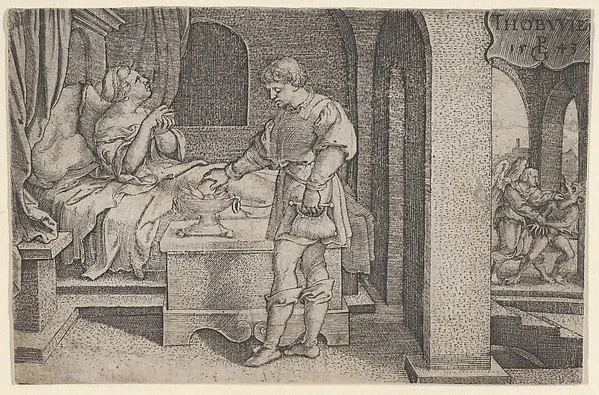
The crown of these gifts is "an everlasting name." In a world where reputations fade and even great names are forgotten within a generation or two, Wisdom gives something that outlasts the grave. To inherit an everlasting name is to be remembered and held by God, whose memory does not fail. This is the deepest reversal of human anxiety about being forgotten. The treasure of joy and gladness she heaps up is not a passing mood; it is bound to a name that endures because it is kept by the Eternal One.
7But foolish men shall not obtain her, and wise men shall meet her, foolish men shall not see her: for she is far from pride and deceit. 8Lying men shall not be mindful of her: but men that speak truth shall be found with her, and shall advance, even till they come to the sight of God.
The chapter is honest that not everyone finds Wisdom, and it names the reason: "she is far from pride and deceit." The fool here is not the person of low intelligence but the one whose heart is bent away from God. Pride is the great barrier, because the proud already believe they have arrived and so stop seeking. Wisdom cannot be installed in a heart that thinks it has no need of her. The distance is not Wisdom's coldness; it is the closed door that pride keeps locked from the inside.
Truthfulness is the open road to Wisdom. "Men that speak truth shall be found with her, and shall advance, even till they come to the sight of God." There is a trajectory here: the one who lives in truth keeps advancing, and the goal of the advance is nothing less than the sight of God. Honesty is not merely a moral nicety; it is the path along which a soul travels toward God Himself. The lie keeps a person circling in the dark, while the truth, however costly, keeps leading upward toward the One who is its source.
Sirach 15:9-13Do Not Say, He Caused Me to Err
9Praise is not seemly in the mouth of a sinner: 10For wisdom came forth from God: for praise shall be with the wisdom of God, and shall abound in a faithful mouth, and the sovereign Lord will give praise unto it.
Praise, the chapter says, does not sit well in the mouth of one who persists in sin, because praise belongs with wisdom, and "wisdom came forth from God." There is no scorn for the sinner here; the point is about integrity of life and speech. Worship that flows from a heart actively committed to wrong rings hollow, like a song sung against the grain of the singer's own life. Praise becomes real and full when it rises from "a faithful mouth," a life and a tongue that agree.
Then, the chapter says, the Lord Himself gives praise to it, honouring the worship He inspired.
11Say not: It is through God, that she is not with me: for do not thou the things that he hateth. 12Say not: He hath caused me to err: for he hath no need of wicked men.
Now the chapter confronts the oldest excuse in the human heart. "Say not: It is through God, that she is not with me." The instinct it names is the urge to make God the reason for our failures, to say that if wisdom is absent or if we have stumbled, somehow God withheld or arranged it. The chapter cuts that off at once with a command pointed straight back at the speaker: "do not thou the things that he hateth."
The absence of wisdom is traced not to God's stinginess but to the chooser's own conduct. The excuse that points up is turned around to point back at the one making it.
The second forbidden sentence is sharper still: "Say not: He hath caused me to err." Some have wanted to lay the cause of their sin at God's feet, as though He were behind their wandering. The chapter answers with a reason that settles the matter: "for he hath no need of wicked men." God gains nothing from human evil; it serves no purpose of His, fills no lack in Him. There is therefore no hidden divine motive driving a person into sin.
The cause of wickedness is not in God, who needs no wickedness at all. Where evil comes from, this chapter is about to say with great clarity, is the misuse of the choice God placed in our own hand.
13The Lord hateth all abomination of error, and they that fear him shall not love it.
The argument is sealed with the plainest statement of God's character: "The Lord hateth all abomination of error." Far from being the author of sin, God is its sworn opponent; He hates it without exception. And those who truly fear Him come to share His heart toward it: "they that fear him shall not love it." This is the test that runs back through the whole chapter. The reverent heart that Wisdom comes to meet is recognized here by what it loves and what it refuses.
To fear God is to begin to hate what He hates and to want what He wants.
Sirach 15:14-22Fire and Water, Life and Death, Set Before You
14God made man from the beginning, and left him in the hand of his own counsel. 15He added his commandments and precepts. 16If thou wilt keep the commandments and perform acceptable fidelity for ever, they shall preserve thee.
Here is the verse the whole chapter has been building toward. "God made man from the beginning, and left him in the hand of his own counsel." The deciding power, the faculty of weighing and choosing, was placed by God into the human hand at creation. This is the answer to the forbidden excuses just spoken. Sin cannot be charged to God, because God entrusted the choice to the person. And notice that this counsel is described as a gift of the Maker, part of what it means to be made by God.
The capacity to choose is woven into the dignity of being human.
God did not leave that freedom without light to guide it. "He added his commandments and precepts." Into the hand that holds the power to choose, God also placed His instruction, so the chooser would not be left to guess in the dark. The commandments are presented as a kindness, a lamp for the path: "if thou wilt keep the commandments... they shall preserve thee." They are not a cage but a guardrail, given to keep the one who walks by them from ruin.
Freedom and commandment arrive together, the choice and the wisdom to choose well held out in the same hand of God.
17He hath set water and fire before thee: stretch forth thy hand to which thou wilt. 18Before man is life and death, good and evil, that which he shall choose shall be given him:
The teaching becomes an image you cannot forget. Water and fire are set before you, and you may "stretch forth thy hand to which thou wilt." One gives life; the other can destroy. They lie within reach, and the hand that chooses between them is your own. The picture honours the reader as a genuine agent, capable of reaching one way or the other. God has not tied your hands. He has set the alternatives before you in the open and left the reaching to you.
The image is then named outright: "Before man is life and death, good and evil, that which he shall choose shall be given him." This is among the clearest statements in all of Scripture that the human choice is real and that its outcome follows from it. What a person reaches for is what that person receives. The chapter does not soften this or hedge it. Life and death lie open before us, and the choosing is genuinely ours, with consequences that are genuinely ours as well. The dignity is immense, and so is the responsibility that comes with it.
19For the wisdom of God is great, and he is strong in power, seeing all men without ceasing. 20The eyes of the Lord are towards them that fear him, and he knoweth all the work of man.
The freedom God gives is not freedom from His sight. "The wisdom of God is great, and he is strong in power, seeing all men without ceasing." The same chapter that places the choice in our hands insists that God watches the choosing with full knowledge. These two truths are held together rather than played against each other: the choice is truly ours, and God truly sees and knows it all. "The eyes of the Lord are towards them that fear him" is a word of comfort to the reverent, that they are seen and not forgotten, and a word of seriousness to all, that nothing chosen is hidden from Him.
The chapter ends by closing every remaining door on the excuse it has fought all along. "He hath commanded no man to do wickedly, and he hath given no man license to sin." There is no divine permission slip for evil, no hidden command from God that authorizes wrong. God has neither ordered sin nor licensed it. The whole weight of the chapter rests here: the choice is ours, the commandments are given, and the responsibility cannot be shifted upward.
What remains for the reader is simply to reach, with an honest hand, for water and not fire, for life and not death.
Where this echoes in Scripture
Wisdom Comes Like a Mother to the One Who Fears God
- Proverbs 9:1-2Wisdom hath builded her house... she hath killed her beasts; she hath mingled her wine; she hath also furnished her table.Wisdom personified as a host who feeds those who come to her, as she does here.
- Proverbs 9:10The fear of the LORD is the beginning of wisdom: and the knowledge of the holy is understanding.The same order the chapter opens with: reverence first, then wisdom.
- Matthew 5:6Blessed are they which do hunger and thirst after righteousness: for they shall be filled.The hunger and thirst Wisdom satisfies finds its promise on the lips of Jesus.
A Robe of Glory, and Why the Proud Never Find Her
- Isaiah 11:2And the spirit of the LORD shall rest upon him, the spirit of wisdom and understanding, the spirit of counsel and might.The "spirit of wisdom and understanding" Wisdom pours out is the Spirit who rests on the promised one.
- James 4:6God resisteth the proud, but giveth grace unto the humble.Why the proud never obtain her: God gives wisdom and grace to the lowly.
- Matthew 5:8Blessed are the pure in heart: for they shall see God.The truthful "come to the sight of God," exactly the promise Jesus gives the pure in heart.
Do Not Say, He Caused Me to Err
- James 1:13Let no man say when he is tempted, I am tempted of God: for God cannot be tempted with evil, neither tempteth he any man.The New Testament forbids the same excuse this chapter forbids, almost word for word.
- Deuteronomy 30:19I have set before you life and death, blessing and cursing: therefore choose life, that both thou and thy seed may live.The same setting of life and death before a person, with the call to choose.
- Habakkuk 1:13Thou art of purer eyes than to behold evil, and canst not look on iniquity.God hates the abomination of error; evil is foreign to His nature, not authored by it.
Fire and Water, Life and Death, Set Before You
- Deuteronomy 30:15See, I have set before thee this day life and good, and death and evil.The same two paths set before a person, the very framework this chapter uses.
- Joshua 24:15Choose you this day whom ye will serve... but as for me and my house, we will serve the LORD.The summons to choose, answered by a hand stretched out toward life.
- John 6:35And Jesus said unto them, I am the bread of life: he that cometh to me shall never hunger.The bread of life Wisdom feeds her seekers is fulfilled in Christ Himself.