Tobit 4
People in this chapter
A blind old man, convinced his life is nearly over, gathers his son to his side. Tobit has nothing left to give but what he has learned, so he gives that. "Hear, my son, the words of my mouth, and lay them as a foundation in thy heart." What follows is one of the most concentrated passages of practical wisdom in all of Scripture, a father pressing into his child everything he wishes him to remember when the father himself is gone.
Honor your mother. Keep the commandments. Be merciful to the poor. Guard your purity. Refuse pride. Pay your workers. Do to no one what you would hate done to you. Seek the counsel of the wise. Bless God at all times.
Tap any highlighted phrase to jump to the commentary that unpacks it.
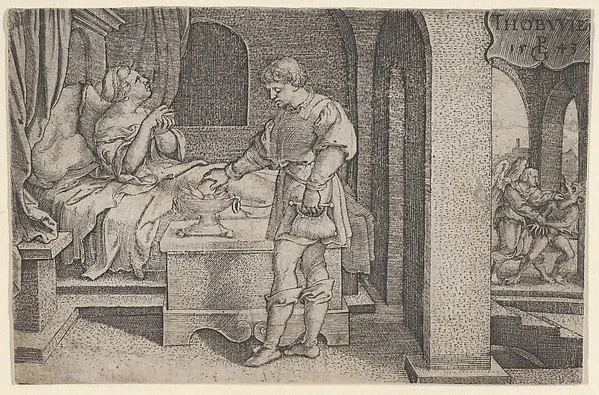
Tobit 4:1-5Lay These Words as a Foundation in Your Heart
1Therefore when Tobias thought that his prayer was heard that he might die, he called to him Tobias his son, 2And said to him: Hear, my son, the words of my mouth, and lay them as a foundation in thy heart.
Tobit believes he is dying. Earlier he had prayed, in his grief and blindness, to be released from life, and now he assumes that prayer will be granted. So he does what a faithful parent does at the end: he gathers his son and entrusts him with what matters most. Notice that he does not begin with property or arrangements. He begins with words to be laid "as a foundation" in the heart, the way a builder lays the first stones a whole house will rest upon.
This is the language of formation, not mere advice. A father is trying to build something inside his child that will hold when the father is no longer there to hold it.
3When God shall take my soul, thou shalt bury my body: and thou shalt honour thy mother all the days of her life: 4For thou must be mindful what and how great perils she suffered for thee in her womb.
The very first instruction, before all the others, is to honor his mother all the days of her life. Tobit grounds it in memory: remember the perils she endured for you, the cost she carried in her own body to bring you into the world. This is the fifth commandment given flesh, "Honour thy father and thy mother" turned from a rule into a remembered debt of love. A dying father's first concern reaches past himself to his wife, that she will be cared for and honored when he is gone, and that his son will never forget what she suffered for him.
Gratitude, here, is the root of obedience.
Tobit 4:6-12Have God in Your Mind, and Be Merciful to the Poor
6And all the days of thy life have God in thy mind: and take heed thou never consent to sin, nor transgress the commandments of the Lord our God. 7Give alms out of thy substance, and turn not away thy face from any poor person: for so it shall come to pass that the face of the Lord shall not be turned from thee.
The center of the whole speech is this: "all the days of thy life have God in thy mind." Everything else flows from that one settled disposition, the steady habit of keeping God before the eyes of the heart at all times, in plenty and in want, in youth and in age. From that root grows the resolve never to consent to sin or break the commandments. Tobit is not handing his son a list of rules to obey by willpower.
He is handing him a way of seeing - a life lived always in the presence of God - and trusting that a heart fixed on God will recognize sin for what it is and turn from it.
Then comes the theme that beats through this entire chapter and the whole book: give alms, and never turn your face from the poor. The promise attached is striking in its symmetry - turn not your face from the needy, and "the face of the Lord shall not be turned from thee." How we treat the poor, Tobit insists, is bound up with how God turns toward us. The same conviction runs through the prophets and reaches its height in the words of Jesus, who taught that what is done to the least of these is done to Him.
To see the face of the poor with mercy is, somehow, to be seen by God with favor.
8According to thy ability be merciful. 9If thou have much give abundantly: if thou have a little, take care even so to bestow willingly a little. 10For thus thou storest up to thyself a good reward for the day of necessity.
Mercy is measured "according to thy ability," not according to some fixed amount. Much from the one who has much; even a little, given willingly, from the one who has little. The point is that no one is too poor to be generous, because generosity is reckoned by the heart and not the sum. And then a remarkable image: in giving, you are "storing up" a good reward for "the day of necessity." The poor man Tobit pictures wealth being quietly accumulated in heaven through the very act of giving wealth away on earth.
The day of necessity will come for everyone, and what greets us there is what we gave away rather than what we held onto.
11For alms deliver from all sin, and from death, and will not suffer the soul to go into darkness. 12Alms shall be a great confidence before the most high God, to all them that give it.
Here Tobit makes his boldest claim about mercy: "alms deliver from all sin, and from death." Christians across the centuries have weighed these words with great seriousness, for they bind almsgiving closely to the soul's deliverance. Scripture elsewhere speaks the same way - "charity shall cover the multitude of sins" (1 Peter 4:8), and Daniel counseled a king to "break off thy sins by righteousness, and thine iniquities by shewing mercy to the poor" (Daniel 4:27).
What is clear, and what the whole Bible affirms, is that mercy toward the poor is no small or optional thing. It stands near the very center of a righteous life, and it gives the giver a "great confidence before the most high God." The reader is invited to ponder how deep that promise runs.
Tobit 4:13-16Flee Pride, Pay the Laborer, Do to None What You Would Hate
13Take heed to keep thyself, my son, from all fornication, and beside thy wife never endure to know a crime. 14Never suffer pride to reign in thy mind, or in thy words: for from it all perdition took its beginning.
Tobit turns to the inner life. First, purity: keep yourself from all fornication, and be faithful to your wife alone. Then he names what he calls the deepest root of ruin: pride. "Never suffer pride to reign in thy mind, or in thy words: for from it all perdition took its beginning." He traces the very origin of destruction back to pride, the inward swelling that puts the self where God belongs. This is the ancient diagnosis of the human fall, that ruin begins inwardly, in an exaltation of self, before it ever shows itself in any outward act.
Guard the heart against pride, Tobit says, and you have struck at the source of nearly every other evil.
15If any man hath done any work for thee, immediately pay him his hire, and let not the wages of thy hired servant stay with thee at all. 16See thou never do to another what thou wouldst hate to have done to thee by another.
Tobit's wisdom is never abstract; it lands in the marketplace. Pay the worker the moment the work is done, and do not let his wages "stay with thee at all" overnight. This echoes the law of Moses, which commanded that a hired servant's pay not be held back, for "he is poor, and setteth his heart upon it" (Deuteronomy 24:15). Behind the rule is a tender awareness of the laborer's need - that the poor man is counting on today's wage for today's bread.
Justice toward those who work for us is not a separate category from mercy toward the poor; it is the same mercy, exercised honestly.
And then, in a single line, the rule that the whole moral life can be hung upon: "See thou never do to another what thou wouldst hate to have done to thee." Long before the Sermon on the Mount, the principle is here in a father's mouth at his deathbed, the great hinge of love for neighbor. Jesus would give it a positive turn - "all things whatsoever ye would that men should do to you, do ye even so to them" - and call it the sum of the Law and the Prophets.
Tobit immediately makes it concrete: share your bread with the hungry, clothe the naked. The golden rule is a practice to be measured out in bread and cloth, far more than a passing feeling.
Tobit 4:17-23Seek Wise Counsel, Bless God, and Do Not Be Afraid
18Lay out thy bread, and thy wine upon the burial of a just man, and do not eat and drink thereof with the wicked. 19Seek counsel always of a wise man.
Tobit's counsel turns to the company a person keeps. Honor the dead and the righteous; share your bread and wine at the burial of a just man, an act of reverence and remembrance among the faithful, rather than spending yourself in feasting with the wicked. The instinct here is to spend your resources where honor and goodness are, not where corruption is. Then a short and weighty line: "Seek counsel always of a wise man."
No one is meant to navigate life alone. The humble habit of asking, of submitting your plans to someone wiser, is itself a mark of wisdom - and it stands in pointed contrast to the pride Tobit warned against just before.
20Bless God at all times: and desire of him to direct thy ways, and that all thy counsels may abide in him.
The crown of all the instruction is worship: "Bless God at all times." Not only when blessed, not only when the prayer is answered, but at all times - in blindness and in health, in poverty and in plenty. And alongside blessing comes dependence: ask God to direct your ways, that all your plans "may abide in him." This is the posture the whole chapter has been building toward. A son who blesses God at all times and lets his plans rest in God will keep the commandments, give alms, flee pride, and love his neighbor, because all of it grows from a heart turned continually toward God in praise and trust.
21I tell thee also, my son, that I lent ten talents of silver, while thou wast yet a child, to Gabelus, in Rages a city of the Medes, and I have a note of his hand with me: 23Fear not, my son: we lead indeed a poor life, but we shall have many good things if we fear God, and depart from all sin, and do that which is good.
Only now, after all the wisdom is given, does the practical matter surface: there is money owed, ten talents of silver left long ago with a man named Gabelus in a far city, and a signed note to prove it. It is the seed of the journey the rest of the book will unfold. But look how Tobit frames even this. He does not end on the silver. He ends on the heart: "Fear not, my son: we lead indeed a poor life, but we shall have many good things if we fear God."
A blind man at the edge of the grave, with little to leave but a debt to collect, tells his son not to be afraid. Real wealth, he insists, is the fear of God and a life that departs from sin and does good. Everything else is detail.
Where this echoes in Scripture
Lay These Words as a Foundation in Your Heart
- Exodus 20:12Honour thy father and thy mother: that thy days may be long upon the land which the LORD thy God giveth thee.Tobit's first command to his son is the fifth commandment, given as a remembered debt of love.
- Proverbs 4:1-2Hear, ye children, the instruction of a father, and attend to know understanding. For I give you good doctrine, forsake ye not my law.The same scene: a father pressing wisdom into a child to carry for life.
- Ephesians 6:2-3Honour thy father and mother; which is the first commandment with promise.Paul lifts the very command Tobit places first, with its promise of life.
Have God in Your Mind, and Be Merciful to the Poor
- Proverbs 19:17He that hath pity upon the poor lendeth unto the LORD; and that which he hath given will he pay him again.The same accounting Tobit describes: mercy to the poor is treasure stored with God.
- Matthew 6:19-20Lay not up for yourselves treasures upon earth... but lay up for yourselves treasures in heaven.Jesus on the very storehouse Tobit names: a reward laid up beyond the reach of loss.
- Matthew 25:40Inasmuch as ye have done it unto one of the least of these my brethren, ye have done it unto me.Turning toward the poor is turning toward the Lord Himself.
Flee Pride, Pay the Laborer, Do to None What You Would Hate
- Deuteronomy 24:14-15Thou shalt not oppress an hired servant that is poor... At his day thou shalt give him his hire, neither shall the sun go down upon it.The law behind Tobit's command to pay the worker without delay.
- Matthew 7:12All things whatsoever ye would that men should do to you, do ye even so to them: for this is the law and the prophets.Jesus gives the golden rule its positive form; Tobit voices it first as a warning.
- Proverbs 16:18Pride goeth before destruction, and an haughty spirit before a fall.The same diagnosis Tobit makes: from pride, all perdition takes its beginning.
Seek Wise Counsel, Bless God, and Do Not Be Afraid
- Proverbs 11:14Where no counsel is, the people fall: but in the multitude of counsellers there is safety.The wisdom of seeking counsel that Tobit urges on his son.
- Psalm 34:1I will bless the LORD at all times: his praise shall continually be in my mouth.David lives out Tobit's command to bless God at all times, in every season.
- Matthew 6:33But seek ye first the kingdom of God, and his righteousness; and all these things shall be added unto you.Tobit's assurance: fear God first, and the good things follow.