Painter of the Bible
Andrea Mantegna
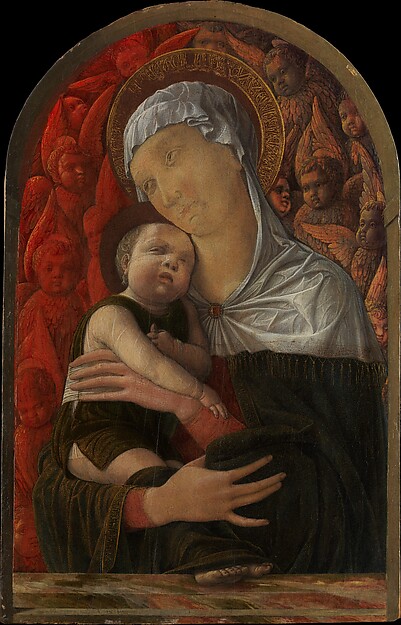
Andrea Mantegna was the leading painter of the Paduan school in the second half of the fifteenth century and the artist who, more than any other Italian master of his generation, brought the recovered language of classic…

Their faith
Why Andrea Mantegna painted Christ
Andrea Mantegna, a pivotal figure in the Paduan school of painting, dedicated his life to merging the beauty of classical antiquity with the profound themes of Christian faith. Born around 1431 near Padua, Mantegna was deeply influenced by his apprenticeship under Francesco Squarcione, whose passion for Roman art ignited Mantegna's own reverence for sacred subjects. His marriage to Nicolosia, daughter of the renowned painter Jacopo Bellini, further rooted him within a family of artists committed to the Christian tradition. As court painter for the Gonzaga family in Mantua, Mantegna's work was not only a reflection of his artistic prowess but also a testament to his devotion, as he created altarpieces and devotional panels imbued with spiritual significance. His approach to scripture and the sacred was marked by a desire to convey the divine through his art, showcasing a lifetime of commitment to his faith.
Mantegna's faith profoundly influenced his artistic vision, particularly evident in masterpieces such as the San Zeno Altarpiece and The Lamentation of Christ. In the San Zeno Altarpiece, Mantegna presents a serene Madonna surrounded by saints, inviting viewers into a sacred space that reflects both Renaissance beauty and deep reverence for the divine. The Lamentation of Christ, with its striking foreshortening, powerfully captures the pathos of Christ's sacrifice, drawing the viewer into a moment of profound grief and reflection. Through these works, Mantegna not only illustrated biblical narratives but also expressed his own spiritual journey, inviting all who encounter his art to experience the beauty of faith. His devotion continues to resonate, reminding us of the sacred connection between art and spirituality, and how the legacy of his faith-infused creations still inspires viewers today.
Life & work
Andrea Mantegna was the leading painter of the Paduan school in the second half of the fifteenth century and the artist who, more than any other Italian master of his generation, brought the recovered language of classical antiquity into Italian Christian painting. Born around 1431 near Padua, apprenticed to the painter Francesco Squarcione (whose archaeological enthusiasm for Roman fragments in the Padua workshop shaped Mantegna's lifelong love of carved reliefs and stone surfaces), and married into the Bellini family of Venice — Jacopo Bellini's daughter Nicolosia became his wife in 1453, making Giovanni and Gentile Bellini his brothers-in-law — he served as court painter at the Gonzaga court in Mantua from 1460 until his death in Mantua in 1506.
His Christian religious work is concentrated in altarpieces and devotional panels of unusual sculptural intensity. The San Zeno Altarpiece (1457–1459) for the church of San Zeno in Verona — Madonna and saints in a Renaissance loggia, with predella panels of the Crucifixion, the Resurrection, and the Agony in the Garden (the predella now in the Louvre and Tours) — is the central monument of his early style. The Lamentation of Christ (Brera, Milan, c. 1480), with its famously foreshortened body of Christ on a marble slab seen from the soles of the feet, is one of the most reproduced single religious images of the Italian Renaissance. The Saint Sebastian paintings in Vienna, the Louvre, and the Ca' d'Oro in Venice, the Presentation in the Temple (Berlin), and the Madonna della Vittoria (Louvre, 1496) round out his religious output.
His most famous secular project, the Camera degli Sposi (Bridal Chamber) in the Ducal Palace of Mantua, painted between 1465 and 1474, includes the great trompe l'oeil oculus on the ceiling — putti, women, and a peacock looking down through a balustrade open to the sky — that is the founding work of Italian illusionistic ceiling painting and the direct technical ancestor of Correggio's Parma cupolas a generation later.
He was equally a major engraver. The seven or so plates plausibly attributed to his own hand — the Battle of the Sea Gods, the Bacchanal with the Wine Vat, the Risen Christ between Saints Andrew and Longinus — are among the technical landmarks of late-fifteenth-century Italian printmaking and were copied throughout Europe. Albrecht Dürer, on his second Italian trip in 1505, traveled to Mantua specifically to meet him and arrived just after Mantegna's death.
Notable works in detail
met-436966
The Adoration of the Shepherds, painted by Andrea Mantegna around 1450 in tempera and gold on canvas transferred from wood and now in the Metropolitan Museum of Art in New York, is among the earliest surviving Mantegna paintings and a defining statement of the new Paduan style of figural sculpture-into-painting that he was developing in his early twenties. The composition shows the Holy Family on the left under a small thatched lean-to, with two shepherds approaching from the right across a craggy rocky landscape that looks more carved than painted; the Christ Child lies on the ground in the swaddling cloth typical of the late-medieval Northern Italian tradition, and the Virgin and Joseph kneel before him in postures of slow tender adoration. The chromatic palette of warm browns, ochres, and faded gold against the grey rocky landscape is unmistakably Mantegna; the painting entered the Metropolitan in 1932 from the Henry G. Marquand bequest.
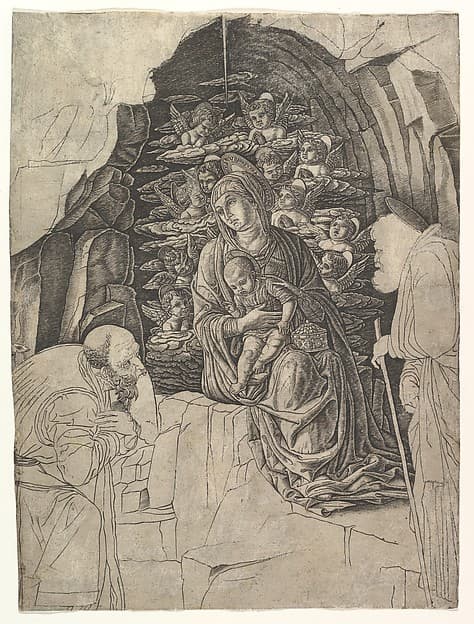
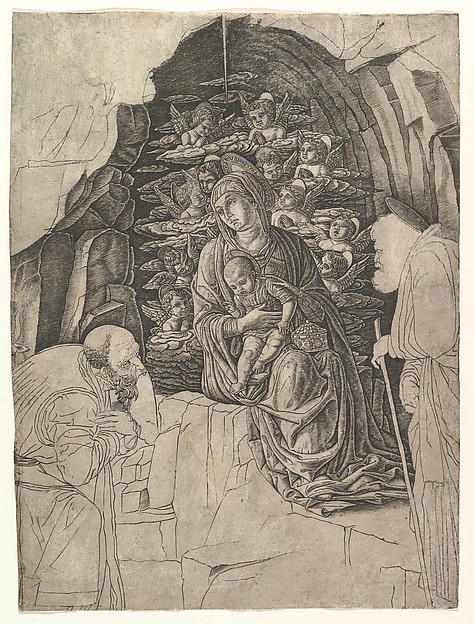
The Adoration of the Magi, designed by Andrea Mantegna around 1470 and engraved by his workshop, is among the surviving prints of his independent printmaking career — the small body of about seven engravings traditionally attributed to Mantegna's own hand or to immediate workshop members trained directly by him. The composition shows the three Magi approaching the Holy Family in a classical Renaissance setting of low marble ruins and broken columns, with the small star above the lean-to and a panoramic Italian landscape stretching into the distance. Mantegna's prints were among the technical landmarks of late-fifteenth-century Italian engraving and were copied throughout Europe; Albrecht Dürer specifically traveled to Mantua in 1505 hoping to meet the older master, only to find him just dead. The print is one of the principal Mantegna engravings in any American collection.
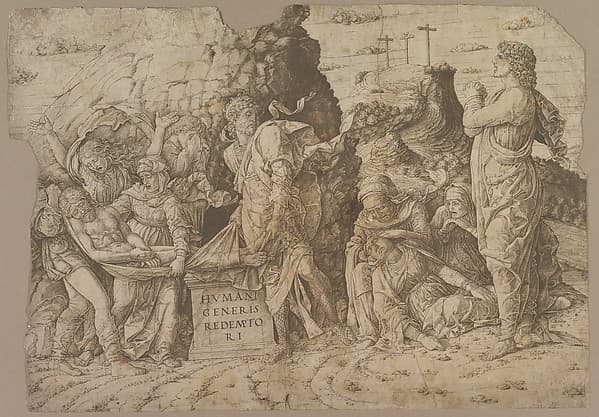
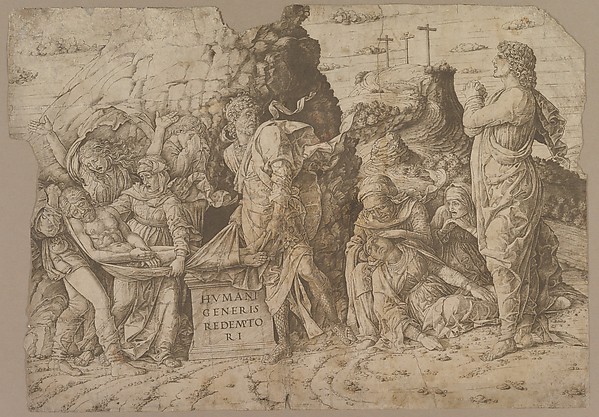
The Entombment of Christ, designed by Andrea Mantegna around 1475 and engraved by his workshop, depicts the moment after the Crucifixion when the body of Christ is being lowered into the rock-cut tomb. The composition shows the body laid horizontally across the foreground, with the Virgin, John the Evangelist, and Joseph of Arimathea gathered around it in postures of grief; the rocky tomb opening in the background is rendered with Mantegna's characteristic relish for sculpted stone and complex foreshortening. The print circulated through Italian and Northern European print collections in editions throughout the late fifteenth and early sixteenth centuries and shaped the iconographic tradition of the Entombment subject for several generations of subsequent printmakers.
met-372965
The Risen Christ between Saints Andrew and Longinus, designed by Andrea Mantegna around 1470 and engraved by his workshop, depicts the risen Christ flanked by the apostle Andrew (with his X-shaped cross) and the centurion Longinus (with the lance that pierced Christ's side at the Crucifixion and that became one of the principal medieval relics of the Passion). The composition arranges the three figures in a strict frontal symmetry against a dark neutral background, with Christ in the center holding the staff of the Resurrection. The choice of subject — the risen Christ flanked by these two specific saints — points to a Mantuan provincial commission or print intended for the cult of the Holy Blood at the Mantuan basilica of Sant'Andrea, where the relic of the lance and a relic of the blood were both venerated. The print is among the most ambitious of Mantegna's surviving engraved compositions.
met-459415
The Descent into Limbo, designed by Andrea Mantegna around 1436 (or, more probably, in the 1470s — the dating of the print is contested) and engraved by his workshop, illustrates the apocryphal Harrowing of Hell — the tradition that Christ between his death on Friday and his Resurrection on Sunday descended into the underworld to free the souls of the just who had died before his Incarnation. Mantegna's composition shows Christ at the lower right standing at the entrance to the cavernous underworld; Adam and Eve and the patriarchs reach toward him from the open mouth of hell on the left; small figures of the damned writhe in the darkness behind them. The treatment of the rocky cave architecture and the carved-stone figures is characteristically Mantegna; the print is among the most reproduced of his surviving engraved compositions.
Bible scenes Andrea Mantegna painted
Luke
Matthew