Painter of the Bible
Botticelli
Sandro Botticelli — born Alessandro di Mariano Filipepi in Florence in 1445, called Botticelli (little barrel) probably from the nickname of an older brother — was one of the most accomplished and most identifiable painters of the Florentine Quattrocento.

Their faith
Why Botticelli painted Christ
Sandro Botticelli, born Alessandro di Mariano Filipepi, was a devout Christian whose faith profoundly influenced his artistic journey. Trained under the guidance of Fra Filippo Lippi, Botticelli's early works reflect a deep reverence for scripture and the sacred narratives of Christianity. His connection to the Medici family, who were known patrons of the arts and devout Catholics, provided him with a platform to explore and express his faith through art. Botticelli's later life was notably shaped by the fervent preaching of Girolamo Savonarola, a Dominican friar whose apocalyptic messages stirred Botticelli's spiritual convictions and led him to create more austere religious works. This transformation illustrates how Botticelli's faith was not merely a backdrop but a driving force in his creative expression.
Botticelli's paintings, such as the 'Madonna del Magnificat' and 'Mystic Nativity,' reveal the depth of his spiritual vision. In 'Madonna del Magnificat,' the Virgin Mary is depicted in a moment of divine grace, surrounded by angels, showcasing Botticelli's ability to convey the beauty of faith and devotion. Similarly, the 'Mystic Nativity' reflects Botticelli's response to the turbulent times he lived in, presenting a vision of hope and redemption amidst chaos. Through his art, Botticelli invites viewers into a contemplative space where they can experience the sacred and the divine. His unwavering devotion continues to resonate with audiences today, reminding us of the timeless connection between faith and creativity.
Life & work
Sandro Botticelli — born Alessandro di Mariano Filipepi in Florence in 1445, called Botticelli (little barrel) probably from the nickname of an older brother — was one of the most accomplished and most identifiable painters of the Florentine Quattrocento. Trained in the goldsmith trade in his youth and then in painting under Fra Filippo Lippi (whose son Filippino Lippi later became Botticelli's own pupil), he ran one of the leading Florentine workshops through the 1470s and 1480s and worked under the patronage of the Medici and their circle until the political upheavals of the 1490s. He died in Florence in 1510.
His mythological masterpieces — the Primavera (c. 1482), the Birth of Venus (c. 1486), the Pallas and the Centaur, the Venus and Mars — have made him a popular emblem of the Italian Renaissance, but the bulk of his output was Christian religious painting. The Madonna del Magnificat (Uffizi, c. 1483), the Madonna of the Pomegranate (Uffizi, c. 1487), the Madonna of the Book (Milan, c. 1480), the Bardi Altarpiece (Berlin), the San Marco altarpiece, the great Coronation of the Virgin (Uffizi, 1490), the Adoration of the Magi panels in the Uffizi and Washington, the late Mystic Nativity (London, 1500), and the smaller predella panels of the Lives of Saint Zenobius and the Stories of the Virgin fill museums in Florence, Berlin, Madrid, London, and New York.
In 1481–1482 he worked in Rome on the wall frescoes of the Sistine Chapel — Old Testament scenes from the lives of Moses and Christ, painted before Michelangelo's ceiling and Last Judgment redirected attention to the higher walls. Botticelli's Sistine contributions include the Trials of Moses and the Temptations of Christ, both still on the chapel walls.
In the 1490s, deeply influenced by the apocalyptic preaching of the Dominican friar Girolamo Savonarola — who briefly held political power in Florence between 1494 and his execution in 1498 — Botticelli's late religious work turned harsher and more austere. The Mystic Nativity in London bears a hand-written Greek inscription identifying the painting as a vision of "the troubles of Italy in the year 1500." His drawings for an illustrated Dante's Divine Comedy (Berlin and the Vatican Library), commissioned by Lorenzo di Pierfrancesco de' Medici and left unfinished, are among the supreme drawn cycles of the Italian Renaissance.
Notable works in detail
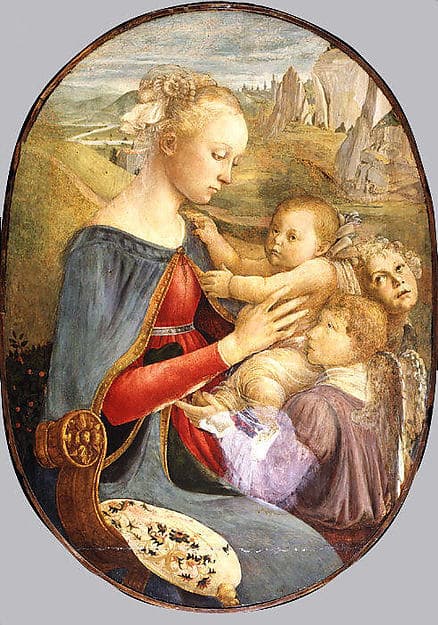
Madonna and Child with Two Angels
Madonna and Child with Two Angels, painted around 1464 in tempera on wood and now in the Metropolitan Museum of Art in New York, is one of the small early Madonnas from the years immediately after Botticelli left Fra Filippo Lippi's workshop and set up on his own in Florence. The Virgin sits in a window niche with the Christ Child standing on her lap, her right hand cradling his shoulder; two child angels — closer in age and expression to ordinary Florentine children than to celestial messengers — flank the niche, one looking out at the viewer, the other at the Christ Child. The chromatic palette of soft rose, sky blue, and pale gold; the elongated proportions of the Virgin's face; and the sweet melancholy that would become Botticelli's lifelong signature are all already present in this small early panel. The painting entered the Metropolitan's collection in the 1880s and remains one of the principal Botticelli devotional paintings in any American collection.
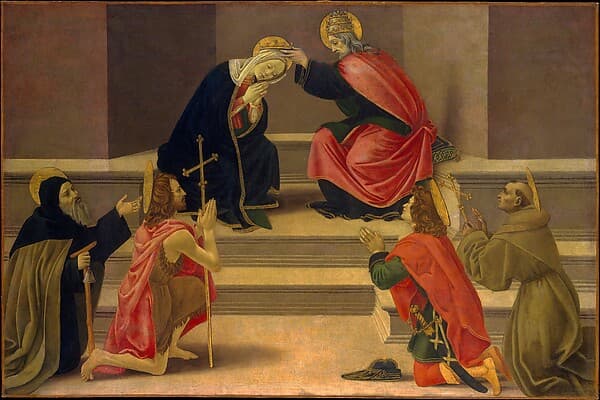
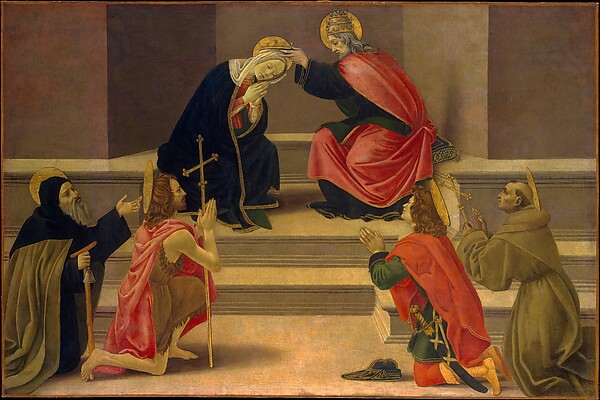
The Coronation of the Virgin, painted around 1475 and now in the Metropolitan Museum of Art in New York, shows the moment from the apocryphal Marian narrative in which Christ crowns his mother Queen of Heaven in the celestial court. The Virgin kneels in the lower foreground, her hands folded; Christ floats above her in a circle of seraphim, lowering the crown onto her bowed head; an angel choir surrounds the central pair on every side. The composition follows the Florentine Quattrocento conventions for the subject worked out by Filippo Lippi and Verrocchio in the previous generation, but the soft chromatic palette, the elongated proportions of both figures, and the unmistakable melancholy of the Virgin's face are distinctively Botticelli. The painting was once part of the Cook Collection at Richmond and entered the Metropolitan in the early twentieth century; it remains one of the principal Botticelli religious paintings in any American collection.
Bible scenes Botticelli painted
Luke
Matthew
Galatians
Romans
Isaiah

.jpg?width=800)