Painter of the Bible
Giorgio Ghisi
Giorgio Ghisi was a Mantuan-born engraver of the second quarter of the sixteenth century and one of the principal Italian reproductive printmakers who carried the Marcantonio engraving tradition through the middle decades of the Cinquecento.

Their faith
Why Giorgio Ghisi painted Christ
Giorgio Ghisi, born in Mantua around 1520, was deeply influenced by the rich Christian heritage of his Italian surroundings. Trained under the esteemed Giulio Romano, a pupil of Raphael, Ghisi's artistic journey was steeped in the traditions of the Catholic faith that permeated the art of the Cinquecento. His work primarily consisted of engravings that reproduced the masterpieces of great artists like Raphael and Michelangelo, reflecting a reverence for the divine narratives they portrayed. The act of engraving these sacred subjects was not merely a technical endeavor for Ghisi; it was a devotional practice that allowed him to engage with scripture and the teachings of Christ. His meticulous attention to detail and the spiritual significance of his subjects reveal a heart committed to honoring his faith through art.
This devotion is most evident in his renowned engravings, such as the reproduction of Raphael's "School of Athens," which, while depicting philosophers, embodies the pursuit of truth that resonates with Christian teachings. Additionally, Ghisi's original work, "Allegory of Life," presents a contemplative scene that invites viewers to reflect on the spiritual journey of existence. Through these works, Ghisi not only carried forward the legacy of the Italian Renaissance but also infused his art with a sense of sacred purpose. His engravings continue to inspire viewers today, serving as a bridge between the divine and the artistic, reminding us of the beauty that arises when faith and creativity intertwine.
Life & work
Giorgio Ghisi was a Mantuan-born engraver of the second quarter of the sixteenth century and one of the principal Italian reproductive printmakers who carried the Marcantonio engraving tradition through the middle decades of the Cinquecento. Born in Mantua around 1520, trained in Mantua in the orbit of Giulio Romano (Raphael's principal Roman pupil who had moved to Mantua in 1524 to serve the Gonzaga ducal court), and active in Mantua, Rome, Antwerp (where he worked under Hieronymus Cock at Aux Quatre Vents in the 1550s), and finally Mantua again, he died in Mantua in 1582.
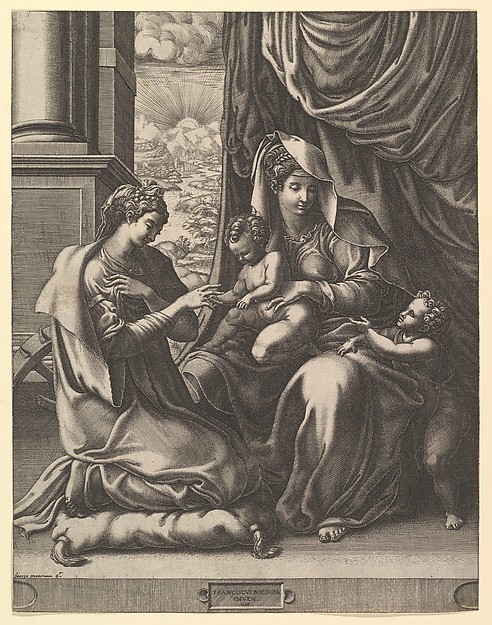
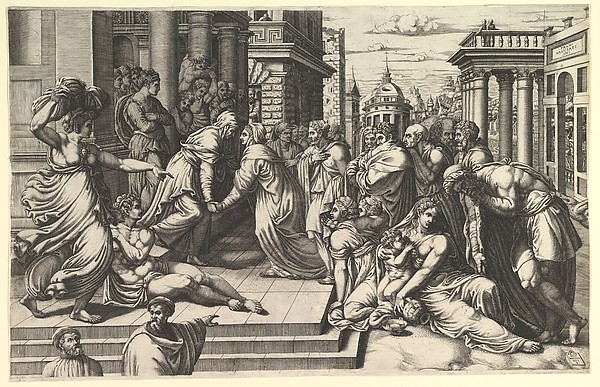
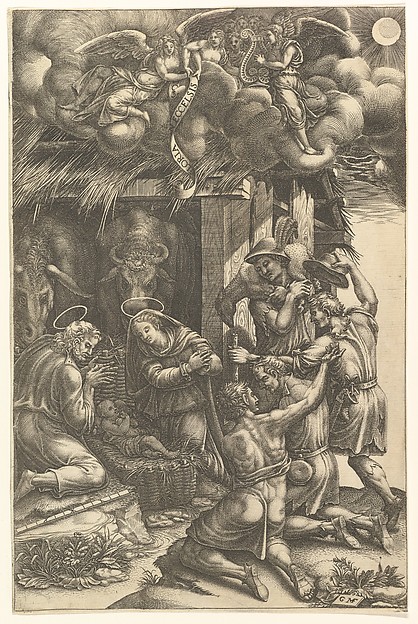
His Christian religious work is concentrated in engraved reproductions of paintings by Raphael, Michelangelo, Giulio Romano, and the great Italian Cinquecento masters whose compositions Ghisi's plates carried into the European print market. The reproductive engraving of Raphael's School of Athens (Antwerp, 1550 — Ghisi's most famous single plate, a vast architectural composition of the philosophers of antiquity gathered around Plato and Aristotle that became the canonical visual reference for Raphael's Vatican fresco), the great Last Judgment of Michelangelo (Antwerp, 1543 — actually engraved by the slightly older Mantuan engraver Niccolò della Casa, but completed and published with Ghisi's contribution), the Raphael Madonnas, the Allegory of Life (Ghisi's own original composition of 1561, an enigmatic allegorical scene of an old man on a barren island consulting an oracle), and the great series of Stanza della Segnatura plates fill the painted corpus.
His personal style — careful, patient, with finely worked engraved lines and a particular ability to render the Italian Cinquecento Mannerist figural elongation and complex foreshortening in the engraved medium — distinguished his work from his Roman contemporaries Bonasone and Cherubino Alberti. The Antwerp years in particular gave Ghisi an international reach: Cock's distribution network carried Ghisi's plates throughout the European print market and shaped the Northern European reception of the Italian High Renaissance for at least a generation.
He worked in close professional dialogue with the broader mid-Cinquecento Italian reproductive-engraving tradition. The eighteenth-century French and English connoisseurs collected Ghisi's plates as touchstones of mid-sixteenth-century Italian printmaking technique.