Painter of the Bible
Giovanni Benedetto Castiglione (Il Grechetto)
Giovanni Benedetto Castiglione, called Il Grechetto for his early Greek-themed work, was the leading Genoese painter of the seventeenth century and a major innovator in printmaking and oil-on-paper technique.

Their faith
Why Giovanni Benedetto Castiglione (Il Grechetto) painted Christ
Giovanni Benedetto Castiglione, known as Il Grechetto, was a deeply devoted Christian whose faith was intricately woven into his artistic practice. Born in Genoa in 1609, Castiglione's upbringing in a vibrant city steeped in Catholic tradition undoubtedly influenced his spiritual outlook. His training under notable artists and his extensive travels throughout Italy exposed him to a variety of artistic styles, yet his heart remained anchored in the biblical narratives that defined his most significant works. Castiglione's fascination with pastoral scenes and biblical journeys reflects a profound reverence for scripture, as he often portrayed the lives of Old Testament patriarchs in his art. His commitment to depicting these sacred stories was not merely for aesthetic pleasure but a means of sharing his faith with the world, allowing viewers to witness the divine through his brushstrokes.
Castiglione's paintings, such as "The Journey of Abraham" and "The Adoration of the Shepherds," reveal his spiritual vision and dedication to illustrating the beauty of biblical narratives. In these works, he masterfully combines his love for animals and landscapes with profound theological themes, inviting the viewer to reflect on the divine journey of faith. His innovative techniques, particularly in oil-on-paper, allowed him to create works that were both visually stunning and spiritually enriching. Through his art, Castiglione not only captured the essence of biblical stories but also conveyed a message of hope and devotion that continues to resonate with audiences today. His legacy as a Christian artist endures, inspiring countless viewers to see the beauty of faith mirrored in the world around them.
Life & work
Giovanni Benedetto Castiglione, called Il Grechetto for his early Greek-themed work, was the leading Genoese painter of the seventeenth century and a major innovator in printmaking and oil-on-paper technique. Born in Genoa in 1609, trained in his home city in the workshops of Giovanni Andrea de Ferrari and Sinibaldo Scorza (whose specialty in the painting of animals shaped Castiglione's lifelong devotion to the genre), he traveled extensively — to Rome (where he absorbed Poussin and the Bamboccianti), to Naples, to Mantua, and finally to the Gonzaga court at Mantua, where he settled in 1651 and worked as court painter until his death in Mantua in 1664.
His Christian religious work is concentrated in pastoral biblical narratives — subjects in which a procession or a journey through landscape allowed him to combine his fascination with animal painting and his interest in the patriarchal Old Testament. The Journey of Abraham (Royal Collection, Windsor), the Journey of Jacob (multiple versions, the most famous in the Genoa Galleria di Palazzo Bianco), the Adoration of the Shepherds, the Crossing of the Red Sea, the Sacrifice of Noah, and the great Genesis cycles — sheep, cattle, camels, dogs, and household goods winding through Italianate landscapes — became his signature compositions and were reproduced in painting, drawing, and etching across Europe.
His drawings on prepared blue or buff paper, often in oil with the brush rather than in chalk or ink, are among the earliest sustained uses of brushed oil on paper as a finished autonomous medium — a technique he largely invented and that the eighteenth century would develop further. The drawings of pagan sacrifices, biblical patriarchs, and the late Allegory of Vanitas count among the most-collected Italian seventeenth-century sheets.
He invented the monotype around 1640 — a single-impression printmaking technique in which the artist paints directly onto the metal plate before pulling a single print from the wet ink — and was its principal seventeenth-century practitioner. The Genius of Castiglione (etching, 1648), his self-portrait as a winged figure surrounded by the instruments of art, summarizes his ambitious self-conception.
His son Francesco Castiglione continued the workshop after his death; his style was a major influence on the eighteenth-century Venetian school of Tiepolo and on the Romantic painters of the early nineteenth century who rediscovered him as a forerunner.
Notable works in detail
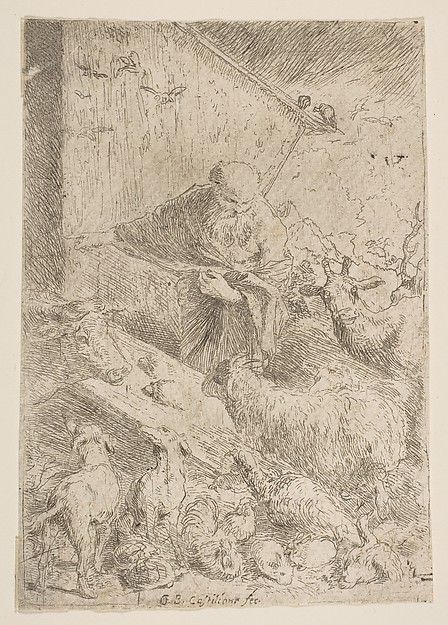
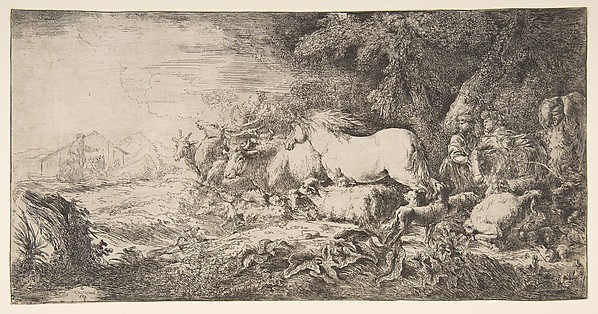
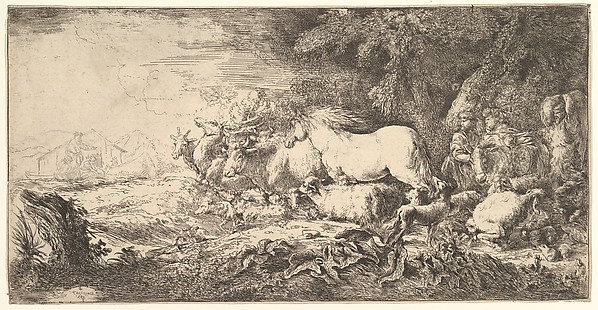
Noah Entering the Ark, etched by Giovanni Benedetto Castiglione around 1655 (the dating of his prints is somewhat contested) and now in the Metropolitan Museum of Art in New York, illustrates the moment from Genesis 7 in which the patriarch Noah leads his family and the pairs of animals into the Ark before the great Flood. Castiglione composes the scene as a panoramic procession: Noah and his family in the foreground leading a long winding line of cattle, sheep, dogs, camels, horses, and exotic animals across an Italianate landscape toward the great wooden vessel waiting on the right side of the print. The composition demonstrates Castiglione's signature combination of pastoral biblical narrative and his lifelong fascination with the painting of livestock — the genre at which he excelled above any other Italian artist of the seventeenth century. The print is among the most reproduced of his etched Genesis cycle.
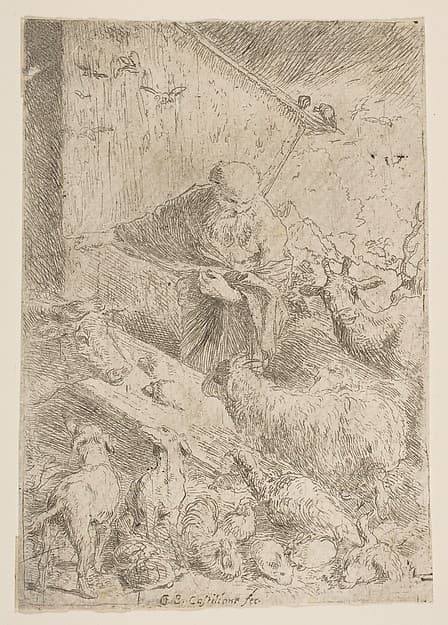
Noah letting the animals into the ark
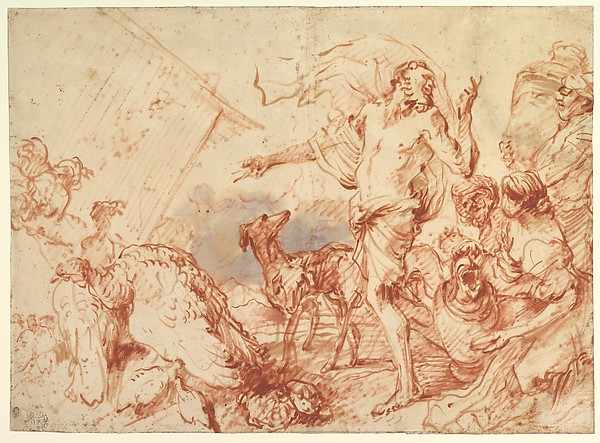
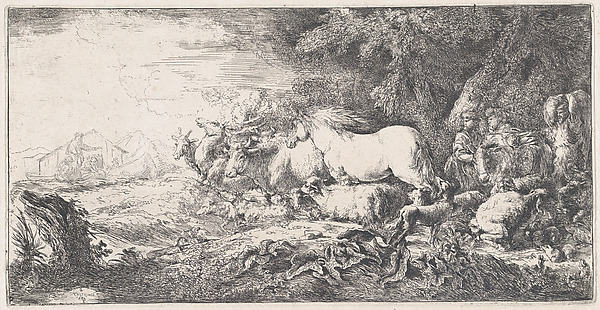
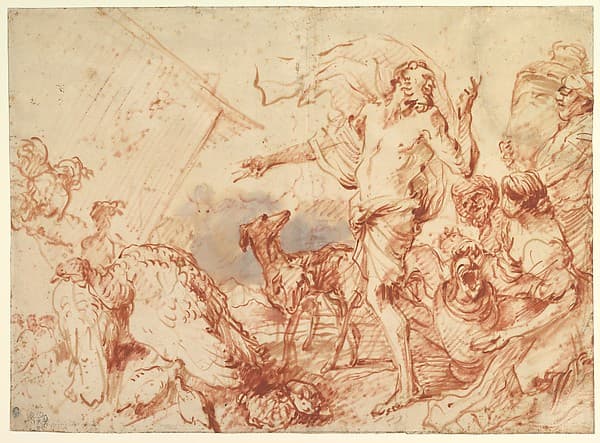
Noah Letting the Animals into the Ark, drawn by Giovanni Benedetto Castiglione around 1625 in oil on paper (a medium Castiglione largely invented and made his own) and now in the Metropolitan Museum of Art in New York, is a large autonomous brush-drawing of one of his favorite Old Testament subjects. The composition shows the Ark on the right side of the sheet with Noah waiting at the gangway, while the long line of animals winds across the foreground and the background — cattle, horses, lions, dogs, sheep, exotic birds — each rendered with the characteristic Castiglione fascination with animal anatomy and texture. The technique — oil paint applied with the brush directly onto blue or buff prepared paper — was Castiglione's principal contribution to the seventeenth-century drawing tradition and the immediate ancestor of the eighteenth-century brush-drawing technique that Tiepolo and Boucher would develop.
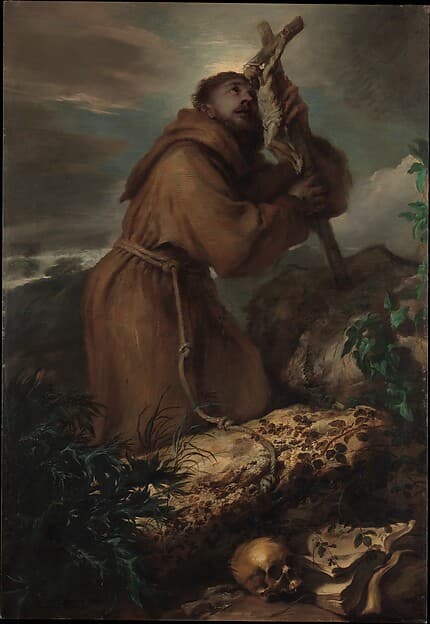
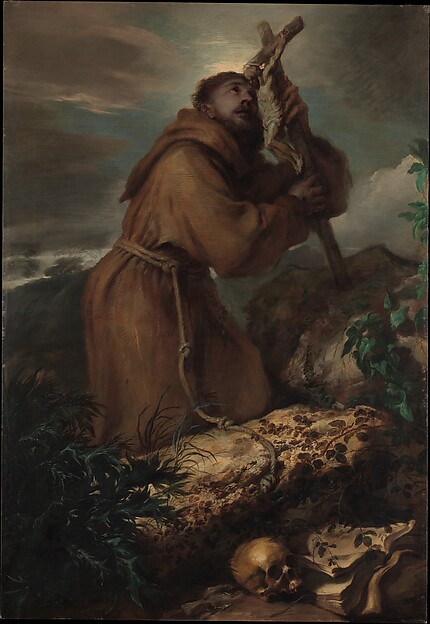
Saint Francis in Ecstasy, drawn by Giovanni Benedetto Castiglione around 1645 in oil on prepared paper and now in the Metropolitan Museum of Art in New York, depicts the medieval Italian Franciscan saint in the moment of his receiving the stigmata on Mount La Verna in 1224. Castiglione stages the scene as a vertical mystical encounter: the saint kneels in profile in the lower left, his arms outstretched, his face lifted in ecstasy toward the upper-right where the seraphic vision of the wounded Christ appears in a luminous burst of light, the wounds of the stigmata rendered as small lines of golden energy descending toward the saint's hands and side. The drawing is among the principal late-Castiglione brush-drawings on the Saint Francis subject and a defining example of the painter's brushed-oil technique at full mature statement.
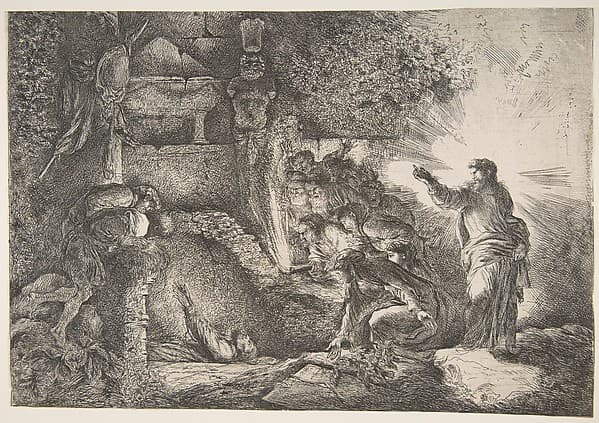
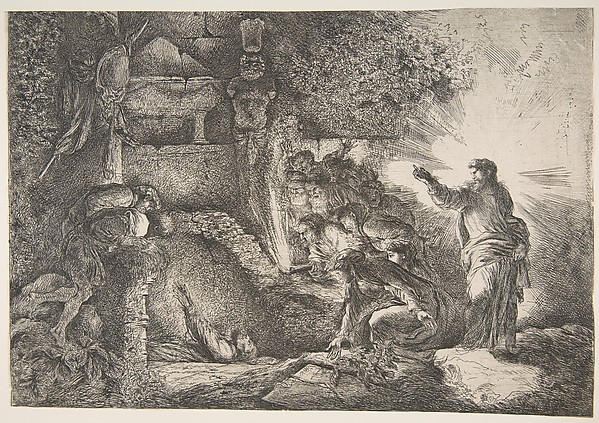
Raising of Lazarus, etched by Giovanni Benedetto Castiglione around 1645 and now in the Metropolitan Museum of Art in New York, illustrates the climactic miracle of John 11. Castiglione composes the scene with characteristic dramatic compositional density: Christ at the lower left with his right arm extended in command, the bound figure of Lazarus emerging upright from the open tomb at the upper right, the sisters Martha and Mary kneeling between them at Christ's feet, and a small crowd of witnesses gathered behind. The print demonstrates Castiglione's mature etching technique — long swelling lines, dense crosshatched shadow, and the characteristic Italianate landscape that fills the background — and is one of the principal Castiglione religious etchings in any American collection.