Painter of the Bible
Giovanni Domenico Tiepolo
Giovanni Domenico Tiepolo (also called Giandomenico Tiepolo) was the eldest son and principal heir of the supreme Italian fresco painter Giovanni Battista Tiepolo, and was himself one of the leading Italian decorative pa…

Their faith
Why Giovanni Domenico Tiepolo painted Christ
Giovanni Domenico Tiepolo, the son of the renowned fresco artist Giovanni Battista Tiepolo, was deeply embedded in the Christian tradition from an early age. Growing up in a household where art and faith intertwined, Domenico was trained in his father's workshop, absorbing the devotional spirit that characterized his father's work. His early commission, the Stations of the Cross fresco cycle in San Polo, showcases not only his artistic talent but also his commitment to expressing the Christian narrative through art. As a member and the first president of the Venetian Accademia di Belle Arti, Tiepolo was influential in promoting the integration of faith and creativity, reflecting a life dedicated to the glory of God through artistic expression.
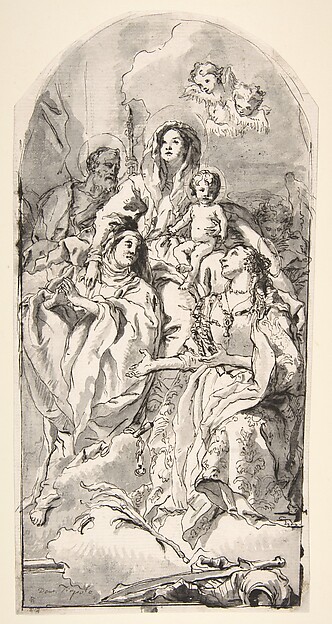
Domenico's faith significantly shaped his artistic output, particularly in his altarpieces and devotional works. His collaborations with his father often involved him painting secondary figures and architectural settings that enhanced the spiritual narratives being depicted. Notably, his Madonna and Saints altarpieces reveal a deep reverence for the divine, capturing the beauty and sanctity of these figures in a manner that invites viewers into a contemplative experience. Even in his later works, such as the Punchinello drawings, while they may parody religious themes, they still reflect a profound engagement with the spiritual and cultural life of Venice. Tiepolo's devotion resonates through his art, continuing to inspire viewers with a sense of the divine and the beauty of faith.
Life & work
Giovanni Domenico Tiepolo (also called Giandomenico Tiepolo) was the eldest son and principal heir of the supreme Italian fresco painter Giovanni Battista Tiepolo, and was himself one of the leading Italian decorative painters of the second half of the eighteenth century. Born in Venice in 1727, trained from his youth in his father's workshop, and active in close partnership with his father across the great fresco campaigns at the Würzburg Residenz (1750–1753), the Villa Valmarana ai Nani in Vicenza (1757), the Madrid Royal Palace (1762–1770), and other major commissions, he succeeded to direction of the Tiepolo workshop after his father's death in Madrid in 1770. He died in Venice in 1804.
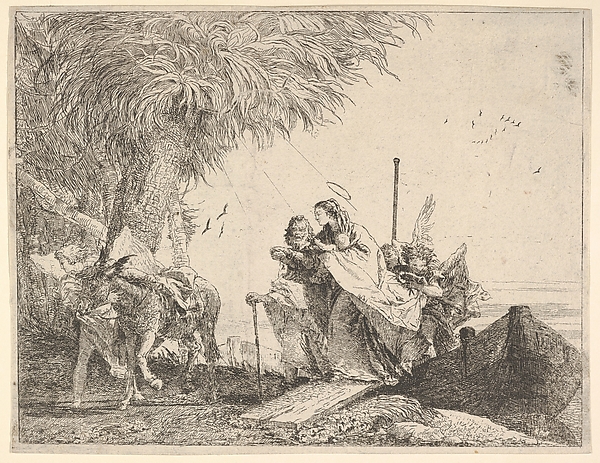
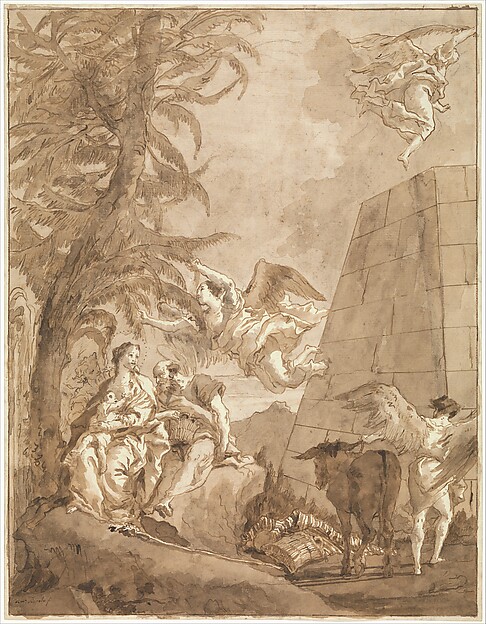
His Christian religious work is concentrated in altarpieces and small devotional canvases produced both in collaboration with his father (where Giandomenico typically supplied the secondary figures, the architectural settings, and the small predella narratives) and in his independent late career across Venice and the Veneto. The Stations of the Cross fresco cycle in San Polo in Venice (1747–1749 — Giandomenico's first major independent commission, painted while still a teenage assistant in his father's workshop), the great series of Punchinello drawings and frescoes (which sit somewhat outside conventional religious painting but include several biblical-subject parodies), the Madonna and Saints altarpieces produced after his father's death, and the late biblical narrative drawings produced in his last Venetian decade fill the painted-and-drawn corpus.
His personal style is closely modeled on his father's — the same luminous chalk-pink and electric blue chromatic palette, the same compositional vocabulary of vortex-like ceiling compositions and panoramic landscapes, the same rapid confident pen-and-wash drawing technique — but with a slightly cooler emotional register and a more idiosyncratic interest in scenes from everyday Venetian life. The Punchinello drawings of the late 1790s and early 1800s — comic-grotesque scenes of the masked Venetian carnival figure performing every conceivable secular and (parodically) religious action — are the principal idiosyncratic Giandomenico contribution to late-Tiepolo workshop output.
He was a member of the Venetian Accademia di Belle Arti and served as its first president from 1756.