Painter of the Bible
Guercino (Giovanni Francesco Barbieri)
Guercino — born Giovanni Francesco Barbieri in Cento, near Bologna, in 1591, called Guercino (the squinter) from a childhood eye injury — was one of the leading Bolognese painters of the seventeenth century and a major successor to the Carracci reform.

Their faith
Why Guercino (Giovanni Francesco Barbieri) painted Christ
Guercino, born Giovanni Francesco Barbieri, was deeply rooted in his Christian faith, which was evident throughout his life and work. Growing up in Cento, near Bologna, he honed his artistic skills under the influence of the Carracci family, who were known for their commitment to religious themes. Guercino's devotion was not just an aspect of his art; it permeated his daily life. He dedicated himself to creating sacred works, producing altarpieces and devotional panels that reflected his reverence for scripture and the divine. His refusal to leave Bologna for the allure of foreign courts later in life speaks to his commitment to his community and faith, choosing to serve local patrons and the church rather than pursue fame or fortune elsewhere.
This profound faith is beautifully encapsulated in works such as "The Burial of Saint Petronilla" and the "Vision of Saint Jerome." In these pieces, Guercino employed dramatic chiaroscuro and vibrant colors to convey deep spiritual narratives, inviting viewers to engage with the sacred stories of the saints. His ability to infuse emotion into his subjects reflects a heart attuned to the divine, demonstrating how his faith shaped his artistic vision. The reverence he held for Christ and the saints continues to resonate with viewers today, reminding us of the enduring power of devotion and the beauty that can emerge from a life dedicated to God.
Life & work
Guercino — born Giovanni Francesco Barbieri in Cento, near Bologna, in 1591, called Guercino (the squinter) from a childhood eye injury — was one of the leading Bolognese painters of the seventeenth century and a major successor to the Carracci reform. Trained in his native Cento and then in the orbit of Ludovico Carracci in Bologna, he was summoned to Rome in 1621 by the newly elected Pope Gregory XV (Alessandro Ludovisi, a Bolognese) and worked there during Gregory's brief two-year pontificate before returning to Bologna and Cento. He died in Bologna in 1666.
His Christian religious work is concentrated in altarpieces, ceiling frescoes, and devotional panels for Bolognese, Roman, and central-Italian patrons. The Aurora ceiling fresco in the Casino Ludovisi in Rome (1621–1623), painted as the response to the Aurora ceiling Guido Reni had completed at the nearby Palazzo Pallavicini-Rospigliosi a few years earlier, is the supreme statement of his early Roman style — a horse-drawn chariot of dawn rushing through illusionistic clouds. The Burial of Saint Petronilla (Capitoline Museums, Rome, 1623) — painted for old Saint Peter's and once installed there before being removed during the eighteenth-century renovations — is the principal Roman altarpiece survival.
The Bolognese religious commissions of his later career run for forty years and include the Madonnas of the Rosary, the Vision of Saint Jerome (Pinacoteca Nazionale, Bologna), the Miracle of Saint Peter (Vatican Pinacoteca), the Saint Bruno in the Charterhouse, the Et in Arcadia Ego (Galleria Nazionale d'Arte Antica, Rome) and a long sequence of single-figure devotional saints painted for Cento, Bolognese, and Mantuan patrons. The 1620s Roman style — dramatic chiaroscuro, deep saturated color, and a Caravaggesque emotional intensity — gave way after his return to Bologna to a more classicizing, lighter manner influenced by Reni's late style.
He kept careful business records — the famous Libro dei Conti, partially preserved, lists his commissions, prices, and the patrons who paid him — making him one of the better-documented artists of the Italian Baroque. Late in life he refused to leave Cento and Bologna for the major foreign courts that tried to recruit him; the Spanish king, the French queen mother, and Charles I of England all sent inquiries. He never married, lived modestly, and was buried in San Salvatore in Bologna.
Notable works in detail
met-338997
The Raising of Lazarus, drawn by Guercino around 1614 in pen and brown ink with brown wash on paper and now in the Metropolitan Museum of Art in New York, is among the early masterworks of his drawn output from the Bolognese years before his summons to Rome under Pope Gregory XV. The drawing illustrates the climactic miracle of John 11: Christ stands at the lower left with his right arm extended in command, while the bound figure of Lazarus emerges upright from the open tomb in the upper right; the sisters Martha and Mary kneel between them at Christ's feet, and a small crowd of witnesses fills the background. Guercino's characteristic combination of dramatic chiaroscuro built up in dense brown wash, confident pen outlines, and crowded narrative composition reaches mature statement here. The sheet is among the principal Guercino drawings in any American collection and entered the Metropolitan in 1962.
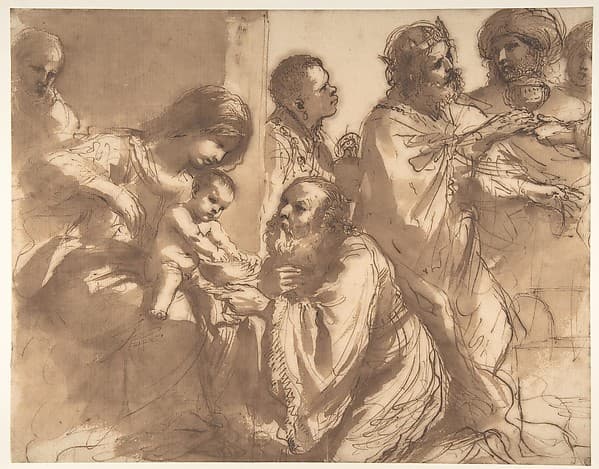
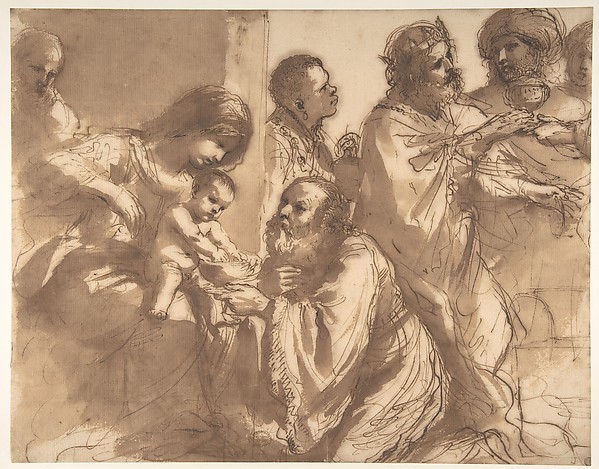
The Adoration of the Magi, drawn by Guercino around 1625 in pen and brown ink with brown wash on paper and now in the Metropolitan Museum of Art in New York, is from the central Roman-into-Bolognese phase of Guercino's career — the years immediately after his return from Rome following Pope Gregory XV's death. The drawing shows the Virgin and Christ Child seated under the small thatched lean-to of the Bethlehem stable while the three Magi approach in formal procession from the right; the eldest king kneels in profile in the foreground offering his gift, the second king stands waiting his turn, and the third king arrives with a small attending retinue at the rear. The composition demonstrates the late-mature Guercino's ability to organize a many-figured Adoration scene with the calm pictorial restraint that distinguished his Bolognese years from the more theatrical chiaroscuro of his Roman phase.
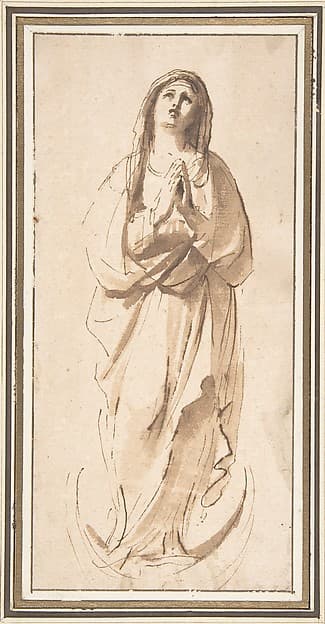
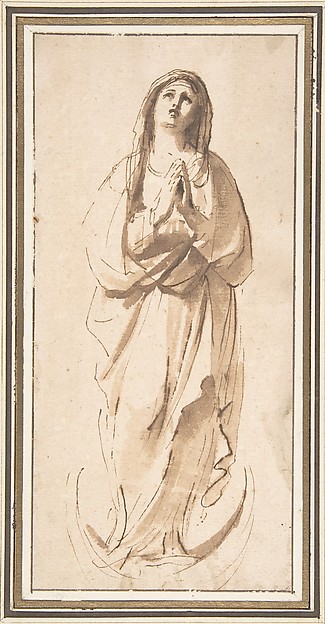
The Virgin Immaculate, drawn by Guercino around 1651 in pen and brown ink on paper and now in the Metropolitan Museum of Art in New York, is a late drawing from the final decade of his Bolognese career. The drawing shows the Virgin Mary as the woman of the Apocalypse described in Revelation 12 — standing on a crescent moon, her hands folded at her breast, surrounded by a circle of small attendant cherubs, her gaze upturned. The Catholic doctrine of the Immaculate Conception was a particular preoccupation of seventeenth-century Bolognese religious patronage, and the standing-Virgin-on-the-crescent type that Guercino works out here was the canonical visual treatment that subsequent Spanish and Italian painting (Murillo above all) would adopt and circulate across the Catholic world. The sheet is one of the principal late Guercino drawings in any American collection.
met-339080
Saint Jerome Writing, drawn by Guercino in pen and brown ink with brown wash on paper from his early Bolognese workshop period and now in the Metropolitan Museum of Art in New York, depicts the early Church Father seated in his characteristic posture of scholarly attention — head lowered to a manuscript, quill in hand, his lion (the iconographic attribute that distinguishes Jerome from any other bearded saint) curled at his feet. Jerome's translation of the Bible into Latin (the Vulgate, completed around 405 AD) made him a particular favorite of Counter-Reformation patronage, and Guercino produced multiple painted and drawn treatments of the seated-Jerome subject across his career. The Met sheet is among the principal early Guercino drawings of the subject and demonstrates the rapid confident pen-and-wash technique that defined his draughtsmanship throughout his career.
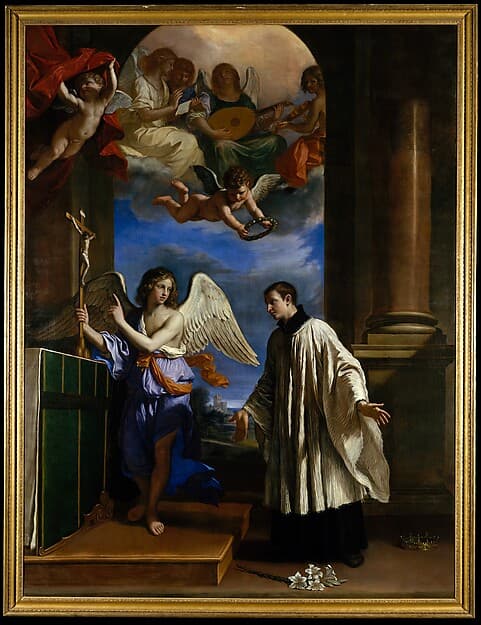
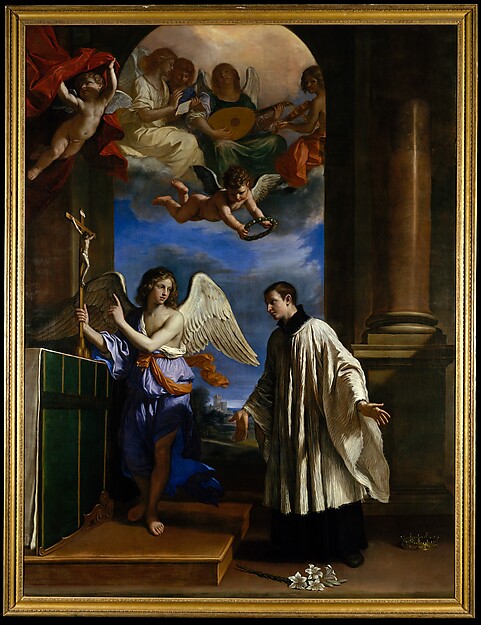
The Vocation of Saint Aloysius (Luigi) Gonzaga
The Vocation of Saint Aloysius (Luigi) Gonzaga, painted by Guercino around 1645 in oil on canvas and now in the Metropolitan Museum of Art in New York, depicts the moment in which the young Italian Jesuit saint, born into the noble Gonzaga family of Mantua and canonized in 1726, renounces his hereditary title and prepares to enter the Society of Jesus. Guercino stages the scene as a moment of vision: the young Aloysius kneels in profile at the lower right, an angel descends from the upper left bearing a lily of purity, and a small group of family attendants in the background represents the worldly inheritance the saint is in the act of refusing. The painting was commissioned in connection with Aloysius's ongoing seventeenth-century beatification process and is one of the principal late-Guercino works in any American collection.
Bible scenes Guercino (Giovanni Francesco Barbieri) painted
Luke
Matthew