Painter of the Bible
Sebald Beham
Sebald Beham was one of the leading German engravers of the second quarter of the sixteenth century and a member of the loose group known as the Little Masters — Albrecht Dürer's heirs in Nuremberg who specialized in tin…

Their faith
Why Sebald Beham painted Christ
Sebald Beham was a devout Protestant engraver whose faith was deeply intertwined with his artistic practice. Born in Nuremberg in 1500, he was trained in the circle of the renowned artist Albrecht Dürer, which profoundly influenced his approach to sacred art. Beham's radical beliefs led to his brief banishment in 1525 due to his Anabaptist sympathies, but he later embraced Lutheran orthodoxy, reflecting a journey of spiritual growth and commitment to the Reformation. Throughout his life, he produced works that not only showcased his technical prowess but also served as vehicles for his faith, illustrating biblical themes that resonated with the Protestant emphasis on scripture and personal devotion.
Beham's engravings, particularly his Old Testament series, such as the Story of David and the Story of Joseph, reveal his dedication to conveying biblical narratives in a way that was accessible and meaningful to the faithful. His small-format prints, designed to fit in the palm of one’s hand, invite viewers to engage intimately with the stories of scripture. The Passion of Christ series, along with his illustrations for the Biblische Historien, exemplifies how he sought to inspire devotion and reflection among his audience. Beham's art continues to inspire today, reminding us of the power of faith expressed through creativity and the enduring impact of biblical stories in our spiritual journeys.
Life & work
Sebald Beham was one of the leading German engravers of the second quarter of the sixteenth century and a member of the loose group known as the Little Masters — Albrecht Dürer's heirs in Nuremberg who specialized in tiny, technically virtuoso engravings on biblical, mythological, and allegorical subjects. Born in Nuremberg in 1500, trained in Dürer's circle (along with his older brother Barthel and the engraver Georg Pencz, all of whom were tried in 1525 for radical Protestant beliefs and briefly banished from the city), he eventually settled in Frankfurt in 1532 and worked there until his death in 1550.
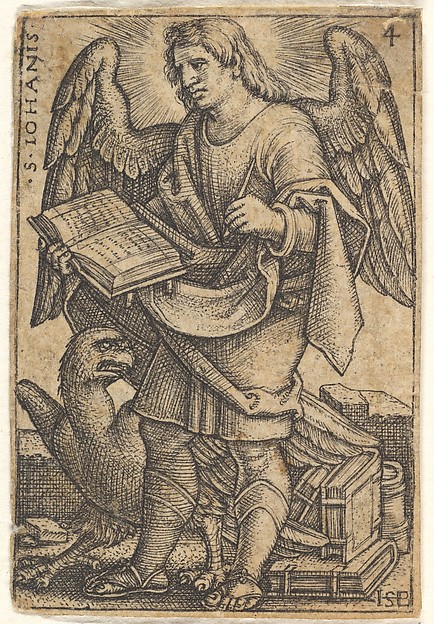
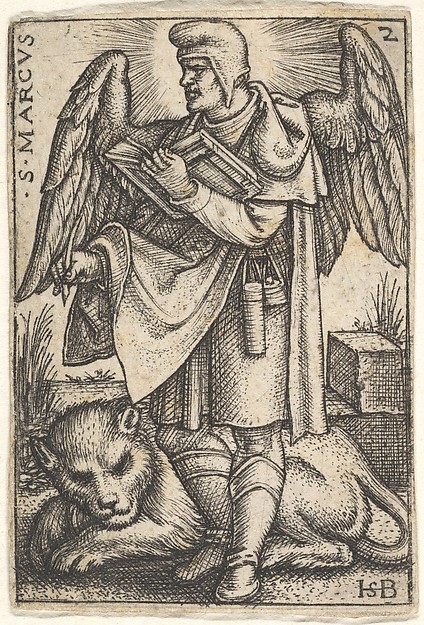
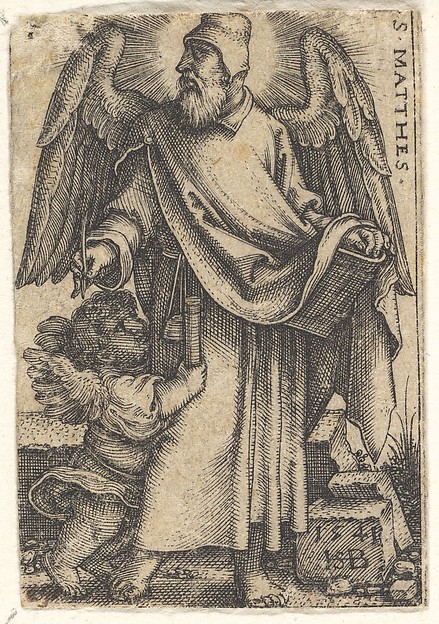
His religious output is concentrated in small-format engravings, woodcuts, and book illustration. The Old Testament series — including the Story of David, the Story of Joseph, the Patriarchs, the Prophets, and the Old Testament Heroes — and the New Testament cycles — the Apostles, the Beatitudes, the Eight Beatitudes, scenes from the Passion of Christ — circulated as both single-leaf prints and as components of devotional and emblematic books. He produced the woodcut illustrations for the Biblische Historien (Frankfurt, 1533, in editions through the next twenty years) and for several other vernacular biblical publications of the early Reformation period.
His Frankfurt years were prolific in the production of secular subjects as well — peasant dances, allegories of the months, mythological cycles, illustrations to Lucian and Aesop — but the religious work continued without break alongside the secular. He developed the Little Master format to its highest finish: prints small enough to fit in the palm of the hand, executed with engraved lines so close-set that they read at first glance as continuous tone, with biblical or allegorical narratives compressed into the densest possible visual statement.
He was a Protestant his entire adult life. His banishment from Nuremberg in 1525 was for radical Anabaptist sympathies; he later moderated to Lutheran orthodoxy and held citizenship in Frankfurt with no further conflict. The Little Master prints of the 1530s and 1540s, his and his brother's together, count among the most-collected German Renaissance prints of any period and shaped the engraved devotional image throughout the German-speaking lands.
Notable works in detail
met-334794
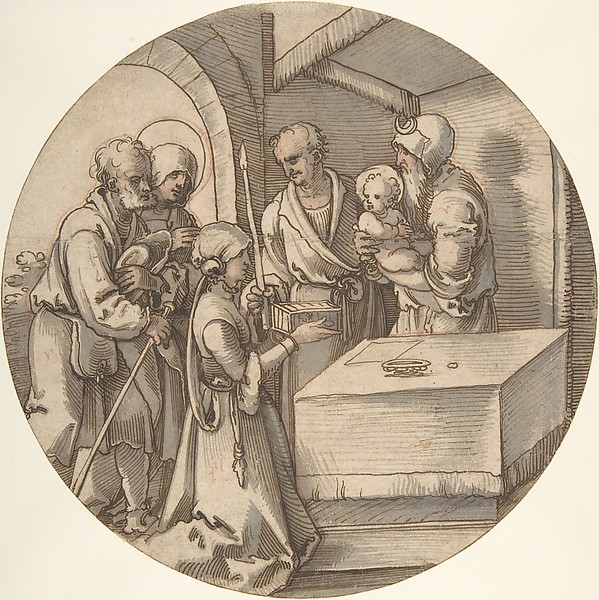
The Circumcision of Christ, engraved by Sebald Beham around 1510 in his early Nuremberg workshop years, depicts the moment from Luke 2 in which the infant Christ is brought to the Temple eight days after his birth for the ritual of circumcision required by the Mosaic law. Beham composes the scene with characteristic German Little Master density — the entire narrative compressed into a small print suitable for binding into prayer books or distribution at confraternity meetings. The priest stands at the small stone altar at the center holding the small instrument of circumcision; the Virgin stands behind on the right with her hands folded in attendance; Joseph waits at the back with the offering of the two doves required by the Mosaic law. The print belongs to the small-format devotional output of the Beham Nuremberg workshop in the years immediately before the 1525 banishment of the Beham brothers from the city for radical Protestant beliefs.
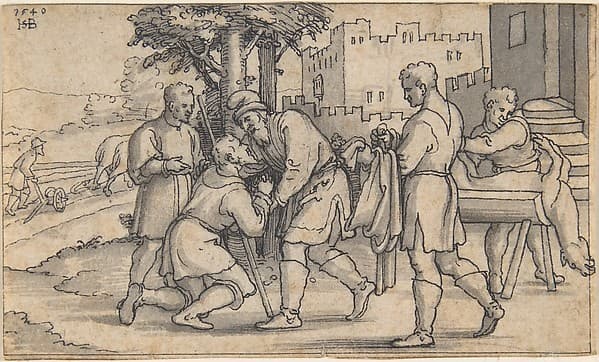
The Return of the Prodigal Son
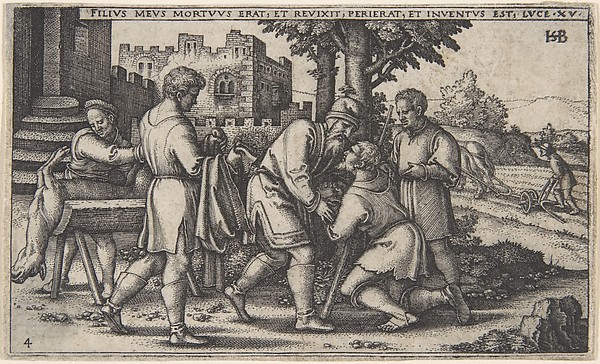
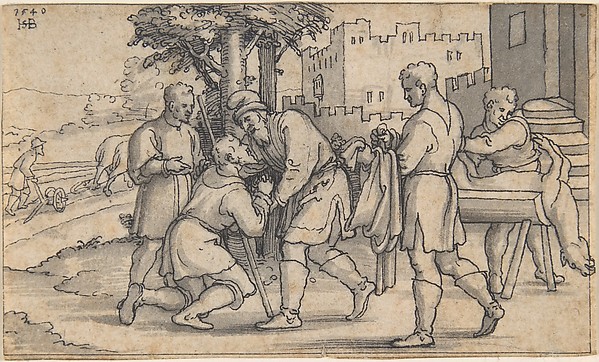
The Return of the Prodigal Son, engraved by Sebald Beham around 1540 in his Frankfurt workshop years, illustrates the climactic moment of the Luke 15 parable: the father runs to embrace his returning son who, having squandered his inheritance, has returned home to throw himself at his father's feet. Beham stages the scene as a small intimate vertical composition: the kneeling son in the foreground embraced by the standing father, the elder brother visible in the deeper background tending the flocks, the fatted calf being prepared for the celebratory meal at the upper left. The print belongs to the great Beham series of small-format Old and New Testament narratives produced in Frankfurt across the 1530s and 1540s for the German Reformation publishing market.
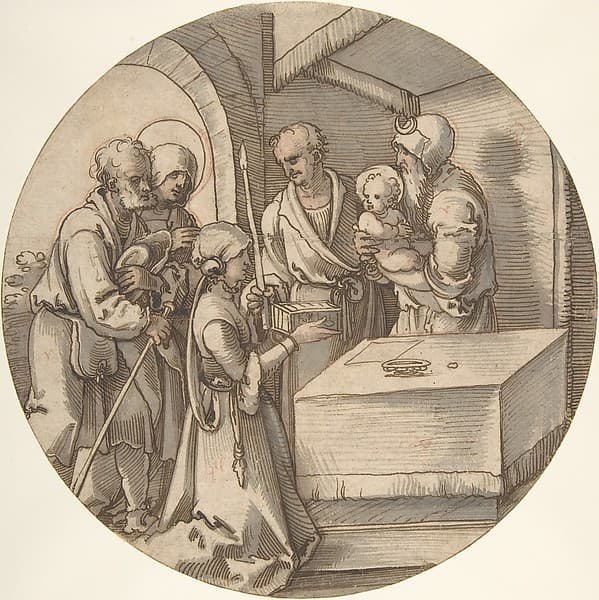
The Presentation of the Infant Jesus in the Temple
The Presentation of the Infant Jesus in the Temple, engraved by Sebald Beham around 1520 in his Nuremberg workshop years, depicts the moment from Luke 2 in which the infant Christ is brought to the Temple in Jerusalem on the fortieth day after his birth for the ritual of Mosaic purification. Beham composes the scene in a small architectural setting with characteristic German Little Master compression: the Virgin handing the Christ Child to the aged Simeon at the small stone altar, the prophet Anna in the background, Joseph at the lower right with the offering of the two doves required by the Mosaic law. The print belongs to the small-format Life of Christ devotional output of the Beham Nuremberg workshop, immediately before the 1525 trial of the Beham brothers and Georg Pencz for radical Protestant beliefs forced their temporary exile from the city.