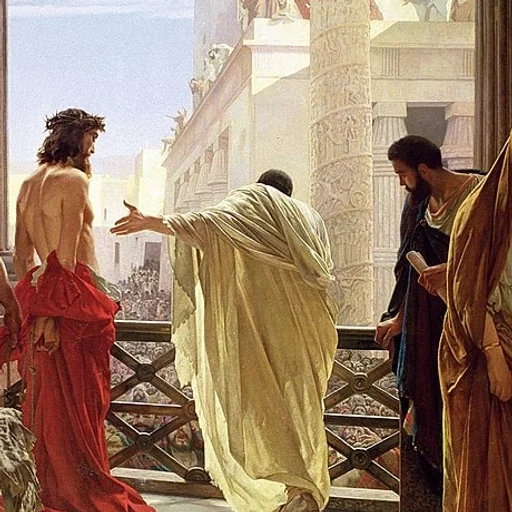
Who was Caiaphas in the Bible?
Caiaphas was the high priest who led the plan to put Jesus to death.
High Priest Who Condemned Jesus
1st century AD
Caiaphas was the high priest who led the plan to put Jesus to death.
Follow the reading trailBEYOND THE NAME
Caiaphas served as high priest in Jerusalem during the ministry of Jesus and presided over the council that sought to destroy Him. After the raising of Lazarus, he declared that it was better for one man to die for the people than for the whole nation to perish. He later questioned Jesus at His trial and judged Him worthy of death for claiming to be the Son of God.
FOLLOW THE PASSAGES
These are chapter studies associated with this record. Their order follows the books and chapters, rather than a reconstructed timeline of the person’s life.
presides over the high-priestly council that interrogates Jesus and condemns him for blasphemy
The hour Matthew has been pointing toward since the first shadow of the cross now arrives. Jesus says it plainly to His disciples: Ye know that after two days is the feast of the passover, and the Son of man is betrayed to be crucified (v. 2). He is not overtaken by events; He names them in advance. Meanwhile the chief priests and the elders gather in the palace of the high priest, Caiaphas, plotting how to take Him by subtilty and kill Him - though not, they decide, during the feast, for fear of the crowds. The chapter opens with the machinery of death quietly turning, and with Jesus walking into it on purpose.
Chapter overview from the authored study guide.joins the chief priests in asking Pilate to seal the tomb against any theft of the body
Everything in Matthew has been moving toward this chapter, and it opens at first light with the verdict already settled: When the morning was come, all the chief priests and elders of the people took counsel against Jesus to put him to death (v. 1). They bind Him and hand Him over to Pontius Pilate, the Roman governor - the only man in Jerusalem who can authorize an execution. But before the trial proper begins, the chapter turns aside to Judas, who has watched what his betrayal set in motion and cannot live with it.
Chapter overview from the authored study guide.high priest who presides over the trial of Jesus and condemns him for blasphemy
Mark 14 opens with the machinery of death quietly turning. After two days was the feast of the passover, and of unleavened bread: and the chief priests and the scribes sought how they might take him by craft, and put him to death (v. 1). They want Him dead, but not during the feast, lest there be an uproar of the people (v. 2). Against that dark backdrop Mark sets a scene of startling tenderness: at Bethany, in the house of Simon the leper, a woman breaks open an alabaster box of ointment of spikenard very precious and pours it on the Lord’s head.
Chapter overview from the authored study guide.presides over the council that questions Jesus about whether he is the Son of God
The feast of unleavened bread draws near, and the chief priests look for a way to kill Jesus without stirring up the crowds. Their opening comes from inside the circle: Then entered Satan into Judas surnamed Iscariot, being of the number of the twelve (v. 3). Judas goes to the priests and agrees to hand Jesus over for money. Meanwhile Jesus sends Peter and John to make ready the Passover, giving them a sign to follow - a man bearing a pitcher of water - and a furnished upper room where the meal will be eaten.
Chapter overview from the authored study guide.high priest who counsels the council that it is better for one man to die for the people
John has been building, sign by sign, toward this chapter - water made wine, a boy healed from a distance, a paralytic raised from his bed, five thousand fed, a man born blind given sight - and now he sets down the last and greatest sign before the cross. It opens with sickness and an appeal: Now a certain man was sick, named Lazarus, of Bethany (v. 1), and his sisters Mary and Martha send to Jesus the simplest of pleas, Lord, behold, he whom thou lovest is sick (v. 3). What follows is meant to unsettle us: When he had heard therefore that he was sick, he abode two days still in the same place where he was (v. 6).
Chapter overview from the authored study guide.high priest whose house serves as the venue for Jesus's initial Jewish interrogation
The long farewell of the upper room is over; now the Gospel turns to the night of the arrest. Jesus goes out with his disciples over the brook Cedron, where was a garden, a place He often used and that Judas therefore knew well (vv. 1-2). Judas comes with a band of men and officers from the chief priests and Pharisees… with lanterns and torches and weapons (v. 3) - a force armed against a man who has done nothing but teach in the open. What follows is unlike any arrest. Jesus, knowing all things that should come upon him, went forth, and said unto them, Whom seek ye? (v. 4).
Chapter overview from the authored study guide.THE PEOPLE AROUND THE PERSON
Recorded spouses
Relationships follow the source graph. Some are interpretive or uncertain, and individual verse citations are not yet available for every connection.
STUDY & INTERPRETATION
Caiaphas spoke more truth than he knew when he said one man should die for the people, for the Gospel notes that he was unknowingly prophesying how Jesus would die for the nation and gather God’s scattered children into one. As high priest he held an office meant to bring the people near to God through sacrifice, yet he used that office to engineer the death of the very One the sacrifices had pointed toward. His words and his actions together reveal the strange way God’s purpose moved forward even through those who opposed it. The death he intended for political safety became the means by which God offered salvation to the world.
From the Learn of Christ person commentary. Read alongside the linked Scripture passages.KEEP SCRIPTURE CLOSE
6 authored chapter guides feature this person. This is guide coverage, not an exhaustive count of biblical mentions.
ASK A BETTER QUESTION
Identity, story, early-life sources, family, and where to read.
Caiaphas was the high priest who led the plan to put Jesus to death.
Caiaphas served as high priest in Jerusalem during the ministry of Jesus and presided over the council that sought to destroy Him. After the raising of Lazarus, he declared that it was better for one man to die for the people than for the whole nation to perish. He later questioned Jesus at His trial and judged Him worthy of death for claiming to be the Son of God.
The individualized passage index associates this Caiaphas record with Matthew, Luke, John, Acts. There are 9 distinct indexed verse references in the 66-book Bible. Browse the book-by-book list below; it separates this identity from other people who share the name. Source assignments and textual identifications can require interpretation.
A separate childhood account for Caiaphas is not provided in our current authored profile sources. Begin with Matthew 26:3 and the passages linked here for the evidence that is available. The first indexed reference to a name is not a birth record. This profile does not establish a birth date, schooling, or childhood events beyond what its sources state.
Caiaphas’s source record lists Annas’s daughter (spouse). These are source-graph relationships; legal family, uncertain identifications, and ancestral language require the cautions below. Individual verse evidence is not yet retained for every family edge.
Caiaphas spoke more truth than he knew when he said one man should die for the people, for the Gospel notes that he was unknowingly prophesying how Jesus would die for the nation and gather God’s scattered children into one. As high priest he held an office meant to bring the people near to God through sacrifice, yet he used that office to engineer the death of the very One the sacrifices had pointed toward.
Answers draw on our existing authored biography and linked chapter studies. Where supplied, verse assignments come from the individualized STEP Bible index. Childhood answers distinguish documented events from gaps in the available sources.
FIND THE PERSON IN THE TEXT
9 distinct verse references in the source’s 66-book index. These are indexed name assignments, rather than every indirect allusion to this person. A name may also refer to descendants, a tribe, or a nation; read each passage to distinguish that usage from the individual.
“Then assembled together the chief priests, and the scribes, and the elders of the people, unto the palace of the high priest, who was called Caiaphas,”
Matthew 26:3 · King James Version
“And one of them, named Caiaphas, being the high priest that same year, said unto them, Ye know nothing at all,”
John 11:49 · King James Version
“Now Caiaphas was he, which gave counsel to the Jews, that it was expedient that one man should die for the people.”
John 18:14 · King James Version
“And Annas the high priest, and Caiaphas, and John, and Alexander, and as many as were of the kindred of the high priest, were gathered together at Jerusalem.”
Acts 4:6 · King James Version
References are adapted from STEP Bible / Tyndale House TIPNR (CC BY 4.0). Deduplicated, matched to this identity, and checked against the bundled KJV’s verse bounds. Interpretive assignments and translation/versification differences may remain. This index is separate from evidence for individual family relationships.
YOUR OWN OBSERVATIONS
Notes, saved people, and study marks stay in this browser. They do not sync to your account.
KEEP EXPLORING
People featured in the same study guides. Sharing a chapter does not establish a family relationship.