Who was Pontius Pilate in the Bible?
Pontius Pilate was the Roman governor who questioned Jesus and handed Him over to be crucified.
Roman Governor Who Sentenced Jesus
1st century AD
Pontius Pilate was the Roman governor who questioned Jesus and handed Him over to be crucified.
Follow the reading trailBEYOND THE NAME
Pilate was the Roman governor of Judea before whom Jesus was brought for judgment. He questioned Jesus, declared more than once that he found no fault in Him, and asked his famous question, “What is truth?” Yielding to the pressure of the crowd and fearing for his own standing, he handed Jesus over to be crucified while protesting his own innocence.
Themes in the authored commentary
These entries connect the study to the source’s recorded family context. Read their cautions when the family records or identifications differ.
FOLLOW THE PASSAGES
These are chapter studies associated with this record. Their order follows the books and chapters, rather than a reconstructed timeline of the person’s life.
questions Jesus, offers the crowd a choice between Jesus and Barabbas, and ultimately condemns Jesus under public pressure
Everything in Matthew has been moving toward this chapter, and it opens at first light with the verdict already settled: When the morning was come, all the chief priests and elders of the people took counsel against Jesus to put him to death (v. 1). They bind Him and hand Him over to Pontius Pilate, the Roman governor - the only man in Jerusalem who can authorize an execution. But before the trial proper begins, the chapter turns aside to Judas, who has watched what his betrayal set in motion and cannot live with it.
Chapter overview from the authored study guide.Roman governor who questions Jesus, releases Barabbas, and hands Jesus over to be crucified
Mark has been building to this from his first sentence - The beginning of the gospel of Jesus Christ, the Son of God (1:1) - and now the hour has come. In the early morning the chief priests, elders, scribes, and the whole council bind Jesus and deliver Him to Pilate, the Roman governor. Pilate’s question goes to the heart of it: Art thou the King of the Jews? Jesus answers, Thou sayest it (v. 2) - owning the title, but not on the terms Pilate has in mind. Then, under a storm of accusation, He says nothing at all, so that Pilate marvelled (v. 5).
Chapter overview from the authored study guide.examines Jesus, finds no fault, and ultimately hands him over to be crucified
Luke has brought the long night of arrest and questioning to its end; now it is morning, and the whole council rises and leads Jesus to Pilate, the Roman governor, the only man with power to put Him to death. The charge they bring is political, framed to alarm Rome: We found this fellow perverting the nation, and forbidding to give tribute to Caesar, saying that he himself is Christ a King. Pilate puts the one question that matters to an empire: Art thou the King of the Jews? Jesus answers, Thou sayest it - affirming the title without playing the part of a rebel.
Chapter overview from the authored study guide.Roman governor who interrogates Jesus about kingship and finds no basis for a charge
The long farewell of the upper room is over; now the Gospel turns to the night of the arrest. Jesus goes out with his disciples over the brook Cedron, where was a garden, a place He often used and that Judas therefore knew well (vv. 1-2). Judas comes with a band of men and officers from the chief priests and Pharisees… with lanterns and torches and weapons (v. 3) - a force armed against a man who has done nothing but teach in the open. What follows is unlike any arrest. Jesus, knowing all things that should come upon him, went forth, and said unto them, Whom seek ye? (v. 4).
Chapter overview from the authored study guide.sentences Jesus under pressure from the crowd while repeatedly declaring him innocent
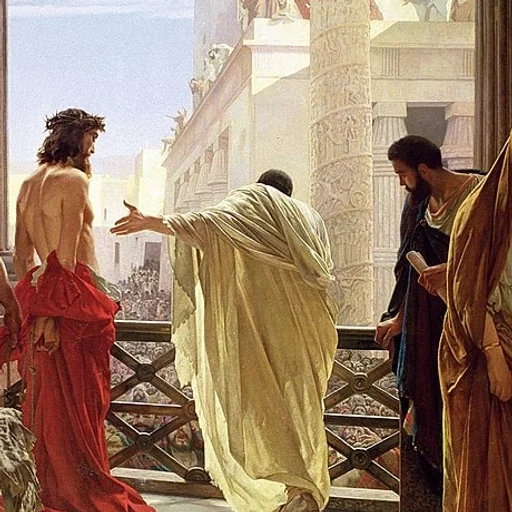
The trial has reached its terrible turn. Pilate, hoping a lesser cruelty might satisfy the crowd, has Jesus scourged, and the soldiers turn the punishment into a game: they plait a crown of thorns, press it onto His head, throw a purple robe over His torn back, and come up to Him one by one - Hail, King of the Jews! - and strike Him in the face (vv. 1-3). Then Pilate brings Him out, broken and bleeding, and says the words John means us never to forget: Behold the man! (v. 5). He says it to provoke pity, perhaps to shame the crowd into letting the matter drop.
Chapter overview from the authored study guide.THE PEOPLE AROUND THE PERSON
Relationships follow the source graph. Some are interpretive or uncertain, and individual verse citations are not yet available for every connection.
STUDY & INTERPRETATION
Pilate holds the power of Rome in his hands and yet finds himself unable to master the quiet figure before him, drawn into a dialogue about kingship and truth that exposes his own uncertainty. He repeatedly declares Jesus innocent, but political fear wins out over conviction, and he delivers to death the One he could not condemn in conscience. His attempt to wash his hands of the matter cannot remove him from the story, for in his courtroom the King of an unworldly kingdom stood on trial before earthly authority. In Pilate the Gospel sets the kingdoms of this world face to face with the King who said His kingdom was not from here, and lets the reader weigh which authority truly reigned that day.
From the Learn of Christ person commentary. Read alongside the linked Scripture passages.KEEP SCRIPTURE CLOSE
5 authored chapter guides feature this person. This is guide coverage, not an exhaustive count of biblical mentions.
ASK A BETTER QUESTION
Identity, story, early-life sources, family, and where to read.
Names and spellings in the source: Pontius Pilate · Pilate · Pontius
Pontius Pilate was the Roman governor who questioned Jesus and handed Him over to be crucified.
Pilate was the Roman governor of Judea before whom Jesus was brought for judgment. He questioned Jesus, declared more than once that he found no fault in Him, and asked his famous question, “What is truth?” Yielding to the pressure of the crowd and fearing for his own standing, he handed Jesus over to be crucified while protesting his own innocence.
The individualized passage index associates this Pontius Pilate record with Matthew, Mark, Luke, John, Acts, 1 Timothy. There are 52 distinct indexed verse references in the 66-book Bible. Browse the book-by-book list below; it separates this identity from other people who share the name. Source assignments and textual identifications can require interpretation.
A separate childhood account for Pontius Pilate is not provided in our current authored profile sources. Begin with Matthew 27:2 and the passages linked here for the evidence that is available. The first indexed reference to a name is not a birth record. This profile does not establish a birth date, schooling, or childhood events beyond what its sources state.
The current source graph does not list immediate family for Pontius Pilate. That is a limit of this data, not evidence that Pontius Pilate had no relatives. Read the cited passages for the details they actually give.
Pilate holds the power of Rome in his hands and yet finds himself unable to master the quiet figure before him, drawn into a dialogue about kingship and truth that exposes his own uncertainty. He repeatedly declares Jesus innocent, but political fear wins out over conviction, and he delivers to death the One he could not condemn in conscience.
Answers draw on our existing authored biography and linked chapter studies. Where supplied, verse assignments come from the individualized STEP Bible index. Childhood answers distinguish documented events from gaps in the available sources.
FIND THE PERSON IN THE TEXT
52 distinct verse references in the source’s 66-book index. These are indexed name assignments, rather than every indirect allusion to this person. A name may also refer to descendants, a tribe, or a nation; read each passage to distinguish that usage from the individual.
“And when they had bound him, they led him away, and delivered him to Pontius Pilate the governor.”
Matthew 27:2 · King James Version
“Now in the fifteenth year of the reign of Tiberius Caesar, Pontius Pilate being governor of Judaea, and Herod being tetrarch of Galilee, and his brother Philip tetrarch of Ituraea and of the region of Trachonitis, and Lysanias the tetrarch of Abilene,”
Luke 3:1 · King James Version
“Pilate saith unto him, What is truth? And when he had said this, he went out again unto the Jews, and saith unto them, I find in him no fault at all.”
John 18:38 · King James Version
“I give thee charge in the sight of God, who quickeneth all things, and before Christ Jesus, who before Pontius Pilate witnessed a good confession;”
1 Timothy 6:13 · King James Version
References are adapted from STEP Bible / Tyndale House TIPNR (CC BY 4.0). Deduplicated, matched to this identity, and checked against the bundled KJV’s verse bounds. Interpretive assignments and translation/versification differences may remain. This index is separate from evidence for individual family relationships.
YOUR OWN OBSERVATIONS
Notes, saved people, and study marks stay in this browser. They do not sync to your account.
KEEP EXPLORING
People featured in the same study guides. Sharing a chapter does not establish a family relationship.