
- Starting price
- Free, then around $49.99/yr
- Free tier
- Yes
- Platforms
- iOS · Android
- Developer
- Apps Momentum
- Launched
- 2023
- Updated
- May 24, 2026
The verdict
Bible Chat is the clear category leader in AI faith apps - polished, fast, and genuinely useful for verse lookup and devotional prompts. It is also a large language model, which means it can be confidently wrong on theological questions. Use it as a search and reflection tool, not as a teacher.
Try Bible Chat ↗Opens thebiblechat.com
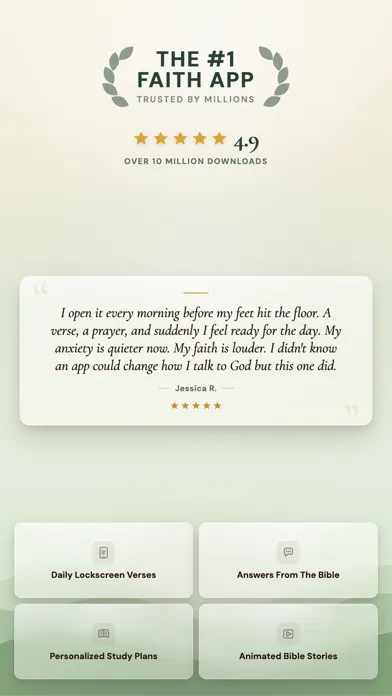
Bible Chat has quietly become the default AI faith app for tens of millions of users. The developer, Apps Momentum, claims north of 25 million downloads across iOS and Android, which would make it - by a wide margin - the most-installed AI Bible chatbot on either store. Open the App Store category for "Bible" and you will see it parked near the top of the charts almost every week. That is not an accident. It is a very well-shipped app.
It is not a Bible-reading app in the YouVersion sense. It is not a study platform in the Logos sense. It is not a prayer app in the Hallow sense. It is a conversational interface - a chat window - that you ask Bible-shaped questions and that responds with Scripture references, paraphrased context, generated devotionals, and prayer prompts. The underlying engine is a large language model, almost certainly OpenAI-class, tuned for tone and bounded with a system prompt that keeps it inside a broadly Protestant-evangelical lane.
That last sentence is where everything interesting about this app lives. A Bible chatbot is a new category, and the category has real risks - hallucinated verse references, theological positions stated with more confidence than the training data warrants, and a default voice that reads as one tradition even when the user belongs to another. Bible Chat has done a better job than most at containing those risks. It has not eliminated them. This review is about what the app does well, where it falls short, and how to use it responsibly.
✓ The good
- Best-in-class conversational verse lookup - natural-language questions like "what does Paul say about anxiety" return relevant passages in seconds
- Genuinely good AI-generated daily devotionals - short, focused, often surprisingly thoughtful when given a verse anchor
- Prayer-request tracking that actually works - you can log intentions, mark answered prayers, and get gentle reminders
- Polished mobile UX - the app feels like a modern consumer product, not a ministry side-project
- Free tier is usable - you can ask several questions a day without hitting a paywall
- Onboarding is friendly to first-time Bible readers - no assumption that you already know the books or chapters
- Cross-platform parity - iOS and Android builds feel identical, which is rare in this category
✗ Watch out
- Hallucination risk on theology - the model can confidently misattribute verses or state contested positions as settled
- Doctrinal lens is broadly Protestant evangelical - Catholic, Orthodox, and Latter-day Saint readers will sometimes get answers framed against their tradition
- No real citation transparency - you cannot see what sources, commentaries, or translation it is pulling from
- Premium paywall is aggressive - many of the most-marketed features sit behind around $49.99/yr
- No desktop or web app (yet) - phone-only limits use for study or sermon prep
- Limited translation choice in chat responses - the model often paraphrases rather than quoting a named version
Best for
- New or returning Bible readers who want low-friction answers
- Devotional users who like a short daily prompt
- Anyone who has ever Googled "what does the Bible say about…"
- People who want to track prayer intentions in one place
Avoid if
- You need rigorous, citation-backed theological answers
- Your tradition is Catholic, Orthodox, or Latter-day Saint and you want a same-lens app
- You are doing sermon prep or teaching prep
- You are uncomfortable with AI-generated spiritual content as a category
What Bible Chat is
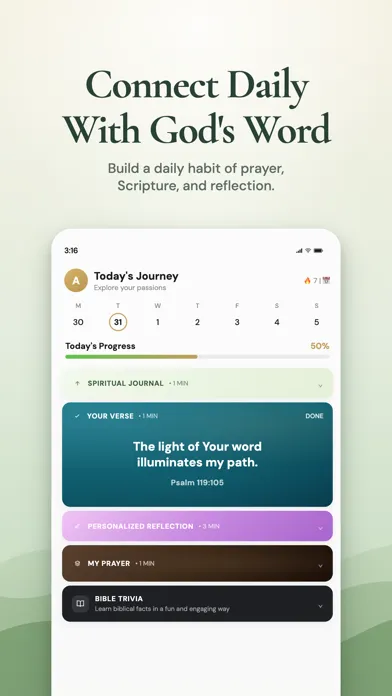
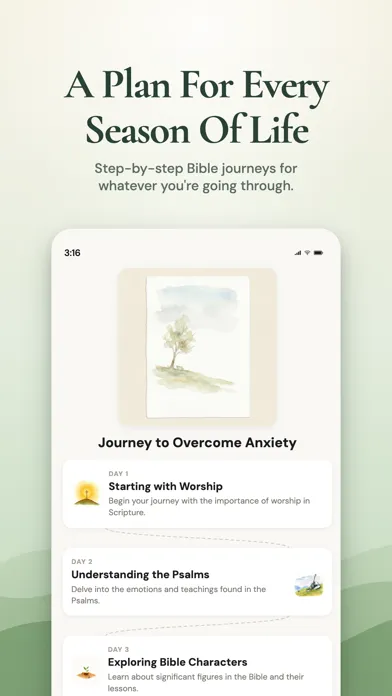
Bible Chat is a mobile app built around a single screen: a chat window where you type a question and the AI responds with Scripture-anchored answers. The product extends that core loop in three directions - a daily AI-generated devotional, a prayer-intentions tracker, and a library of guided plans on topics like anxiety, forgiveness, marriage, and grief. Everything funnels back to the chat interface.
The developer is Apps Momentum, a consumer-app studio that has shipped the app into the top of the App Store religion category and kept it there. The model behind the chat is not disclosed in the product, but the response style is consistent with a tuned GPT-class LLM running against a system prompt that emphasizes Scripture references, pastoral tone, and a refusal to give medical or crisis-line advice. It is a chatbot wearing a Bible cover, and Apps Momentum has put real effort into making it feel like a faith product rather than a generic AI.
Why so many people are using Bible Chat
The single biggest practical difference between Bible Chat and a generic chatbot like ChatGPT is the framing. When you open Bible Chat, the app already assumes you want Scripture-anchored answers, a devotional tone, and a prayer-shaped follow-up. You do not need to prompt-engineer your way into a useful faith response. You just ask. That removes a friction layer that, for most users, was the only thing standing between them and getting an answer.
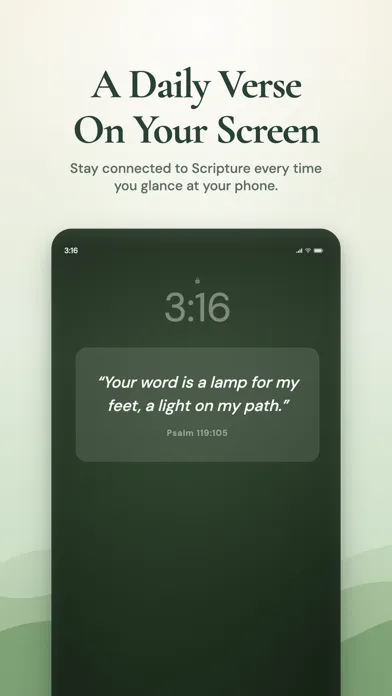
The other reason for the install numbers is more mundane: the app is well-built. The keyboard is fast. The chat history saves. The daily devotional shows up on the lock screen. The prayer tracker syncs. Reading-app conversion is brutal - most "Bible AI" apps churn in a week. Bible Chat keeps users because the core loop is short, the answers feel personal, and the surface area is small enough that nothing in the app feels broken.
Conversational verse lookup: the killer feature
You type a question - "what does Jesus say about worry," "verses for someone grieving a parent," "where does Paul talk about contentment" - and the app responds within a few seconds with a list of relevant passages, usually quoted or paraphrased inline, often with a one-line explanation of context. There is no Strong's lookup. There is no concordance UI. There is just a question and an answer. For the millions of users who have ever Googled a verse, this is the natural next interface.
In practice it is transformative for casual readers and dangerous for advanced ones. Casual readers get to Scripture they would never have found in a paper concordance. Advanced readers will catch the model paraphrasing a verse that does not exist in the form quoted, or citing a passage that is only loosely on-topic. The right mental model is: treat every Bible Chat response as a starting point for verification, not as a finished answer. Click through to the actual chapter and read it in context. The app is a much better search engine than it is a teacher.
AI-generated daily devotional: short, focused, mostly good
Every morning the app surfaces a short devotional - usually a single verse, two or three paragraphs of reflection, and a closing prayer prompt. The content is generated rather than written by a human staff, which means it is fresh every day and tuned to the user's recent chat history and saved topics. Length is the strength here. Most human-written devotionals are too long for a phone read; Bible Chat's land in the two-minute range, which is the right size for what users actually do with them.
The quality is genuinely better than the category average. The devotionals do not preach beyond the text, they do not stack ten verses on a single point, and they usually end with an actionable prompt rather than a vague encouragement. The downside is the same downside as the chat: occasionally a devotional will lean on an interpretive frame that reads clearly as one tradition, and a reader from another tradition will notice. Most users will not. For a free daily nudge into Scripture, it is a strong feature - and one of the main reasons users keep the app on their phone.
Prayer requests and intentions tracking
The prayer tab is simpler than it looks. You add an intention - a name, a situation, a request - and the app lets you mark it as ongoing, answered, or archived. You can set a reminder cadence (daily, weekly), and Bible Chat will surface the intention back to you at that interval with a short prayer prompt generated around it. It is the same loop a paper prayer journal has carried for centuries, ported into a notification.
This sounds like a small thing. In practice it is the feature most users say turned the app from a curiosity into a habit. Prayer journals are notoriously hard to keep - paper journals get lost, notes apps lack the cadence prompt. Bible Chat closes that loop without trying to be a full prayer app like Hallow or Pray.com. It is not guided audio. It is not contemplative. It is a list with a memory, and that turns out to be exactly what a lot of people wanted.
Pricing
Free
$0
Limited daily messages, basic verse search, sample devotionals. Enough to decide whether the app is useful to you.
Premium (annual)
~$49.99/yr
Unlimited chat, full daily devotional series, prayer journal, all themed plans, no ads. The tier the app is built around.
Premium (monthly)
~$9.99/mo
Same features as annual, billed monthly. Useful for a one-month trial; expensive long-term.
Lifetime
Occasionally offered
A one-time purchase tier surfaces in some promo flows. If you see it and you like the app, it can be the cheapest path.
The free tier is real. You can install Bible Chat, ask a handful of questions a day, read the daily devotional, and log a few prayer intentions without paying. Apps Momentum has not gated the core experience behind a paywall the way some faith apps do. That is part of why the install numbers are what they are.
Premium runs around $49.99 a year, and what it buys you is mostly volume - unlimited chat messages, the full devotional series rather than a sampler, the deeper themed plans, no ads. There is also a monthly option around $9.99, which only makes sense if you are trialing or know you will use the app for a few weeks and stop.
Lifetime pricing surfaces occasionally in promo flows. If you see it offered and you have already decided you like the app, it is usually the cheapest path long-term. Most users do not need the lifetime tier; the annual is the balanced default.
Worth noting: the paywall is aggressive on first install. The app will try hard to convert you in the first session. Decline it once, use the free tier for a week, and decide on the data - not on the onboarding pressure.
Where Bible Chat falls behind
No real citation transparency. When Bible Chat tells you something - a doctrinal position, a historical claim, a translation choice - you cannot see where it came from. There is no "this is from this commentary" link, no translation toggle on every response, no footnote layer. For a casual question that is fine. For anything you intend to teach from, it is a problem.
No desktop or web app. Bible Chat is phone-only. That rules it out for sermon prep, for users who do their study at a laptop, and for anyone who wants to copy-paste an answer into a document with any ease. For an app that has 25 million downloads, the lack of a web client is conspicuous.
Limited translation transparency in responses. The app will happily quote a verse, but it often does not name the translation, and the quoted text sometimes drifts toward a paraphrase. Users who care about translation precision - KJV, ESV, NRSV, NIV, NASB - will find this frustrating. A "show me this in the KJV" command exists but is uneven.
Doctrinal lens is one lens. The system prompt and training data give the app a broadly Protestant-evangelical voice. Catholic readers will notice the sacraments handled lightly. Orthodox readers will notice church-tradition questions handled as if Scripture alone were the operative authority. Latter-day Saint readers will sometimes get answers that contradict their tradition without flagging the disagreement. None of this is malicious - it is the default behavior of an LLM tuned on the most-common English-language Christian corpus - but it is a real limit on who the app serves equally well.
Hallucination risk is not solved. Apps Momentum has clearly invested in reducing it - refusal patterns on crisis topics, Scripture-first response framing - but the underlying model can still generate a verse reference that does not exist, or attribute a quote to the wrong author. The category has not solved this problem yet. No AI Bible app has.
Bible Chat vs. FaithGPT vs. Magisterium AI
Different strengths. Bible Chat is the consumer app - polished, freemium, broadly Protestant in voice, optimized for casual questions and daily devotional reads. FaithGPT is the lighter alternative, a similar chat interface with a smaller user base and a comparable feature set; it competes mostly on price and on the user not wanting to install Bible Chat for whatever reason. Magisterium AI is a different product entirely - a Catholic-trained chatbot that returns answers grounded in the Catechism, Church documents, and the Catholic theological tradition, with citation links to the source.
If you want a daily faith app for personal use, Bible Chat is the obvious starting point - biggest install base, best devotional loop, smoothest mobile UX. If you are Catholic and you want answers in your own tradition with citations you can verify, Magisterium AI is the better choice and it is not close. If you want a free alternative to Bible Chat without paying for premium, FaithGPT is a reasonable second option.
None of the three replaces a study Bible, a commentary, or a pastor. All three are best understood as conversational front ends to Scripture - useful for finding the passage and starting the conversation, not for ending it.
The bottom line
Bible Chat is the category leader in AI faith apps for good reasons: it is well-built, it is well-priced, and it solves a real friction problem for casual Bible readers who want a verse or a prompt without opening a study tool. It is also a large language model, and the category has not yet solved hallucination or doctrinal lens. Use it as a starting point - for verse search, daily devotionals, and prayer tracking - and verify anything you would teach from against your actual Bible. On those terms it is genuinely useful, and the install numbers are not a fluke.
Alternatives to Bible Chat
 CrossTalk: Bible Chat + PrayerThe original BibleChat.ai, now renamed: free ordinary AI access, reading plans, and a community Prayer Wall supported by sponsors.
 YouVersionThe default Bible app. Not AI-driven, but the reading-plan and verse-of-the-day infrastructure is unmatched and completely free.
 HallowCatholic prayer and meditation app with guided audio, daily prayers, and celebrity-led content. Different lane entirely, but the alternative most Bible Chat users also try.
 Pray.comAudio-first prayer and devotional app, broadly Christian. Stronger on bedtime stories and audio than on chat or search.
 GlorifyDevotional and worship app with a strong daily reading habit. Less AI-forward than Bible Chat but more polished as a meditation experience.
 Bible Answers AIA simpler question-and-follow-up Bible chatbot with linked verses, a free entry point, and much less transparent model, doctrine, and pricing documentation.
Frequently asked questions
Is Bible Chat safe to trust on theology?
Partially. It is a large language model, which means it can generate confident answers that are wrong on details - misattributed verses, contested positions stated as settled, occasional invented quotes. For casual verse search and daily devotional prompts, it is useful. For anything you intend to teach from or build a belief on, verify every answer against an actual Bible and, ideally, a trusted commentary.
What tradition is Bible Chat written from?
The default voice reads as broadly Protestant evangelical - that is the lane the underlying model and the system prompt point at. Catholic, Orthodox, and Latter-day Saint readers will sometimes get answers that do not match their tradition, and the app does not always flag the disagreement. If your tradition is important to you, treat the app as a search tool and read the cited passages in your own translation and frame.
How much does Bible Chat cost?
There is a real free tier with limited daily messages. Premium is around $49.99 a year, or roughly $9.99 a month. A lifetime tier surfaces occasionally in promotional flows. The annual is the balanced default for most users; the monthly only makes sense for a short trial.
Is Bible Chat the same thing as ChatGPT?
No, but it is built on the same kind of technology. Bible Chat is a consumer app from Apps Momentum that wraps a large language model with a faith-focused system prompt, devotional features, and a prayer tracker. The underlying model is undisclosed but behaves like a tuned GPT-class LLM. You could approximate parts of the experience in ChatGPT itself, but you would lose the devotional, prayer, and mobile-app polish.
Does Bible Chat hallucinate verses?
Sometimes. It is less prone to obvious fabrication than an untuned chatbot, but the risk is not zero - the model can paraphrase a verse in a form that does not match any translation, or cite a passage that is only loosely on-topic. Always click through and read the actual chapter before quoting anything from the app.
Is there a desktop or web version?
Not at the time of writing. Bible Chat is iOS and Android only. For desktop or web AI Bible chat, your alternatives are Magisterium AI (Catholic, web-based), or generic LLMs like ChatGPT and Claude with a custom prompt.
Who is Bible Chat best for?
Casual or returning Bible readers who want a low-friction way to find verses, get a daily devotional, and track prayer requests in one place. It is not the right tool for sermon prep, deep theological study, or for users who need answers in a specific non-Protestant tradition.
Sources & further reading
More AI Bible Apps
 Faith: Scripture MeditationFaith turns a Bible passage or personal concern into a narrated meditation with Scripture, breathing and music—an inviting format whose undisclosed AI data path deserves more scrutiny than its local-storage promise suggests.
 GamalielGamaliel pairs a Bible reader with free AI questions, source links, audience profiles and publicly inspectable theological prompts—an unusually transparent experiment whose deployed model, retention and store disclosures still require independent caution.
 Agentic JesusAgentic Jesus is a proactive Claude-powered faith companion with Bible chat, adaptive devotionals, prayer memory, voice and follow-ups—and its unusually clear data map also shows why intimate spiritual AI needs firm human boundaries.
 My BibleVerseMy BibleVerse turns an emotion or written concern into a suggested Bible passage, reflection and AI-written prayer, then saves the moment into a daily habit—but its costly weekly plan, intimate data processing and confident personalization claims require discernment.
 ScOARA free, focused AI tool that translates an ordinary-life situation into several Scripture suggestions, explanations and practical steps—approachable and transparent about many limits, but undermined by a direct contradiction over whether guest queries leave the device.
 LumenologyLumenology combines a multi-translation Bible with cited AI research, interlinear data, historical commentary and passage tools in a clean workspace—but citations reduce risk rather than removing it, and every important claim still needs verification.