
- Starting price
- Around $72/mo flat-rate
- Free tier
- No
- Platforms
- Web · iOS · Android
- Developer
- Breeze ChMS (a Tithe.ly company)
- Launched
- 2011
- Updated
- May 25, 2026
The verdict
Breeze has quietly become the favorite ChMS of small-church administrators who do not have a full-time IT person and do not want one. The flat-rate price is the headline, but the real product is the lack of friction - most volunteers can run it on day one.
Try Breeze ChMS ↗Opens breezechms.com
Breeze ChMS is what happens when a software team looks at the church management category - historically a swamp of clunky, modular, surprisingly expensive enterprise products - and asks a different question. Not "how do we add more features?" but "how do we make a non-technical volunteer feel competent in the first ten minutes?" The answer turns out to be a flat-rate price, a stripped-down interface, and an opinionated set of defaults that cover what a small church actually does: track people, take attendance, run check-in on Sunday morning, send a Wednesday email blast, and collect online giving.
It does not have the depth of Planning Center. It does not have the worship-team workflow of Subsplash. It does not pretend to be a member-engagement platform. What it does is run the boring administrative bones of a 50-to-300-member congregation on a single subscription, on one screen, with a UI that a retired bookkeeper can learn in a Sunday afternoon - and that is the entire pitch.
The product has been around since 2011, was acquired by Tithe.ly in 2022, and has - to the surprise of skeptics who watched the acquisition - kept its brand, its pricing model, and most importantly its design philosophy intact. The Tithe.ly tie-in shows up mainly as the giving engine under the hood, which is a genuine upgrade. If you are a small church evaluating ChMS options in 2026, Breeze is the one that almost every consultant will name first when you say the words "we do not have a tech person on staff."
✓ The good
- Flat-rate pricing - one monthly price regardless of head count, so there is no penalty for growing or for adding modules
- Genuinely small-church UX - the navigation has ~7 top-level items and most pages fit on one screen without scrolling
- Volunteer-ready check-in - the Sunday morning check-in flow runs on any iPad and trains in under fifteen minutes
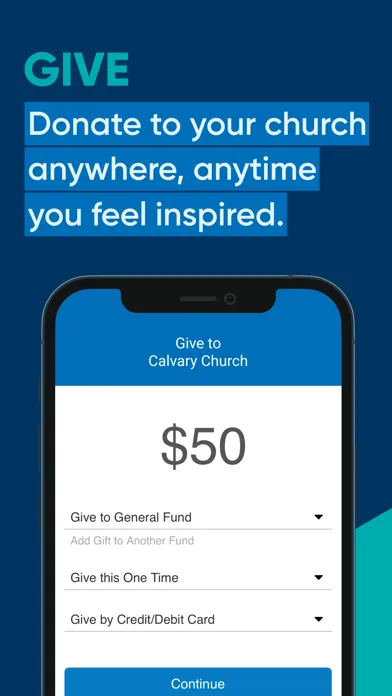
- Tithe.ly giving baked in - online giving, text-to-give, and recurring donations are integrated rather than bolted on
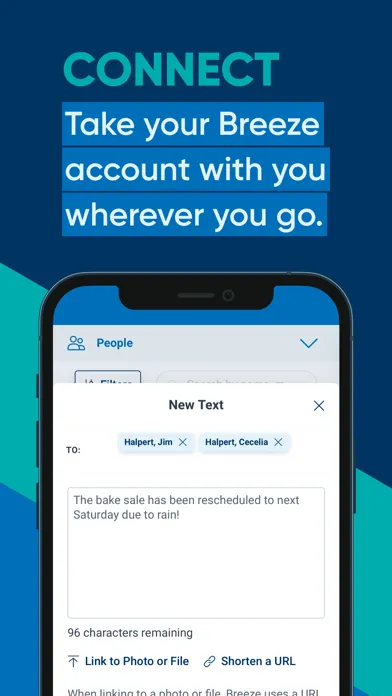
- Mass email and text from inside the directory - no need for a separate Mailchimp or Twilio account for routine comms
- Strong support team - the chat support is famously responsive, and there is a free migration assistant for incoming data
- No long-term contract - month-to-month billing, cancel any time, full data export
✗ Watch out
- Not built for large churches - once you cross ~750 active members the lack of advanced segmentation starts to bite
- No native worship-team scheduling - no service planning, set lists, or rehearsal flow (Planning Center owns that)
- Limited custom reporting - the report builder is friendly but shallow; power users will hit the ceiling fast
- Workflow automations are basic - assimilation pipelines exist, but they are nothing like a real CRM
- Mobile apps lag the web app - the iOS and Android versions cover the core but feel a step behind
- Tithe.ly Giving fees are standard, not exceptional - 2.9% + $0.30 for cards, ACH around 1%
Best for
- Small-to-mid churches (50-300 members) with one part-time admin
- Church plants that want one tool from day one
- Volunteer-led congregations without a dedicated IT person
- Churches leaving paper directories or spreadsheets for the first time
Avoid if
- You are a multi-site church over 1,000 members
- You need a deep worship-team planning workflow
- You want a true marketing-automation CRM
- You require granular role-based permissions for 20+ staff
What Breeze ChMS is
Breeze ChMS is a web-based church management system - what the industry calls a ChMS - designed specifically for the small-to-mid church. The product handles five core jobs: a membership and family directory, attendance and group tracking, child check-in, mass email and text communication, and online giving through its Tithe.ly integration. It runs in any browser, with companion iOS and Android apps for the on-the-go pieces (check-in, looking up a member, recording attendance from the back of the sanctuary).
The product was founded in 2011 by Jared Pritchett and acquired by Tithe.ly in 2022, but it continues to operate under its own brand with its original team and design language. There is no free tier - Breeze is a paid subscription only - but there is a thirty-day free trial that requires no credit card, and the company will migrate your existing data in for free as part of onboarding. The deliberate restraint of the feature set is the product.
Why small-church administrators prefer Breeze
The single biggest practical difference between Breeze and the larger competitors is that Breeze decided, very early, that the customer is a volunteer or a single part-time administrator - not an IT department. Every UX decision flows from that. The home screen does not surface twenty-seven widgets. The settings panel does not require you to learn what a "form factor" or a "process queue" is. Adding a new family takes one screen. Recording attendance for a small group takes three taps. The whole product is built on the assumption that the person using it has approximately ninety seconds of attention before a child needs picking up.
That sounds like a small thing. In practice it is transformative - because the alternative, for most churches this size, is not a fancier ChMS. The alternative is a shared Google Sheet, a paper sign-in clipboard, and a youth pastor with a personal Mailchimp account. Breeze wins those churches not by competing with Planning Center on depth, but by competing with chaos on simplicity, and at a price the treasurer will sign off on without a board meeting.
Flat-rate pricing: the differentiator that ends most evaluations
Breeze charges one price. As of writing it is around $72 a month, billed monthly, with a small discount for annual prepay. That price covers every feature in the product, unlimited people in your database, unlimited user accounts, unlimited storage, and unlimited support. There is no "Pro tier" that unlocks groups. There is no per-user seat charge that quietly grows as you add staff. There is no "more than 500 members? contact sales" wall. The same price is what a 60-person church plant pays and what a 280-person established congregation pays.
This matters more than it sounds, because the dominant competitor - Planning Center - uses a modular per-product, per-tier pricing model that can be a great fit for a 600-member multi-staff church and a budget nightmare for a 90-member plant trying to enable three modules. With Breeze you do the math once. You know the line item for next year. You do not have to forecast user count or transaction volume or which module the worship director will request in Q3. The flat rate is not just a price; it is a way of removing an entire category of administrative decisions from a church board that did not want to be making them in the first place.
Small-church-focused UX: the simpler-than-Planning-Center pitch
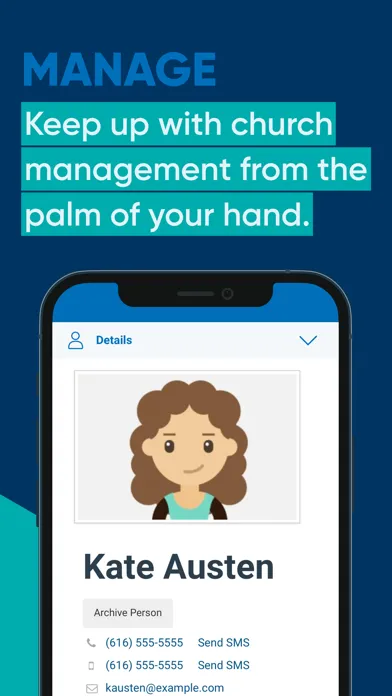
Breeze's interface is the thoughtful person's ChMS in the sense that someone clearly thought about it from the volunteer's point of view rather than the product manager's. The left-hand nav has seven items - People, Tags, Events, Forms, Contributions, Email, More - and that is the entire surface area you need to know. The People screen is a single sortable list with inline edit. Tags replace the more complicated "groups, smart lists, saved searches, segments" hierarchy that other ChMS products use, and one mental model covers small groups, ministry teams, baptism candidates, and the Christmas Eve volunteer list.
The result is a tool that a brand-new church secretary can learn in about ninety minutes, and that does not require an annual administrator-training conference. Compared to Planning Center, where each of the nine modules has its own paradigm and onboarding curve, Breeze has one paradigm and one curve. You give up power-user features - there is no segment of "people who gave between $200 and $500 in Q2 but did not attend in October" without exporting to a spreadsheet - but you gain the thing that small churches actually need, which is staff and volunteers who use the system instead of avoiding it.
The Tithe.ly acquisition and the integrated giving stack
When Tithe.ly acquired Breeze in 2022, the reasonable fear among existing customers was the usual one: the brand would be absorbed, the pricing model would be "harmonized," the simplicity would be sacrificed on the altar of a unified platform. None of that happened. Breeze still ships under the Breeze name, the flat-rate price did not move, and the team and roadmap stayed largely the same. What did change - and this is the upside - is the giving engine underneath. Online giving, text-to-give, recurring donations, and the donor-facing app all run on Tithe.ly's stack now, which is one of the two or three most-used giving platforms in the US church space.
For administrators, this matters mostly because the giving data and the people data finally live in the same place. A donation made through Tithe.ly automatically tags the giver in Breeze, updates their contribution history, and runs through the same statement generator at year-end. You do not have to reconcile two systems, you do not have to manually export and import CSVs every January, and the giving forms can be embedded on a church website without standing up a separate Tithe.ly account. It is the rare acquisition that delivered the integration story the press release promised, without the price tag growing.
Pricing
Breeze (single plan)
Around $72/mo
The only plan. Unlimited people, unlimited users, unlimited storage, all modules. Billed monthly, no contract.
Annual prepay
Around $66/mo equivalent
Same product, paid yearly. Saves roughly one month per year. Most established churches choose this once they have committed.
Tithe.ly Giving
2.9% + $0.30 (card), ~1% (ACH)
Optional but bundled. No platform fee on top of processor fees - the giving stack is the giving stack.
SMS bundle
Around $10/mo for ~500 messages
Optional add-on for higher-volume text blasts. Light SMS is included; heavy senders top up here.
Pricing is the easiest part of evaluating Breeze, which is exactly what the company wants. As of writing the single subscription is around $72 a month, billed monthly, with a small annual-prepay discount that brings the effective rate down a few dollars. That is it - there is no tier ladder, no per-seat math, no transaction caps to forecast.
The optional pieces are Tithe.ly Giving fees, which are processor fees - about 2.9% plus $0.30 per card transaction and roughly 1% on ACH - and a low-cost SMS bundle if you send heavy text volume. Light texting is included in the base plan. Most churches will not need anything beyond the base subscription and the giving processor fees.
Compare that to Planning Center, where a small church running People, Check-Ins, Giving, and Services typically lands somewhere between $80 and $200 a month once usage scales, and where forecasting the future bill requires a spreadsheet. Breeze's pitch is that you do the math once and never again - and for a treasurer reporting to a finance committee that does not want surprises, that is genuinely worth something.
The thirty-day trial does not ask for a credit card, and Breeze's onboarding team will migrate data in from a previous ChMS for free. Cancel any time, full data export, no termination fee. Most users do not need anything else from a pricing page.
Where Breeze ChMS falls behind
No service-planning module. If you need song set lists, rehearsal scheduling, volunteer rotations across multiple services, or musician practice files, Breeze does not do that - Planning Center Services is the category leader and Breeze does not try to compete there. Many Breeze customers run Breeze for the office side and Planning Center Services for the worship side. That is a normal and accepted pattern, but it is two subscriptions.
Limited custom reporting. The report builder is friendly enough for "attendance over the last twelve weeks" or "givers above $500 in the last year," but the moment you want a cross-tabbed report with multiple filters and a calculated field, you are exporting to a spreadsheet. Larger churches that have grown into a data team will outgrow this; small churches mostly will not notice.
Workflow automation is light. Breeze has a basic follow-up pipeline - first-time guest, returning guest, baptism candidate - but compared to a real CRM, or even Planning Center People's workflows, the automation logic is shallow. If you want event-triggered, multi-step, branching follow-up sequences, this is not the tool.
Mobile apps trail the web app. The iOS and Android apps are perfectly adequate for the on-the-go cases - look up a member, take attendance, run check-in - but feature parity with the browser lags. Most admin work still happens on a laptop.
Permissioning is simple by design. Roles and access are straightforward but coarse-grained. If you have twenty staff with twenty distinct permission profiles, you will find Breeze's model frustratingly broad. For small staffs of two to six this is invisible; for larger ones it becomes a real limitation.
Breeze vs. Planning Center vs. ChMeetings
These three products dominate three different conversations. Planning Center is the gold standard for mid-to-large churches with multiple ministry departments and a real worship team - its Services module is unmatched, its People module is deep, and its modular pricing makes sense when you have the staff to use it. The downside is complexity and forecasting: a growing church can easily land at $150-$300/month across modules, and the onboarding curve is real.
Different strengths. Breeze is better at being chosen and used. Planning Center is broader (Services, Music Stand, Calendar, Registrations, Publishing, Giving, Check-Ins, People, Groups). The honest test is "do you have someone on staff whose job includes learning Planning Center?" If yes, Planning Center wins. If your administrator is a part-time volunteer who already has another full-time job, Breeze wins, full stop.
ChMeetings is the budget option that punches above its weight. It is genuinely inexpensive - often under $25/month for a small church - and covers the same core ground as Breeze on paper: members, groups, events, giving, attendance. Where it falls short is polish and the giving stack: the UX is denser, the design feels a half-step behind, and the giving integration is less established than Tithe.ly's. ChMeetings is a real option for a 30-to-80-person church that needs the absolute lowest line item; Breeze is the option once the church has decided that paying a little more for the experience is worth it.
The bottom line
Breeze ChMS is the right answer to a specific question: "we are a small-to-mid church, we do not have a dedicated tech person, we want one tool that handles people, attendance, check-in, comms, and giving without becoming a second job." It is not the most powerful ChMS on the market and it does not pretend to be - Planning Center exists and is excellent for the churches it fits. But for the 50-to-300-member congregation that wants to stop running on spreadsheets and start running on software, Breeze is the path of least resistance, and the flat-rate pricing means you can sign off on it tonight and know what next year costs. That combination - simple enough for a volunteer, priced like a utility, integrated giving included - is rare in this category, and it is why Breeze keeps winning the recommendation.
Alternatives to Breeze ChMS
 Planning CenterThe deep, modular ChMS for mid-to-large churches with dedicated staff. Best worship-team workflow on the market. Per-module pricing scales with use.
 Tithe.lyNow Breeze's parent company. Tithe.ly's giving and church-app products stand alone for churches that want giving and a mobile app without a full ChMS.
 ChMeetingsThe budget-tier ChMS. Real feature coverage at a notably lower price than Breeze, with a denser UX and a less polished giving stack.
 SubsplashLess a ChMS than a full church-engagement platform - custom apps, streaming, giving, push notifications. Heavier and pricier than Breeze.
Frequently asked questions
Is Breeze ChMS really one flat price for any size church?
Yes. As of writing, the subscription is around $72 a month for unlimited people, unlimited users, all modules, and unlimited storage. A 60-person plant and a 280-person established church pay the same. Annual prepay shaves off roughly one month per year. The only variable costs are processor fees on Tithe.ly Giving and an optional bundle for heavy SMS volume.
Did Tithe.ly buying Breeze change anything for existing customers?
The acquisition closed in 2022, and the visible changes have been mostly upside - the giving engine is now Tithe.ly's, which means tighter integration between donations and member records. The Breeze brand, team, pricing model, and UX philosophy stayed intact. The fears about a forced rebrand or pricing overhaul did not materialize.
How does Breeze compare to Planning Center for a small church?
Breeze is simpler, cheaper, and easier for a volunteer to run. Planning Center is more powerful, has the better worship-team workflow, and has more depth across the board. If your administrator is a part-time volunteer, Breeze almost always wins. If you have a dedicated staff member whose job includes learning the tool, Planning Center is worth the curve.
Does Breeze do online giving?
Yes - through the integrated Tithe.ly Giving stack. You get online giving forms, text-to-give, recurring donations, and a donor-facing app. Processor fees are roughly 2.9% + $0.30 for cards and around 1% for ACH, with no separate platform fee from Breeze on top.
Can Breeze handle child check-in on Sunday morning?
Yes, and it is one of the most-praised features. The check-in runs on any iPad in a browser, prints labels to a supported label printer, and trains volunteers in about fifteen minutes. It supports security tags, parent receipts, and allergy/medical notes.
What size church is Breeze designed for?
The sweet spot is roughly 50 to 300 active members, though plenty of churches use it successfully up to about 500-750. Above that, the lack of advanced segmentation, permissioning, and reporting starts to be a real constraint, and most churches in that range move to Planning Center or a higher-end ChMS.
Is there a free trial or free tier?
There is a thirty-day free trial that does not require a credit card, and the Breeze onboarding team will migrate your data in from another system for free. There is no permanent free tier - Breeze is a paid subscription only - but cancellation is month-to-month with full data export and no termination fee.
Sources & further reading
More Church Management Software
 B1 ChurchA genuinely free, open-source church platform - app, website, giving and check-in on one database - run by an Oklahoma nonprofit. The catch is not the price - it is that the vendor own docs call the native app deprecated.
 Involv Chat (church.chat)Involv Chat combines ministry-team messaging, rosters, blocked dates and service scheduling in a focused church workspace—useful when leaders protect volunteer consent and resist turning attendance or gifts data into a spiritual score.
 Pastor Notes AppA two-app system that lets leaders publish sermon notes and invite live congregational response while attendees use the free Bible Notes companion—but its pricing math, refund terms and app privacy disclosures need correction before a church commits.
 Take RootA low-cost, offline-friendly relationship tracker built specifically for evangelism and discipleship follow-up—more intentional than a spreadsheet, but its old generic privacy policy does not adequately describe the sensitive ministry data the product exists to hold.
 ChurchSoftwareChurchSoftware—formerly StoreHouse—offers an unusually broad church-management core for $0, including giving, check-in, accounting and a shared mobile app, while charging transparently for vendor-heavy extras.
 Develop.MeDevelop.Me packages course building, cohorts, discussion, assignments, gamification and mobile learning for churches and mission-driven organizations—with unlimited learners on paid plans, but a vague free tier and a 2022 website privacy notice leave procurement questions open.