
- Starting price
- Free, Premium around $29.99/yr
- Free tier
- Yes
- Platforms
- iOS · Android
- Developer
- Cantcha Inc.
- Launched
- 2010
- Updated
- May 24, 2026
The verdict
iMissal Catholic is the closest thing to a digital pew missal that the App Store has produced. The free tier alone handles daily readings, the Order of Mass, and the saint of the day. Premium adds the Liturgy of the Hours, scripture commentary, and multi-language Mass texts that turn the app into a one-stop pocket missal.
Try iMissal Catholic ↗Opens imissalapp.com
iMissal Catholic has quietly become the favorite of daily-Mass Catholics who want a single app that opens to today’s readings without ceremony. It is not the flashiest Catholic app on the store - Hallow has the celebrity reach, Laudate has the Swiss-army-knife reputation - but iMissal has been doing one thing well for more than a decade: showing you exactly what is being read at Mass today, in the language the parish is praying in, with the Order of Mass underneath so you can follow along when a visiting priest moves faster than you expect.
The app is built by Cantcha Inc., a small developer that has shipped iMissal continuously since the early App Store era. It doesn’t chase trends. It doesn’t pivot to short-form video. It doesn’t bundle a meditation library to compete with the wellness apps. What it does is keep the readings current with the USCCB lectionary, keep the saints calendar current with the Roman calendar, and keep the Order of Mass synced to the third edition of the Roman Missal in English - plus Spanish, Latin, and Italian for parishes and travelers who need them.
The result is the kind of utility app that doesn’t demand attention. You open it during the entrance procession, swipe to today’s readings, glance at the saint of the day in the sidebar, and put the phone face-down on the kneeler. That’s the whole loop - and after fifteen years of iteration, iMissal has gotten the loop down to about three taps.
✓ The good
- Daily Mass readings always current - USCCB lectionary cycle is reliable and the app pre-loads upcoming days so you’re not scrambling for signal in a basement chapel
- Order of Mass in four languages - English, Spanish, Latin, and Italian side-by-side, which is rare in any single Catholic app
- Daily saints with full biographies - not just the name, but a readable life sketch for the feast and any optional memorials
- Examination of conscience built in - organized by the Ten Commandments and by state of life, with confession prep flowing into the act of contrition
- Liturgy of the Hours in Premium - a credible alternative to iBreviary for those who want LOTH bundled inside their missal
- Long-running and actively maintained - launched in 2010, still receiving lectionary updates and OS-compatibility patches in 2026
- One-time-feeling Premium price - around $29.99/yr puts it well under Hallow and most general-purpose prayer apps
✗ Watch out
- Interface shows its age - the navigation patterns are functional but visibly pre-iOS-7 in places (yet)
- No audio readings in the base app - if you want the Mass read aloud, you’re going to a separate app
- Scripture commentary is brief - useful for context but not a substitute for a true commentary like the Navarre or Ignatius Study Bible
- Liturgy of the Hours is Premium-only - iBreviary gives the same hours away free, which makes the Premium pitch harder for LOTH-only users
- No community or sharing layer - there is no equivalent of a YouVersion-style friends feed or shared reading plan
- Search is functional, not delightful - finding a specific prayer or rite sometimes means scrolling rather than typing
Best for
- Daily-Mass Catholics who want a pew-ready digital missal
- Bilingual parishes serving English- and Spanish-speaking communities
- Travelers attending Mass in Italy or any Latin Novus Ordo / TLM setting
- Sacramental prep - anyone using an examination of conscience before confession
Avoid if
- You want guided audio prayer in the style of Hallow or Pray as You Go
- You are looking primarily for a meditation, mental-health, or sleep-content app
- You only need the Liturgy of the Hours and don’t care about anything else (iBreviary is free)
- You want a modern, design-forward UI as a primary criterion
What iMissal Catholic is
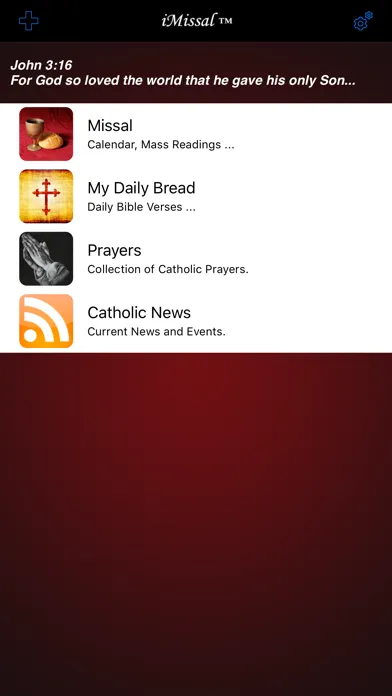
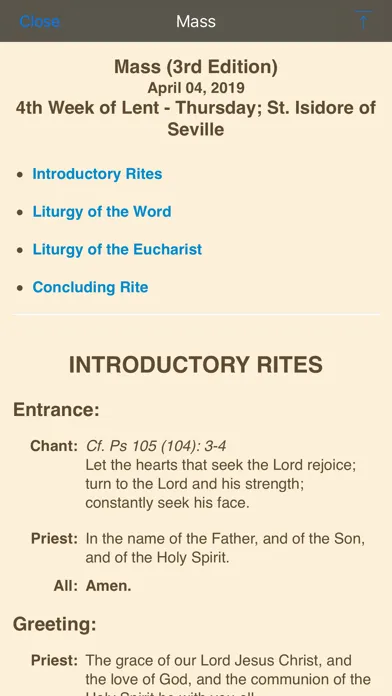
iMissal Catholic is a daily missal in app form. The home screen opens to today’s Mass: the entrance antiphon, the first reading, the responsorial psalm, the second reading on Sundays and solemnities, the Gospel acclamation, and the Gospel - all pulled from the current USCCB lectionary cycle. Below the readings sits the Order of Mass with the people’s responses bolded, so a parishioner who hasn’t been to Mass in a while can find their lines without flipping through a printed missalette.
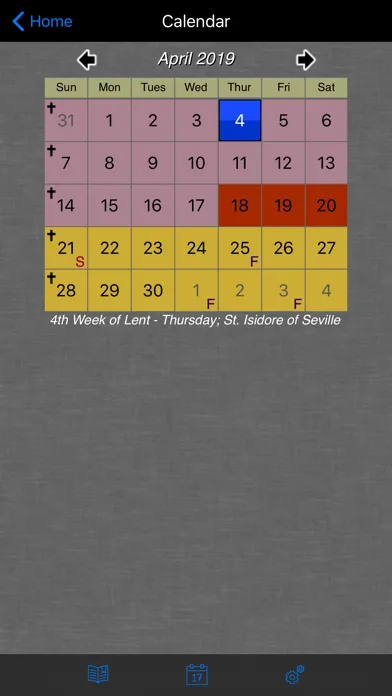
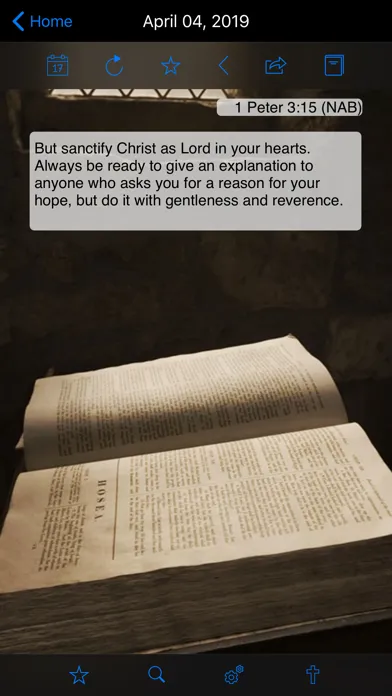
Beyond the daily Mass, iMissal carries the things a Catholic typically wants in their pocket: a calendar of saints and feasts, a prayer book covering Marian devotions and traditional prayers, an examination of conscience for confession prep, the major sacramental rites, and - for Premium subscribers - the four-volume Liturgy of the Hours, scripture commentary, and Mass texts in Spanish, Latin, and Italian alongside the English. The category is “digital missal,” and iMissal is one of the most complete entries in it.
Why daily-Mass Catholics keep iMissal on their home screen
The single biggest practical difference between iMissal and a general-purpose Catholic app like Laudate is focus. Laudate is a directory - it gives you the readings, but it also gives you a hundred other modules. iMissal is built around the question “what is the Church praying today, and what do I need to say back?” Every screen in the app is downstream of that question. The readings are the first thing you see. The Order of Mass is one tap away. The saint of the day sits in a sidebar so it’s glanceable, not buried.
This sounds like a small thing. In practice it’s transformative for the use case the app actually serves: someone sliding into a pew thirty seconds before the entrance hymn, who wants the right page in front of them without thinking. Magnificat (the print monthly) is the gold standard for that use case in paper form. iMissal is the closest digital cousin - and unlike Magnificat, it doesn’t require a subscription just to see Sunday’s readings.
Daily Mass readings + the Order of Mass: the killer combo
The core of iMissal is a single screen that pairs the day’s lectionary readings with the Order of Mass underneath. Open the app and you land on today: entrance antiphon, first reading with the citation header (e.g., “Gn 12:1-4”), responsorial psalm with the people’s refrain bolded, second reading on Sundays and solemnities, Gospel acclamation, and the Gospel itself. Scroll past the readings and the Order of Mass is right there - sign of the cross, penitential act, Gloria, Creed, all the way through the dismissal - with the people’s parts visually distinct from the priest’s parts so a returning Catholic or a curious visitor can follow without guesswork.
The reason this matters is that the alternative is fumbling. Print missalettes get out of sync with the actual readings when a feast bumps the ordinary calendar. The USCCB website works on a phone but isn’t laid out for a pew. iMissal pre-caches the upcoming days, so a basement chapel with no signal still gets the right propers - the model that respects your work. The Order of Mass underneath means you don’t need two apps open, which is the whole reason you brought a phone in the first place instead of a binder.
English + Spanish + Latin + Italian: the multilingual missal
iMissal Premium ships the full Order of Mass in four languages: English (third edition of the Roman Missal), Spanish (the Misal Romano text used across U.S. and Latin American dioceses), Latin (the editio typica, useful for the Novus Ordo in Latin and as a reference for the TLM’s common parts), and Italian (the messale used across Italy). Switching languages is a tap, and the app holds your place - so you can flip from English to Latin during the Sanctus to follow along in both, or sit through a Mass in Rome with the Italian text open while the words register in English in your head.
This is the feature that pulls travelers and bilingual parishes to iMissal specifically. A Catholic visiting Italy who wants to attend daily Mass at a neighborhood parish can have the Italian text in front of them while the English text waits one tap away. A bilingual parish in the U.S. Southwest can use the Spanish text for the proper of the Mass and switch to English for the readings. Most other Catholic apps give you one language and call it done. iMissal treats multi-language as a first-class feature, which is rare even among the more expensive entries in the category.
Examination of conscience + sacramental aid: the confession-prep layer
Tucked inside the prayer section, iMissal carries an examination of conscience organized two ways: by the Ten Commandments (the traditional structure) and by state of life (married, single, priest/religious, parent, employer/employee). Each section walks through specific questions - not generic prompts - and the flow ends with the Act of Contrition, the formula for confession, and a brief guide to the sacrament for anyone who hasn’t been in a while. The same section carries the rites of baptism, confirmation, and matrimony at a level of detail useful for parents and sponsors who need to know what’s coming.
This is the layer that turns iMissal from a Mass-only app into a sacramental companion. Most Catholic apps surface a prayer list and stop there. iMissal’s examination is detailed enough that someone preparing for confession after a long absence can use it without separately buying a printed pamphlet. Combined with the Order of Mass and the Liturgy of the Hours in Premium, the app starts to look less like a missal and more like a pocket-sized parish resource shelf - the thoughtful person’s Catholic utility app.
Pricing
Free
$0
Daily Mass readings, Order of Mass in English, daily saint, core Catholic prayers, examination of conscience. Sufficient for most weekly Mass-goers.
Premium (Annual)
Around $29.99/yr
Full multi-language Mass texts (English, Spanish, Latin, Italian), Liturgy of the Hours, scripture commentary, traditions and customs library, expanded prayer book, and removal of in-app promotions.
Premium (Monthly)
Available in-app
Same Premium features billed monthly. Most users who keep the app past the first month settle on the annual plan.
iMissal is free at the level most Catholics will ever need. Daily Mass readings, the Order of Mass in English, the daily saint, the standard prayer book, and the examination of conscience all sit inside the free tier and aren’t artificially gated.
Premium runs around $29.99 a year and unlocks the multilingual Mass texts (Spanish, Latin, Italian alongside the English), the Liturgy of the Hours, scripture commentary on the daily readings, the traditions and customs library, an expanded prayer book, and removes in-app promotions. It’s billed annually through the App Store or Google Play.
Monthly billing is available for users who want to trial Premium before committing for a year. Most users who keep the app past the first month settle on the annual plan - the math favors it heavily.
Compared to the broader Catholic app market, iMissal’s Premium price lands well under Hallow’s $69.99/yr and roughly in line with Magnificat’s digital subscription. Most users do not need Premium to get value out of iMissal - but if you want the Liturgy of the Hours and the four-language Order of Mass in a single app, the price is reasonable.
Where iMissal Catholic falls behind
No native audio readings. The app gives you the text of the daily readings beautifully, but if you want to hear them - either for accessibility or for listening on a commute - you’re going to a separate app or the USCCB’s audio page. Hallow and Pray as You Go have built audio into their core experience; iMissal hasn’t.
Interface shows its age. The information architecture is solid, but the visual design is recognizably pre-iOS-7 in spots. Buttons feel slightly chunky, transitions are utilitarian, and the typography hierarchy could be tightened. None of this affects function, but it’s the first thing a new user notices next to a design-forward app like Hallow.
No community layer. There is no friends feed, shared reading plan, or social streak system. For a missal app this is arguably the right call - the use case is private - but readers coming from YouVersion sometimes expect community features and don’t find them.
Scripture commentary is light. Premium’s commentary on the daily readings is useful for short-form context but doesn’t replace a full commentary like the Navarre Bible, the Ignatius Catholic Study Bible, or the USCCB’s own footnotes for serious study. iMissal positions the commentary as a daily nudge, not a teaching resource - fine, but worth knowing.
No Apple Watch or web companion. The app lives on iOS and Android. Anyone hoping to glance at the day’s readings on a Watch face or pull them up at a desktop is out of luck for now.
iMissal vs. Laudate vs. Magnificat
These are the three apps most U.S. Catholics weigh when picking a daily missal app, and they sit in three different lanes. iMissal is the focused missal: built around daily readings and the Order of Mass, with sacramental and multilingual support layered on top. Laudate is the Swiss-army-knife: free, ad-supported, and packed with dozens of modules (rosary, stations, Latin Mass, podcasts, news) at the cost of a more cluttered home screen and less polish on any single one. Magnificat is the digital edition of the long-running monthly print missal - beautifully edited daily reflections, Mass texts, and morning/evening prayer, behind a subscription that’s closer to $50/yr.
Different strengths. iMissal is better at being a pew companion you actually open three taps before Mass starts. Laudate is broader (more modules, more devotional content, more language coverage in a free tier). Magnificat is better at being a literary daily companion - the reflections and saint biographies are professionally edited in a way the app-native competitors don’t match.
A reasonable Catholic could keep all three. In practice, most settle on one as their pew app: iMissal if they value focus and multilingual Mass texts, Laudate if they want everything in one ad-supported bundle and don’t mind the visual noise, Magnificat if they already subscribe to the print edition and want the iOS/Android counterpart. None of the three is wrong - they’re just optimized for different daily habits.
The bottom line
iMissal Catholic is the digital missal that most daily-Mass Catholics will end up on if they try the alternatives. The free tier is genuinely useful - lectionary readings, Order of Mass, daily saints, examination of conscience - and Premium’s multilingual Mass texts and Liturgy of the Hours are priced sensibly for what they deliver. The interface is dated and there’s no native audio, but those are real gaps worth knowing about going in rather than dealbreakers. For Catholics who want one app that opens to today’s Mass and gets out of the way, iMissal has earned its long run.
Alternatives to iMissal Catholic
 LaudateThe free Swiss-army-knife of Catholic apps - daily readings, rosary, stations, Latin Mass, podcasts, and more in a single ad-supported bundle.
 MagnificatThe digital edition of the literary monthly print missal - professionally edited daily Mass texts, reflections, and morning/evening prayer.
 iBreviaryThe free Liturgy of the Hours app from an Italian priest, with the breviary, daily Mass, and ritual texts in multiple languages.
 HallowThe leading Catholic prayer and meditation app - guided audio prayer, rosary, sleep content, and celebrity-led series at a higher price point.
Frequently asked questions
Is iMissal Catholic free?
Yes. The free tier includes daily Mass readings, the Order of Mass in English, the daily saint, an examination of conscience, and a core prayer book. Premium (around $29.99/yr) adds multilingual Mass texts, the Liturgy of the Hours, scripture commentary, and an expanded prayer library.
Which languages does iMissal support?
The free tier covers English. Premium adds the Order of Mass in Spanish (Misal Romano), Latin (editio typica), and Italian alongside English - making it one of the few Catholic apps that treats multilingual Mass texts as a first-class feature.
Does iMissal include the Liturgy of the Hours?
Yes, with a Premium subscription. The four-volume Liturgy of the Hours is bundled inside iMissal’s Premium tier. If you only need the LOTH and nothing else, iBreviary offers the same hours for free - worth knowing before you subscribe.
Is iMissal Catholic available on Android?
Yes. iMissal Catholic ships on both iOS and Android, with feature parity between the two platforms. There is currently no Apple Watch app or dedicated web version.
Who makes iMissal Catholic?
iMissal is developed by Cantcha Inc., a small studio that has shipped the app continuously since around 2010. It is one of the longer-running Catholic apps still receiving active lectionary and OS updates.
How does iMissal compare to Hallow?
They serve different needs. Hallow is a guided audio prayer and meditation app - rosary, sleep content, celebrity-led series - priced around $69.99/yr. iMissal is a digital missal focused on daily Mass readings, the Order of Mass, and sacramental texts at roughly $29.99/yr. Many Catholics keep both.
Are the daily readings always current?
Yes. iMissal follows the USCCB lectionary cycle and pre-caches upcoming days, so the app works in chapels and travel locations without reliable signal. Feast-day overrides and saint memorials are updated against the Roman calendar.
Sources & further reading
More Catholic Apps
 Latria - Bible & CommentariesLatria brings a Catholic Bible, patristic commentary, early Christian writings, councils, Lectio-style reflections, prayers, and a Scriptural Rosary into a quiet offline iPhone library—but source-text documentation, accessibility, export, and its lifetime-price math need closer inspection.
 FioA genuinely useful Catholic audio home that pays creators more and combines podcasts, music, and audiobooks—much smaller than Spotify, but far more intentional about what Catholic listeners can discover.
 Heroic MenA donor-funded Catholic media library built to move men from watching into prayer, friendship, and small groups—generous in content, but muddled across its media and community products.
 Word on Fire InstituteBishop Barron’s Institute combines serious Catholic formation, live seminars, prayer groups, and a large online community for $27 a month—far more than a video library, and priced accordingly.
 FormedThe Augustine Institute’s “Catholic Netflix” is now a much larger formation library—movies, studies, daily reflections, books, audio, parish programs, and children’s content for $99.99 a year or through a sponsoring parish.
 AmenAmen is the Augustine Institute's free Catholic prayer and audio Scripture app, and it is free in the strict sense - no subscription, no in-app purchase list, no locked sessions. The reason to read past the 4.9 rating is what the nonprofit still does not carry.