
- Starting price
- Free; complete notes $5.99 once
- Free tier
- Yes
- Platforms
- iPhone · iPad · Apple Silicon Mac · Apple Vision · Android
- Developer
- Grace to You
- Launched
- 2015
- Updated
- Aug 2, 2026
The verdict
The Study Bible is one of the easiest Bible-study app purchases to recommend if John MacArthur is already a teacher you trust. The free layer is unusually deep, the complete second-edition notes cost only $5.99 once, and 17,625 ratings support the app’s reliability. Its limitations are equally clear: one theological voice, a smaller translation library than general platforms, and no credit for owning the printed Study Bible.
Try The Study Bible ↗Opens studybible.org
The Study Bible is Grace to You’s mobile Bible reader and teaching library built around John MacArthur’s sermons, devotionals, and study notes. It should not be confused with the printed MacArthur Study Bible or with a general-purpose platform such as Logos. The app is free to download and already includes Bible text, audio, personal notes, bookmarks, highlights, cross-references, study guides, articles, devotionals, and access to more than 3,000 full-length sermons. The premium transaction is refreshingly small: $5.99 once for John MacArthur’s complete Study Bible Notes.
That purchase unlocks almost 25,000 explanatory comments plus nearly 200 maps, charts, timelines, and illustrations, book introductions, doctrinal outlines, and linked Scripture references from the second edition. There is no monthly subscription for the notes. Readers who bought the notes in the old version can restore access after signing into the same Grace to You account, and synced personal notes and highlights are designed to carry into the redesigned app.
The free and paid boundaries are easy to misunderstand. Buying a printed MacArthur Study Bible does not include the digital notes; the official FAQ says they must be purchased in the app. Conversely, purchasing the $5.99 notes does not turn the app into a broad scholarly library. You are buying one study Bible’s annotation layer inside a capable reader, not a bookstore, commentary bundle, or seminary research system.
This review is based on Grace to You’s current product page and FAQ, the live U.S. App Store listing, store privacy labels, and version metadata as of August 2, 2026. We did not represent vendor materials as hands-on testing. The result is a strong value verdict with a doctrinal-fit caveat: the app is most useful when MacArthur’s verse-by-verse, conservative evangelical interpretation is the perspective you came to study.
✓ The good
- Exceptional one-time value - the complete MacArthur Study Bible Notes cost $5.99, not $5.99 every month
- Substantial free foundation - Bible text and audio, more than 3,000 sermons, devotionals, articles, guides, bookmarks, highlights, and personal notes work without buying the note set
- Full second-edition apparatus - nearly 25,000 comments and almost 200 visual aids, plus introductions, outlines, and cross-references
- Serious store validation - a 4.85 average across 17,625 U.S. App Store ratings and an active July 2026 build
- Account sync - notes, highlights, bookmarks, and earlier note purchases can follow a signed-in user across supported devices
- Audio plus teaching in one place - listen to Scripture and move directly into MacArthur’s sermon archive without juggling separate apps
✗ Watch out
- One interpretive voice - notes and sermons come from John MacArthur and Grace to You rather than a range of scholars or traditions
- Print ownership does not unlock the app - even recent buyers of the physical Study Bible must pay separately for John’s Notes
- Translation information is inconsistent - the live store description names ESV, NASB, and KJV while the redesigned official page also displays LSB and NKJV
- English only on iOS - Apple lists no additional interface languages
- Account-linked data collection - Apple says purchases, contact information, user content, and identifiers may be linked to identity
- Not a research platform - no original-language morphology, multi-volume commentary store, citation system, or advanced library search like Logos
Best for
- Readers who already use the MacArthur Study Bible
- Sermon listeners following Grace to You
- Bible students wanting a low-cost one-time note set
- Church members in conservative evangelical settings
Avoid if
- You want Catholic, Orthodox, Wesleyan, or ecumenical notes
- You need Greek, Hebrew, or academic research tools
- You expect print ownership to include digital access
- You prefer several commentaries beside each passage
What The Study Bible is
The Study Bible is a free mobile Bible reader published by Grace to You, the teaching ministry associated with John MacArthur. Its free layer combines ESV, NASB, and KJV Scripture in the current store description with audio, more than 45 years of sermons, MacArthur answers to Bible questions, devotionals, articles, and user-created highlights, notes, and bookmarks.
A one-time purchase adds the full annotation layer from the second edition of The MacArthur Study Bible. That makes the app a hybrid: more teaching-rich than a plain Bible reader, far less expansive than Logos or Olive Tree, and dramatically cheaper than buying a new physical study Bible. It launched in July 2015; the current iOS build requires iOS 15 or later and also runs on Apple Silicon Macs.
A complete named study Bible for less than the price of lunch
Most Bible apps divide into two economic models: free reading with a large bookstore of separate resources, or a recurring subscription for premium study features. The Study Bible takes a simpler path. The reader, sermons, audio, and personal tools are free; one $5.99 purchase adds the entire MacArthur notes package. There is no library-building pressure and no annual decision.
The simplicity is also the limit. Every explanatory layer leads back to one teacher’s framework. That coherence helps someone following a MacArthur sermon or using the printed edition, because language and conclusions align. It is a poor fit for comparing interpretations. The app is best treated as one deeply integrated study Bible—not as a neutral arbiter or complete research environment.
Nearly 25,000 notes with visual and doctrinal support
John’s Notes cover virtually every passage, supported by almost 200 maps, charts, timelines, and illustrations, an introduction to every biblical book, doctrinal outlines, and linked Scripture. Grace to You says this is the complete second-edition content rather than a limited sample assembled for mobile.
Integration is the value. A reader can move from verse to note to cross-reference without balancing a heavy volume or searching a PDF. The notes are concise study-Bible annotations rather than full commentary chapters, which makes them practical during daily reading, group preparation, or sermon follow-up but insufficient for contested academic questions by themselves.
The sermon archive is the real free premium feature
The app links more than 3,000 full-length sermons drawn from over 45 years of Grace to You teaching, covering the New Testament and portions of the Old. It also includes Bible-question answers, study guides, articles, and three daily devotionals. That is substantially more free teaching than the modest store description might suggest.
For a listener already following MacArthur, this can replace a separate podcast app and make sermon discovery passage-led instead of date-led. For anyone outside that audience, quantity does not solve viewpoint breadth. The archive is deep within one ministry and should be paired with other trusted sources when a passage has several historic readings.
Reading, audio, personal notes, and account sync
The reader supports Scripture audio, hidden verse numbers, highlights, bookmarks, personal study notes, adjustable text, cross-references, and footnotes. Signed-in data can synchronize across devices, and the redesign preserves synced notes, highlights, and favorites from the earlier version according to the official FAQ.
Those are ordinary features in a modern Bible app, but their presence keeps the $5.99 notes from becoming a static reference product. The privacy cost is an account: Apple says purchases, contact information, user content, and identifiers may be linked to identity, with search history, identifiers, usage data, and diagnostics also collected without being linked.
Pricing
Free app
Free
Bible reading and listening, more than 3,000 sermons, MacArthur Q&A, personal notes, highlights, bookmarks, syncing, study guides, articles, three daily devotionals, and the MacArthur Daily Bible plan.
John MacArthur’s Study Bible Notes
$5.99 once
Unlocks nearly 25,000 explanatory notes and the companion maps, charts, timelines, illustrations, book introductions, doctrinal outlines, and linked references. This is a one-time in-app purchase in the U.S. App Store.
Existing digital purchaser
Restore at no charge
Users who purchased John’s Notes in the prior app and signed in with a Grace to You account should regain access automatically after signing into the redesigned app.
Print owner
$5.99 app purchase still required
Owning a physical MacArthur Study Bible does not confer a digital license. The official FAQ explicitly separates the print and app products.
The core app is genuinely useful for free. You can read and listen, use personal study tools, access devotionals and articles, and search the sermon archive without purchasing John’s Notes.
The complete notes are $5.99 once in the U.S. App Store. There is no subscription listed. At that price, the app is less expensive than almost any new print study Bible and easier to search, though it provides no physical book or resale value.
Earlier digital purchasers should restore rather than repurchase. Grace to You says the entitlement is recorded against the account used in the old app. Sign into that same account after installing the redesigned version.
Print purchasers are not included. The official FAQ says a physical MacArthur Study Bible does not unlock John’s Notes in the app. That may feel ungenerous, but it is disclosed plainly and the extra charge remains low.
Where The Study Bible falls behind
Theology is coherent, not representative. A note set bearing one teacher’s name should be expected to reflect his conservative evangelical, dispensational, cessationist framework. The app does not balance it with Catholic, Orthodox, Wesleyan, Pentecostal, or critical-scholarship annotations.
Translation claims need clarification. The App Store’s current description names ESV, NAS, and KJV; the redesigned official page visually lists NASB, LSB, ESV, and NKJV. Until the rollout documentation is synchronized, choose based on the translation you can confirm inside your platform’s build.
There are no original-language research tools. Logos, Accordance, and Olive Tree can sell lexicons, grammars, morphology, and full commentary series. Here, search and cross-references stay within a study-Bible scale.
Digital and print ownership are separate. A code in new print copies would make the ecosystem friendlier, especially for buyers who already paid for the same note content. Grace to You instead charges the small app fee again.
The app is English-only in Apple’s metadata. A sermon archive this large could serve more readers if the interface and study notes matched the multilingual reach of many general Bible platforms.
The Study Bible vs. Logos vs. Olive Tree vs. Blue Letter Bible
The Study Bible wins on price and focus. $5.99 unlocks one complete, named note set inside a free reader. Logos wins on total research depth, with original-language tools, datasets, and a vast bookstore; its complexity and potential cost are in another category. Olive Tree sits between them, offering a friendly reader and a broad à-la-carte study library.
Blue Letter Bible is the strongest free comparison. Its 4.9 rating rests on more than 331,000 App Store ratings and it includes interlinear, lexicon, concordance, commentary, and audio tools without tying the whole experience to one teacher. Its interface is more utilitarian, and the annotation experience is assembled from many resources rather than designed as a single study Bible.
Choose The Study Bible when you specifically want MacArthur’s notes and sermons. Choose Blue Letter Bible for free breadth, Olive Tree for a purchasable library in an approachable reader, and Logos for serious original-language or seminary work. They can coexist: this app costs little enough to remain a dedicated MacArthur reference beside a broader platform.
The bottom line
The Study Bible is a focused product with unusually honest economics. Its free reader already carries three named translations in the current listing, audio, personal tools, devotionals, and more than 3,000 sermons; $5.99 once adds almost 25,000 notes and nearly 200 visual aids. The 4.85 average across 17,625 ratings and July 2026 maintenance make it more than a forgotten ministry app. Buy it if MacArthur is a voice you deliberately want. Skip it as your only study source if you need doctrinal breadth, original languages, or a large commentary library.
Alternatives to The Study Bible
 Grace to YouThe broader free John MacArthur sermon, radio, TV, devotional, and 24/7 streaming archive—with a much weaker current app rating.
 LogosThe full research platform: original languages, datasets, academic libraries, and far more complexity and expense.
 Blue Letter Bible AppThe best free route to concordance, lexicon, interlinear, commentaries, and audio across a very large user base.
 Olive Tree Bible AppAn approachable reader with a large store of study Bibles, commentaries, maps, and original-language resources.
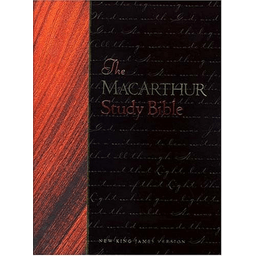 The MacArthur Study BibleThe print edition for readers who want permanent ownership, page context, and no account or device dependency.
Frequently asked questions
Is The Study Bible app free?
Yes. The reader, Bible audio, personal notes, highlights, bookmarks, devotionals, articles, and more than 3,000 Grace to You sermons are free. The complete MacArthur Study Bible note set is a separate $5.99 one-time purchase.
How much are John MacArthur’s study notes?
The U.S. App Store lists John MacArthur’s Study Bible Notes at $5.99 as a one-time in-app purchase as of August 2, 2026.
Which Bible translations are included?
The current App Store description names ESV, NAS, and KJV. The redesigned official page also displays NASB, LSB, ESV, and NKJV. Because those public lists do not fully agree, verify your required translation in the current build for your platform.
Does owning the printed MacArthur Study Bible unlock the app notes?
No. Grace to You’s official FAQ says print owners still need to purchase John’s Notes in the app. The products are licensed separately.
Can I restore notes bought in the old app?
Yes, if the purchase was associated with your Grace to You account. Install the redesigned app and sign in with the same account; the official FAQ says access should restore automatically.
Is this the same as Logos?
No. The Study Bible is a focused reader, sermon archive, and one-study-Bible annotation set. Logos is a large research library with original-language tools, scholarly datasets, and thousands of purchasable books.
Sources & further reading
More Bible Study Software
 VerseLink BibleVerseLink Bible keeps Scripture, sermon notes, highlights and original-language helps entirely on your device with no account, tracking, ads or subscription—but local-first privacy makes manual backup your responsibility.
 Ezra Bible AppA serious free, open-source study workspace built around topical verse collections, notes and the SWORD module ecosystem, now spanning desktop and mobile—but resource licensing varies, sync depends on Dropbox, and its 2022 privacy template contradicts the current App Store disclosure.
 Rava: Discover God’s StoryA free, multilingual facilitator that lets almost anyone press play and guide a Discovery Bible Study with little preparation—excellent for reproducible group participation, but not a replacement for wise leadership, contextual interpretation or a modern privacy policy.
 ARMA CoursesARMA makes serious Bible and theology teaching approachable through short, energetic courses—valuable for guided learners, but narrower and less transparent than a seminary library.
 Storyverse InstituteStoryverse makes Bible, theology, soul care and ministry training approachable through 200+ videos, community and cohorts—but its age, collection and deletion disclosures conflict too sharply for informed enrollment.
 The Word One to OneA polished, completely free guide for reading John and Acts with a friend—excellent for a trusted conversation, but narrow in scope and incomplete on app privacy and safeguarding.