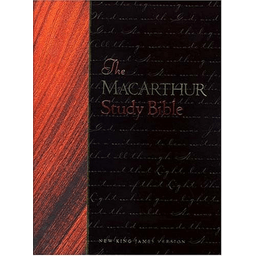
- Starting price
- $49.99 hardcover
- Free tier
- No
- Platforms
- Print · Kindle · Logos · Olive Tree
- Developer
- Thomas Nelson
- Launched
- 1997 (2nd ed. 2019)
- Updated
- May 24, 2026
The verdict
The MacArthur Study Bible is the gold standard for readers who want a single, consistent, opinionated voice walking them through the whole canon. If that voice is yours, it is excellent. If it isn’t, you will feel the friction on every page.
Try MacArthur Study Bible ↗Opens gty.org
The MacArthur Study Bible has quietly become the default study Bible for a generation of Reformed Baptist pulpits, Bible college dorms, and serious lay readers who want one teacher rather than a committee. Since its 1997 debut it has reportedly moved over four million copies and now sits in a 2019 second edition with roughly 25,000 study notes - every last one written or supervised by John MacArthur himself, the long-tenured pastor of Grace Community Church in Sun Valley, California.
That single-author DNA is the whole point. It doesn’t feel like a reference work. It doesn’t feel like a committee compromise. It doesn’t feel hedged. It reads like a 2,000-page sermon series from one preacher who has been working through the same Bible for fifty years and has a settled opinion about almost every contested verse - and is happy to tell you what it is.
That confidence is exactly what some readers love and exactly what others find tiring. MacArthur writes from a specific theological location - Reformed Baptist, dispensational, complementarian, cessationist - and he doesn’t pretend otherwise. Readers who share that framework get a study Bible that lines up cleanly with their Sunday sermons. Readers from Wesleyan, Catholic, Orthodox, Latter-day Saint, or continuationist traditions will find theology outside their own on a lot of contested passages, and the notes won’t always flag where MacArthur’s reading is one tradition among several.
✓ The good
- Single-author consistency - every note sounds like the same teacher, so you never get whiplash from one contributor to the next
- 25,000+ exegetical notes - dense, verse-anchored, and almost always practical rather than merely academic
- Four translation editions - the same note system is available in NKJV (original), NASB, ESV, and NIV, so you can match it to the pew Bible at your church
- Strong introductions - each book opens with author, date, themes, and an outline that doubles as a sermon-prep skeleton
- Word-study sidebars and topical indexes - useful even if you already own a separate concordance
- Durable physical editions - the Premier leather and Leathersoft printings are built to last decades of daily handling
- Reads cover-to-cover - unusual for a study Bible; many readers actually finish the notes the way they’d finish a long book
✗ Watch out
- Opinionated where other study Bibles hedge - you get MacArthur’s reading, not a survey of credible options
- Distinctly cessationist and dispensational - readers from continuationist, covenantal, Wesleyan, Catholic, Orthodox, or LDS backgrounds will encounter theology outside their tradition on many contested passages
- Complementarian framing throughout - notes on 1 Timothy 2, Ephesians 5, and 1 Corinthians 14 reflect that position without surveying alternatives
- Limited interaction with other scholars - footnotes rarely cite or engage commentators who disagree
- Print-first design - the digital editions in Kindle, Logos, and Olive Tree work, but the notes were laid out for paper
- No interactive maps or video - if you want multimedia, this isn’t that kind of study Bible (yet)
Best for
- Reformed Baptist and dispensational readers
- Pastors and teachers who want a consistent voice in their study notes
- Bible college and seminary students using it as a portable reference
- Long-time MacArthur listeners who already trust his pulpit
Avoid if
- You want a multi-voice survey of credible scholarly options
- You’re Wesleyan, Catholic, Orthodox, Latter-day Saint, or continuationist and want notes inside your tradition
- You prefer a study Bible heavy on maps, charts, photography, and video
- You bristle at confident commentary and prefer questions over answers
What MacArthur Study Bible is
The MacArthur Study Bible is a single-volume study Bible: the full biblical text plus an apparatus of book introductions, verse-by-verse study notes, topical sidebars, charts, a concordance, and maps. What sets it apart from almost every competitor is that the entire study apparatus - roughly 25,000 notes - was written and supervised by one person, John MacArthur, drawing on the verse-by-verse expository preaching he has done at Grace Community Church for more than five decades.
Thomas Nelson first released it in 1997 in the NKJV. A thoroughly revised second edition arrived in 2019 with updated notes, expanded charts, and refreshed introductions, and the project has since shipped in NASB, ESV, and NIV editions so readers can keep the same notes alongside whichever translation their church or school uses.
Why pastors and serious lay readers stay with MacArthur
The single biggest practical difference between the MacArthur Study Bible and almost any modern competitor is voice. The ESV Study Bible runs on 95 contributors. The NIV Study Bible draws on a similar committee. The MacArthur Study Bible is one preacher across 66 books. You’re not getting a survey of the field - you’re getting one settled reading from one settled teacher, on every page, for the entire canon.
For readers inside MacArthur’s theological frame, that consistency is the killer feature. The notes on Romans line up with the notes on Revelation. Ecclesiology in 1 Timothy matches ecclesiology in Titus. Eschatology in Daniel matches eschatology in Matthew 24. You don’t spend half your study time triangulating between contributors who disagree with each other; you spend it working through one coherent reading. That’s either the strongest selling point in the category or the reason to pick a different study Bible - depending on whether MacArthur’s reading is yours.
Single-author voice: consistency as a feature and as a limitation
The MacArthur Study Bible is structurally unusual in 2026. Most study Bibles in print - ESV Study Bible, NIV Study Bible, CSB Study Bible, NLT Study Bible - are committee projects with dozens of scholars writing sections in their specialty. MacArthur ran the opposite playbook: one pastor, one pulpit, one decades-long preaching ministry condensed into 25,000 verse-anchored notes. That’s why the prose has a recognizable rhythm. You hear the same teacher on Leviticus that you hear on Jude.
The upside is coherence. The downside is range. A committee project can hand 1 Corinthians to a Pauline specialist and Hebrews to someone fluent in second-temple Judaism; MacArthur covers both himself and reads them through one theological lens. Readers who want that lens get a tight, unified study Bible. Readers who don’t share it should know that the notes won’t usually pause to lay out alternative readings before settling on MacArthur’s.
25,000+ exegetical notes: dense, practical, and pastor-shaped
The notes are the product. Roughly 25,000 of them sit at the bottom of the page, keyed verse-by-verse, and they lean heavily exegetical rather than devotional. You get definitions of Greek and Hebrew terms where they matter, historical-cultural background where it changes the meaning, cross-references to parallel passages, and short pastoral applications. Almost every note ties back to something MacArthur has preached.
What that means in practice: this is a study Bible you can actually read straight through, not just consult. Many readers report finishing the entire study apparatus alongside their annual Bible reading plan, the way you’d finish a long commentary set. The trade-off is that the notes are confident rather than exploratory. On disputed verses - the warning passages in Hebrews, the household codes in Ephesians, the millennium in Revelation 20 - you get one careful answer rather than a tour of the credible options.
Multiple translation editions: one note set, four pew Bibles
The MacArthur Study Bible launched in 1997 in NKJV - the translation MacArthur preached from for most of his career - and over time Thomas Nelson and Crossway licensing has expanded it into NASB, ESV, and NIV editions as well. The study apparatus is essentially the same across editions; the underlying English text is what changes. That makes it unusually portable across church contexts.
In practice this matters more than it sounds. If your church preaches from the ESV, you can put the ESV edition next to the pulpit Bible without translation drift. If your Sunday school uses NIV for accessibility, the NIV edition keeps the notes intact. The NASB edition is popular with seminary students who want the most literal English text, and the original NKJV remains the default for traditionalist congregations. Pick the translation your community is actually reading.
Pricing
Hardcover
$49.99
The standard edition most readers buy. Sewn binding, full 25,000 notes, book introductions, concordance, and maps. The right starting point.
Kindle / Digital
around $32
The full text and full notes in the Kindle reader. Convenient for travel and search, less convenient for the kind of cross-referencing this Bible rewards.
Leathersoft
around $89
Flexible imitation-leather cover, same content as the hardcover. The everyday upgrade most pastors land on.
Premier Goatskin / Calfskin
around $130 and up
Edge-lined leather editions built to last decades. Overkill for casual use, exactly right for a preacher’s pulpit Bible.
Translation editions
varies
Available in NKJV (the original), NASB, ESV, and NIV. The notes are the same; the underlying text changes. Pick the translation your church uses on Sunday.
The standard hardcover lists at $49.99 and is the right starting point for almost every reader. You get the full 25,000-note apparatus, all the book introductions, the concordance, and the maps - nothing in the more expensive editions changes the actual content.
From there the upgrades are about durability and feel. Leathersoft editions land around $89 and are the everyday choice for pastors who carry the same Bible to the pulpit every Sunday. The Premier goatskin and calfskin editions start around $130 and are built to last decades - the kind of Bible you re-cover rather than replace.
Digital editions trade physical durability for portability and search. The Kindle edition runs around $32. The same notes are also licensed inside Logos Bible Software and Olive Tree, where they integrate with the rest of your library - useful if you already live in one of those study platforms.
If you are choosing between translation editions, pick the one your church reads on Sunday. The study notes are identical; the only meaningful variable is which English text you want underneath them.
Where MacArthur Study Bible falls behind
No multi-voice survey of disputed passages. On contested texts - baptism, spiritual gifts, the millennium, the role of women in ministry - you get MacArthur’s reading, not a fair summary of the alternatives. The ESV Study Bible and Zondervan’s NIV Study Bible both tend to flag where credible scholars disagree before recommending a view; MacArthur usually doesn’t.
Limited engagement outside the Reformed Baptist tradition. The notes rarely interact with Wesleyan, Lutheran, Anglican, Catholic, Orthodox, or Latter-day Saint readings, even on passages where those traditions read differently. That’s a feature for readers inside MacArthur’s frame and a real limitation for everyone else.
Cessationist by default. Notes on 1 Corinthians 12-14, Acts 2, and related passages reflect the view that the miraculous gifts ceased with the apostolic age. Continuationist readers - most Pentecostal, charismatic, and Third Wave traditions - will find their position not so much engaged as set aside.
Print-first layout in a digital era. The Kindle, Logos, and Olive Tree editions are usable, but the notes were typeset for paper. If you want a study Bible designed natively for video, animation, interactive maps, and tappable cross-references, this isn’t that product (yet).
Minimal photography and visual study aids. The ESV Study Bible spends real budget on full-color maps, archaeological photography, and infographic-style charts. MacArthur is text-dense by design - fine if you want commentary, thin if you want a coffee-table study experience.
MacArthur Study Bible vs. ESV Study Bible vs. Reformation Study Bible
These three sit at the top of the Reformed-adjacent study Bible market and they’re genuinely different products. The MacArthur Study Bible is one pastor across 66 books, dispensational and cessationist, with 25,000 verse-keyed notes that read like sermon transcripts. The ESV Study Bible is a 95-contributor committee project, broadly Reformed but ecumenical in scope, with heavier visual design, more interaction with credible scholarly options, and longer essays. The Reformation Study Bible, edited by R.C. Sproul, sits closer to confessional Reformed (Presbyterian, covenantal, Westminster Confession) than to MacArthur’s Reformed Baptist dispensationalism.
Different strengths. MacArthur is better at consistency - you hear one voice, you know what you’re getting. ESV is broader (more contributors, more art, more essays, more willingness to lay out alternative readings before landing). Reformation is the natural pick if you want confessional Reformed theology rather than Reformed Baptist or dispensational framing, with notes shaped by the Westminster and Three Forms of Unity tradition.
Most readers benefit from owning more than one. A common pattern: MacArthur for daily reading because the voice is steady, ESV for sermon prep because the contributor mix gives you more angles, Reformation Study Bible if your church sits in the confessional Reformed tradition. None of the three is wasted shelf space.
The bottom line
The MacArthur Study Bible is the thoughtful person’s single-author study Bible. If you sit inside MacArthur’s Reformed Baptist, dispensational, cessationist, complementarian frame - or you actively want to learn it - it’s as good as the category gets, with 25,000 notes that read like a 2,000-page sermon series from a preacher who has spent fifty years on the same canon. If you sit outside that frame, you’ll want a multi-voice study Bible alongside it so you’re not reading one tradition’s answers as the only ones on the table. Real limitations, but worth knowing about going in rather than dealbreakers.
Alternatives to MacArthur Study Bible
 The Study Bible AppGrace to You’s free reader and 3,000-sermon archive, with the complete second-edition MacArthur notes available for $5.99 once.
 ESV Study BibleThe 95-contributor committee project. Broader voice, heavier visual design, more willing to survey alternative readings before landing.
 NIV Study BibleMulti-author, evangelical, accessible. The most readable English text in the category and a strong default for newer readers.
 Mere ChristianityC.S. Lewis’s short, rigorous case for the core of historic Christian belief. Pair it with any study Bible for theological breadth.
 The Purpose Driven LifeRick Warren’s 40-day discipleship classic. Not a reference work - a practical companion when you want application rather than exegesis.
Frequently asked questions
Which translation should I get the MacArthur Study Bible in?
Pick the translation your church reads on Sunday. The study notes are essentially the same across the NKJV (the original 1997 edition), NASB, ESV, and NIV releases - only the underlying English text changes. NKJV is the traditional default, NASB is the most literal, ESV is popular in Reformed and evangelical churches, and NIV is the most accessible for newer readers.
What’s the difference between the 1997 first edition and the 2019 second edition?
The 2019 second edition is a thorough revision: roughly 25,000 notes (expanded from the original), updated book introductions, refreshed charts, and several hundred additional study notes that reflect MacArthur’s preaching since the first edition. If you’re buying new, get the second edition.
Is the MacArthur Study Bible suitable for readers outside MacArthur’s theological tradition?
It can be valuable as one voice among several. MacArthur writes from a specific Reformed Baptist, dispensational, cessationist, complementarian position and doesn’t typically survey alternative readings before landing. Readers from Wesleyan, Lutheran, Anglican, Catholic, Orthodox, Latter-day Saint, or continuationist traditions will find theology outside their own on many contested passages and should pair it with a study Bible from their own tradition for balance.
How does it compare to the ESV Study Bible?
Different products. ESV Study Bible is a 95-contributor committee work with more visual design, longer essays, and more willingness to flag alternative readings. MacArthur is one author, more text-dense, more confident on disputed passages, and more consistent in voice. Many readers own both.
Is there a digital version?
Yes. Grace to You’s free The Study Bible app sells the complete second-edition notes for $5.99 once and includes Bible audio, personal notes, and more than 3,000 sermons. The notes are also licensed in Logos and Olive Tree, while Kindle editions provide a more book-like format. Owning the print edition does not automatically unlock the app notes.
Is it good for new Christians?
It can be, with a caveat. The notes are clear and the introductions are well-organized, but the voice is opinionated. A new reader using only the MacArthur Study Bible may absorb MacArthur’s specific theological positions without realizing they are one tradition among several. Many pastors recommend it alongside, rather than instead of, a multi-author study Bible during the first few years.
Why do so many pastors recommend it?
Two reasons. First, the consistency - one voice across 66 books means the notes never contradict themselves, which is unusual in the category. Second, MacArthur’s decades of verse-by-verse expository preaching at Grace Community Church gave him an unusually deep working file on almost every passage, and the notes pull directly from that. For pastors who share his theological frame, it functions like a portable commentary set.
Sources & further reading
More Study Bibles
ESV Study BibleThe ESV Study Bible has quietly become the default desk Bible for pastors, seminarians, and serious lay readers in the Reformed evangelical world - and the reasons it earned that spot are worth understanding before you buy.NIV Study BibleThe original modern study Bible - over nine million copies sold and still the most balanced one-volume evangelical study Bible most readers will ever own. NIV Cultural Backgrounds Study BibleA 2,400-page reference Bible built around one question - what would an ancient reader have heard in this verse?
 NIV Life Application Study BibleThe best-selling study Bible of the last forty years built its name on one idea - notes that tell you what a passage means for your Tuesday, not just what it meant in the first century. Here is what that trade-off actually buys you.
 Reformation Study BibleR.C. Sproul's flagship study Bible pairs the ESV text with confessional Reformed notes, historic creeds, and a stack of theology articles - and Ligonier gives the whole apparatus away free online, which changes the buying math.
 Ignatius Catholic Study BibleThe Catholic study Bible that built its reputation one New Testament volume at a time - Scott Hahn and Curtis Mitch on the RSV-2CE - has finally arrived as a complete single volume, and it's worth understanding what it does before you buy.