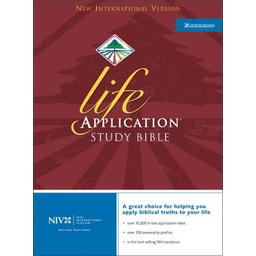
- Starting price
- ~$35 hardcover
- Free tier
- No
- Platforms
- Print · Kindle · App
- Developer
- Tyndale House / Zondervan
- Launched
- 1988
- Updated
- May 31, 2026
The verdict
The all-time best-selling study Bible, and it earned that spot by answering a question most study Bibles skip: not just what does this passage mean, but what do I do about it. The Life Application Notes are devotional and practical rather than technical, which is exactly right for daily readers and exactly wrong for someone hunting original-language depth. Broadly evangelical, application-first, and available in nearly every major translation.
Try NIV Life Application Study Bible ↗Opens tyndale.com
The Life Application Study Bible first appeared in 1988 and has quietly become the best-selling study Bible in the world - well over 20 million copies across its editions and translations, a number reference books almost never reach. Co-published by Tyndale House and Zondervan, it has been issued in the NIV, NLT, KJV, NKJV, NASB, and other translations, so a reader can keep the same notes alongside whichever text they already read. The NIV edition is the one most American buyers reach for, and the one this review centers on.
It is not a technical study Bible. It does not lead with Hebrew morphology. It does not try to compress a seminary commentary into the footnotes. What it does instead is take each passage and ask a second question after the historical one: now what? The signature feature - the Life Application Notes - moves past explaining what a verse meant to its first audience and presses into what it asks of the reader making decisions today. Around that core sit 100-plus character profiles, full book introductions, maps, charts, timelines, and a large topical index built for finding guidance by life situation.
There are a handful of obvious competitors a buyer weighs against it: the NIV Study Bible (Zondervan, more exegetical and translation-driven), the ESV Study Bible (Crossway, denser and more academic), the NIV Cultural Backgrounds Study Bible (ancient-context focused), and the NIV Biblical Theology Study Bible (whole-Bible storyline). The Life Application edition sits apart from all of them on one axis - it is the application-first option where the others are explanation-first. A major revision landed in 2019, refreshing notes, profiles, and design. For daily readers and small-group leaders who want the Bible to land on their actual lives, that emphasis is the whole appeal. For readers who want original-language detail and exegetical depth, it is a useful companion rather than a primary reference.
✓ The good
- Best-in-class for application - the Life Application Notes are the most developed "now what do I do" apparatus in any mainstream study Bible, and nothing else in the category matches the volume
- Translation-flexible - the same notes ship in NIV, NLT, KJV, NKJV, NASB, and more, so you keep your preferred text without losing the study material
- Over 100 character profiles - full-page sketches of figures like Abraham, Ruth, David, Peter, and Paul that pull lessons from their lives, strengths, and failures alike
- Genuinely accessible to beginners - notes assume no theological vocabulary and read in plain English, which is rare density done without jargon
- Strong everyday reference scaffolding - book introductions, a large topical index organized by life situation, maps, charts, and timelines built for quick orientation
- The 2019 revision modernized it - updated notes, refreshed character profiles, cleaner typography, and added study material across the volume
- Broad availability and format range - hardcover, leather editions, large print, Kindle, and inclusion of the notes inside several Bible apps
✗ Watch out
- Application notes are devotional and practical rather than deeply exegetical - readers wanting verse-by-verse technical commentary will find this thinner than the ESV or NIV Study editions
- No original-language tools - there is no interlinear, no Hebrew/Greek word study apparatus, and lexical detail is minimal by design
- Physically bulky - the sheer volume of notes makes the print edition thick and heavy; not an easy carry-to-church Bible in standard form
- Application can feel directive - by telling you what a passage asks of you, the notes occasionally land more prescriptively than readers who prefer to draw their own conclusions may want
- Broadly evangelical, 66-book Protestant canon - readers in Catholic, Orthodox, or Latter-day Saint traditions will want a reference from inside their own tradition alongside it
- Small standard font - the page real estate goes to notes, so the standard hardcover text runs small unless you buy the large-print edition
Best for
- Daily readers who want each passage to connect to real decisions and habits
- Small-group and Bible-study leaders preparing discussion that lands on everyday life
- New believers and first-time Bible readers who want plain-English help with no jargon
- Readers who want the same application notes alongside their preferred translation
Avoid if
- You want deep exegetical or original-language commentary as your primary reference
- You're Catholic, Orthodox, or Latter-day Saint and want a study Bible from inside your tradition
- You need a lightweight Bible to carry - the note volume makes the print edition heavy
- You prefer notes that explain and then step back rather than suggest direct application
What NIV Life Application Study Bible is
The NIV Life Application Study Bible is a single-volume study Bible built around the New International Version, co-published by Tyndale House and Zondervan and first released in 1988. The biblical text sits at the top of each page; the lower portion carries the study notes. What distinguishes those notes is their purpose. Most study Bibles annotate a verse to explain it - who wrote it, what the words meant, how it connects elsewhere. The Life Application Notes do that briefly, then take a further step: they spell out what the passage asks of a reader living today, framing decisions, attitudes, and habits the text speaks to. Roughly 10,000 of these notes run across the volume.
Around the running notes sits a deep layer of supporting material. More than 100 character profiles give full-page treatments of biblical figures, drawing lessons from both their faithfulness and their failures. Each of the 66 books opens with an introduction covering author, setting, themes, and a "how to apply" orientation. A large topical index is organized so a reader can search by life situation - anxiety, money, forgiveness, parenting - rather than only by reference. Maps, charts, and timelines round it out. The whole apparatus is broadly evangelical and built on the Protestant 66-book canon, and a major 2019 revision refreshed the notes, profiles, and design throughout.
Why everyday readers reach for the Life Application Study Bible
The most-cited reason is the second question. A typical study-Bible note tells you what a passage meant; the Life Application note tells you what to do with it once you understand it. Read a passage in Philippians on anxiety, glance down, and instead of only a historical gloss you get a note about how the instruction reshapes a worried decision this week. This sounds like a small thing. In practice it is the entire reason the book outsold every other study Bible - it closes the gap between reading scripture and living it, which is exactly the gap most lay readers get stuck in.
The other reason is reach. Because the notes are application-driven rather than translation-specific, the same apparatus ships across the NIV, NLT, KJV, NKJV, NASB, and more - so a reader committed to a particular text keeps it without giving up the study material. Add 100-plus character profiles that turn biblical figures into case studies, book introductions written to orient rather than impress, and a topical index built for life situations rather than scholars, and you have a volume engineered around the everyday reader from the first page. It is the thoughtful beginner's study Bible, and it became the best-seller by knowing precisely who it was for.
The Life Application Notes: the "now what do I do" apparatus
The Life Application Notes are the heart of the product and the reason it exists. There are roughly 10,000 of them, written to a consistent pattern: a brief explanation of what a passage means, followed by a turn toward the reader's own life - the decision it speaks to, the attitude it confronts, the habit it would reshape. Where a traditional study note on, say, the Sermon on the Mount might unpack first-century context and move on, the application note presses the question of how the teaching changes the way you treat a difficult coworker tomorrow. The notes are written in plain English, assume no theological training, and are placed inline so the move from text to application takes seconds, not a trip to a separate book.
What sets this apart from a typical study Bible is the sheer development of that second step. Most study Bibles include occasional application; here it is the organizing principle of every note, sustained across all 66 books and refreshed in the 2019 revision. The trade-off is honest and worth naming up front: depth of application comes at the cost of exegetical and original-language depth. You will not find extended Greek word studies or technical text-critical discussion, because that is not what this volume is for. For a daily reader or a small-group leader, the application focus is the whole point. For someone preparing a verse-by-verse exposition, it is a starting layer that wants a more technical reference beside it.
Character profiles and book introductions: scripture as case study
Tucked among the notes are more than 100 character profiles - full-page treatments of figures like Abraham, Moses, Ruth, David, Esther, Peter, and Paul. Each profile sketches the person's story, lists their strengths and accomplishments alongside their weaknesses and mistakes, draws out lessons from their life, and points to the key verses and passages where they appear. The willingness to dwell on failures as much as triumphs is part of the design: the profiles treat biblical figures as case studies a reader can learn from rather than as polished portraits, which makes them unusually useful for personal reflection and for small-group discussion.
The book introductions are the other underrated piece. Each of the 66 books opens with a multi-page introduction covering the author, the setting and occasion, the major themes, an outline, and - distinctively for this volume - an orientation toward how the book applies to a reader's life. For someone about to read or lead through an unfamiliar book, the introduction is the natural on-ramp, and it is written to the same accessible standard as the notes. Paired with the topical index, which is organized by life situation rather than only by reference, the introductions and profiles turn the volume into something a reader can navigate by question - "what does scripture say about money, or grief, or patience" - and not only by chapter and verse.
Translation range and the 2019 revision: the same notes, your text, updated
Because the Life Application apparatus is built around application rather than the wording of one translation, it has been published across an unusually wide range of texts - the NIV and NLT editions are the most common in the United States, with KJV, NKJV, NASB, and other versions also available. This matters more than it first appears. A reader attached to the KJV, or a church standardized on the NASB, can adopt the same study material everyone else is using without switching the translation they read and memorize from. Few study Bibles travel across translations this freely; most lock their notes to a single text.
The 2019 revision was a substantial refresh rather than a cosmetic reprint. It updated and expanded the application notes, revised the character profiles, added study material, and modernized the typography and page design for readability. The result is a volume that reads as current rather than as a 1988 product carried forward unchanged. Buyers should simply confirm which printing and translation they are getting, since older editions remain in circulation; the post-2019 printings reflect the latest round of updates. As always with this title, the notes are broadly evangelical and built on the Protestant 66-book canon - useful buyer information rather than a verdict on any tradition.
Pricing
Hardcover
~$35
The standard entry edition. Full application apparatus, character profiles, maps, and index. The version most buyers should start with, and the cheapest print path in.
Bonded / Genuine Leather
~$55-90
Imitation, bonded, and genuine-leather covers in several colorways. Same content as hardcover; the upgrade is durability and feel, not extra notes or features.
Large Print
~$60-80
Bigger type for the biblical text and notes, at the cost of a noticeably thicker and heavier volume. The right pick if the standard font is a strain.
Kindle / eBook
~$20-30
Full text and notes on Kindle hardware and apps. Searchable and tappable; maps and charts display but lose some fidelity at small screen sizes. The most portable option.
In-App (Bible apps)
Varies (often IAP)
The Life Application notes appear as a purchasable add-on inside several Bible apps. Pricing and availability vary by platform; check the specific app before buying.
The hardcover at roughly $35 is the right choice for most buyers and the cheapest print path in. You get the full application apparatus, every character profile, the book introductions, the topical index, and the maps and charts - the complete study experience in the most affordable binding. Most readers do not need anything beyond this tier unless durability or font size is a specific concern.
The leather editions run higher - bonded and imitation leather in the $55 range, genuine leather higher still - and are a cosmetic and durability upgrade rather than a content one. Same notes, same pagination, longer cover life and a nicer feel. If this is the Bible that will sit on a nightstand or desk for a decade, the upgrade is reasonable; if you mostly want the study material, save the money and buy the hardcover.
The large-print edition (roughly $60-80) trades portability for legibility. The note volume already makes the book thick, and larger type pushes it thicker still, but for a reader who finds the standard font a strain it is the right call. The Kindle and eBook editions (around $20-30) are the cheapest and most portable route - all the notes are present and tappable, though maps and charts lose some fidelity on small screens.
One more path: the Life Application notes are sold as an add-on inside several Bible apps. Pricing and availability vary by platform and change over time, so confirm in the specific app before buying. As of writing, the standalone print hardcover remains the simplest way to get the complete apparatus at a predictable price.
Where NIV Life Application Study Bible falls behind
Exegetical and original-language depth. By design, the notes prioritize application over technical commentary. There is no interlinear, no Hebrew or Greek word-study apparatus, and lexical and text-critical detail is minimal. A reader who wants to know why a translation rendered a word a particular way, or what the underlying Greek tense implies, will need a more technical study Bible - the ESV Study Bible or the NIV Study Bible - alongside this one. That is a positioning choice, not a flaw, but it is the single biggest thing to know before buying.
Note volume and bulk. The same density of application that makes the book valuable also makes it physically heavy and the standard font small. The print real estate goes to the notes. For a desk or nightstand Bible this is fine; for a Bible you want to carry to small group or slip in a bag, the standard hardcover is more than most people want to lug, and the large-print edition only adds to it.
Tradition and canon. The volume is broadly evangelical and built on the Protestant 66-book canon. Readers in Catholic, Orthodox, or Latter-day Saint traditions will find the deuterocanon absent and the framing outside their own tradition, and will likely want a study reference from inside their tradition as the primary text. This is buyer information - what the resource is and whom it serves - not a judgment on any tradition.
Directive framing. Because the notes tell you what a passage asks of you, they occasionally land more prescriptively than a reader who prefers to draw conclusions independently may want. Some readers find this clarifying; others would rather the note explain the passage and then step back. If you bristle at being told the application rather than discovering it, the more restrained explanatory notes of a traditional study Bible may suit you better.
NIV Life Application vs. NIV Study Bible vs. ESV Study Bible vs. NIV Cultural Backgrounds
These are the study Bibles a buyer in this lane most often weighs against each other, and they split cleanly on one question: do you want notes that explain a passage, or notes that apply it? The NIV Life Application Study Bible is the application-first option. Its notes lead with what a passage asks of you today; its character profiles read as case studies; its topical index is organized by life situation. For daily readers, new believers, and small-group leaders, that emphasis is the whole appeal.
The NIV Study Bible (Zondervan) and the ESV Study Bible (Crossway) are the explanation-first options. The NIV Study Bible is broader and more accessible, with concise exegetical notes tied to the NIV text; the ESV Study Bible is the densest and most academic of the group - 20,000-plus notes, extensive articles, and a Reformed-leaning evangelical perspective held with editorial discipline. The NIV Cultural Backgrounds Study Bible is a third kind of thing again: its notes specialize in the ancient Near Eastern and Greco-Roman context behind each passage, illuminating what the original audience would have assumed. None of these three leads with application the way the Life Application edition does.
Different strengths. The Life Application edition is better at the "now what do I do" question and at translation flexibility - the same notes ship across the NIV, NLT, KJV, NASB, and more. The NIV and ESV Study Bibles are broader and deeper on explanation and, in the ESV's case, on technical and original-language detail. The Cultural Backgrounds edition is the specialist on ancient context. For a reader who wants scripture to connect directly to daily life, the Life Application Study Bible is the natural pick - and it pairs well with one of the explanation-first volumes for the days you want more depth.
The bottom line
The NIV Life Application Study Bible became the best-selling study Bible in the world by doing one thing better than anyone else: connecting each passage to the reader's actual life. At around $35 for the hardcover, with 10,000-plus application notes, 100-plus character profiles, and the same apparatus available across nearly every major translation, it is the study Bible to buy if your goal is daily reading that lands on real decisions. The trade-off is depth - it is devotional and practical rather than technical, and it assumes the Protestant 66-book canon - so readers wanting original-language detail or a reference from another tradition will want a second volume beside it. For everyday readers and small-group leaders, that trade-off is exactly the right one.
Alternatives to NIV Life Application Study Bible
 ESV Study BibleCrossway's flagship - 20,000+ notes, 50+ articles, and 200+ maps. The denser, more academic, explanation-first counterpart for readers who want technical depth.
 NIV Study BibleZondervan's broad evangelical reference on the NIV text - concise exegetical notes that explain rather than apply. A natural depth companion to the Life Application edition.
 NIV Cultural Backgrounds Study BibleNotes specialize in the ancient Near Eastern and Greco-Roman context behind each passage - what the original audience would have assumed. The context specialist of the group.
 NIV Biblical Theology Study BibleTraces the unfolding storyline of scripture book to book, with notes focused on how the whole Bible fits together. For readers who want the big-picture narrative.
Frequently asked questions
What makes the Life Application Study Bible different from a regular study Bible?
Its notes do not stop at explaining what a passage meant - they go a step further and spell out what it asks of a reader today, framing decisions, attitudes, and habits the text speaks to. Roughly 10,000 of these Life Application Notes run across the volume, alongside 100-plus character profiles and a topical index organized by life situation. The emphasis is application and daily life rather than technical or original-language commentary.
Which translations is it available in?
Because the application notes are built around the passage rather than one specific wording, the apparatus has been published across many translations - the NIV and NLT editions are the most common in the United States, with KJV, NKJV, NASB, and others also available. That lets a reader keep their preferred text while using the same study material as everyone else.
Is it good for someone new to the Bible?
Yes - it is one of the more beginner-friendly study Bibles in print. The notes assume no theological vocabulary and read in plain English, the book introductions orient you before you start, and the topical index lets you search by life situation rather than only by chapter and verse. The application focus is especially helpful for readers who want scripture to connect directly to daily life.
What is the theological perspective?
It is broadly evangelical and built on the Protestant 66-book canon, with notes that emphasize practical application rather than the distinctives of any one denomination. Readers in Catholic, Orthodox, or Latter-day Saint traditions will find the framing outside their own tradition and the deuterocanon absent, and will likely want a study reference from inside their tradition alongside it.
How does it compare to the ESV Study Bible?
They serve different goals. The ESV Study Bible is explanation-first and the more academic of the two - 20,000-plus notes, extensive articles, original-language and technical detail, and a Reformed-leaning evangelical perspective, available only in the ESV. The Life Application Study Bible is application-first - its notes lead with what a passage asks of you today, it is lighter on technical depth, and it is available across many translations. Many readers own one of each.
What changed in the 2019 revision?
The 2019 revision was a substantial refresh: it updated and expanded the application notes, revised the character profiles, added study material, and modernized the typography and page design. Older editions remain in circulation, so if the latest updates matter to you, confirm you are buying a post-2019 printing.
Is there an app or digital version?
Yes. There is a Kindle/eBook edition with the full text and notes (searchable and tappable, though maps lose some fidelity on small screens), and the Life Application notes also appear as a purchasable add-on inside several Bible apps. Pricing and availability in apps vary by platform and change over time, so check the specific app before buying.
Sources & further reading
More Study Bibles
ESV Study BibleThe ESV Study Bible has quietly become the default desk Bible for pastors, seminarians, and serious lay readers in the Reformed evangelical world - and the reasons it earned that spot are worth understanding before you buy.NIV Study BibleThe original modern study Bible - over nine million copies sold and still the most balanced one-volume evangelical study Bible most readers will ever own.NIV Cultural Backgrounds Study BibleA 2,400-page reference Bible built around one question - what would an ancient reader have heard in this verse? Reformation Study BibleR.C. Sproul's flagship study Bible pairs the ESV text with confessional Reformed notes, historic creeds, and a stack of theology articles - and Ligonier gives the whole apparatus away free online, which changes the buying math.
 Ignatius Catholic Study BibleThe Catholic study Bible that built its reputation one New Testament volume at a time - Scott Hahn and Curtis Mitch on the RSV-2CE - has finally arrived as a complete single volume, and it's worth understanding what it does before you buy.
 CSB Study BibleHolman's flagship study Bible pairs the readable Christian Standard Bible translation with about 16,000 study notes - a clean, modern, broadly evangelical reference that competes in one of the most crowded categories in publishing.