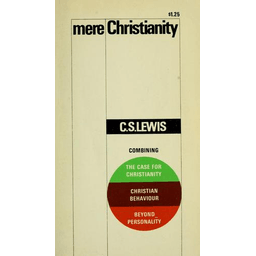
- Starting price
- $10.99 paperback
- Free tier
- No
- Platforms
- Print · Kindle · Audiobook · Audible
- Developer
- HarperOne
- Launched
- 1952
- Updated
- May 24, 2026
The verdict
Seventy-plus years on, Mere Christianity is still the single most-recommended modern introduction to the Christian faith. Lewis aimed at the shared center - what Christians of every tradition hold in common - and hit it cleanly enough that Catholics, Protestants, Orthodox, and Latter-day Saints all quote him. If you read one modern apologetics book, read this one.
Try Mere Christianity ↗Opens harpercollins.com
Mere Christianity has quietly become the book Christians of nearly every tradition agree on. Catholic seminarians cite it. Evangelical pastors hand it out at college ministries. Orthodox priests recommend it. Latter-day Saints find lines that read like their own theologians. That is a strange piece of real estate to occupy in a polarized religious landscape, and it is the whole point - Lewis was trying to map only what Christians shared, the floor under every denomination's house.
The book did not begin as a book. It began as a series of BBC radio talks delivered between 1941 and 1944, while London was being bombed and a war-tired public turned the dial looking for something to make sense of suffering. Lewis - an Oxford literature don, a former atheist, a layman with no theology degree - was asked to defend the faith on air. He did it in fifteen-minute increments, in plain English, with no jargon. The talks were collected into three small books, then in 1952 published together as Mere Christianity. It has never been out of print.
What you actually get is four short books in one volume: Right and Wrong as a Clue to the Meaning of the Universe, What Christians Believe, Christian Behaviour, and Beyond Personality. The voice is conversational, slightly clipped, occasionally funny in a very British way. Lewis does not argue you into Christianity in the modern debate-bro sense. He sets up an image - a fleet of ships, a tin soldier coming alive, a man pretending to be a tree - and then walks around it with you until you see what he is pointing at. It is the most ecumenical popular theology book of the last hundred years, and it earns that title fresh every time someone hands a copy to a friend.
✓ The good
- The single most-recommended modern intro to Christianity - across Catholic, Protestant, Orthodox, and LDS readers, almost everyone has read it or had it pressed on them
- Genuinely ecumenical by design - Lewis worked his manuscript past clergy of multiple traditions to scrub out anything denominationally distinctive
- Prose that has aged remarkably well - the sentences are short, the analogies are concrete, and the vocabulary is still legible to a modern reader
- The moral argument in Book 1 is the cleanest popular statement of it ever written - used in apologetics courses to this day
- Book 3 (Christian Behaviour) is unusually frank about pride, sex, and forgiveness in ways most modern Christian living books soften - Lewis does not flatter you
- Book 4 (Beyond Personality) opens up the doctrine of God and human transformation in language that feels less like a textbook and more like a window - readers across traditions describe it as the part that stayed with them
- Short. ~225 pages, readable in a weekend, re-readable for the rest of your life
✗ Watch out
- Lewis is a layman, not a trained theologian - some passages (on free will, on the Trinity, on atonement) read more as illustration than as careful dogmatic statement
- The 1940s register shows in places - examples about wartime, marriage, and "the modern world" occasionally feel dated
- A few passages on women in marriage (Book 3, chapter 6) reflect mid-century assumptions and tend to land awkwardly with modern readers regardless of tradition
- The "Liar, Lunatic, or Lord" trilemma (Book 2) has been criticized by philosophers as a false trichotomy - it is still the most-quoted line in the book, but it is not airtight
- Not a substitute for serious theology - anyone wanting depth on the atonement, ecclesiology, or sacraments will need to read further (Lewis explicitly says so himself)
Best for
- Anyone curious about Christianity who wants one book to start with
- Skeptics willing to be reasoned with rather than yelled at
- New Christians of any tradition looking for shared ground
- Long-time believers wanting a re-read that still sharpens
Avoid if
- You want denominational distinctives - Lewis deliberately avoids them
- You want a step-by-step systematic theology - this is not that book
- You want contemporary cultural-apologetics framing - Lewis is mid-20th-century and feels it
- You bounce off mid-century British prose and need a more conversational modern voice
What Mere Christianity is
Mere Christianity is C.S. Lewis's compiled wartime radio apologetic for the Christian faith, published as a single volume in 1952 and continuously in print since. It is short - about 225 pages depending on edition - and divided into four parts. Book 1 argues that the universal human sense of right and wrong points to a moral lawgiver. Book 2 lays out the core of what Christians believe about God, humanity, and Jesus. Book 3 walks through how Christians are supposed to live. Book 4 turns to who God is and what it means that human beings can, in some sense, be remade into His likeness.
The book is not a confession of faith for any single tradition. Lewis was Anglican, and he says so plainly in the preface, but he wrote the manuscript and circulated it past clergy from multiple traditions to strip out language that would mark it as the property of one denomination. The phrase "mere Christianity" is borrowed from the 17th-century Puritan Richard Baxter and means the basic, shared, lowest-common-denominator faith - what all Christians, in every century and every communion, have held in common. That ecumenical aim is the book's quiet superpower and the reason it still travels everywhere.
Why everyday readers still reach for Lewis
Most apologetics books are written for one audience - the doubter who reads philosophy, the evangelical college student, the cradle Catholic going through a phase. Lewis was writing for everyone with a radio. That forced a discipline on him that most modern Christian writers never have to practice: no insider vocabulary, no tribal shibboleths, no assumption that you already know what "justification" or "sanctification" means. He has to earn every move with an analogy a bus driver in 1942 could follow.
The result is a book that bypasses the usual filters. A Catholic reader does not have to dodge anti-Catholic asides. A Latter-day Saint reader does not have to dodge anti-LDS asides. A Reformed reader does not have to dodge Arminian asides. There are simply no asides - Lewis stays on the shared center the whole way through. That is rarer than it sounds, and it is why Mere Christianity is the one book a parish priest, a pastor, a youth leader, and an LDS bishop can all confidently put in the same person's hands.
The moral argument (Book 1): the cleanest popular version ever written
Book 1 - "Right and Wrong as a Clue to the Meaning of the Universe" - is Lewis's opening move and it is still the cleanest popular statement of the moral argument for God's existence in print. The setup is almost embarrassingly simple. When two people quarrel, Lewis observes, they do not usually say "I am stronger than you and I take it." They appeal to some standard of fairness they both assume the other already knows about. That assumed standard - the Moral Law, the Law of Human Nature - does not behave like a law of physics. People break it constantly. But everyone, in every culture, in every century, knows that it is there and that they are failing to keep it.
Lewis then asks where such a law could come from. Not from instinct, because we can choose between instincts. Not from social convention, because we judge whole societies (Nazi Germany was his live example) by it. The argument moves slowly, by accumulation, and by the end you are standing in front of a fairly heavy conclusion: there is Something behind the universe that resembles a mind more than a machine, and that Something cares about right and wrong. Philosophers have poked at the argument for seventy years. It survives those pokes well enough that it is still taught in apologetics courses, and it is still the chapter most people remember six months after closing the book.
"Christianity is not soft" (Book 3, Christian Behaviour)
Book 3 is the section that surprises people. Modern Christian-living books are almost uniformly encouraging, affirming, gentle. Lewis is none of those things. He spends a chapter ("The Great Sin") arguing that pride is the chief vice, the one that turned angels into devils, and that the more religious a person becomes the more dangerous their pride gets. He spends another chapter ("Sexual Morality") saying flatly that the Christian standard on sex is hard, that it is not going to feel natural, and that the modern world's assumption it can be made easy is a lie. He spends another ("Forgiveness") saying that forgiving real enemies - not abstract ones - is the most difficult thing Christianity asks of you, and you have to start practicing on small grudges or you will never manage the big ones.
The voice in Book 3 is the reason Mere Christianity survived the 20th century. It does not flatter the reader. It does not soft-pedal the cost. It does not pretend that following Jesus is mostly about feeling better about yourself. Lewis tells you, in a tone that lands somewhere between a tutor and a slightly impatient older brother, that the road is narrow and that you signed up for it on purpose. Readers from every tradition come back to Book 3 specifically because it is the rare popular Christian book that treats them like adults who can be told the truth.
Beyond Personality (Book 4): the doctrine of God, in plain English
Book 4 - "Beyond Personality: Or First Steps in the Doctrine of the Trinity" - is the part Lewis was most nervous about and the part most readers end up loving. He spends the first chapters trying to get the reader to see why "theology" is not optional - why thinking carefully about who God is matters as much as the experience of God. Then he walks through the doctrine of God using a series of homely images: a flat-lander trying to imagine a cube, a man trying to imagine three dimensions when he only lives in two, a statue slowly being changed into a real human being.
The most-quoted passage in the book lives in Book 4: Lewis says God became man so that men might become - and here different traditions hear different things. Some Christian traditions read this as theosis or deification (the historic Eastern Orthodox and Catholic teaching that human beings are remade into the divine likeness). Latter-day Saints find resonance with their own language about human destiny. Reformed readers hear the language of adoption and glorification. Lewis intentionally leaves the line standing in plain English so each tradition can hear its own theological vocabulary in it. That is not accident. That is the whole craft of the book.
Pricing
Paperback
~$10.99
The standard HarperOne edition. The copy most people own.
Kindle
~$9.99
Searchable, highlight-syncs to your account. Roughly the same price as paperback.
Audible / Audiobook
~$14.95
Multiple recordings exist; the Geoffrey Howard and the Ralph Cosham narrations are widely loved.
Hardcover
~$24
Gift-grade edition. The one you give to a graduating senior.
Annotated edition
~$30
The 2017 annotated edition with editorial notes - useful for study groups and first-time readers who want context.
Mere Christianity is not free. Used paperback copies turn up at every thrift store and library sale for under five dollars, which is the way most college students still acquire their first one. A new HarperOne paperback runs around $10.99 - call it the everyday default - and is the edition almost every quotation in print is keyed to.
The Kindle edition runs roughly the same as paperback, which is unusual for a 1952 title and a function of the Lewis estate's licensing rather than any printing economics. Highlighting syncs across devices, which is genuinely useful for a book this quotable. The Audible recordings - the Geoffrey Howard narration is the one most long-time readers cite - run around $14.95 or are included with an Audible membership, and Lewis's prose holds up beautifully read aloud (it was written to be read aloud, after all).
If you are buying a gift, the ~$24 hardcover is the natural pick. If you are running a study group or reading it for the first time and want context, the ~$30 annotated edition is worth the difference - the notes catch a lot of period references that modern readers would otherwise miss. Most readers do not need the annotated edition. The paperback is the balanced default and the copy you will reach for again.
Where Mere Christianity falls behind
Dated examples. Lewis was writing for 1940s Britain, and a handful of his illustrations - about wartime, about marriage roles, about "the modern world" - read like artifacts of their decade. Most aren't obstacles, but a first-time reader in 2026 will hit two or three sentences that make them pause.
Theological depth. Lewis was a literature professor, not a trained theologian, and he says so himself in the preface. On the atonement, on the sacraments, on the nature of the Church, Lewis stays deliberately shallow because going deeper would force him to pick a denominational lane. That is the right call for the book he was writing. It does mean Mere Christianity is a starting point, not an ending point, on those questions.
The trilemma. "Liar, Lunatic, or Lord" - Lewis's famous argument that Jesus could not have been merely a great moral teacher - is the most-quoted passage in the book and also the one that has taken the most philosophical fire. Critics point out it is a false trichotomy (legend, mistaken, mythologized) and that Lewis treats the historical reliability of the gospels as more settled than a modern skeptic would grant. The line still lands rhetorically. It is not the strongest brick in the wall.
A few passages on women. Book 3, chapter 6 ("Christian Marriage") contains a paragraph on the husband as head of the household that reflects mid-century assumptions and lands awkwardly with most modern readers, including readers in traditions that hold complementarian views. Most editions leave it as written. It is worth flagging for a study group rather than being surprised by it.
Mere Christianity vs. The Reason for God vs. The Case for Christ
These three are the modern apologetics shortlist, and they do genuinely different jobs. Mere Christianity (Lewis, 1952) is the philosophical-imaginative introduction - it argues from the moral law and from the shape of human longing toward the Christian God, and it does so in prose meant for a general radio audience. The Reason for God (Tim Keller, 2008) is the urban-professional update - Keller engages contemporary objections (suffering, exclusivism, science, hell) in the vocabulary of a Manhattan skeptic and quotes Lewis constantly. The Case for Christ (Lee Strobel, 1998) is the historical-evidential approach - Strobel, a former investigative reporter, interviews scholars on the reliability of the gospels and the case for the resurrection.
Different strengths. Lewis is the deepest and most timeless - the book you will still be quoting in twenty years. Keller is the most useful for someone who is reading the New York Times and finds Christianity intellectually embarrassing. Strobel is the most useful for someone whose question is specifically "can we trust the historical record about Jesus?" If you are starting from zero and want one book, it is still Mere Christianity. If you are starting from active modern objections, add Keller. If your question is the historical Jesus specifically, add Strobel.
All three are widely read across Catholic, Protestant, and other Christian traditions. Lewis is the most ecumenical of the three by design. Keller writes from a Reformed Presbyterian perspective but engages broadly. Strobel writes from an evangelical perspective but the historical evidence he marshals is used across traditions.
The bottom line
Mere Christianity is the gold standard of modern apologetics for a reason. Lewis wrote the book that almost any thoughtful person - believer, skeptic, or somewhere in between - can read straight through without being insulted, condescended to, or sold something. It is short, it is honest, it is funny in places, it is hard in places, and it has held up across seventy years of changing intellectual fashion. If a friend asks you for one book to understand what Christians actually believe and why, this is still the book to hand them.
Alternatives to Mere Christianity
 ESV Study BibleThe most-used English-language study Bible of the last twenty years - pair Lewis with this for serious follow-up.
 The Purpose Driven LifeRick Warren's 40-day devotional - softer and more practical than Lewis, aimed at a different reader.
 Jesus CallingSarah Young's devotional in the voice of Jesus - the most popular modern devotional, though not without controversy.
 Reasonable FaithWilliam Lane Craig's apologetics site and book - the academic-philosophical end of what Lewis began on the radio.
Frequently asked questions
Was C.S. Lewis Catholic, Protestant, or something else?
Lewis was a lifelong Anglican (Church of England). He says so in the preface to Mere Christianity. He intentionally wrote the book to stay on the shared center of Christian belief rather than to advocate for Anglican distinctives, which is why Catholics, Orthodox, Protestants, and Latter-day Saints all read and quote him.
Is Mere Christianity hard to read?
No. It is one of the most readable serious books in print. Lewis was writing for a general radio audience in the 1940s and his sentences are short, his analogies are concrete, and he assumes no theological vocabulary. Most readers finish it in a weekend. A few mid-century examples feel dated, but the prose itself is plain English.
What is the famous "Liar, Lunatic, or Lord" argument?
In Book 2, Lewis argues that Jesus claimed to be God in a way that rules out the modern compliment that he was "just a great moral teacher." On those claims, Lewis says, Jesus was either lying, deluded, or telling the truth - there is no respectable fourth option. The argument has been criticized by philosophers as a false trichotomy (other options like "legend" or "misquoted" exist), but it remains the most-quoted passage in the book.
Do Latter-day Saints read Mere Christianity?
Yes, widely. Lewis is frequently quoted in LDS settings - including in conference talks and devotional writing - because his ecumenical framing avoids the doctrinal flashpoints that would otherwise be friction. Book 4 in particular contains language about human transformation into the divine likeness that resonates with LDS theology, though Lewis himself was Anglican.
Is Mere Christianity still relevant in 2026?
Yes. It is still the most-recommended modern introduction to the Christian faith in nearly every tradition. A few mid-century examples have aged, but the core arguments - the moral law, the cost of discipleship, the doctrine of God - are the questions every generation has to answer for itself, and Lewis answers them better than most contemporary writers.
Which edition should I buy?
The standard HarperOne paperback (~$10.99) is the right default for almost everyone. Pick the annotated edition (~$30) if you are running a study group or want help with period references. Pick the audiobook (~$14.95) if you commute or prefer to listen - Lewis was written to be read aloud and it shows.
Where should I go after Mere Christianity?
For Lewis specifically: The Screwtape Letters, The Great Divorce, and The Problem of Pain are the natural next reads. For modern apologetics in Lewis's tradition: Tim Keller's The Reason for God. For historical evidence about Jesus: Lee Strobel's The Case for Christ. For deeper theology: most readers move toward a study Bible (the ESV Study Bible is widely used) and then a systematic theology in their own tradition.
Sources & further reading
More Modern Christian Classics
 Knowing GodJ.I. Packer’s 1973 classic on the doctrine of God has sold more than 1.5 million copies and is still the book most pastors hand to laypeople who want theology that goes somewhere - here’s what it actually does and who it’s for.
 The Cost of DiscipleshipDietrich Bonhoeffer’s 1937 exposition of the Sermon on the Mount, written for pastors training under a regime that wanted them silent - and still the sharpest book in print on what following Jesus actually costs.
 Gentle and LowlyDane Ortlund’s 23 short chapters on Matthew 11:29 have quietly become the most-given new Christian book of the decade - and the reason is not what you’d guess.
 The Holiness of GodR.C. Sproul’s career-defining book on the one attribute of God the church most forgets - and the vision in Isaiah 6 he believed everything else flows from.
 The Weight of GloryThe 1941 sermon many call Lewis's single finest piece of writing - "there are no ordinary people" - gathered with eight other addresses into one slim, uneven, unforgettable collection.
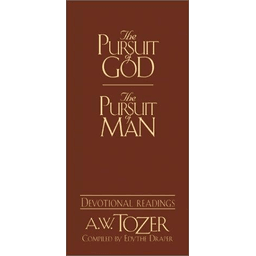 The Pursuit of GodA.W. Tozer’s ten-chapter wake-up call on knowing God personally - short, severe, and the one devotional Reformed, Wesleyan, Catholic, and Orthodox readers all seem to keep on the nightstand.