
- Starting price
- Around $9.99/mo Verbum Pro; library packages from ~$300
- Free tier
- Yes
- Platforms
- macOS · Windows · iOS · Android · Web
- Developer
- Faithlife
- Launched
- 2013
- Updated
- May 24, 2026
The verdict
Verbum is the most thorough Catholic study platform money can buy - a Logos-grade engine wrapped around a curated Catholic library that runs from the Vulgate through Vatican II. The price tag is real, but for seminarians, priests, and serious lay students, nothing else comes close.
Try Verbum ↗Opens verbum.com
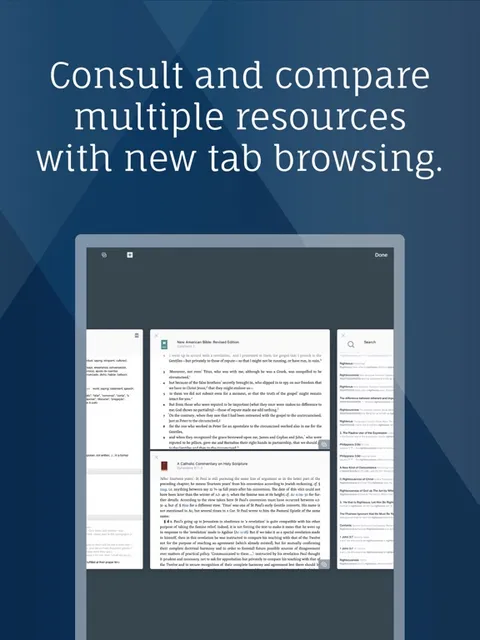
Verbum has quietly become the default desktop for Catholic seminarians, priests, deacons, and lay theologians who want a single place to read the NABRE next to the Vulgate, pull the relevant Catechism paragraph, drop into Aquinas on the same verse, and check what John Paul II said about it in an encyclical - all in one window. It is built on the same software engine as Logos Bible Software, which means the original-language tooling, search graph, and cross-resource linking are already mature. What changes is the library.
It is not a reading app. It is not a devotional. It is not a casual study tool you open on the bus.
Verbum is a research workstation - currently in its 11th generation - that assumes you want to spend an hour on a single pericope, with the Greek, the Latin, the Catechism, two Doctors of the Church, and a magisterial document open at the same time. The price model reflects that. A modest monthly subscription gets you the engine plus a small starter library, but the platform really opens up when you buy one of the curated Catholic library packages - and those run from a few hundred dollars to well into the thousands depending on how deep into the Fathers and the Summa you want to go.
✓ The good
- Catholic library curation done by Catholic editors - the NABRE, RSV-2CE, Douay-Rheims, and Vulgate ship together, cross-linked at the verse level
- Catechism of the Catholic Church and Code of Canon Law integrated as first-class resources - paragraph references resolve like scripture references
- Magisterial document library - papal encyclicals, conciliar documents, congregational instructions - searchable as a single corpus
- Patristic and medieval depth - Fathers of the Church, Ancient Christian Writers, Aquinas’s Summa and biblical commentaries available as add-on collections
- Lectionary integration - pulls the day’s readings and lets you jump straight into commentary on each pericope
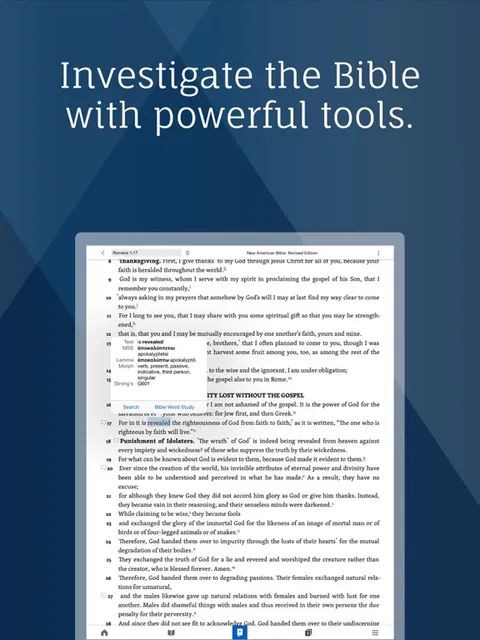
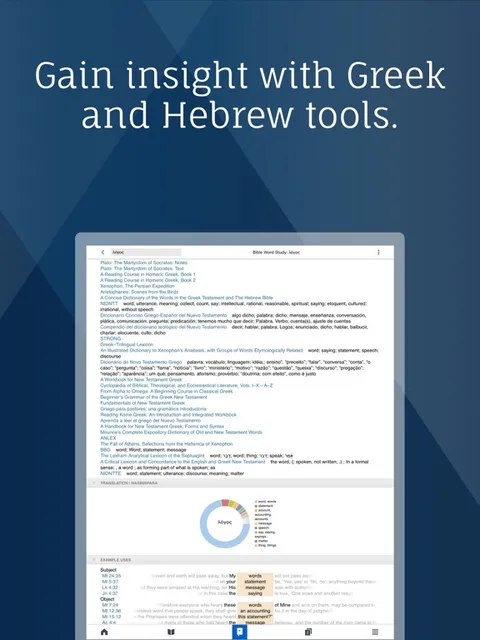
- Logos-grade original-language tooling - morphological tagging, lexicons, sentence diagrams, and Greek/Hebrew/Latin search work identically to Logos
- Cross-device sync across Mac, Windows, iOS, Android, and web - your highlights, notes, and reading position follow you
✗ Watch out
- Library packages are expensive - the deeper Catholic collections cost more than a semester of seminary textbooks
- Steep learning curve - the workspace, layouts, and Passage Guide take real time to master
- Mobile apps are capable but not where the serious work happens - the desktop is the real workstation
- Monthly subscription gets you the engine, but Catholic-specific depth requires a library purchase on top (yet)
- Overkill for casual readers - anyone who just wants a Catholic Bible and the Catechism will find this far heavier than they need
Best for
- Catholic seminarians and priests writing homilies
- Lay theologians and catechists who want magisterial sourcing
- Deacons preparing lectionary-based teaching
- Researchers working across patristic and magisterial sources
Avoid if
- You want a free, simple Catholic Bible app
- You only read scripture devotionally on a phone
- You don’t plan to invest in a library package
- You’re primarily looking for a Protestant or non-denominational study tool
What Verbum is
Verbum is Faithlife’s Catholic edition of Logos Bible Software. The underlying engine - the search graph, the morphological tagging, the resource-linking framework, the Passage Guide, the original-language tools - is the same code that powers Logos. What sits on top of that engine is different: a library curated specifically for Catholic study, an interface that surfaces Catholic-specific tools first, and an editorial pipeline that prioritizes Catholic translations, magisterial documents, patristic sources, and Catholic reference works.
The product is sold in two layers. The platform layer - the app itself and the Verbum Pro subscription - gives you the engine and the workflow tools. The library layer - sold as one-time packages at escalating tiers - is where the actual books live. You can mix and match: subscribe to Pro for the workflow tools and buy a Starter library for the core Catholic resources, then add individual collections (the Summa, a Fathers package, a magisterial set) over time.
Why Catholic seminarians and priests use Verbum
The single biggest practical difference between Verbum and a generic Bible app is the assumption Verbum makes about how you study. A reading app assumes you want a verse. Verbum assumes you want a verse, the Latin behind it, the Greek behind that, the Catechism paragraph that cites it, the encyclical that footnotes that Catechism paragraph, and the patristic commentary that the encyclical is drawing from - all open at once, cross-linked, and searchable as a single corpus.
That is the Catholic theological method as software. For a homilist preparing Sunday, it collapses what used to be a stack of books and a stack of PDFs into one workspace. For a seminarian writing a paper, it turns "find me everywhere the Magisterium has commented on this verse" into a one-click query. The reason this is the model that respects your work - and why people stay on the platform for decades - is that the cross-linking actually pays off once your library is large enough.
Catholic library curation: NABRE, Vulgate, Catechism, Magisterium in one corpus
The Catholic library is what you are actually buying when you buy Verbum. Out of the box at the Starter tier you get the New American Bible Revised Edition (NABRE) - the translation read at Mass in the United States - alongside the RSV-2CE, the Douay-Rheims, and the Latin Vulgate, all cross-linked at the verse level. Open a passage in the NABRE and the Vulgate is one click away. The Catechism of the Catholic Church is in the library as a first-class resource, which means CCC paragraph references resolve and cross-link the same way scripture references do - hover a citation, see the paragraph; click through, land in context. The Code of Canon Law works the same way.
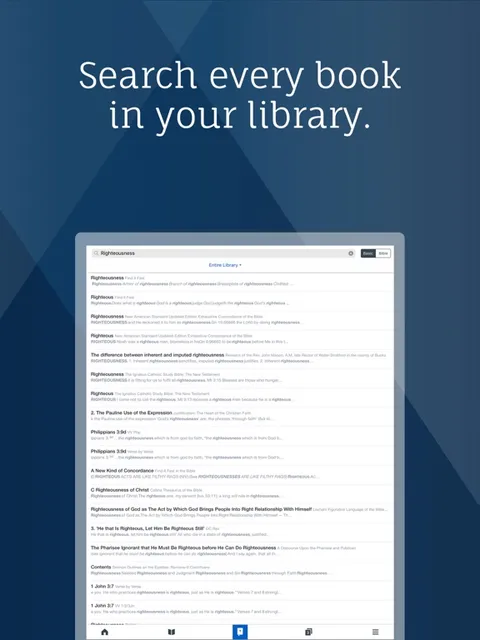
On top of those primary documents sits the magisterial library: papal encyclicals, apostolic exhortations, conciliar documents from the ecumenical councils (Vatican II is fully present, and earlier councils are available at the deeper library tiers), and instructions from the Roman dicasteries. These are searchable as one corpus, which is the part that matters. Asking "where has the Magisterium commented on Romans 13?" stops being a research project and becomes a query. That kind of integration is the whole reason the platform exists.
Patristic library and the Doctors of the Church
Verbum’s patristic depth is the second pillar. The Fathers of the Church series and the Ancient Christian Writers series - both standard English translations used in graduate-level patristics - are available as add-on collections, and the deeper library packages include large swaths of both. The Doctors of the Church get their own treatment: Augustine, Aquinas, Jerome, Ambrose, Gregory the Great, Bernard of Clairvaux, John of the Cross, Teresa of Ávila, Thérèse of Lisieux, and the rest are present at varying depths depending on tier, with cross-references back into scripture and forward into the Catechism.
Aquinas in particular is treated as a major resource. The Summa Theologiae is available with full cross-linking - articles cite scripture, scripture references resolve back into Aquinas, and his biblical commentaries (the Catena Aurea, the Pauline commentaries, the commentary on John) sit in the same library. For anyone working on a paper about how a verse has been received in the Catholic theological tradition, the ability to chain from the Vulgate to a Father to Aquinas to a magisterial document to the Catechism, without leaving the workspace, is the kind of feature you don’t fully appreciate until you have used it for a few months. Then you can’t go back.
Lectionary integration - Sunday and daily readings, fully linked
Verbum’s lectionary integration is where the platform earns its keep for parish priests, deacons, and anyone teaching from the readings of the day. The lectionary itself - the Roman Missal’s Sunday and weekday cycles, with feast days, solemnities, and ritual Masses - is a navigable resource. Open the calendar, pick the day, and Verbum presents the first reading, responsorial psalm, second reading (if any), and Gospel as linked passages. Click any of them and you are in the Passage Guide for that pericope, with cross-references, commentaries, and patristic homilies on that text surfaced automatically.
For homily prep this is the workflow that replaces a small stack of physical books. The Passage Guide can pull together what the Catechism cites for the day’s Gospel, what the Fathers wrote about it, which encyclicals reference it, and what your installed commentaries say - all in one column, in the order you tell it to prioritize. The Sermon Builder (shared with Logos) lets you write the homily in the same app, with citations that link back to their sources. It is not a magic homily-writer. It is a research environment that assumes the day’s readings are the unit of work, which is exactly the assumption a Catholic preacher needs the software to make.
Pricing
Verbum Free / Basic
$0
Engine plus a small starter set - a Catholic Bible, a few reference works, and basic study tools. Enough to learn the interface; not enough for serious study.
Verbum Pro (subscription)
Around $9.99/mo
Adds the core Catholic toolset - Passage Guide, advanced search, sermon and notes workflows, lectionary integration - on top of whatever library resources you already own.
Foundations / Starter library
Around $300 one-time
The entry-level Catholic library: NABRE, RSV-2CE, Douay-Rheims, Vulgate, Catechism, Code of Canon Law, a handful of commentaries and reference works.
Capstone / Master libraries
$1,500-$5,000+ one-time
Deep Catholic libraries - Fathers of the Church, Ancient Christian Writers, Aquinas, expanded magisterial collections, scholarly commentaries, original-language datasets.
Verbum’s pricing is genuinely two-dimensional, and the website does not always make this obvious. There is a subscription dimension - Verbum Pro, around $9.99/mo as of writing - and a library dimension, where you buy curated collections of books as a one-time purchase. You can have one without the other, but you usually want both.
Most users do not need the deepest library tier. The Starter / Foundations library, around $300 one-time, covers the four core Catholic Bibles, the Catechism, the Code of Canon Law, a basic magisterial set, and enough commentaries and reference works to do real study. Add Verbum Pro on top and you have a fully functional Catholic study workstation. That is the balanced default for serious lay students, catechists, and most parish use.
The mid-tier libraries (roughly $1,000-$2,000) start adding meaningful patristic depth, the Summa, expanded magisterial collections, and scholarly commentaries - the level a seminarian or a deacon preparing for diaconal ministry would actually use. The capstone tiers ($3,000-$5,000+) are seminary-library territory: full Fathers and Ancient Christian Writers series, Aquinas in depth, the full Latin patristic and medieval datasets, original-language scholarly tooling.
Faithlife runs sales - particularly around Lent, Advent, and the start of the academic year - and library packages are very often discounted significantly during those windows. If you’re sitting on the fence about a library tier, waiting for a sale is usually the right call.
Where Verbum falls behind
Price is the real wall. The Starter library is approachable; the deeper tiers are not, and Verbum has not solved the problem of giving serious Catholic students an affordable on-ramp into the full library. For a graduate student or a priest with a parish book budget the math works. For a curious layperson it does not.
Learning curve is steep. The Passage Guide, the workspace layouts, the search syntax, the Sermon Builder - none of these are self-explanatory, and the documentation, while extensive, is the kind you have to actually sit and read. Expect to spend several hours getting comfortable before the software stops fighting you.
Mobile is capable but secondary. The iOS and Android apps will let you read your library, run basic searches, and follow cross-references, but the workspace metaphor that makes the desktop so powerful does not translate cleanly to a phone screen. Verbum is a desktop product with a mobile companion, not the other way around.
No first-party AI assistant tuned to the Catholic library (yet). Faithlife has been adding AI features to the Logos/Verbum platform, but a dedicated Catholic-trained chat layer - the kind of thing Magisterium AI built its product around - is not Verbum’s home turf. Some users pair Verbum with Magisterium AI for that reason.
Library is sold, not rented. Once you buy a library package you own it, which is the strength of the model - but it also means a wrong purchase is expensive. Take the buying-guide consultations Faithlife offers seriously before you spend four figures.
Verbum vs. Logos vs. Magisterium AI
Verbum and Logos are the same engine with different libraries and different default UIs. If you’re Catholic and you want a Catholic library that comes pre-curated, Verbum is the right SKU - the NABRE, the Vulgate, the Catechism, the Code of Canon Law, the magisterial library, and the patristic collections are surfaced first, and the workspace assumes Catholic study workflows. Logos is the broader Protestant-leaning version of the same platform: the default libraries lean toward Reformed and evangelical reference works, but you can buy Catholic resources inside Logos too. The shared file format means your highlights and notes carry over if you ever switch.
Magisterium AI is a different category of product. It is a chat-style interface trained on Catholic magisterial documents - you ask a question in plain English, and it answers with footnoted citations to encyclicals, conciliar documents, and the Catechism. It is fast, free at the basic tier, and brilliant for surfacing "where has the Church said something about this." It is not a study workstation, it does not give you the Vulgate side-by-side with the NABRE, and it does not build homilies. It is a research assistant, not a library.
Different strengths. Verbum is better at deep, multi-source study where you want primary documents open at once. Logos is broader and the only choice if you also want substantial Protestant reference works. Magisterium AI is faster for "what does the Church teach about X" lookups, and pairs naturally with Verbum rather than replacing it. Many Catholic seminarians end up using Verbum as their library and Magisterium AI as their first-pass research tool.
The bottom line
Verbum is the thoughtful Catholic student’s study platform - the most thorough Catholic library available in software form, sitting on top of a Logos-grade engine that handles original languages, magisterial cross-referencing, and lectionary-driven homily prep better than any competitor. The price tag is real, and the learning curve is real, but for seminarians, priests, deacons, and serious lay students of the Catholic tradition, nothing else integrates the Vulgate, the NABRE, the Catechism, the Fathers, and the Magisterium into a single searchable corpus this well. Start with the Starter library and Verbum Pro, wait for a sale on a deeper tier, and grow into it.
Alternatives to Verbum
 Logos Bible SoftwareThe same engine as Verbum with a broader, Protestant-leaning default library - the right SKU if your study spans traditions.
 Magisterium AIA Catholic-trained AI chat with citation-grade answers from the Magisterium. Pairs with Verbum rather than replacing it.
 AccordanceA Mac-first Bible study workstation with strong original-language tooling and growing Catholic resources, though a smaller Catholic library than Verbum.
 Olive TreeA free mobile-first Bible app with Catholic translations and a la carte Catholic commentary purchases - lighter than Verbum, easier to start.
Frequently asked questions
Is Verbum the same as Logos Bible Software?
It is the same software engine with a Catholic-curated library and a Catholic-default UI. Files, notes, and highlights are compatible between the two, and you can buy Catholic resources inside Logos or Protestant resources inside Verbum if you want.
Do I need to buy a library, or is the subscription enough?
The Verbum Pro subscription (around $9.99/mo) gives you the engine and the workflow tools, but the depth of Catholic study comes from the library packages. Most serious users pair the subscription with at least a Starter library purchase.
Which Bible translations come with Verbum?
The core Catholic libraries include the New American Bible Revised Edition (NABRE), the Revised Standard Version Catholic Edition (RSV-2CE), the Douay-Rheims, and the Latin Vulgate, all cross-linked at the verse level. Additional translations are available as add-ons.
Does Verbum include the Catechism and Canon Law?
Yes - the Catechism of the Catholic Church and the Code of Canon Law are included from the Starter library upward, and they are integrated as first-class resources so that paragraph references resolve and cross-link like scripture references.
Is Verbum good for homily preparation?
Yes - lectionary integration, the Passage Guide, and the Sermon Builder are designed around the homiletic workflow. Open the day’s readings, pull the Catechism and patristic citations, and draft the homily in the same workspace.
How does Verbum compare to Magisterium AI?
They serve different needs. Verbum is a research workstation for deep, multi-source study. Magisterium AI is a chat-style research assistant trained on magisterial documents. Many Catholic students use both - Magisterium AI for fast lookups, Verbum for the actual study session.
Are there discounts on the libraries?
Faithlife runs significant sales around Lent, Advent, and the academic-year transition. Library packages are very often discounted during those windows, and waiting for a sale on a deeper tier is usually worth it.
Sources & further reading
More Bible Study Software
 VerseLink BibleVerseLink Bible keeps Scripture, sermon notes, highlights and original-language helps entirely on your device with no account, tracking, ads or subscription—but local-first privacy makes manual backup your responsibility.
 Ezra Bible AppA serious free, open-source study workspace built around topical verse collections, notes and the SWORD module ecosystem, now spanning desktop and mobile—but resource licensing varies, sync depends on Dropbox, and its 2022 privacy template contradicts the current App Store disclosure.
 Rava: Discover God’s StoryA free, multilingual facilitator that lets almost anyone press play and guide a Discovery Bible Study with little preparation—excellent for reproducible group participation, but not a replacement for wise leadership, contextual interpretation or a modern privacy policy.
 ARMA CoursesARMA makes serious Bible and theology teaching approachable through short, energetic courses—valuable for guided learners, but narrower and less transparent than a seminary library.
 Storyverse InstituteStoryverse makes Bible, theology, soul care and ministry training approachable through 200+ videos, community and cohorts—but its age, collection and deletion disclosures conflict too sharply for informed enrollment.
 The Word One to OneA polished, completely free guide for reading John and Acts with a friend—excellent for a trusted conversation, but narrow in scope and incomplete on app privacy and safeguarding.