1 Maccabees 5
People in this chapter
A strange thing happens the moment the altar in Jerusalem is rebuilt and the daily worship begins again. You might expect the surrounding nations to lose interest now that the sanctuary is restored. Instead they are enraged. The recovery of Israel's worship is felt as a threat, and the anger falls not on the soldiers in Judea but on the defenseless Jewish families scattered through the lands all around: in Idumea to the south, in Gilead across the Jordan, in Galilee to the north.
They begin to kill some, to persecute, to plot the destruction of "the generation of Jacob" living among them. The light that has just been lit in the temple has drawn the darkness out into the open.
Tap any highlighted phrase to jump to the commentary that unpacks it.
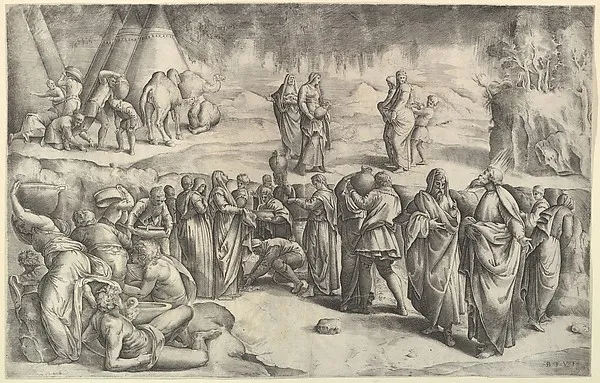
1 Maccabees 5:1-8When the Altar Is Restored, the Darkness Rises
1Now it came to pass, when the nations round about heard that the altar and the sanctuary were built up as before, that they were exceeding angry. 2And they thought to destroy the generation of Jacob that were among them, and they began to kill some of the people, and to persecute them.
The chapter opens on a paradox. The good news that "the altar and the sanctuary were built up as before" does not bring peace; it provokes fury. The restoration of true worship is felt by the surrounding peoples as an offense, and their rage is immediate. There is a pattern here as old as faith itself. The recovery of what is holy never goes unnoticed by what opposes it. When a light is lit, the shadows it casts grow sharper, and the renewal of devotion is often the very thing that draws hostility into the open.
Notice where the blow falls. The nations cannot easily reach the soldiers fortified in Judea, so they turn on "the generation of Jacob that were among them," the ordinary Jewish families living scattered through foreign territory, far from any army. These are the vulnerable: neighbors suddenly become enemies, households without walls or weapons, people whose only crime is that they belong to a worshiping people. The enemy of God's people has always preferred the defenseless target. And it is precisely for these, the exposed and the forgotten, that the rest of the chapter mobilizes.
3Then Judas fought against the children of Esau in Idumea, and them that were in Acrabathane: because they beset the Israelites around about, and he made a great slaughter of them.
Judas moves first against "the children of Esau" in Idumea, the descendants of Jacob's brother, here the old kinship has curdled into siege. The reason given is defensive: "because they beset the Israelites around about." Judas is breaking an encirclement that is strangling his people. Throughout this chapter the campaigns follow distress, driven by the cry of the besieged. The army moves because brothers and sisters are surrounded, and the relief of the besieged is the thread that ties every march together.
1 Maccabees 5:9-23Come and Deliver Us
10And they sent letters to Judas and his brethren, saying, The heathens that are round about are gathered together against us, to destroy us: 12Now therefore come, and deliver us out of their hands, for many of us are slain.
Now the besieged speak for themselves. Letters come from the Jews of Gilead, trapped in the fortress of Dathema: the surrounding peoples have gathered "to destroy us." There is no exaggeration in their plea and no time for it. They report the dead, the captured wives and children, the thousand men already slain at Tubin. The chapter lets us hear the voice of the cornered, the cry that goes out when there is no human help left except the one army that might still come.
It is the voice of people clinging to the bare hope that they have not been forgotten.
The heart of the letter is three words: "deliver us." It is the oldest prayer of God's people, the cry of Israel under Egypt, the refrain of the Psalms, the petition the Lord Himself would teach His disciples to pray. The besieged in Gilead do not ask for vengeance or for spoil. They ask to be rescued out of the hand of death. And the chapter takes that plea with utter seriousness, because the worth of a people is shown in whether it answers such a cry or lets it die unheard in a distant fortress.
14And while they were yet reading these letters, behold there came other messengers out Galilee with their garments rent, who related according to these words: 16Now when Judas and all the people heard these words, a great assembly met together to consider what they should do for their brethren that were in trouble, and were assaulted by them.
The crisis doubles before the first letter is finished. As the words from Gilead are still being read aloud, messengers from Galilee burst in "with their garments rent," the ancient sign of grief so deep it tears at the clothing. Now the danger presses from two directions at once, east and north, and the small community in Judea must reckon with the fact that its people are dying on more than one front. The torn garments are a wordless sermon.
They say what no letter quite can: this is not a problem to be filed away, it is a wound in the body of the people.
What Judas does first is gather. "A great assembly met together to consider what they should do for their brethren that were in trouble." Faced with overwhelming need, the people deliberate as one body, weighing how to spend their limited strength to save the most lives. There is wisdom here. Zeal alone, rushing in every direction at once, would have rescued no one. The decision to divide the army and assign each front its force is born in this assembly, where love for the endangered is disciplined into a plan.
17And Judas said to Simon his brother: Choose thee men, and go, and deliver they brethren in Galilee: and I, and my brother Jonathan will go into the country of Galaad. 23And he took with him those that were in Galilee and in Arbatis with their wives, and children, and all that they had, and he brought them into Judea with great joy.
The plan is a family sent in different directions for the sake of strangers who are also kin. Simon takes three thousand to Galilee; Judas and Jonathan take eight thousand across the Jordan to Gilead. Brothers part to save brothers. There is something deeply costly in this scattering of the leadership, each going where the danger is, none holding back in safety. The deliverance of God's people in this chapter is never the work of one hero standing alone. It is a body, sending its members into the places of greatest need.
Simon's campaign in the north ends in homecoming. He takes the rescued Jews of Galilee, "with their wives, and children, and all that they had," and brings them into Judea "with great joy." The aim of the whole operation comes clear here: gathering the scattered and endangered and carrying them to safety. The joy belongs to a shepherd who has gone out after the lost and returned with them on his shoulders.
1 Maccabees 5:24-44They Cried Out in Prayer
31And Judas saw that the fight was begun, and the cry of the battle went up to heaven like a trumpet, and a great cry out of the city: 32And he said to his host: Fight ye today for your brethren.
Judas and Jonathan cross the Jordan and march three days through the desert to reach Gilead, arriving at dawn to find the fortress under full assault, ladders and siege engines already at the walls. And here the narrator gives us an image that lingers: "the cry of the battle went up to heaven like a trumpet." The noise of the fighting and the cry of the trapped within the city rise together toward heaven. A trumpet in Israel was a summons, a signal that God's help was being invoked.
The sound of this desperate hour is not merely chaos; it ascends, like a call for the God of Israel to look down and act.
Judas's battle order is a single sentence that names the whole reason for the war: "Fight ye today for your brethren," the people pinned inside those walls. It is a commander reminding exhausted men, before the clash, what they are bleeding for. The motive purifies the fight. When the next verses describe trumpets and a sudden charge from behind, the reader already knows this is a rescue, undertaken in the open sight of heaven.
33And he came with three companies behind them, and they sounded their trumpets, and cried out in prayer. 34And the host of Timotheus understood that it was Machabeus, and they fled away before his face: and they made a great slaughter of them: and there fell of them in that day almost eight thousand men.
This is the spiritual center of the chapter, and it is easy to miss in the rush of the narrative. At the moment of attack, Judas's men "sounded their trumpets, and cried out in prayer." The charge and the prayer are the same act. They pray as they advance, lifting their voices to God in the very instant of greatest danger. The trumpet that goes up like a cry to heaven a few verses earlier is now answered by an army that turns its battle shout into a petition.
They fight as people who know that the outcome is not in their hands alone.
The result is overwhelming and swift. The enemy under Timotheus recognizes Maccabeus, and they flee; eight thousand fall. The narrator does not credit the victory to superior numbers, for Judas was the one who had marched through the desert into a siege already in progress. The deliverance comes as something larger than the men who carried it out. From here Judas presses on through the cities of Gilead, taking Maspha, Casbon, Mageth, Bosor, and the rest, breaking siege after siege so the trapped can be gathered.
The God who was called upon in the charge has answered the trumpet that went up to heaven.
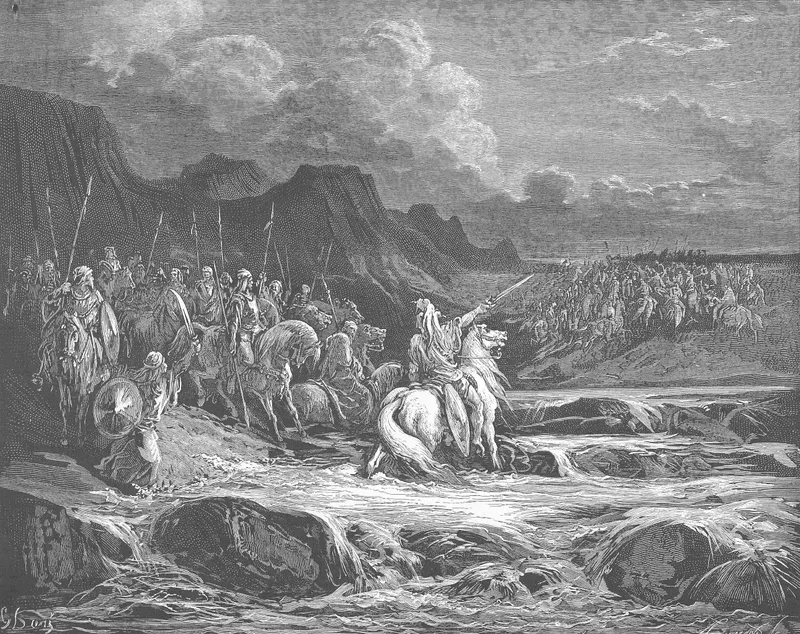
1 Maccabees 5:45-62The Battle You Were Not Sent to Fight
45And Judas gathered together all the Israelites that were in the land of Galaad, from the least even to the greatest, and their wives, and children, and an army exceeding great, to come into the land of Juda. 54And they went up to mount Sion with joy and gladness, and offered holocausts, because not one of them was slain, till they had returned in peace.
When the fighting in Gilead is done, Judas does the thing the whole campaign was for: he gathers the people, "from the least even to the greatest," and leads them home. The phrase is tender. No one is too small to be worth the long march, too poor or too obscure to be left behind. The great army exists to escort the helpless. Even the dangerous passage through the hostile city of Ephron, which refuses to let them pass and must be taken street by street, is endured so that this column of families can reach safety.
The strength of the strong is spent entirely on carrying the weak.
They come up to Mount Zion "with joy and gladness," and they do the most fitting thing imaginable: they offer sacrifices, because "not one of them was slain, till they had returned in peace." The first response to deliverance is worship. They do not throw a feast for themselves or build a monument to Judas; they bring offerings to God, naming Him as the one who brought them through without loss. Gratitude turned Godward is what a rescued people owes. The joy of the homecoming rises, like the battle cry before it, straight up to heaven.
57And he said: Let us also get us a name, and let us go fight against the Gentiles that are round about us. 61Because they did not hearken to Judas, and his brethren, thinking that they should do manfully. 62But they were not of the seed of those men by whom salvation was brought to Israel.
Now the chapter turns dark for a moment, and the contrast is deliberate. Joseph and Azarias had been left to guard Judea with one clear order: "make no war against the heathens, till we return." But hearing of the victories elsewhere, they grow restless. Their motive is laid bare in their own words: "Let us also get us a name." Where Judas fought to deliver his brethren, these two go out to win glory for themselves.
The same battlefield, the same enemy, but an entirely different heart. The desire to make a name is the quiet substitution that turns a holy cause into a vanity.
The result is disaster. Gorgias comes out against them, they are routed, and about two thousand of Israel fall. The narrator names the cause without flinching: "because they did not hearken to Judas, and his brethren, thinking that they should do manfully." Their courage was real but disordered, bravery untethered from obedience. They wanted to "do manfully," and the wish was not wicked in itself, but it overrode the command they had been given. There is a kind of zeal that is really self-will wearing the costume of valor, and Scripture has seen enough of it to warn us plainly.
Then comes the chapter's sharpest line, and its theological heart: "they were not of the seed of those men by whom salvation was brought to Israel." The defeat came because deliverance is a calling God assigns, given to those He has appointed. The Maccabean victories were never the achievement of bold individuals; they were the work God did through the ones He had appointed to that work. To step outside that appointing, to make oneself a savior for the sake of one's own renown, is to fight a battle one was never sent to fight, and to fall.
1 Maccabees 5:63-68Magnified Before All the People
63And the men of Juda were magnified exceedingly in the sight of all Israel, and of all the nations where their name was heard. 64And people assembled to them with joyful acclamations.
Here is the irony the chapter wants us to feel. Joseph and Azarias went out to "get themselves a name" and were defeated. Judas and his brothers went out to deliver their brethren, sought no glory at all, and "were magnified exceedingly in the sight of all Israel, and of all the nations where their name was heard." The name they did not chase was given to them. This is the consistent witness of Scripture: the honor seized is forfeited, and the honor laid aside is bestowed.
Those who poured themselves out for others became great precisely because greatness was never the point.
The people gather to the house of Judas "with joyful acclamations." A nation that had lived under terror now has a gathering place of celebration. The same brothers who marched into deserts and sieges become the center of a grateful people's joy. There is a quiet dignity in this. Faithful courage, spent for others over a long and dangerous season, earns a trust that no self-promotion can manufacture. The acclamations are the natural gladness of people who have been delivered, flowing toward the ones who delivered them.
67In that day some priests fell in battle, while desiring to do manfully they went out unadvisedly to fight. 68And Judas turned to Azotus into the land of the strangers, and he threw down their altars, and he burnt the statues of their gods with fire: and he took the spoils of the cities, and returned into the land of Juda.
Even amid the triumph the narrator will not let us forget the cost. "Some priests fell in battle, while desiring to do manfully they went out unadvisedly to fight." These were priests, holy men, and their courage was sincere, but going out "unadvisedly," without counsel and outside their calling, cost them their lives.
Bravery is not enough by itself. It must be joined to obedience and to the wisdom of acting within what God has appointed.
The chapter ends where it began, with altars, but the picture is inverted. It opened with the altar of the Lord rebuilt in Jerusalem and the nations enraged by it. It closes with Judas at Azotus throwing down the altars of false gods and burning their images. The campaign that began as a rescue of besieged people ends as a cleansing of the land from the idols that had fed the hostility. The one true altar is restored; the false altars come down.
And Judas "returned into the land of Juda," the deliverer come home, the people gathered, the worship of the living God standing where it belongs.
Where this echoes in Scripture
When the Altar Is Restored, the Darkness Rises
- John 15:18-19If the world hate you, ye know that it hated me before it hated you... therefore the world hateth you.The hostility that meets restored devotion is the world reacting to the light, as it did here.
- Genesis 12:3And I will bless them that bless thee, and curse him that curseth thee: and in thee shall all families of the earth be blessed.The promise over "the generation of Jacob," which the nations now rage against.
- Nehemiah 4:7-8They conspired all of them together to come and to fight against Jerusalem... when they heard that the walls of Jerusalem were made up.Rebuilding what is holy provoked the same fury in Nehemiah's day.
Come and Deliver Us
- Galatians 6:2Bear ye one another's burdens, and so fulfil the law of Christ.The torn-garment cry from Gilead is exactly the burden the people here take up.
- Luke 15:5-6And when he hath found it, he layeth it on his shoulders, rejoicing... Rejoice with me; for I have found my sheep which was lost.Simon brings the rescued home "with great joy," the joy of the found.
- Psalm 35:17Lord, how long wilt thou look on? rescue my soul from their destructions, my darling from the lions.The prayer "deliver us" in its rawest form, the cry of the besieged.
They Cried Out in Prayer
- 2 Chronicles 20:21-22When they began to sing and to praise, the LORD set ambushments against the children of Ammon... and they were smitten.Another battle where the people cried out to God in the fight, and God Himself routed the enemy.
- 1 Thessalonians 4:16For the Lord himself shall descend from heaven with a shout... and with the trump of God.The trumpet cry going up to heaven finds its answer in the descending Lord.
- John 15:13Greater love hath no man than this, that a man lay down his life for his friends."Fight ye today for your brethren" reaches toward the love that gives its life for friends.
The Battle You Were Not Sent to Fight
- Genesis 11:4Let us build us a city and a tower... and let us make us a name, lest we be scattered abroad.The same fatal phrase, "make us a name," that drives Babel and drives Joseph and Azarias.
- 1 Samuel 15:22Behold, to obey is better than sacrifice, and to hearken than the fat of rams.Their courage could not cover their refusal to hearken to the command they were given.
- John 3:27A man can receive nothing, except it be given him from heaven.Deliverance belonged to those God appointed; it could not be seized for a name.
Magnified Before All the People
- Matthew 23:12And whosoever shall exalt himself shall be abased; and he that shall humble himself shall be exalted.The exact pattern of the chapter: the name-seekers abased, the self-forgetful magnified.
- Proverbs 11:14Where no counsel is, the people fall: but in the multitude of counsellors there is safety.The priests fell because they went out "unadvisedly," without counsel.
- Philippians 2:9Wherefore God also hath highly exalted him, and given him a name which is above every name.The One who emptied Himself, seeking no name, was given the highest name of all.