Daniel 11
People in this chapter
The angel keeps speaking, and the longest, most exact prophecy in Scripture unrolls. Kings in Persia, then a mighty king of Greece whose empire breaks and scatters toward the four winds of heaven (v. 4). Then a long war between the king of the south and the king of the north - marriages betrayed, gods hauled off as plunder, leagues sworn and broken, armies swept away. The names are never given. All of it was spoken before it came to pass.1
Tap any highlighted phrase to jump to the commentary that unpacks it.
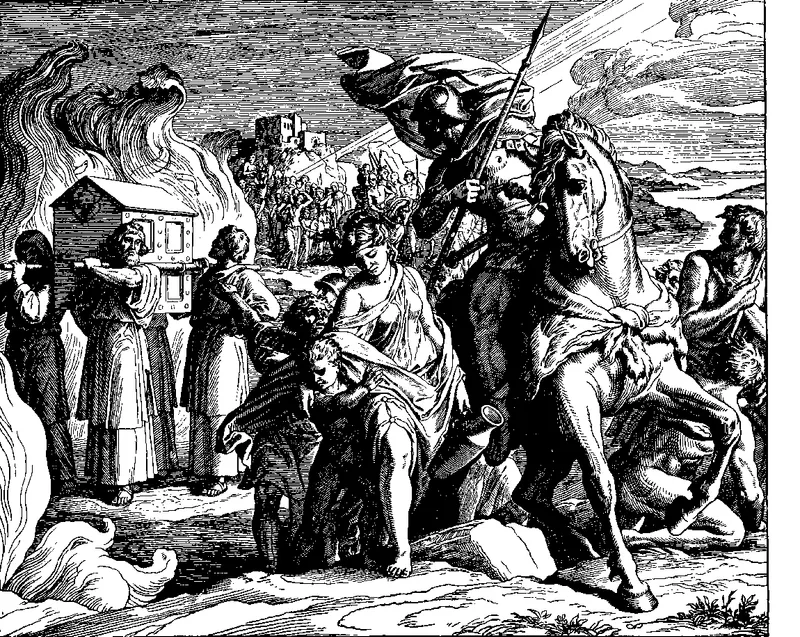
Daniel 11:1-2Now Will I Shew Thee the Truth
1Also I in the first year of Darius the Mede, even I, stood to confirm and to strengthen him. 2And now will I shew thee the truth. Behold, there shall stand up yet three kings in Persia; and the fourth shall be far richer than they all: and by his strength through his riches he shall stir up all against the realm of Grecia.
The voice in this chapter is the same one that ended the last: the heavenly messenger who came to Daniel after three weeks of mourning, and who now keeps unrolling what is written in the scripture of truth. He opens by recalling his own steadiness on Daniel's behalf - I… stood to confirm and to strengthen him (v. 1) - and then turns to the future with a striking promise: And now will I shew thee the truth (v. 2).
That word governs everything that follows. What comes next is truth - the settled reality of things, told before they happen. He begins near Daniel's own day: there shall stand up yet three kings in Persia; and the fourth shall be far richer than they all. The fourth king's wealth becomes a weapon: by his strength through his riches he shall stir up all against the realm of Grecia. So the long sweep begins - Persia provoking Greece, and the great clash of empires set in motion.
The reader is meant to feel, from the very first verse, that this is no improvisation. The messenger speaks of kings not yet born as plainly as a historian speaks of the dead.
Daniel 11:3-4Divided Toward the Four Winds of Heaven
3And a mighty king shall stand up, that shall rule with great dominion, and do according to his will. 4And when he shall stand up, his kingdom shall be broken, and shall be divided toward the four winds of heaven; and not to his posterity, nor according to his dominion which he ruled: for his kingdom shall be plucked up, even for others beside those.
Here is power at its apparent summit - a mighty king who rules with great dominion, so strong he does simply according to his will (v. 3), answerable, it seems, to no one. And then the prophecy does the thing it will do again and again: it cuts the mighty man down to size in the very next breath. And when he shall stand up, his kingdom shall be broken, and shall be divided toward the four winds of heaven; and not to his posterity (v. 4).
At the height of his dominion the kingdom shatters. It does not pass to his children; it is plucked up and scattered to the four winds, parceled out even for others beside those - to men outside his own line. Notice how little the chapter lingers over his greatness and how quickly it announces his fall. This is the prophecy's quiet theology of power: the most dominant kingdom a person can imagine is, in the long view, a thing that rises, breaks, and blows away.
The wind that scatters it is not random. It blows at the four points of heaven - the breaking is reported from heaven's side, as something heaven foresaw and allowed.1
Daniel 11:5-9The King of the South and the King of the North
5And the king of the south shall be strong, and one of his princes; and he shall be strong above him, and have dominion; his dominion shall be a great dominion. 6And in the end of years they shall join themselves together; for the king’s daughter of the south shall come to the king of the north to make an agreement: but she shall not retain the power of the arm; neither shall he stand, nor his arm: but she shall be given up, and they that brought her, and he that begat her, and he that strengthened her in these times. 7But out of a branch of her roots shall one stand up in his estate, which shall come with an army, and shall enter into the fortress of the king of the north, and shall deal against them, and shall prevail: 8And shall also carry captives into Egypt their gods, with their princes, and with their precious vessels of silver and of gold; and he shall continue more years than the king of the north. 9So the king of the south shall come into his kingdom, and shall return into his own land.
With the great kingdom broken, the chapter settles into its long middle subject: the protracted struggle of the king of the south and the king of the north (vv. 5-9). These are two of the fragments into which the shattered empire fell, and for the rest of the chapter they grind against each other. The first thing the prophecy shows is how their conflict tries to dress itself in peace. In the end of years they shall join themselves together, and a marriage is arranged to seal the bond: the king's daughter of the south shall come to the king of the north to make an agreement (v. 6).
But the agreement is hollow. She shall not retain the power of the arm; neither shall he stand - the alliance collapses, and the daughter, those who brought her, her father, and her backers are all swept away. War resumes at once: out of a branch of her roots shall one stand up, an avenger who invades the north, breaks into the fortress of the king of the north, and carries off plunder (vv. 7-9).
The detail in verse 8 is telling - he carries away their gods along with the silver and gold. Even the idols of the nations are spoil, hauled off in carts; they cannot defend their own shrines, let alone their worshippers. The whole tangle of marriages and raids and counter-raids makes one point by sheer accumulation: this is how the kingdoms of men actually behave, and every move of it was seen beforehand.
Daniel 11:10-13Multitudes Raised, and Not Strengthened by It
10But his sons shall be stirred up, and shall assemble a multitude of great forces: and one shall certainly come, and overflow, and pass through: then shall he return, and be stirred up, even to his fortress. 11And the king of the south shall be moved with choler, and shall come forth and fight with him, even with the king of the north: and he shall set forth a great multitude; but the multitude shall be given into his hand. 12And when he hath taken away the multitude, his heart shall be lifted up; and he shall cast down many ten thousands: but he shall not be strengthened by it. 13For the king of the north shall return, and shall set forth a multitude greater than the former, and shall certainly come after certain years with a great army and with much riches.
The middle of the chapter reads like the rise and fall of a tide, in and out, year after year. His sons shall be stirred up, and shall assemble a multitude of great forces… and overflow, and pass through (v. 10); the king of the south answers with choler and sets forth a great multitude (v. 11); the king of the north returns with a multitude greater than the former… a great army and with much riches (v. 13).
Armies gather, clash, are scattered, regroup, and gather again. What is striking is the prophecy's flat, almost weary tone toward all this raw strength. A king takes away a vast multitude and his heart shall be lifted up, yet the very next clause undercuts him: but he shall not be strengthened by it (v. 12). He cast down many ten thousands and was no stronger for it. There is a hard wisdom buried here.
The chapter watches men pour out human lives by the tens of thousands in pursuit of an advantage that does not last, a strength that does not hold. Each campaign feels, to those waging it, like the decisive one; from heaven's vantage it is one more wave that rises, breaks, and runs back out, leaving the shoreline much as it was.
Daniel 11:14-16The Glorious Land Trampled
14And in those times there shall many stand up against the king of the south: also the robbers of thy people shall exalt themselves to establish the vision; but they shall fall. 15So the king of the north shall come, and cast up a mount, and take the most fenced cities: and the arms of the south shall not withstand, neither his chosen people, neither shall there be any strength to withstand. 16But he that cometh against him shall do according to his own will, and none shall stand before him: and he shall stand in the glorious land, which by his hand shall be consumed.
Twice in this stretch the prophecy turns, briefly, from the great powers to thy people - Daniel's own people, the small nation caught between the grinding empires. In those times there shall many stand up against the king of the south: also the robbers of thy people shall exalt themselves to establish the vision; but they shall fall (v. 14). The phrase establish the vision is sobering. Some among the people imagine they can force God's purposes forward by their own violent action - that by rising up at the right moment they will make the prophecy come true.
And the verdict is blunt: they shall fall. God's vision does not need our self-exalting help, and those who try to seize it by force are swept away with the rest. Then the storm rolls over the people themselves. The king of the north shall come, and cast up a mount, and take the most fenced cities, and against him there shall be… no strength to withstand (v. 15). He comes to stand in the glorious land - the holy land itself - which by his hand shall be consumed (v. 16).
The land God promised becomes a corridor for marching armies, a place trampled in passing. For a faithful reader, this is the ache at the heart of the chapter: the people of God live inside the violence of the age, planted in the headlines, pressed by the same storms as everyone around them.
Daniel 11:17-20He Shall Stumble and Fall, and Not Be Found
17He shall also set his face to enter with the strength of his whole kingdom, and upright ones with him; thus shall he do: and he shall give him the daughter of women, corrupting her: but she shall not stand on his side, neither be for him. 18After this shall he turn his face unto the isles, and shall take many: but a prince for his own behalf shall cause the reproach offered by him to cease; without his own reproach he shall cause it to turn upon him. 19Then he shall turn his face toward the fort of his own land: but he shall stumble and fall, and not be found. 20Then shall stand up in his estate a raiser of taxes in the glory of the kingdom: but within few days he shall be destroyed, neither in anger, nor in battle.
The closing verses of this section trace the familiar arc one more time - ambition, overreach, and a fall that comes from an unexpected direction. A king set[s] his face to enter with the strength of his whole kingdom, even attempting a marriage-alliance to undermine his rival from within: he shall give him the daughter of women, corrupting her: but she shall not stand on his side (v. 17). The scheme fails; the daughter does not betray her new house as planned.
He turns instead to the coastlands - he shall turn his face unto the isles, and shall take many (v. 18) - but there a prince turns back his reproach upon his own head. So he retreats: he shall turn his face toward the fort of his own land: but he shall stumble and fall, and not be found (v. 19). The man who sought the strength of his whole kingdom ends as someone who simply stumbles and vanishes.
And his successor fares no better - a raiser of taxes who squeezes the kingdom for its glory and is gone within few days… neither in anger, nor in battle (v. 20). Not killed in glorious combat; just suddenly finished. Verse after verse, the prophecy strips the romance from power. These are the masters of the earth, and they end stumbling, vanishing, snuffed out between the lines.
Daniel 11:21-24A Vile Person Obtains the Kingdom by Flatteries
21And in his estate shall stand up a vile person, to whom they shall not give the honour of the kingdom: but he shall come in peaceably, and obtain the kingdom by flatteries. 22And with the arms of a flood shall they be overflown from before him, and shall be broken; yea, also the prince of the covenant. 23And after the league made with him he shall work deceitfully: for he shall come up, and shall become strong with a small people. 24He shall enter peaceably even upon the fattest places of the province; and he shall do that which his fathers have not done, nor his fathers’ fathers; he shall scatter among them the prey, and spoil, and riches: yea, and he shall forecast his devices against the strong holds, even for a time.
Now the prophecy narrows from the broad sweep of empires to a single, dangerous figure: in his estate shall stand up a vile person, to whom they shall not give the honour of the kingdom: but he shall come in peaceably, and obtain the kingdom by flatteries (v. 21). Everything about how he rises is worth noticing. He is vile - contemptible, a man others did not think worthy of the throne. The kingship is not his by right; it would not be given to him.
So he takes it by other means: not by open war but peaceably, not by honest claim but by flatteries. He flatters and schemes his way into a power that was never rightly his, and once in, he shall work deceitfully (v. 23), growing strong from small beginnings by treachery and broken agreements. Verse 24 marks how he differs even from the conquerors before him: he shall do that which his fathers have not done - he buys loyalty, scattering the prey, and spoil, and riches among his followers, purchasing a kingdom he could not command.
This is a portrait of a particular kind of evil: the deceiver who smiles, flatters, bribes, and lies his way to the top. The chapter has shown us many violent men; here it shows us a charming one, and reckons him more dangerous still.
Daniel 11:25-29They Shall Speak Lies at One Table
25And he shall stir up his power and his courage against the king of the south with a great army; and the king of the south shall be stirred up to battle with a very great and mighty army; but he shall not stand: for they shall forecast devices against him. 26Yea, they that feed of the portion of his meat shall destroy him, and his army shall overflow: and many shall fall down slain. 27And both these kings’ hearts shall be to do mischief, and they shall speak lies at one table; but it shall not prosper: for yet the end shall be at the time appointed. 28Then shall he return into his land with great riches; and his heart shall be against the holy covenant; and he shall do exploits, and return to his own land. 29At the time appointed he shall return, and come toward the south; but it shall not be as the former, or as the latter.
His career unfolds as a tissue of broken faith. He makes a league only to betray it (v. 23); even the men closest to his rival, they that feed of the portion of his meat - those who eat at the table - turn destroyer (v. 26). And verse 27 lifts the curtain on a scene of pure cynicism: both these kings' hearts shall be to do mischief, and they shall speak lies at one table. Picture it - two rulers seated together at a banquet, exchanging pleasantries and pledges, and every word a lie, each plotting the other's ruin even as the cups are filled.
It is one of the most quietly devastating verses in the chapter, a window into how the powerful so often deal with one another. And then comes the line that keeps the whole grim scene from feeling hopeless: but it shall not prosper: for yet the end shall be at the time appointed. The lies will not finally succeed. There is an appointed end, set not by the schemers at the table but by God, and toward it everything moves.
Twice more the prophecy sounds this note - at the time appointed he shall return (v. 29); the trial runs only to the time of the end… for a time appointed (v. 35). The deceit is real, but it is on a clock God is holding.
Daniel 11:30-32But the People That Do Know Their God
30For the ships of Chittim shall come against him: therefore he shall be grieved, and return, and have indignation against the holy covenant: so shall he do; he shall even return, and have intelligence with them that forsake the holy covenant. 31And arms shall stand on his part, and they shall pollute the sanctuary of strength, and shall take away the daily sacrifice, and they shall place the abomination that maketh desolate. 32And such as do wickedly against the covenant shall he corrupt by flatteries: but the people that do know their God shall be strong, and do exploits.
The vile person's rage finally turns where the chapter has been heading all along - against the holy covenant and the worship of God. Thwarted abroad by the ships of Chittim (v. 30), he comes home filled with indignation against the holy covenant, and makes common cause with them that forsake the holy covenant. Then the desecration: they shall pollute the sanctuary of strength, and shall take away the daily sacrifice, and they shall place the abomination that maketh desolate (v. 31).
This is the chapter's gravest moment. The sanctuary - the one place on earth set apart for the worship of the living God - is profaned. The daily sacrifice, the steady morning-and-evening rhythm of Israel's devotion, is cut off. And in the holy place is set up something so defiling that it is named only by what it does: the abomination that maketh desolate. The text handles it without sensationalism, in the plainest words, and so should we.
What it describes is the deliberate desecration of the holy, the attempt to stamp out the worship of God at its source. And the method against the people is the same one that brought the vile person to power: such as do wickedly against the covenant shall he corrupt by flatteries (v. 32). He does not only attack the faith by force; he seduces away from it those already willing to be seduced, flattering the half-hearted into open betrayal.
Daniel 11:33-35To Try Them, and to Make Them White
33And they that understand among the people shall instruct many: yet they shall fall by the sword, and by flame, by captivity, and by spoil, many days. 34Now when they shall fall, they shall be holpen with a little help: but many shall cleave to them with flatteries. 35And some of them of understanding shall fall, to try them, and to purge, and to make them white, even to the time of the end: because it is yet for a time appointed.
Into the very darkest verse of the chapter - the sanctuary profaned, the faithful flattered toward apostasy - the prophecy drops its great defiant promise: but the people that do know their God shall be strong, and do exploits (v. 32). That little word but turns the whole chapter on its hinge. Set against the abomination, against the corrupting flatteries, against everything that looks like the triumph of the proud, stands a people who cannot be bought or broken, held steady by the one thing the chapter names: they know their God. The strength is in the knowing.
And what they do is no small thing: they do exploits - great deeds, acts of courage and faithfulness in an evil day. Then the prophecy tells the truth about what such faithfulness costs. They that understand among the people shall instruct many - the wise do not hoard their knowing; they teach it, strengthening others - yet they shall fall by the sword, and by flame, by captivity, and by spoil, many days (v. 33). Being strong in God does not mean being spared.
Some of the very wisest and most faithful fall. The chapter refuses to pretend otherwise. And yet their fall is not what it appears.
The most consoling words in the chapter come fastened to its hardest fact. The wise fall - and the very next breath gives the reason: to try them, and to purge, and to make them white, even to the time of the end (v. 35). The persecution that strikes down the wise has a purpose the chapter names plainly: the fall is meant to try them - to test and prove what is real; to purge - to burn away the dross; and to make them white - to bring out a purity that only the fire could reveal.
This is one of Scripture's steadiest answers to the hardest question the faithful ask: why are the godly allowed to suffer? In His hand even the assaults of the wicked become a refiner's fire, making His people white. And it has an end: it runs only to the time of the end… for a time appointed. The trial is bounded. There is a date past which it will not go, set by the same God who declared the whole chapter before it began.
The faithful who fall are being purified by a process God is holding to a fixed term.
Daniel 11:36-40He Shall Magnify Himself Above Every God
36And the king shall do according to his will; and he shall exalt himself, and magnify himself above every god, and shall speak marvellous things against the God of gods, and shall prosper till the indignation be accomplished: for that that is determined shall be done. 37Neither shall he regard the God of his fathers, nor the desire of women, nor regard any god: for he shall magnify himself above all. 38But in his estate shall he honour the God of forces: and a god whom his fathers knew not shall he honour with gold, and silver, and with precious stones, and pleasant things. 39Thus shall he do in the most strong holds with a strange god, whom he shall acknowledge and increase with glory: and he shall cause them to rule over many, and shall divide the land for gain. 40And at the time of the end shall the king of the south push at him: and the king of the north shall come against him like a whirlwind, with chariots, and with horsemen, and with many ships; and he shall enter into the countries, and shall overflow and pass over.
The prophecy comes at last to the king in whom the whole pattern of the chapter gathers to a head: the king shall do according to his will; and he shall exalt himself, and magnify himself above every god, and shall speak marvellous things against the God of gods (v. 36). Here is self-exaltation in its fullest form. The earlier kings did according to his will over men; this one sets his will against heaven itself.
He magnif[ies] himself above every god - not content to rule the earth, he claims a place above all worship - and he speak[s] marvellous things, astonishing blasphemies, against the God of gods. Verse 37 drives the picture further: neither shall he regard the God of his fathers… nor regard any god: for he shall magnify himself above all. He honors nothing above himself; even the gods of his ancestors are cast aside. What he does honor is raw power - the God of forces… a god whom his fathers knew not, served with gold, and silver, and with precious stones (v. 38).
The man who reveres no god in fact worships might itself, dressing his lust for power in the trappings of devotion. This is the oldest temptation wearing a crown: the creature who will not bow, who puts himself in the place of God. And the chapter sets one phrase beside his swelling pride that he never hears - he shall prosper till the indignation be accomplished: for that that is determined shall be done.
Daniel 11:41-45He Shall Come to His End, and None Shall Help Him
41He shall enter also into the glorious land, and many countries shall be overthrown: but these shall escape out of his hand, even Edom, and Moab, and the chief of the children of Ammon. 42He shall stretch forth his hand also upon the countries: and the land of Egypt shall not escape. 43But he shall have power over the treasures of gold and of silver, and over all the precious things of Egypt: and the Libyans and the Ethiopians shall be at his steps. 44But tidings out of the east and out of the north shall trouble him: therefore he shall go forth with great fury to destroy, and utterly to make away many. 45And he shall plant the tabernacles of his palace between the seas in the glorious holy mountain; yet he shall come to his end, and none shall help him.
For a stretch of verses the willful king seems unstoppable. War comes at the time of the end; he sweeps through the lands like a whirlwind, with chariots, and with horsemen, and with many ships, and he overflow[s] and pass[es] over (v. 40). He enters even the glorious land; country after country is overthrown; Egypt itself does not escape, and he lays hold of the treasures of gold and of silver, and over all the precious things of Egypt (vv. 41-43).
To anyone living through it, this would look exactly like the final triumph of the proud - the blasphemer prospering, the faithful trampled, the treasuries of the nations pouring into his hands. And this is just where the chapter has been quietly schooling us. It told us at the outset that he would prosper - but only till the indignation be accomplished (v. 36). The prospering is real, and it is also leashed. It runs to a fixed point and not one step past it.
The faithful reader, who has watched king after king rise and break across this chapter, has been trained not to mistake a season of success for a settled verdict. The man looks invincible. He is on a clock he cannot see.
The end comes suddenly, and the prophecy lets us feel the turn. At the height of his conquests, tidings out of the east and out of the north shall trouble him (v. 44). Something he did not control - news, a threat from beyond - breaks in upon the man who imagined himself above every god, and his response is the rage of the cornered: he shall go forth with great fury to destroy, and utterly to make away many. He plants his royal tents between the seas in the glorious holy mountain (v. 45) - pitching his power, in his arrogance, against the very mountain of God.
And there, at the apparent summit of his reach, the chapter speaks its last and most decisive word over him: yet he shall come to his end, and none shall help him. Read those final clauses slowly. He shall come to his end - certain, as certain as everything else the angel called truth. And none shall help him - the man who needed no one, who magnified himself above all, dies utterly alone, with no ally, no god, no power to save him.
The blasphemer who set his tent against the holy mountain falls, and not a hand in heaven or earth is raised to hold him up. It is the chapter's whole argument compressed into eight words: the proud come to their appointed end, and there is no help for them at all.
Research trail
Sources & further study
These references support the historical, linguistic, manuscript, and contextual notes in this chapter. Scripture remains the primary text; external sources are provided so readers can inspect the research directly.
- Daniel 11 - Translators' NotesThe NET Bible's detailed footnotes on Daniel 11 - the kings of Persia and Greece in verses 2-4, the long back-and-forth of the kings of south and north, the difficult phrases describing the vile person of verses 21-35, and the willful king who magnifies himself in verses 36-39.
- Daniel 11 · Hebrew + classical Jewish commentaryThe Hebrew text of Daniel 11 with Rashi, Ibn Ezra, and other classical commentators side by side - useful for the phrase yodei elohav (v. 32, “the people that do know their God”) and for shiqquts shomem (v. 31, “the abomination that maketh desolate”), the desecration of the holy place that the chapter handles so gravely.
- Daniel 11 ↔ Isaiah 46 · John 17 · 1 Peter 1 · 2 Thessalonians 2Traces the threads tying Daniel 11 to the rest of Scripture - the foreknown wars read beside the God who declares the end from the beginning (Isa. 46:10), the people that do know their God (v. 32) beside the eternal life that is to know thee (John 17:3), and the self-exalting king (vv. 36-37) beside the one who exalteth himself above all that is called God (2 Thess. 2:4).
Where this echoes in Scripture
The King of the South and the King of the North
- Isaiah 46:9-10I am God, and there is none like me, declaring the end from the beginning... My counsel shall stand, and I will do all my pleasure.The bedrock the whole chapter rests on - the God who foretells the wars of verses 2-9 because He has decreed the end before it begins.
- Daniel 2:21he changeth the times and the seasons: he removeth kings, and setteth up kings.The truth behind verses 3-4 - God's hand governs the rise and breaking of kingdoms. So too Daniel 4:25 - the most High rules in the kingdom of men, and gives it to whomsoever He will.
- Colossians 1:16-17by him were all things created... whether they be thrones, or dominions, or principalities, or powers... and by him all things consist.The kingdoms of verses 2-9 are the very thrones and dominions made by and for the Son they defy.
- Matthew 28:18All power is given unto me in heaven and in earth.The sovereignty that declared these wars beforehand, now full and personal in the risen Christ.
- Daniel 8:8the he goat waxed very great: and when he was strong, the great horn was broken; and for it came up four notable ones.The same mighty kingdom broken and divided four ways as in verse 4 - an earlier vision retold.
- Psalm 33:10-11The LORD bringeth the counsel of the heathen to nought... The counsel of the LORD standeth for ever.The alliances and agreements of verse 6 that come to nothing - over against the counsel of the LORD that stands.
- Jeremiah 10:11The gods that have not made the heavens and the earth, even they shall perish.The plundered gods of verse 8 - idols carried off in carts, unable to save even themselves.
Multitudes Raised, and Not Strengthened by It
The Glorious Land Trampled
- Zechariah 4:6Not by might, nor by power, but by my spirit, saith the LORD of hosts.The answer to those who would “establish the vision” by force (v. 14) - God's purposes come by His Spirit.
- Daniel 8:9out of one of them came forth a little horn, which waxed exceeding great, toward the south, and toward the east, and toward the pleasant land.The trampling of “the glorious land” in verse 16 - the pleasant land caught under the advance of empires.
He Shall Stumble and Fall, and Not Be Found
- Proverbs 16:18Pride goeth before destruction, and an haughty spirit before a fall.The arc of every king in this section - the lifted-up heart (v. 12) and the stumble and fall (v. 19).
- James 4:13-14ye know not what shall be on the morrow. For what is your life? It is even a vapour.The king gone “within few days” (v. 20) and the one who stumbles and is “not found” (v. 19) - the vapor-brevity of even the mightiest life.
But the People That Do Know Their God
- John 17:3this is life eternal, that they might know thee the only true God, and Jesus Christ, whom thou hast sent.The knowing of verse 32 brought to its fullness - to know God, now opened to all in Christ, is eternal life itself.
- Philippians 3:8-10I count all things but loss for the excellency of the knowledge of Christ Jesus my Lord... that I may know him.The knowing of verse 32 that the apostle counted worth everything he had lost.
- Ephesians 3:16that he would grant you... to be strengthened with might by his Spirit in the inner man.How the people who know their God are made “strong” (v. 32) - by His Spirit within. So too Philippians 4:13, “able to do all things through Christ.”
- 1 John 5:20the Son of God is come, and hath given us an understanding, that we may know him that is true.The knowing of verse 32 made possible - the Son has come and given the understanding by which we know God.
- Matthew 24:15When ye therefore shall see the abomination of desolation, spoken of by Daniel the prophet, stand in the holy place.The Lord takes up the very phrase of verse 31 - the abomination that makes desolate, held as a warning over the people of God.
To Try Them, and to Make Them White
- 1 Peter 1:6-7the trial of your faith, being much more precious than of gold that perisheth, though it be tried with fire.The refining purpose of verse 35 - the fall of the faithful sent to try, to purge, and to make them white.
- Malachi 3:3he shall sit as a refiner and purifier of silver... that they may offer unto the LORD an offering in righteousness.The making-white of verse 35 - God Himself the refiner, purifying His people through the fire.
- Revelation 7:14These are they which came out of great tribulation, and have washed their robes, and made them white in the blood of the Lamb.The end of the refining begun in verse 35 - those who fall in tribulation made white, and how.
He Shall Magnify Himself Above Every God
- Isaiah 14:13-14I will ascend into heaven... I will be like the most High.The pride of verses 36-37 in another proud king's mouth - the creature reaching for the place of God.
- Philippians 2:8-9he humbled himself... Wherefore God also hath highly exalted him, and given him a name which is above every name.The opposite road from the self-exalting king - the One who humbled Himself and was lifted by God above all.
He Shall Come to His End, and None Shall Help Him
- 2 Thessalonians 2:3-4that man of sin... who opposeth and exalteth himself above all that is called God, or that is worshipped.The same self-exalting figure as verses 36-37 - the one who sets himself in the place of God.
- 2 Thessalonians 2:8whom the Lord shall consume with the spirit of his mouth, and shall destroy with the brightness of his coming.How the end of verse 45 comes - the proud one undone by the mere breath of the Lord's mouth.
- Revelation 11:15The kingdoms of this world are become the kingdoms of our Lord, and of his Christ; and he shall reign for ever and ever.The far side of every kingdom that rose and broke in this chapter - the reign that has no end.
- Daniel 2:44the God of heaven set up a kingdom, which shall never be destroyed... it shall stand for ever.The answer to every broken kingdom in this chapter - the one kingdom that comes to no end.