Daniel 10
People in this chapter
Three full weeks Daniel mourns by the great river Hiddekel. No rich food, no meat, no wine - just grief and prayer. Then he lifts his eyes. A man stands there clothed in linen, his face like lightning, his eyes like lamps of fire, his limbs like polished brass, his voice like the roar of a crowd. The men with him see nothing, yet they tremble and flee. The glory empties him. His strength drains out and he falls on his face.1
Tap any highlighted phrase to jump to the commentary that unpacks it.
Daniel 10:1-4By the Great River Hiddekel
1In the third year of Cyrus king of Persia a thing was revealed unto Daniel, whose name was called Belteshazzar; and the thing was true, but the time appointed was long: and he understood the thing, and had understanding of the vision. 2In those days I Daniel was mourning three full weeks. 3I ate no pleasant bread, neither came flesh nor wine in my mouth, neither did I anoint myself at all, till three whole weeks were fulfilled. 4And in the four and twentieth day of the first month, as I was by the side of the great river, which is Hiddekel;
The chapter is dated late, the third year of Cyrus king of Persia (v. 1). By now the first exiles had been permitted to return to Jerusalem, yet Daniel, an old man, remains where God placed him, and he is grieved. Watch the order the text insists on: the burden comes first, the answer long after. For three full weeks he sets aside every comfort - rich food, meat, wine, even the oil that freshened the skin in a hot land - and gives himself to grief and prayer.
This is no token fast. The seeking was real and costly before anything was shown. And the detail matters because of what the chapter will reveal: that from the first day Daniel set his heart to understand, his words were already heard in heaven (v. 12). The long wait was never silence on God's side. It only looked like silence from the riverbank, where an old man fasted and mourned and would not give up.1
Daniel 10:5-9A Certain Man Clothed in Linen
5Then I lifted up mine eyes, and looked, and behold a certain man clothed in linen, whose loins were girded with fine gold of Uphaz: 6His body also was like the beryl, and his face as the appearance of lightning, and his eyes as lamps of fire, and his arms and his feet like in colour to polished brass, and the voice of his words like the voice of a multitude. 7And I Daniel alone saw the vision: for the men that were with me saw not the vision; but a great quaking fell upon them, so that they fled to hide themselves. 8Therefore I was left alone, and saw this great vision, and there remained no strength in me: for my comeliness was turned in me into corruption, and I retained no strength. 9Yet heard I the voice of his words: and when I heard the voice of his words, then was I in a deep sleep on my face, and my face toward the ground.
Every line of verses 5-6 piles glory on glory, and the effect is deliberate. The linen and the belt of fine gold mark a figure of priestly and royal splendour. The body gleams like beryl. The face flashes like lightning. The eyes burn like lamps. The limbs shine like polished brass. And the voice is not one voice but the roar of a multitude. This is no ordinary messenger. The sheer weight of the description tells you Daniel has been brought to the edge of something far above the human scale - standing where the river Hiddekel ran, an old man at the threshold of heaven's glory.
The next verses show exactly what that nearness does to a person.
The effect of the vision is total. First, those with Daniel cannot bear even what they do not see: the men that were with me saw not the vision; but a great quaking fell upon them, so that they fled to hide themselves (v. 7). Then Daniel, left alone before the glory, is undone: there remained no strength in me: for my comeliness was turned in me into corruption, and I retained no strength (v. 8).
His vigour drains away; the healthy colour of his face turns to a deathly pallor; and at last he collapses - then was I in a deep sleep on my face, and my face toward the ground (v. 9). This is the consistent biblical pattern when a mortal is brought near the glory of God: collapse, awe, the body itself failing, overwhelmed by what no human frame can bear with ease. Abraham fell on his face; Moses hid his; Isaiah cried that he was undone; Ezekiel fell as one dead; John on Patmos fell at the feet of the One he saw as though lifeless.
Daniel joins them. The lesson is quiet but firm - real nearness to God is not a thing we manage or domesticate. It overwhelms. And yet, as the next section will show, the One whose glory floors the prophet is the very One who reaches down to raise him.
Daniel 10:10-14O Daniel, a Man Greatly Beloved
10And, behold, an hand touched me, which set me upon my knees and upon the palms of my hands. 11And he said unto me, O Daniel, a man greatly beloved, understand the words that I speak unto thee, and stand upright: for unto thee am I now sent. And when he had spoken this word unto me, I stood trembling. 12Then said he unto me, Fear not, Daniel: for from the first day that thou didst set thine heart to understand, and to chasten thyself before thy God, thy words were heard, and I am come for thy words. 13But the prince of the kingdom of Persia withstood me one and twenty days: but, lo, Michael, one of the chief princes, came to help me; and I remained there with the kings of Persia. 14Now I am come to make thee understand what shall befall thy people in the latter days: for yet the vision is for many days.
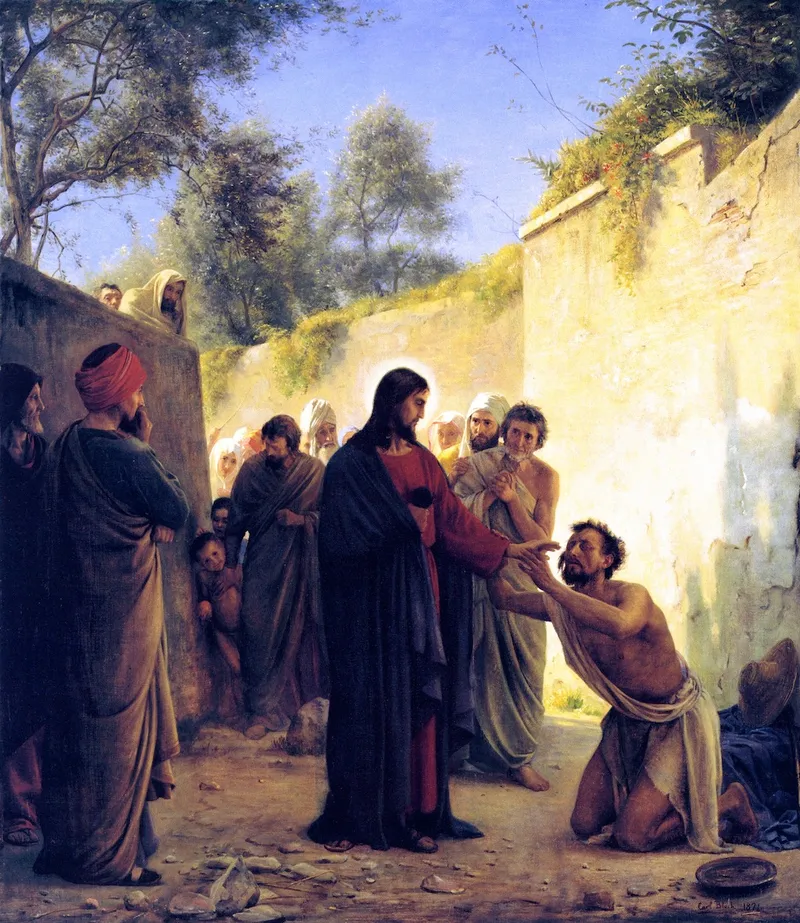
The raising of Daniel comes in gentle stages, and each stage is worth seeing. First, an hand touched me, which set me upon my knees and upon the palms of my hands (v. 10). He is not yanked to his feet; he is brought up partway, onto hands and knees, still bowed. Then comes the word and the next stage: O Daniel, a man greatly beloved, understand the words that I speak unto thee, and stand upright… And when he had spoken this word unto me, I stood trembling (v. 11).
He rises - but trembling. The strength returns by degrees, not all at once. There is great tenderness in this. The figure does not demand that the shattered man pull himself together; he meets him on the ground, touches him, names him beloved, and patiently raises him a step at a time until he can stand. And the very first thing spoken over the fallen prophet is not a rebuke or a command but a title of affection: a man greatly beloved. Before Daniel is told to understand, before he is told to stand, he is told he is loved.
That is the foundation everything else is built on. His strength is gone; heaven's settled regard for him never wavered.
Then comes the word that reframes the whole three weeks of waiting: Fear not, Daniel: for from the first day that thou didst set thine heart to understand, and to chasten thyself before thy God, thy words were heard, and I am come for thy words (v. 12). From the first day. From the very first day he turned his heart to seek God, his words were heard in heaven, and the messenger was dispatched in answer.
The long delay, then, was never a sign that God had not heard or did not care. The prayer was received the moment it was prayed. This is one of the most reassuring things the chapter says, and it speaks directly to every season of seeming silence. We measure God's response by what we can see arriving, and when nothing arrives we conclude nothing is happening. Daniel learns the opposite: heaven had answered on day one, and what felt like silence was in fact a response already on its way.
The encouragement is not that every prayer is granted exactly as asked, but that no sincere seeking of God falls to the ground unheard. Thy words were heard.
Now the chapter lifts a curtain on something the rest of Scripture only rarely shows: the prince of the kingdom of Persia withstood me one and twenty days: but, lo, Michael, one of the chief princes, came to help me; and I remained there with the kings of Persia (v. 13). The plain sense is that between the sending of the answer and its arrival there was real opposition - some unseen resistance bound up with the kingdom of Persia - and that the messenger was helped by Michael, named here as one of the chief princes and later as Michael your prince (v. 21).
The text says this much and stops; it does not lay out a map of the unseen world or invite us to chart its ranks. Restraint is the right response. What the verse plainly establishes is twofold and pastoral. First, the period that felt to Daniel like unanswered waiting was, behind the scenes, a contested span - the answer was real and was coming, even while it was withstood. Second, and far more important, the messenger is helped and the answer arrives; the resistance does not prevail.
The chapter does not hand us a system to be anxious about. It hands us the assurance that what God sends in answer to prayer reaches its destination - and that His servant did not wait alone.1
Daniel 10:15-18Then Opened My Mouth, and Spake
15And when he had spoken such words unto me, I set my face toward the ground, and I became dumb. 16And, behold, one like the similitude of the sons of men touched my lips: then I opened my mouth, and spake, and said unto him that stood before me, O my lord, by the vision my sorrows are turned upon me, and I have retained no strength. 17For how can the servant of this my lord talk with this my lord? for as for me, straightway there remained no strength in me, neither is there breath left in me. 18Then there came again and touched me one like the appearance of a man, and he strengthened me,
Even raised to his feet, Daniel is not yet whole. The words have left him speechless: I set my face toward the ground, and I became dumb (v. 15). So the touch comes a second time, now to his mouth: one like the similitude of the sons of men touched my lips: then I opened my mouth, and spake (v. 16). Only then can he voice what he feels - by the vision my sorrows are turned upon me, and I have retained no strength… neither is there breath left in me (vv. 16-17).
Daniel hides nothing. He confesses that he is wrung out, that the sight has emptied him, that he cannot even draw breath to speak with the one before him. And the response is not impatience but a third touch and fresh strength: Then there came again and touched me one like the appearance of a man, and he strengthened me (v. 18). Three times now a hand has reached for the failing prophet - to raise him, to open his lips, to strengthen him.
Heaven does not tire of restoring the one who keeps being overwhelmed. Each time Daniel falters, the touch comes again. This is the patient kindness of God toward the weak: not one grudging assist, but a steady returning to the same person until he can stand and speak and go on.
Daniel 10:19-21Be Strong, Yea, Be Strong
19And said, O man greatly beloved, fear not: peace be unto thee, be strong, yea, be strong. And when he had spoken unto me, I was strengthened, and said, Let my lord speak; for thou hast strengthened me. 20Then said he, Knowest thou wherefore I come unto thee? and now will I return to fight with the prince of Persia: and when I am gone forth, lo, the prince of Grecia shall come. 21But I will shew thee that which is noted in the scripture of truth: and there is none that holdeth with me in these things, but Michael your prince.
Watch the sequence at the heart of verse 19, because the order is the meaning. The title comes first - greatly beloved, the same word of affection as before. Then fear not, then peace be unto thee, and only then the command twice over: be strong, yea, be strong. Here is the wonder of it: Daniel is told to be strong precisely when he has just confessed he has no strength left at all. The command is not a demand that he manufacture courage by willpower.
It comes wrapped in the words that supply what it asks for, and it is followed at once by the result - when he had spoken unto me, I was strengthened. The strength came as the word was spoken. This is how God's strengthening so often works: strength given in the moment of weakness, carried in on the very word that tells us to be strong. The weak are told they are loved, granted peace, and strengthened in the telling.
Restored and able to listen, Daniel is told why the messenger came and what lies ahead: Knowest thou wherefore I come unto thee? and now will I return to fight with the prince of Persia: and when I am gone forth, lo, the prince of Grecia shall come. But I will shew thee that which is noted in the scripture of truth (vv. 20-21). Two things stand out, and both should be held with the same restraint the chapter itself keeps.
The first is that the unseen struggle is not over - the messenger speaks of returning to the conflict, and of Persia giving way in time to Greece, which is exactly the march of empires Daniel's visions have traced elsewhere. The text does not invite us to systematize this or grow anxious about it; it simply lets us know that history's great turns are not happening apart from God's sight or beyond His reach.
The second is the steady ground under it all: that which is noted in the scripture of truth. Whatever rises or falls among the kingdoms, what is written in God's record stands. The kingdoms of men shift like sand - Persia, then Greece, then whatever follows - but the word of God is fixed, and Daniel is being shown what is already settled there.
Research trail
Sources & further study
These references support the historical, linguistic, manuscript, and contextual notes in this chapter. Scripture remains the primary text; external sources are provided so readers can inspect the research directly.
- Daniel 10 - Translators' NotesThe NET Bible's detailed footnotes on Daniel 10 - the three weeks of mourning and fasting (vv. 2-3), the description of the glorious figure by the Hiddekel (vv. 5-6), the difficult report of the prince of Persia and Michael (vv. 13, 20-21), and the repeated strengthening of the overwhelmed prophet.
- Daniel 10 · Hebrew + classical Jewish commentaryThe Hebrew text of Daniel 10 with Rashi, Ibn Ezra, and other classical commentators side by side - useful for the phrase ish chamudot (vv. 11, 19, “a man greatly beloved”), for sar (v. 13, the “prince” standing over a kingdom), and for the verb chazaq (v. 19, the repeated “be strong” that lifts the fallen seer).
- Daniel 10 ↔ Revelation 1 · Matthew 17 · Ephesians 1Traces the threads tying Daniel 10 to the rest of Scripture - the glorious man with eyes as lamps of fire and feet like polished brass (vv. 5-6) read alongside the risen Christ John sees on Patmos (Rev. 1:13-17), the touch and “fear not” that meet the fallen seer (vv. 10, 19) beside the same words on the mount of transfiguration (Matt. 17:7), and the “greatly beloved” standing (vv. 11, 19) beside being accepted in the beloved (Eph. 1:6).
Where this echoes in Scripture
A Certain Man Clothed in Linen
- Revelation 1:13-17his eyes were as a flame of fire; And his feet like unto fine brass... and his voice as the sound of many waters... And when I saw him, I fell at his feet as dead. And he laid his right hand upon me, saying unto me, Fear not.The risen Christ described in the same images as the man by the Hiddekel (vv. 5-6), and meeting the fallen seer the same way.
- Ezekiel 1:28This was the appearance of the likeness of the glory of the LORD. And when I saw it, I fell upon my face.The same collapse before glory as verse 9 - a prophet undone by the sight.
- Isaiah 6:5Woe is me! for I am undone... for mine eyes have seen the King, the LORD of hosts.The undoing of verse 8 - nearness to God's glory leaving a man emptied, not exalted.
- Daniel 8:17-18I was afraid, and fell upon my face... I was in a deep sleep on my face... but he touched me, and set me upright.The same pattern earlier in the book - collapse before the vision, then a touch that sets him upright (cf. vv. 8-11).
- Matthew 17:6-7they fell on their face, and were sore afraid. And Jesus came and touched them, and said, Arise, and be not afraid.The glory that floors and the touch that raises (vv. 8-10) - met again on the mount of transfiguration.
O Daniel, a Man Greatly Beloved
- Ephesians 1:6To the praise of the glory of his grace, wherein he hath made us accepted in the beloved.The “greatly beloved” standing of verse 11 - held out to all who are in Christ.
- 1 John 3:1Behold, what manner of love the Father hath bestowed upon us, that we should be called the sons of God.The love named over Daniel (v. 11) widened to every child of God.
- Daniel 9:23At the beginning of thy supplications the commandment came forth, and I am come to shew thee; for thou art greatly beloved.The same title and the same truth as verses 11-12 - the answer sent at the very start of prayer.
- Matthew 6:8your Father knoweth what things ye have need of, before ye ask him.The assurance behind verse 12 - prayer heard from the first day, before the asking is even finished.
- Matthew 7:7Ask, and it shall be given you; seek, and ye shall find; knock, and it shall be opened unto you.The seeking that was heard from the first day (v. 12) - Christ's own promise that asking does not fall unheard.
- Luke 18:7shall not God avenge his own elect, which cry day and night unto him, though he bear long with them?The delay of verse 13 - God hears, and answers, even when He seems to bear long.
Be Strong, Yea, Be Strong
- Isaiah 40:29-31He giveth power to the faint; and to them that have no might he increaseth strength... they that wait upon the LORD shall renew their strength.The strengthening of verse 19 - strength given to the weak and faint who wait on God.
- 2 Corinthians 12:9-10My strength is made perfect in weakness... when I am weak, then am I strong.The principle of verses 17-19 - God's strength supplied exactly where human strength fails.
- Joshua 1:6-7Be strong and of a good courage... Only be thou strong and very courageous.The same word, “be strong” (v. 19), joined to the promise of God's presence and help.
- John 14:27Peace I leave with you, my peace I give unto you... Let not your heart be troubled, neither let it be afraid.The words spoken over Daniel - peace, fear not (v. 19) - on the lips of Christ to His own.
- Psalm 119:89For ever, O LORD, thy word is settled in heaven.The “scripture of truth” of verse 21 - God's word fixed and settled while kingdoms rise and fall.