Jeremiah 1
People in this chapter
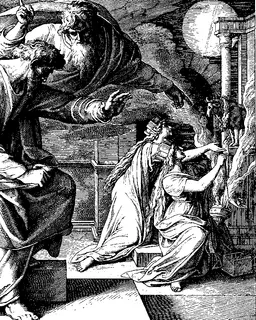
The longest book in the Bible opens not with a sermon but with a calling. We are told plainly who Jeremiah is - the son of Hilkiah, of the priests that were in Anathoth - and when he served: from the thirteenth year of good king Josiah down through the final collapse, unto the carrying away of Jerusalem captive (vv. 1-3). That span is the key to everything that follows. Jeremiah is called to speak for God across the last decades of a dying kingdom, through the reigns of kings who would not listen, right up to the day the city fell.
He is the prophet of a long, losing battle - which makes the way his ministry begins all the more striking.1
Tap any highlighted phrase to jump to the commentary that unpacks it.
Jeremiah 1:1-5Before I Formed Thee in the Belly I Knew Thee
1The words of Jeremiah the son of Hilkiah, of the priests that were in Anathoth in the land of Benjamin: 2To whom the word of the LORD came in the days of Josiah the son of Amon king of Judah, in the thirteenth year of his reign. 3It came also in the days of Jehoiakim the son of Josiah king of Judah, unto the end of the eleventh year of Zedekiah the son of Josiah king of Judah, unto the carrying away of Jerusalem captive in the fifth month. 4Then the word of the LORD came unto me, saying, 5Before I formed thee in the belly I knew thee; and before thou camest forth out of the womb I sanctified thee, and I ordained thee a prophet unto the nations.
The book begins by setting its prophet firmly in real history: The words of Jeremiah the son of Hilkiah, of the priests that were in Anathoth in the land of Benjamin (v. 1). Jeremiah comes from a priestly family in a small town a few miles north of Jerusalem - near enough to the temple to know it, far enough out to be no insider. Then the dates are stacked up, and they tell a story of their own: the word came in the days of Josiah… in the thirteenth year of his reign (v. 2), and kept coming in the days of Jehoiakim… unto the end of the eleventh year of Zedekiah… unto the carrying away of Jerusalem captive (v. 3).
That is roughly forty years, spanning the last good king of Judah and the ruin that followed him. Jeremiah is called to speak across the slow collapse of his nation, through rulers who mostly would not hear, right down to the day the walls came down. The superscription is not dry record-keeping. It quietly frames the whole book: this is the testimony of a man who served God faithfully through a generation that refused to listen, and whose vindication would not come in his own lifetime.1
Three times in these opening verses the same phrase sounds: the word of the LORD came (vv. 2, 4). It is worth pausing on, because it tells us what kind of book this is and what kind of man Jeremiah is. He presents himself as a man to whom a word came - from outside himself, unbidden, addressed to him by name, with no pretense of being a thinker offering opinions or a reformer with a program for the nation.
The initiative is entirely God's. And when the word turns to Jeremiah directly in verse 4, it begins with the person, before any task: Then the word of the LORD came unto me, saying. Before there is a single command, before exile or judgment or any of the hard words Jeremiah will have to carry, God speaks to the man himself about who he is and whose he is. That order matters. The LORD grounds Jeremiah in his identity before He ever lays on him the weight of his calling.
Everything the prophet will endure rests first on what God says to him here, quietly, before the work begins.
Then comes the verse that has anchored countless lives: Before I formed thee in the belly I knew thee; and before thou camest forth out of the womb I sanctified thee, and I ordained thee a prophet unto the nations (v. 5). Read it slowly, because each clause adds something. Before I formed thee… I knew thee - the LORD did not come to know Jeremiah by watching him grow; He knew him already, with a knowing that went before his making.
Before thou camest forth… I sanctified thee - He set him apart for a holy purpose before he was ever cradled or named. I ordained thee a prophet unto the nations - the calling was settled, fixed, given, before Jeremiah could do anything to win or forfeit it. The point being pressed is God's prior initiative: His knowing, His setting-apart, His appointing all stand before Jeremiah's own life and work. This is the deep ground on which the frightened young man of the next verse will be made to stand.
He did not volunteer for this and could not have earned it; it was God's purpose for him before he drew his first breath. The verse does not pause to satisfy our curiosity about how God can know a person before forming him; it simply affirms that He did, and that the affirmation is meant to steady the one who hears it.2
Jeremiah 1:6-10Ah, Lord GOD! · I Have Put My Words in Thy Mouth
6Then said I, Ah, Lord GOD! behold, I cannot speak: for I am a child. 7But the LORD said unto me, Say not, I am a child: for thou shalt go to all that I shall send thee, and whatsoever I command thee thou shalt speak. 8Be not afraid of their faces: for I am with thee to deliver thee, saith the LORD. 9Then the LORD put forth his hand, and touched my mouth. And the LORD said unto me, Behold, I have put my words in thy mouth. 10See, I have this day set thee over the nations and over the kingdoms, to root out, and to pull down, and to destroy, and to throw down, to build, and to plant.
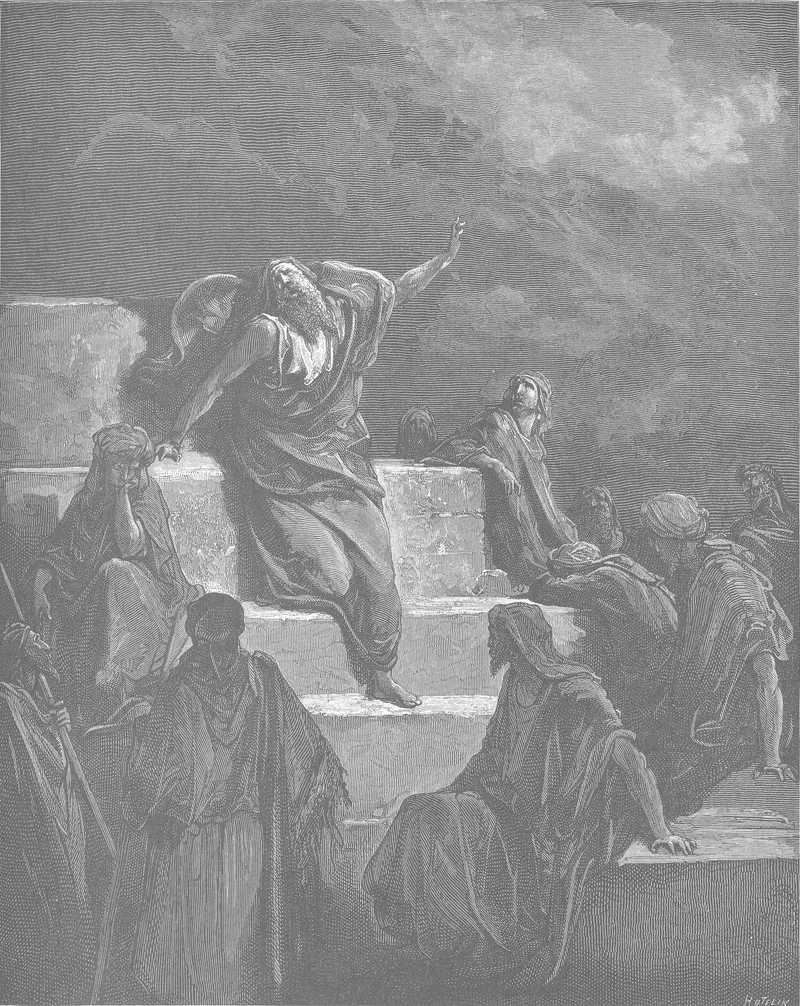
Jeremiah's answer to so high a calling is a cry of inadequacy: Ah, Lord GOD! behold, I cannot speak: for I am a child (v. 6). The little exclamation Ah carries real distress; this is not false modesty but genuine alarm. He raises two objections folded into one. I cannot speak - he feels himself no orator, unequal to standing before kings and crowds with words that will be hated. And I am a child - the Hebrew word can mean a youth or a young man, someone too junior to command a hearing, lacking the years and the standing that might make people listen.
Jeremiah is in good company. Moses protested that he was slow of speech; Gideon pleaded that his family was the least in Manasseh; Isaiah cried that he was a man of unclean lips. When God calls a person to something far beyond them, the honest first response is very often a sense of one's own smallness. What is striking is that the LORD meets Jeremiah's reluctance - which is real - by directing his eyes away from himself entirely.
The LORD's reply is firm and freeing at once: Say not, I am a child: for thou shalt go to all that I shall send thee, and whatsoever I command thee thou shalt speak (v. 7). Notice what He does not say. He does not say, “You are right, you are too young, I will choose someone else.” Nor does He say, “Don't be silly, you are actually very capable.” He never tells Jeremiah that he is, in himself, enough.
Instead He moves the whole question onto different ground. The issue rests entirely on the One who sends and the words He gives. Thou shalt go to all that I shall send thee - the destination is God's to choose. Whatsoever I command thee thou shalt speak - the message is God's to supply. Jeremiah's “I cannot speak” is quietly answered: the speaking will not finally depend on him. This is how God characteristically deals with the called and frightened.
He overrules the sense of inadequacy by promising that He Himself will be in the going and in the speaking. The adequacy lies in the Sender, never in the sent.
Then word becomes gesture: Then the LORD put forth his hand, and touched my mouth. And the LORD said unto me, Behold, I have put my words in thy mouth (v. 9). Jeremiah's objection had centered on his mouth - I cannot speak - and it is precisely his mouth that the LORD touches. The answer is fitted exactly to the fear. The very faculty Jeremiah felt was insufficient is the one God lays His hand upon and claims.
And the words spoken over that touch settle the matter: I have put my words in thy mouth. The message Jeremiah will carry is not his to invent or defend; it is given. This is the scene's great relief. A prophet's burden is to be faithful to a word he has received, with no premium on cleverness or persuasion. The same thing happened to Isaiah, whose unclean lips were touched with a live coal from the altar; here it is the LORD's own hand.
Then the scope is laid bare: I have this day set thee over the nations and over the kingdoms, to root out, and to pull down, and to destroy, and to throw down, to build, and to plant (v. 10). Six verbs - four of tearing down, two of building up. The word Jeremiah carries will do real work in the world, and the order is sobering: there is much to be uprooted before anything can be planted.
But the planting is there, promised at the end. Even this prophet of judgment is given, from the first day, a word that finally builds.3
Jeremiah 1:11-19The Almond Rod and the Seething Pot
11Moreover the word of the LORD came unto me, saying, Jeremiah, what seest thou? And I said, I see a rod of an almond tree. 12Then said the LORD unto me, Thou hast well seen: for I will hasten my word to perform it. 13And the word of the LORD came unto me the second time, saying, What seest thou? And I said, I see a seething pot; and the face thereof is toward the north. 14Then the LORD said unto me, Out of the north an evil shall break forth upon all the inhabitants of the land.
Now the LORD seals the call with two visions, and the first turns on a single small sight: Jeremiah, what seest thou? And I said, I see a rod of an almond tree. Then said the LORD unto me, Thou hast well seen: for I will hasten my word to perform it (vv. 11-12). On the surface it is an ordinary thing - a branch of almond. But the meaning hangs on a play between two Hebrew words that sound almost identical.
The almond is the shaqed; the LORD's “I will hasten” (or “I am watching”) is shoqed. Jeremiah sees the wakeful tree; God hears in it the pledge that He is wakeful over His word. The almond was known as the first tree to wake from winter and blossom, the early riser of the orchard - so its very name carried the idea of watching, of being alert and quick to act. The vision is therefore a promise about every word Jeremiah will be given to speak: God is not asleep behind it.
He is watching over it, attentive to it, awake to perform it. Nothing the LORD says through His prophet will fall idle or be forgotten. What He speaks, He will surely bring to pass - and soon. For a man whose whole task is to speak words that his hearers will dismiss, this is bedrock: the success of the word rests on God, who stands wakeful over it, entirely apart from how it is received.1
The second vision is darker, and it answers the question the first one raises - if God is wakeful over His word, what is the word He is about to perform? I see a seething pot; and the face thereof is toward the north. Then the LORD said unto me, Out of the north an evil shall break forth upon all the inhabitants of the land (vv. 13-14). The picture is a great cauldron boiling over, tipped so that its scalding contents would pour out toward the south - and its mouth faces north. That direction is the whole point.
The armies that would ravage Judah, chiefly Babylon, swept down from the north, since the deserts to the east made a direct approach impossible. So the tilted pot says plainly: disaster is coming, and it is coming from the north, ready to spill over the land. The vision tells Jeremiah, before his ministry has fairly begun, the shape of the message he will have to carry for forty years - a word that is true, however unwelcome.
What he must announce is what the LORD has shown him in advance. The judgment is real, it is near, and it is the word of the God who is wakeful to perform what He says.
The LORD then explains why the pot is tilted toward Judah at all, and the reason is moral, not merely military: I will utter my judgments against them touching all their wickedness, who have forsaken me, and have burned incense unto other gods, and worshipped the works of their own hands (v. 16). The coming evil from the north is not blind fate or the mere churn of empires. It is the LORD's response to a settled wickedness, and three strokes name it.
They have forsaken me - the root of all the rest, a turning away from the God who had bound Himself to them. They have burned incense unto other gods - giving to idols the worship that belonged to Him alone. And they worshipped the works of their own hands - bowing to things they themselves had made, the deep folly of the creature serving its own creation. This is the charge Jeremiah will press home through four decades.
It also quietly explains the “root out… pull down… destroy” of verse 10. Judgment here is the just consequence of a people who abandoned the LORD for gods of their own making. And even now, the very fact that He sends a prophet to say so is itself a mercy - a warning given while there is still time to turn.
15For, lo, I will call all the families of the kingdoms of the north, saith the LORD; and they shall come, and they shall set every one his throne at the entering of the gates of Jerusalem, and against all the walls thereof round about, and against all the cities of Judah. 16And I will utter my judgments against them touching all their wickedness, who have forsaken me, and have burned incense unto other gods, and worshipped the works of their own hands. 17Thou therefore gird up thy loins, and arise, and speak unto them all that I command thee: be not dismayed at their faces, lest I confound thee before them. 18For, behold, I have made thee this day a defenced city, and an iron pillar, and brasen walls against the whole land, against the kings of Judah, against the princes thereof, against the priests thereof, and against the people of the land. 19And they shall fight against thee; but they shall not prevail against thee; for I am with thee, saith the LORD, to deliver thee.
With the visions given, the LORD turns the call into a charge: Thou therefore gird up thy loins, and arise, and speak unto them all that I command thee: be not dismayed at their faces, lest I confound thee before them (v. 17). To gird up the loins was to gather the long robe and tie it at the waist so a person could move, work, or fight unhindered - it is the ancient image for readiness, bracing oneself for hard and active duty.
The command is plain and threefold: get ready, stand up, and speak the whole of what I give you, holding nothing back. Then the same fear from the start of the chapter resurfaces - their faces - with a sharp added warning: be not dismayed at their faces, lest I confound thee before them. There is a sober note here. If Jeremiah lets the hostility of his hearers cow him into softening or silence, it is then he will be shamed before them.
The thing he fears - being broken down by their opposition - would come about not by speaking boldly but by shrinking back. The way through fear is to obey straight into it. Courage, for Jeremiah, is speaking the LORD's word in spite of intimidating faces.
And then the chapter ends where it must, on the promise that makes the whole calling bearable: For, behold, I have made thee this day a defenced city, and an iron pillar, and brasen walls against the whole land… And they shall fight against thee; but they shall not prevail against thee; for I am with thee, saith the LORD, to deliver thee (vv. 18-19). The images are all of unbreakable strength - a fortified city that cannot be stormed, an iron pillar that will not bend, walls of bronze that no assault can breach.
Against him will stand the whole land: kings, princes, priests, and people alike, the entire establishment of his nation arrayed against one man. The LORD does not pretend otherwise - they shall fight against thee. He will know decades of rejection, mockery, and suffering. The promise is something more durable than any of that: they shall not prevail. He will not be broken. And the reason given is the same word that answered his fear at the beginning - for I am with thee… to deliver thee. The chapter opens and closes on that single note.
What makes a person an iron pillar is the presence of God. Jeremiah is made unbreakable because the LORD is with him.
Research trail
Sources & further study
These references support the historical, linguistic, manuscript, and contextual notes in this chapter. Scripture remains the primary text; external sources are provided so readers can inspect the research directly.
- Jeremiah 1 - Translators' NotesThe NET Bible's detailed footnotes on Jeremiah 1 - the historical superscription and its kings (vv. 1-3), the force of “knew” and “sanctified” in verse 5, the much-discussed almond-tree pun in verses 11-12, and the orientation of the boiling pot “from the north” in verses 13-14.
- Jeremiah 1 · Hebrew + classical Jewish commentaryThe Hebrew text of Jeremiah 1 with Rashi, Radak, and other classical commentators side by side - useful for the verb yada (v. 5, “I knew thee”), for the address na'ar (v. 6, the “child” or youth), and above all for the wordplay between shaqed (v. 11, almond tree) and shoqed (v. 12, the LORD watching to perform His word).
- Jeremiah 1 ↔ Galatians 1 · 1 Peter 1 · John 12 · Isaiah 6Traces the threads tying Jeremiah 1 to the rest of Scripture - the prophet known and set apart before birth (v. 5) read alongside Paul separated from my mother's womb (Gal. 1:15) and the Lamb foreordained before the foundation of the world (1 Pet. 1:20), the touched mouth (v. 9) beside Isaiah's coal (Isa. 6:6-7), and the words put in the prophet's mouth beside the Son who speaks what the Father gave Him (John 12:49).
Where this echoes in Scripture
Before I Formed Thee in the Belly I Knew Thee
- Galatians 1:15-16God, who separated me from my mother’s womb, and called me by his grace, to reveal his Son in me, that I might preach him among the heathen.Paul hears his own call in the words of verse 5 - set apart before birth, called by grace, sent to the nations.
- Psalm 139:13-16For thou hast possessed my reins: thou hast covered me in my mother’s womb... thine eyes did see my substance, yet being unperfect.The same intimate knowing as verse 5 - the person fully known by God before he was formed.
- Isaiah 49:1The LORD hath called me from the womb; from the bowels of my mother hath he made mention of my name.A servant called from the womb, as Jeremiah is in verse 5 - the calling that precedes the life.
- 1 Peter 1:20Who verily was foreordained before the foundation of the world, but was manifest in these last times for you.The One foreknown before the world was - the pattern of verse 5 carried to its fullest in the sent Son.
- Ephesians 1:4According as he hath chosen us in him before the foundation of the world, that we should be holy and without blame before him.The setting-apart of verse 5 widened - chosen and consecrated by God before the world began.
Ah, Lord GOD! · I Have Put My Words in Thy Mouth
- Exodus 4:10-12I am not eloquent... I am slow of speech... Now therefore go, and I will be with thy mouth, and teach thee what thou shalt say.Moses raises Jeremiah's very objection (v. 6) and receives the very same answer - God with his mouth.
- Isaiah 6:6-7having a live coal in his hand... he laid it upon my mouth... thine iniquity is taken away, and thy sin purged.A prophet's mouth touched and made ready, as in verse 9 - the called one equipped to speak.
- Matthew 28:19-20Go ye therefore, and teach all nations... and, lo, I am with you alway, even unto the end of the world.The promise of verse 8 on the lips of the risen Christ - presence given to all who are sent.
- John 12:49I have not spoken of myself; but the Father which sent me, he gave me a commandment, what I should say.The Son, like Jeremiah in verse 9, speaks the words given Him by the One who sent Him.
- 2 Corinthians 3:5-6Not that we are sufficient of ourselves... but our sufficiency is of God; who also hath made us able ministers.The lesson of verses 6-9 stated plainly - the adequacy of the called lies entirely in God.
The Almond Rod and the Seething Pot
- Isaiah 55:10-11so shall my word be that goeth forth out of my mouth: it shall not return unto me void, but it shall accomplish that which I please.The promise of the almond rod (vv. 11-12) - God watching to perform His word until it does its work.
- Matthew 16:18upon this rock I will build my church; and the gates of hell shall not prevail against it.The pledge of verses 18-19 widened to the whole people of God - opposed, but never overcome.
- Romans 8:31What shall we then say to these things? If God be for us, who can be against us?The ground of Jeremiah's unbreakable standing (vv. 18-19) - the presence of God against every foe.
- Ezekiel 3:8-9Behold, I have made thy face strong against their faces... as an adamant harder than flint have I made thy forehead.Another prophet made hard against hostile faces, as Jeremiah is in verses 17-18 - strengthened to endure.
- Acts 2:24Whom God hath raised up, having loosed the pains of death: because it was not possible that he should be holden of it.The deepest “they shall not prevail” (v. 19) - the Servant whom death itself could not hold.