Jeremiah 45
People in this chapter
Jeremiah 45 is among the shortest chapters in the book, and it is unlike almost everything around it. The great prophecies of Jeremiah thunder against kings and nations; this is a single private letter, a word to one man. That man is Baruch the son of Neriah, the scribe who stood at Jeremiah's side through the hardest years of his ministry. It was Baruch who wrote the prophet's words in a book at the mouth of Jeremiah (v. 1), Baruch who read that scroll aloud in the temple when Jeremiah could not, Baruch who saw the king cut it to pieces and burn it, and then sat down and wrote it all again.
He had given his life to a message the people would not hear. And the chapter is dated to the fourth year of Jehoiakim - the very year that first scroll was made, with the long collapse of Judah still ahead.1
Tap any highlighted phrase to jump to the commentary that unpacks it.
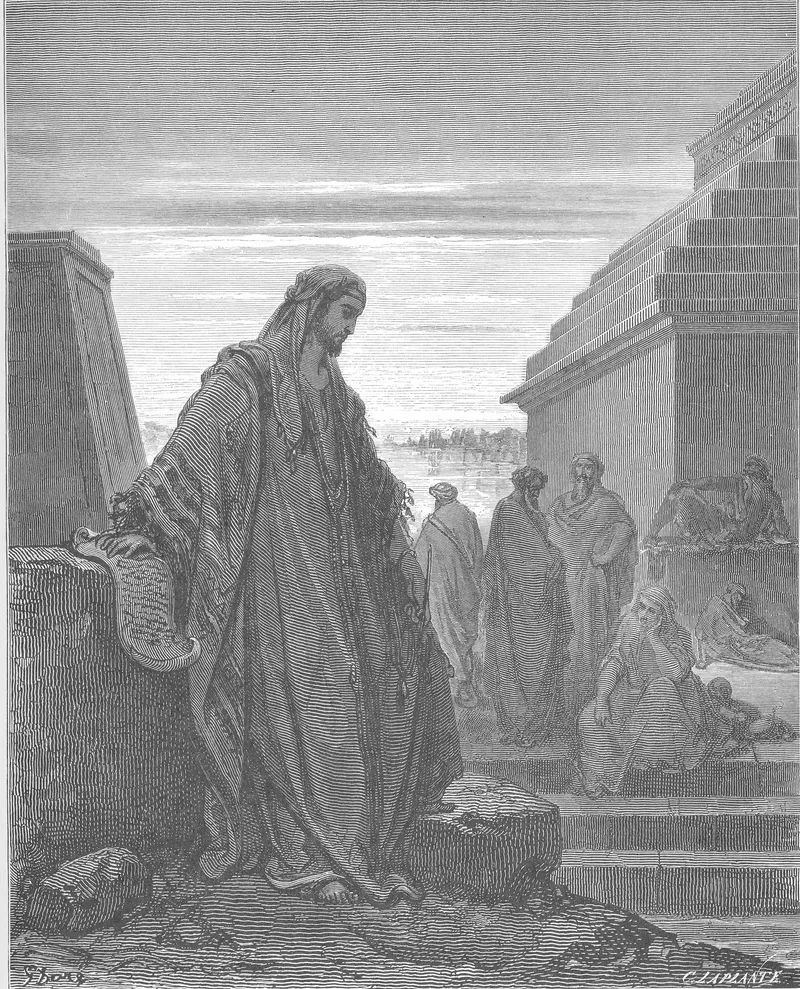
Jeremiah 45:1-3I Fainted in My Sighing, and I Find No Rest
1The word that Jeremiah the prophet spake unto Baruch the son of Neriah, when he had written these words in a book at the mouth of Jeremiah, in the fourth year of Jehoiakim the son of Josiah king of Judah, saying, 2Thus saith the LORD, the God of Israel, unto thee, O Baruch: 3Thou didst say, Woe is me now! for the LORD hath added grief to my sorrow; I fainted in my sighing, and I find no rest.
The chapter opens by telling us exactly when and to whom it was spoken: The word that Jeremiah the prophet spake unto Baruch the son of Neriah, when he had written these words in a book… in the fourth year of Jehoiakim (v. 1). That date is the key to the whole chapter. The fourth year of Jehoiakim is the year of the scroll - the year Jeremiah dictated and Baruch wrote down the words of the LORD in a book, the scroll a king would later slash with a penknife and throw in the fire, only for Baruch to write it all over again.
So this word reaches Baruch at the start of a long, costly labour, with the worst still ahead. And then comes a line easy to read past but tender to dwell on: Thus saith the LORD, the God of Israel, unto thee, O Baruch (v. 2). The God who speaks to nations and topples kings here addresses a single scribe by name. Most of the book is aimed at a whole people; this one short word is aimed at one man.
Before God says anything else, He makes it personal: unto thee, O Baruch.1
Then God repeats back to Baruch the very words Baruch had been saying to himself: Thou didst say, Woe is me now! for the LORD hath added grief to my sorrow; I fainted in my sighing, and I find no rest (v. 3). Notice the honesty God allows. This is a faithful man, a man who has given years to the word of the LORD - and he is at the end of himself. Woe is me now is the cry of someone who cannot see how to go on.
Grief added to sorrow describes pain piling on pain, with no relief between the blows. I fainted in my sighing - he has sighed so long and so deep that the very sighing has worn him out; the strength has drained out of him. And the last phrase is the loneliest: I find no rest. He is looking for rest and there is none anywhere. Anyone who has labored at something hard and thankless, who has watched good work seem to come to nothing, knows this exact place.
What matters is that the Bible records it. The breaking point of a background man - a scribe most would never give a second thought - is written down because God heard it. The complaint is not hidden or scolded; it is named, and answered.
It is worth asking why Baruch is so spent, because the answer shapes everything God says next. Baruch is weary from faithfulness. He has tied his life to a message the nation refuses to hear. He has written words that brought him mockery, danger, and the slow grief of watching a doomed people stumble toward their ruin exactly as the LORD said they would. There is a particular exhaustion that comes from serving God in a season of decline - from pouring yourself into work that, by every visible measure, is failing.
Baruch had likely hoped his service would lead somewhere: recognition, security, a settled future, a sense that it had all been worth it. Instead the world he served in is coming apart. His grief is real, and God treats it as real. But hidden inside that grief, God sees something Baruch may not yet see in himself - an expectation that faithful service ought to purchase a great life. It is that hidden hope God will gently expose in the next two verses, to set him free from a weight he was never meant to carry.
Jeremiah 45:4-5Seekest Thou Great Things for Thyself? Seek Them Not
4Thus shalt thou say unto him, The LORD saith thus; Behold, that which I have built will I break down, and that which I have planted I will pluck up, even this whole land. 5And seekest thou great things for thyself? seek them not: for, behold, I will bring evil upon all flesh, saith the LORD: but thy life will I give unto thee for a prey in all places whither thou goest.
God's answer opens with the whole world Baruch is standing in: Behold, that which I have built will I break down, and that which I have planted I will pluck up, even this whole land (v. 4). Before God speaks to the man's private grief, He sets it inside a far larger grief - His own. The verbs are deliberate: God built, and now God breaks down; God planted, and now God plucks up.
These are the very words spoken over Jeremiah at his call, when the LORD set him to root out, and to pull down… to build, and to plant (Jer. 1:10) - and here the tearing-down side has come due. And the One doing it is the One who first did the building and planting. The ruin is the sorrowful, sovereign act of the God who made the nation and is now, in justice, unmaking it.
The point for Baruch is severe and freeing at once: the collapse he is grieving is a part of God's plan, not its undoing. He is living through an hour when God Himself is pulling down what God Himself built. In such an hour, the question of what one man can secure for himself shrinks to almost nothing.
Now the question that is the heart of the chapter: And seekest thou great things for thyself? seek them not (v. 5). With great gentleness, God names what Baruch has not quite admitted - that beneath the weariness lies a hope for great things for thyself. Understandable things - a reward for faithful service, some honor, some security, some sense that his labour would carry him to a settled and significant place. But God says: seek them not. The word is a word about timing and proportion. When God is pulling down a whole land, the pursuit of personal greatness in its ruins is both futile and beside the point.
There is something here that searches every reader. We carry quiet ledgers of what our faithfulness ought to earn us - recognition, comfort, a life that finally feels like it was worth it. God's word redirects that longing rather than crushing it. Seek them not, He says, because the great thing Baruch is reaching for is not the thing worth having. There is a better gift coming, and it is named in the next breath.
The same verse that takes the great things away holds out the true gift: for, behold, I will bring evil upon all flesh, saith the LORD: but thy life will I give unto thee for a prey in all places whither thou goest (v. 5). God is plain about the disaster - evil, that is, calamity and ruin, is coming upon all flesh, and Baruch will not be exempt from the upheaval. He will be carried into the chaos with everyone else.
But in the middle of it, one thing is promised him: thy life will I give unto thee for a prey. The image is from the battlefield. A prey is plunder - the spoil a soldier snatches up and carries off as the only thing he keeps when everything else is destroyed. So God promises Baruch his very life as the prize he will carry out of the wreck, in all places whither thou goest. Life itself - preserved, given, escorted through every place the collapse drives him.
It is a deliberately modest promise, and that is its mercy. God strips away the dream of greatness and offers something Baruch can actually keep: he will come through alive, and his survival will be a gift from the hand of God, plunder rescued from the fire.
Research trail
Sources & further study
These references support the historical, linguistic, manuscript, and contextual notes in this chapter. Scripture remains the primary text; external sources are provided so readers can inspect the research directly.
- Jeremiah 45 - Translators' NotesThe NET Bible's detailed footnotes on Jeremiah 45 - the date in the fourth year of Jehoiakim and its link to the scroll of chapter 36 (v. 1), the force of Baruch's lament about grief and weariness (v. 3), the meaning of the command not to seek “great things” (v. 5), and the idiom of a life given “for a prey” as survival rescued from disaster.
- Jeremiah 45 · Hebrew + classical Jewish commentaryThe Hebrew text of Jeremiah 45 with Rashi, Radak, and other classical commentators side by side - useful for gedolot (v. 5, the “great things” Baruch is told not to seek), for shalal (v. 5, “for a prey,” the word for spoil carried off from a battle), and for the place of this private word to Baruch within the book's larger structure.
- Jeremiah 45 ↔ Matthew 6 · Mark 8 · Luke 10 · Philippians 3Traces the threads tying Jeremiah 45 to the rest of Scripture - seekest thou great things for thyself? seek them not (v. 5) read beside seek ye first the kingdom of God (Matt. 6:33) and what shall it profit a man, if he shall gain the whole world (Mark 8:36), and thy life… for a prey (v. 5) read alongside the one thing needful (Luke 10:42) and the believer who counts all things loss to gain Christ (Phil. 3:8).
Where this echoes in Scripture
I Fainted in My Sighing, and I Find No Rest
- Jeremiah 36:4Then Jeremiah called Baruch... and Baruch wrote from the mouth of Jeremiah all the words of the LORD... upon a roll of a book.The scroll of verse 1 - the costly work in the fourth year of Jehoiakim that lies behind Baruch's weariness.
- Genesis 16:13Thou God seest me: for she said, Have I not also here looked after him that seeth me?The God who notices the overlooked one - the same care that names Baruch in verse 2.
- Psalm 56:8thou tellest my wanderings: put thou my tears into thy bottle: are they not in thy book?A servant's sorrows counted and kept - as God hears Baruch's sighing in verse 3.
- Matthew 11:28Come unto me, all ye that labour and are heavy laden, and I will give you rest.The rest Baruch cannot find (v. 3) held out by the One who calls the weary.
- 1 Kings 19:4It is enough; now, O LORD, take away my life; for I am not better than my fathers.Elijah's exhaustion after faithful service - the same breaking point as Baruch's in verse 3.
Seekest Thou Great Things for Thyself? Seek Them Not
- Jeremiah 1:10I have this day set thee over the nations... to root out, and to pull down... to build, and to plant.The same verbs as verse 4 - building and planting, breaking down and plucking up, now coming due over the land.
- Matthew 6:33But seek ye first the kingdom of God, and his righteousness; and all these things shall be added unto you.The reordering Baruch is taught in verse 5 - God's kingdom sought first, the self's great things set down.
- Mark 8:36For what shall it profit a man, if he shall gain the whole world, and lose his own soul?The question behind verse 5 - the great things weighed against the one life God preserves.
- Philippians 3:8I count all things but loss for the excellency of the knowledge of Christ Jesus my Lord.The trade Baruch is asked to make (v. 5) - great things let go, the one thing worth having gained.
- Luke 10:42But one thing is needful: and Mary hath chosen that good part, which shall not be taken away from her.The single thing left when the great things fall away (v. 5) - the part that cannot be taken.