Job 5
People in this chapter
Eliphaz brings his first long answer to Job to its close, and he closes it the way the wise of the ancient world closed an argument - by appealing to what everyone supposedly knows. He opens with a challenge: Call now, if there be any that will answer thee; and to which of the saints wilt thou turn? No one will take Job's side, he implies; heaven itself is against him. Then he lays down what he takes to be a law of the world - that wrath killeth the foolish man, and envy slayeth the silly one, that the fool takes root only to be suddenly cursed.
Suffering, in his account, is never random; it grows from a cause, and the cause is sin.1
Tap any highlighted phrase to jump to the commentary that unpacks it.
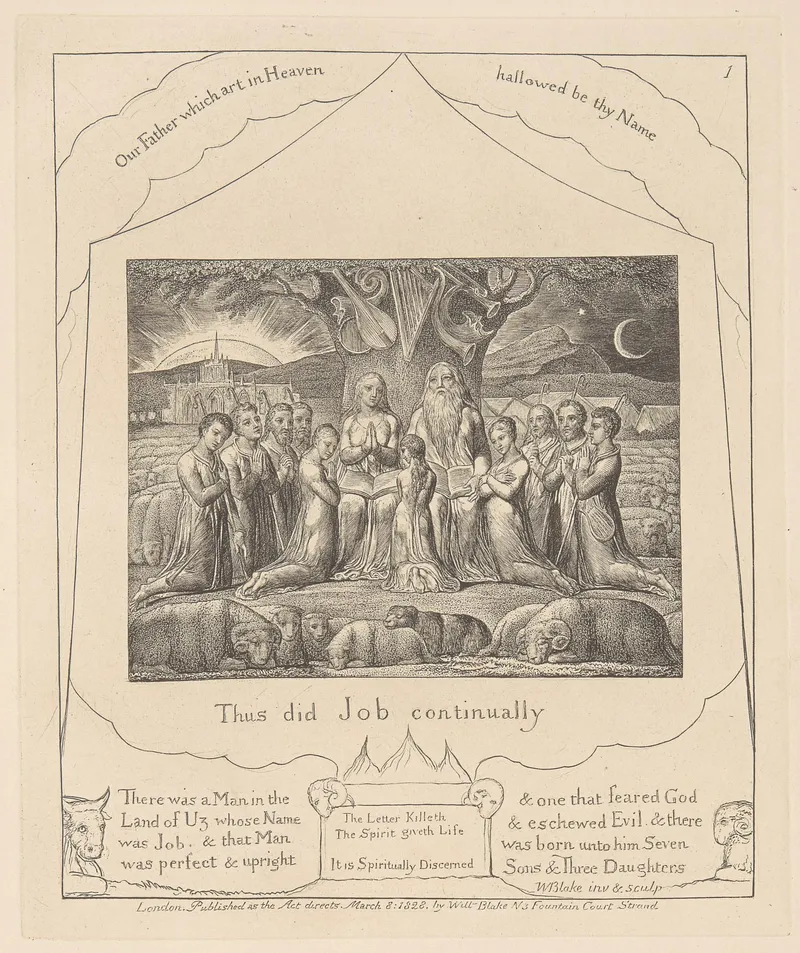
Job 5:1-7Man Is Born unto Trouble
1Call now, if there be any that will answer thee; and to which of the saints wilt thou turn? 2For wrath killeth the foolish man, and envy slayeth the silly one. 3I have seen the foolish taking root: but suddenly I cursed his habitation. 4His children are far from safety, and they are crushed in the gate, neither is there any to deliver them. 5Whose harvest the hungry eateth up, and taketh it even out of the thorns, and the robber swalloweth up their substance. 6Although affliction cometh not forth of the dust, neither doth trouble spring out of the ground; 7Yet man is born unto trouble, as the sparks fly upward.
Eliphaz opens his closing argument with a challenge that is meant to leave Job alone in the universe: Call now, if there be any that will answer thee; and to which of the saints wilt thou turn? The implication is brutal beneath its calm - no one in heaven or earth will take Job's side, because Job's case is indefensible. Then Eliphaz states what he takes to be a settled law of the world: For wrath killeth the foolish man, and envy slayeth the silly one.1 There is real observation here, and we should not pretend otherwise.
Anger and envy are corrosive; they do consume the people who nurse them; a life ruled by resentment often does collapse in on itself. Eliphaz is not inventing nonsense. But notice the move he is making underneath the proverb. He is not merely describing how fools come to ruin; he is building a frame into which he can fit Job. If ruin belongs to the foolish, and Job is ruined, then the conclusion is already waiting at the end of the sentence - before Eliphaz has looked once at the man in front of him.
Eliphaz presses the picture further, and it grows harsh: His children are far from safety, and they are crushed in the gate, neither is there any to deliver them. The gate of an ancient city was the place where justice was rendered, where elders sat and cases were heard.2 To be crushed in the gate is to be destroyed in the very place where one should have found protection - condemned, undefended, with no one to plead the cause.
And the harvest of the fool, Eliphaz adds, is eaten up by the hungry and swallowed by robbers; everything he gathered is stripped away. The cruelty of this in Job's hearing is almost unbearable, for Job has just lost all ten of his children and the whole of his wealth (Job 1). Eliphaz speaks of a fool's children destroyed and a fool's substance plundered as though describing a general principle - but Job is sitting in the ashes of exactly that loss.
Whether Eliphaz means the cut or simply does not feel it, the effect is the same: the bereaved father is being handed, as abstract wisdom, a portrait of his own grief.
Then Eliphaz lays his foundation stone: Although affliction cometh not forth of the dust, neither doth trouble spring out of the ground. The point is that suffering is not a weed that grows by itself out of the bare earth. It does not arise from nowhere; it is not blind, random, causeless. There is truth in this, and it matters - the book of Job is itself a refusal to believe that the world is mere chaos, that what happens to us is meaningless accident.
But watch how Eliphaz uses the truth. For him, “affliction has a cause” collapses immediately into “affliction has a moral cause in the sufferer” - that wherever there is pain, there must be, behind it, a sin that earned it. The reader, though, has been let in on a cause Eliphaz never imagines: the affliction did not spring out of the ground, true - but neither did it spring out of Job's guilt. It came from a contest in heaven over whether a man would love God for nothing.
The trouble has a cause. It is simply not the cause Eliphaz is so sure of.
And then comes the line that outlives the argument it was meant to serve: Yet man is born unto trouble, as the sparks fly upward. It is one of the most piercing images in all of Scripture. As surely as sparks rise from a fire - by the very nature of flame, they cannot do otherwise - so surely does trouble belong to the nature of being human.1 Sorrow is woven into the human condition.
This is true, and deeply so; saints and sinners alike are born to it. Yet the tragedy of Eliphaz is laid bare precisely here. He has just said something that should have softened every word he speaks to Job - trouble is the common inheritance of all flesh; you are not strange, you are not singled out, you are simply human - and instead he uses it to sharpen the knife. If all are born to trouble, he reasons, then Job's extraordinary trouble must point to extraordinary sin.
A truth that could have seated him beside his friend in the ashes becomes, in his hands, the reason to keep standing over him.
Job 5:8-16I Would Seek unto God
8I would seek unto God, and unto God would I commit my cause: 9Which doeth great things and unsearchable; marvellous things without number: 10Who giveth rain upon the earth, and sendeth waters upon the fields: 11To set up on high those that be low; that those which mourn may be exalted to safety. 12He disappointeth the devices of the crafty, so that their hands cannot perform their enterprise. 13He taketh the wise in their own craftiness: and the counsel of the froward is carried headlong. 14They meet with darkness in the day time, and grope in the noonday as in the night. 15But he saveth the poor from the sword, from their mouth, and from the hand of the mighty. 16So the poor hath hope, and iniquity stoppeth her mouth.
The tone lifts. Eliphaz turns from the ruin of the fool to what he himself would do: I would seek unto God, and unto God would I commit my cause. This is sincere and, on its own terms, excellent counsel. To bring your case to God, to lay your complaint before the throne of heaven and leave it there - this is the very posture the Psalms commend and the very thing the righteous are called to do.
If the advice could be lifted clean out of its setting, it would be hard to improve on. The ache of it is that Eliphaz seems unable to imagine that Job has already done this - that Job has cried out to God again and again and met only silence. Eliphaz offers seeking God as though it were a door Job has refused to open, when in truth Job has been pounding on that door through every speech.
The counsel is right; the assumption beneath it - that Job has not yet turned to God - is simply not true.
Eliphaz catalogues the goodness of God, and the catalogue is genuinely lovely. Who giveth rain upon the earth, and sendeth waters upon the fields.2 In a land where rain was never guaranteed and a failed season meant famine, to name God as the giver of rain was to confess Him the sustainer of all life - the One on whom every harvest and every household utterly depends. There is nothing wrong with a single word of it; it is the kind of thing a grateful believer of any age would say.
The catalogue keeps its truth all the way through. The trouble, again, is never in the content but in the use: Eliphaz is reciting the kindness of God to a man who has just watched that kindness, as far as he can tell, be torn out of his life - and reciting it as the prelude to an argument that Job must repent to get it back.
And the goodness rises to its height: God set[s] up on high those that be low; that those which mourn may be exalted to safety. This is the great reversal that the whole Bible sings - the lowly lifted, the mourners brought into safety, the God who does not leave the broken on the ground. It is the music of Hannah's song and Mary's, the heartbeat of the gospel itself. Every syllable is true.
And yet, said to Job, it lands with a strange cruelty Eliphaz does not seem to register: here is a man low as a man can be, a man in the deepest mourning, and Eliphaz holds up the promise that God exalts such people - with the unspoken sting that Job has not been exalted, and therefore has only himself to blame. A promise that should have been pure comfort becomes, by its placement, one more quiet accusation: if God lifts the lowly and you are still in the dust, what does that say about you?
Job 5:17-27Happy Is the Man Whom God Correcteth
17Behold, happy is the man whom God correcteth: therefore despise not thou the chastening of the Almighty: 18For he maketh sore, and bindeth up: he woundeth, and his hands make whole. 19He shall deliver thee in six troubles: yea, in seven there shall no evil touch thee. 20In famine he shall redeem thee from death: and in war from the power of the sword. 21Thou shalt be hid from the scourge of the tongue: neither shalt thou be afraid of destruction when it cometh.
22At destruction and famine thou shalt laugh: neither shalt thou be afraid of the beasts of the earth. 23For thou shalt be in league with the stones of the field: and the beasts of the field shall be at peace with thee. 24And thou shalt know that thy tabernacle shall be in peace; and thou shalt visit thy habitation, and shalt not sin. 25Thou shalt know also that thy seed shall be great, and thine offspring as the grass of the earth. 26Thou shalt come to thy grave in a full age, like as a shock of corn cometh in in his season. 27Lo this, we have searched it, so it is; hear it, and know thou it for thy good.
Having stated the principle, Eliphaz spreads out its promised reward, and the promises are sweeping: He shall deliver thee in six troubles: yea, in seven there shall no evil touch thee. Six, and then seven - a way of saying however many troubles come, and one more besides. He names them: famine, war, the scourge of the tongue, destruction, the beasts of the earth. The dangers are real and acknowledged; Eliphaz does not pretend the world is safe.
His claim is that the man God corrects, once he has accepted the discipline, will be carried through every one of them untouched - that the righteous, rightly chastened, are sealed against harm. There is a thread of truth woven through this too; Scripture does speak of God as the refuge of His people. But the promise is being held out on a condition Eliphaz has smuggled in: that Job is presently under deserved discipline, and that confession and acceptance will unlock the protection.
The blessings are dangled as the reward of an admission Job has nothing to admit. And Job, sitting covered in sores with his children buried, is being told that no evil shall touch the man God is dealing with - while every evil has already touched him.
The vision of restoration grows almost idyllic: thou shalt be in league with the stones of the field: and the beasts of the field shall be at peace with thee.1 It is a picture of a world made friendly - even the stones that break a plough and the wild beasts that threaten a flock are imagined at peace with the blessed man, his fields fruitful and his herds secure. Then the blessings come home to the household: thou shalt know that thy tabernacle shall be in peace; and thou shalt visit thy habitation, and shalt not sin. Tent and home and family settled, secure, untroubled.
The picture is beautiful, and not in itself untrue - it echoes the peace Scripture does promise the people of God. But every line of it is calculated to show Job exactly what he has lost and to imply he can earn it back by repenting. His tent is not in peace; his household is destroyed. The serene picture functions less as comfort than as a measuring-rod held against his ruin: this is what the corrected man enjoys; you do not enjoy it; draw your own conclusion.
Eliphaz crowns the promise with an image of a good death: Thou shalt come to thy grave in a full age, like as a shock of corn cometh in in his season.2 The grain is not cut down green and early; it ripens to its appointed time and is gathered in with honor at the harvest. To die in a full age, like ripened corn brought into the barn at its proper season, is to die fulfilled, complete, having lived out the full span - the very picture of a blessed life rounded off in peace.
It is, in fact, close to how the book itself will describe Job's eventual end: Job died, being old and full of days (Job 42:17). But Eliphaz offers it as a transaction - repent, and this ripe old age is yours. And then he closes his whole case with the sentence that gives the speech away: Lo this, we have searched it, so it is; hear it, and know thou it for thy good. He claims to have searched out the matter, examined it thoroughly, reached a settled verdict - and he commands Job to receive it.
The certainty is the very thing the book will dismantle. Eliphaz has searched, but he has not searched far enough to question his own assumption, and so his confident so it is turns out to be exactly what God will overturn.
Research trail
Sources & further study
These references support the historical, linguistic, manuscript, and contextual notes in this chapter. Scripture remains the primary text; external sources are provided so readers can inspect the research directly.
- Job 5 - Translators' NotesThe NET Bible's detailed footnotes on Job 5 - the proverb behind man is born unto trouble, as the sparks fly upward (v. 7), the difficult idiom of being in league with the stones of the field (v. 23), and the agricultural image of the shock of corn gathered in its season (v. 26).
- Art of the Ancient Near East · Heilbrunn TimelineThe Met's survey of the world behind the book of Job - the threshing floor and the gathered grain that lie behind the shock of corn of verse 26, the city gate where judgment was rendered and the fool's children are crushed in verse 4, and the agrarian dependence on rain (v. 10) that made the giving of water the plainest emblem of a sustaining God.
- Job 5 · Hebrew + classical Jewish commentaryThe Hebrew text of Job 5 with Rashi, Ibn Ezra, and other classical commentators side by side - useful for musar (v. 17, the “chastening” of the Almighty), for the wordplay between wounding and healing in verse 18, and for the long discussion of whether Eliphaz's counsel, however true in itself, fits Job's case at all.
- Job 5 ↔ Hebrews 12 · Proverbs 3 · 1 Corinthians 3 · Hosea 6Traces the threads tying Eliphaz's words to the rest of Scripture - happy is the man whom God correcteth (v. 17) to whom the Lord loveth he chasteneth (Heb. 12:6; Prov. 3:11-12), he taketh the wise in their own craftiness (v. 13) quoted by Paul (1 Cor. 3:19), and he woundeth, and his hands make whole (v. 18) to he hath torn, and he will heal us (Hos. 6:1).
Where this echoes in Scripture
Man Is Born unto Trouble
- Job 1:21The LORD gave, and the LORD hath taken away; blessed be the name of the LORD.The loss Eliphaz turns into evidence of guilt - loss Job had already received from God's hand without sin.
- Ecclesiastes 2:23For all his days are sorrows, and his travail grief; yea, his heart taketh not rest in the night.The same 'amal - the toil and sorrow woven into mortal life that verse 7 names.
- John 9:2-3Master, who did sin, this man, or his parents…? Neither hath this man sinned, nor his parents.The disciples reason like Eliphaz - suffering must mean sin; the Lord Jesus refuses the equation.
- Luke 13:4-5Think ye that they were sinners above all men…? I tell you, Nay.Christ rejects the assumption that calamity measures guilt - the very assumption driving Eliphaz's speech.
I Would Seek unto God
- 1 Corinthians 3:19For the wisdom of this world is foolishness with God. For it is written, He taketh the wise in their own craftiness.Paul quotes Job 5:13 as Scripture - the true principle, even though Eliphaz misapplies it to Job.
- 1 Samuel 2:7-8The LORD maketh poor, and maketh rich… he raiseth up the poor out of the dust.Hannah's song of the great reversal - the lowly lifted, the very promise Eliphaz recites in verse 11.
- Psalm 145:3Great is the LORD, and greatly to be praised; and his greatness is unsearchable.The unsearchable greatness Eliphaz praises - the very thing that should have humbled his certainty about Job.
- Job 42:8My servant Job shall pray for you: for him will I accept.Where Eliphaz's certainty leads - the confident counselor needing the prayer of the man he condemned.
Happy Is the Man Whom God Correcteth
- Hebrews 12:6For whom the Lord loveth he chasteneth, and scourgeth every son whom he receiveth.The true principle Eliphaz states in verse 17 - God's discipline as a Father's love, taken up by the New Testament.
- Proverbs 3:11-12My son, despise not the chastening of the LORD… for whom the LORD loveth he correcteth.The same word and idea as verse 17 - musar, the loving correction of a delighted-in son.
- Hosea 6:1For he hath torn, and he will heal us; he hath smitten, and he will bind us up.The wounding-and-healing of verse 18 - the God whose tearing hand is the hand that heals.
- Isaiah 53:5He was wounded for our transgressions… and with his stripes we are healed.The wound that fell on the innocent - pain that was never the proof of guilt, but the source of healing.