Wisdom of Solomon 18
People in this chapter
There are nights a people never forgets. For Israel it was the night of the Passover, the night the angel of death passed through Egypt and the slaves of Pharaoh walked out free by morning. The Wisdom of Solomon returns to that night and meditates on it as a single great act of God with two faces. To Israel it gave a very great light, a pillar of fire to guide them through country they had never seen.
To Egypt the same hour gave darkness and a multitude of dead. The author keeps holding the two together, because they are not two events but one: the deliverance of the just and the judgment of the unjust are the same midnight seen from opposite sides.
Tap any highlighted phrase to jump to the commentary that unpacks it.
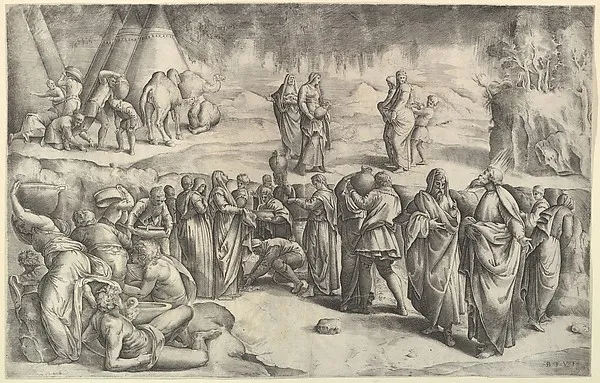
Wisdom of Solomon 18:1-4A Very Great Light, and a Worthy Darkness
1But thy saints had a very great light, and they heard their voice indeed, but did not see their shape. And because they also did not suffer the same things, they glorified thee:
The chapter opens by setting two experiences of the same night side by side. While a thick darkness had fallen over Egypt in the ninth plague, God's people had "a very great light." The contrast is the whole point. One world is plunged into blindness; the other is filled with brightness, and the difference is not the night itself but whose people they are. Notice the response the light produces in them. They "glorified thee."
Deliverance does not make them proud; it makes them worshipful. The right answer to being spared is not to congratulate ourselves but to give glory to the One who spared us.
3Therefore they received a burning pillar of fire for a guide of the way which they knew not, and thou gavest them a harmless sun of a good entertainment. 4The others indeed were worthy to be deprived of light, and imprisoned in darkness, who kept thy children shut up, by whom the pure light of the law was to be given to the world.
The pillar of fire that led Israel by night becomes here a "harmless sun," a light that warms and guides without scorching. It shines on a road "which they knew not," and that detail matters for anyone facing an unknown future. God does not hand His people a map of the whole journey. He gives them light enough for the next step, a fire moving ahead of them in the dark. The way is unknown to them, but it is not unknown to the One who goes before.
The chapter gives a reason the darkness fell where it did. Egypt had "kept thy children shut up," imprisoning the very people through whom "the pure light of the law was to be given to the world." There is a quiet largeness in that phrase. Israel was rescued not only for Israel's sake but so that through them the light of God's law might reach the whole world. To imprison that people in darkness was to fight against the light God intended for everyone, and the judgment fits the crime: those who shut others up in bondage are themselves shut up in night.
Wisdom of Solomon 18:5-9The Night Known Beforehand, and the Courage It Gave
5And whereas they thought to kill the babes of the just, one child being cast forth, and saved, to reprove them, thou tookest away a multitude of their children, and destroyedst them all together in a mighty water.
The chapter reaches back to the beginning of the story. Pharaoh "thought to kill the babes of the just," ordering the Hebrew infants drowned in the Nile. Yet "one child being cast forth, and saved" became the very instrument of Egypt's undoing. That one child is Moses, set adrift on the river meant to kill him and drawn out alive. There is a pattern of God here worth holding onto. The plan to destroy a whole generation was overturned by the survival of a single saved child.
What the powerful meant for death, God turned into the seed of deliverance.
6For that night was known before by our fathers, that assuredly knowing what oaths they had trusted to, they might be of better courage. 7So thy people received the salvation of the just, and destruction of the unjust.
The night of deliverance was "known before by our fathers." God did not spring the Exodus on His people as a surprise; He told them in advance what He would do, so that "knowing what oaths they had trusted to, they might be of better courage." This is how faith works under pressure. Their courage that night did not rest on what they could see, which was a country at war and an army behind them.
It rested on a promise given beforehand and an oath they had trusted. The God who tells His people what He intends to do gives them something to stand on when the night is darkest.
In one tight phrase the chapter names the double edge of that night: "the salvation of the just, and destruction of the unjust." The same event saved one people and judged another. Throughout this book the author insists these are not two unrelated acts of God but a single movement seen from two sides. The hour that delivers the oppressed is the same hour that confronts the oppressor. We tend to want a God who only saves and never judges, but Scripture keeps tying the two together.
The salvation of the wronged and the undoing of the wrong are bound up in one another.
9For the just children of good men were offering sacrifice secretly, and they unanimously ordered a law of justice: that the just should receive both good and evil alike, singing now the praises of the fathers.
While Egypt slept toward catastrophe, Israel kept the first Passover, "offering sacrifice secretly" and "singing now the praises of the fathers." Picture it: on the most dangerous night of their lives, the people gather not in panic but in worship, binding themselves together in covenant and lifting the songs of their ancestors. They pledge to "receive both good and evil alike," to share one another's lot whatever comes. This is what a people of faith does on the eve of deliverance.
They do not wait until the danger passes to give thanks. They worship into the dark, trusting the promise more than the threat.
Wisdom of Solomon 18:10-13One Kind of Death, and the Knowledge It Forced
11And the servant suffered the same punishment as the master, and a common man suffered in like manner as the king. 12So all alike had innumerable dead, with one kind of death. Neither were the living sufficient to bury them; for in one moment the noblest offspring of them was destroyed.
The judgment fell without regard for rank. "The servant suffered the same punishment as the master," the common man like the king. Egypt was a society built on steep hierarchy, from Pharaoh at the top down to the lowest slave, but death that night leveled every distinction. The grave does not check a person's station. This is a sobering truth that runs through all of Scripture: the powerful and the powerless stand alike before God, and no throne exempts its occupant from the reckoning every human being must finally meet.
The scale of the loss is staggering. "In one moment the noblest offspring of them was destroyed," so many at once that "the living were not sufficient to bury them." The chapter does not gloat over this; it lets the weight of it land. There is no triumphant cheer here, only the picture of a nation overwhelmed by grief in a single hour. Even as Scripture affirms that judgment is just, it does not treat the death of the wicked as a small thing.
The God who does not delight in destruction is at work even in judgment, and the right response is sobriety, not celebration.
13For whereas they would not believe any thing before by reason of the enchantments, then first upon the destruction of the firstborn, they acknowledged the people to be of God.
Through plague after plague the Egyptians "would not believe," trusting their enchantments and hardening their hearts against every sign. Only now, in the worst of all losses, do they at last acknowledge "the people to be of God." It is a tragic kind of faith, the recognition that comes too late, forced out by catastrophe rather than offered freely. There is a warning folded into this for anyone who keeps putting God off, waiting for undeniable proof.
Hearts that refuse the gentle signs may finally be convinced only by sorrow. Far better to acknowledge God before the night of loss than to be compelled by it.
Wisdom of Solomon 18:14-19The Almighty Word Leapt Down from Heaven
14For while all things were in quiet silence, and the night was in the midst of her course, 15Thy almighty word leapt down from heaven from thy royal throne, as a fierce conqueror into the midst of the land of destruction.
The chapter slows almost to a hush. "While all things were in quiet silence, and the night was in the midst of her course." Everything is still; the world has gone quiet at the exact center of the night. Into that profound silence the great act of God breaks. There is a deep truth in this setting. God's most decisive works often come not in the noise of day but in the deep stillness, when human strength has run out and the world has nothing left to say.
The silence is not emptiness. It is the held breath before God moves.
Then the line that has echoed through the ages: "Thy almighty word leapt down from heaven from thy royal throne, as a fierce conqueror." God's word is spoken of here as something living and active, descending from the throne with the force of a warrior. In the Exodus story it is the Lord Himself who strikes Egypt at midnight, and the author renders that act as the descent of God's almighty word, leaping down to do His will.
Scripture speaks again and again of God's word as alive and powerful, going out from Him to accomplish exactly what He sends it to do, never returning empty. Here that word comes down into the night as deliverance for the just and judgment for the proud.
16With a sharp sword carrying thy unfeigned commandment, and he stood and filled all things with death, and standing on the earth reached even to heaven.
The image grows immense. The word bears "a sharp sword" carrying God's "unfeigned commandment," His sincere and unbending decree, and "standing on the earth reached even to heaven." It spans the whole distance between earth and sky, a figure too vast for any earthly power to resist. The sword and the commandment belong together: this is judgment by the spoken will of God, not by chance or brute force. When God's word goes out to do justice, no army can stand against it, because it is not finally a weapon of metal but the living command of the One who made heaven and earth.
19For the visions that troubled them foreshewed these things, lest they should perish and not know why they suffered these evils.
Even in judgment there is a strange mercy. The Egyptians were troubled by "visions of evil dreams" that "foreshewed these things," so that they might not "perish and not know why" they suffered. God does not strike blindly or leave His reasons hidden. Even those under His judgment are given to understand that this is no accident, that there is a moral order behind what befalls them. To suffer without knowing why is its own kind of darkness.
That God lets even the judged see the cause is a sign that He is not capricious, that His justice has a reason a conscience can read.
Wisdom of Solomon 18:20-25The Blameless Man Who Stood Between the Living and the Dead
20But the just also were afterwards touched by an assault of death, and there was a disturbance of the multitude in the wilderness: but thy wrath did not long continue. 21For a blameless man made haste to pray for the people, bringing forth the shield of his ministry, prayer, and by incense making supplication, withstood the wrath, and put an end to the calamity, shewing that he was thy servant.
The chapter makes a turn that keeps it honest. The same plague-judgment that fell on Egypt later touched Israel itself, "in the wilderness," when wrath broke out among the very people who had been delivered. Deliverance from Egypt did not make Israel immune to their own failures. The God who saved them was not a tribal favorite who would overlook anything; the rescued people still had to walk in His ways. This is a sober and important note.
Being among the saved is not a license. The God who delivers is the God who calls His people to live as those who have been delivered.
Into that outbreak of wrath steps "a blameless man," Aaron the priest, who "made haste to pray for the people." His weapon is named in a striking phrase: "the shield of his ministry, prayer." He runs toward the danger, not away from it, carrying incense and supplication. There is a whole theology of intercession in that image. The one who stands before God on behalf of others does not fight wrath with force; he fights it with prayer, which is here a shield raised over an endangered people.
When others were perishing, one man's urgent intercession became the protection that turned the calamity back.
22And he overcame the disturbance, not by strength of body nor with force of arms, but with a word he subdued him that punished them, alleging the oaths and covenant made with the fathers. 23For when they were now fallen down dead by heaps one upon another, he stood between and stayed the assault, and cut off the way to the living.
Aaron prevails "not by strength of body nor with force of arms, but with a word." And the content of that word is telling: he overcomes "alleging the oaths and covenant made with the fathers." He does not plead the people's goodness, which would have been a poor argument in that moment, but God's own sworn covenant. This is how the great intercessors of Scripture pray. They hold God to His promises. They come not with the worthiness of the people but with the faithfulness of God, reminding Him of what He swore to do.
The word that turns back wrath is the word that pleads the covenant.
The picture is unforgettable. With the dead falling "by heaps one upon another," Aaron "stood between and stayed the assault, and cut off the way to the living." He plants himself in the gap, in the no-man's-land between those already fallen and those still alive, and there he holds. The intercessor stands in the breach, taking his place between judgment and the people, refusing to let the wrath pass through to those behind him.
Scripture treasures this kind of figure, the one who "stood in the gap" so that a people would not be destroyed. To stand between is to take the danger upon yourself for the sake of others.
24For in the priestly robe which he wore, was the whole world: and in the four rows of the stones the glory of the fathers was graven, and thy majesty was written upon the diadem of his head. 25And to these the destroyer gave place, and was afraid of them: for the proof only of wrath was enough.
The chapter pauses to describe what the intercessor wore. On the high priest's robe "was the whole world," on the four rows of stones "the glory of the fathers was graven," and on his diadem "thy majesty was written." The vestments are a portrait of his office. He carries the whole world, the names of the fathers, and the very majesty of God upon his body as he stands in the gap. The one who intercedes does not come on his own behalf alone; he comes bearing the people and bearing the name of God, a living bridge between the two.
Everything about his garments says that this is what a priest is for: to stand before God carrying others.
And the wrath relents. "To these the destroyer gave place, and was afraid: for the proof only of wrath was enough." God's purpose was never the annihilation of His people but their correction; once the warning had been made, the assault was halted at the body of one praying man. There is mercy written all through this ending. The wrath "did not long continue." A single intercessor was enough. The destroyer withdrew before the priest who stood in the gap pleading the covenant.
This is the heart of the chapter's hope: that judgment can be stayed, that one who stands between can turn it back, and that God is far more eager to spare than to destroy.
Where this echoes in Scripture
A Very Great Light, and a Worthy Darkness
- Exodus 13:21And the LORD went before them by day in a pillar of a cloud, to lead them the way; and by night in a pillar of fire, to give them light.The very pillar of fire this chapter remembers, guiding Israel on a road they did not know.
- Psalm 119:105Thy word is a lamp unto my feet, and a light unto my path.Light enough for the step in front of you, the way God leads through the dark.
- John 8:12I am the light of the world: he that followeth me shall not walk in darkness, but shall have the light of life.The pillar of fire foreshadows the Light who guides every people out of darkness.
The Night Known Beforehand, and the Courage It Gave
- Exodus 12:14And this day shall be unto you for a memorial; and ye shall keep it a feast to the LORD throughout your generations.The night made known beforehand, kept ever after as a memorial of deliverance.
- Exodus 2:3She took for him an ark of bulrushes... and put the child therein; and she laid it in the flags by the river’s brink.The one child cast forth and saved, drawn from the river meant to drown him.
- Acts 2:23Him, being delivered by the determinate counsel and foreknowledge of God, ye have taken... and slain.God’s great acts of deliverance are known beforehand, as the fathers knew that night.
One Kind of Death, and the Knowledge It Forced
- Exodus 12:30There was a great cry in Egypt; for there was not a house where there was not one dead.The mourning in every Egyptian house this chapter recalls, sparing no rank.
- Job 34:19How much less to him that... regardeth not the rich more than the poor? for they all are the work of his hands.Servant and king alike stand before God, who shows no partiality.
- Romans 14:11As I live, saith the Lord, every knee shall bow to me, and every tongue shall confess to God.Egypt acknowledged God too late; every knee will one day confess Him.
The Almighty Word Leapt Down from Heaven
- Isaiah 55:11So shall my word be that goeth forth out of my mouth: it shall not return unto me void, but it shall accomplish that which I please.God’s word goes out to do His will and never returns empty, as it does in this night.
- John 1:1In the beginning was the Word, and the Word was with God, and the Word was God.The almighty word from the throne reaches its fullness in the living Word of God.
- Hebrews 4:12For the word of God is quick, and powerful, and sharper than any twoedged sword.The word bearing a sharp sword, alive and piercing, exactly as this chapter sees it.
The Blameless Man Who Stood Between the Living and the Dead
- Numbers 16:48And he stood between the dead and the living; and the plague was stayed.The very scene this chapter retells: Aaron standing in the gap until the wrath relented.
- Ezekiel 22:30And I sought for a man among them, that should make up the hedge, and stand in the gap before me for the land.God looks for the one who will stand between judgment and the people, as Aaron did.
- Hebrews 7:25Wherefore he is able also to save them to the uttermost that come unto God by him, seeing he ever liveth to make intercession for them.The blameless intercessor finds his fullness in the High Priest who always lives to plead for us.