Painter of the Bible
Federico Zuccaro (Zuccari)
Federico Zuccaro — sometimes spelled Zuccari — was an Italian Late Mannerist painter and theorist of art whose career carried him from his native Marche through the major artistic centers of Italy and abroad to England, France, and Spain.

Their faith
Why Federico Zuccaro (Zuccari) painted Christ
Federico Zuccaro was a devout Christian whose faith deeply influenced his artistic endeavors. Born in the Marche region of Italy, he was trained in the rich tradition of sacred art alongside his brother Taddeo. Their collaborative works, particularly the magnificent fresco cycles in the Villa Farnese, reflect a profound reverence for biblical narratives and the divine. Zuccaro's commitment to his faith is evident not only in his choice of subjects but also in his dedication to elevating the spiritual experience of viewers through his art. His role as the first head of the Accademia di San Luca further underscores his belief in the transformative power of art, as he sought to inspire future generations of artists to pursue beauty and truth in their work, grounded in their faith.
Zuccaro's religious devotion is vividly expressed in several of his notable works. The altarpiece of the Adoration of the Shepherds showcases his ability to capture the sacred moment of Christ's birth, inviting viewers to reflect on the humility and wonder of the Nativity. Similarly, his frescoes in the Cathedral of Florence, particularly the Last Judgment, illustrate his understanding of the gravity of divine judgment and mercy. These works not only reveal his artistic skill but also his desire to communicate profound spiritual truths. Through his paintings, Zuccaro continues to inspire and uplift, reminding us of the beauty of faith and the importance of divine love in our lives.
Life & work
Federico Zuccaro — sometimes spelled Zuccari — was an Italian Late Mannerist painter and theorist of art whose career carried him from his native Marche through the major artistic centers of Italy and abroad to England, France, and Spain. Born in Sant'Angelo in Vado in the Marche in 1540 or 1541, trained alongside his older brother Taddeo Zuccaro (whose Roman workshop Federico inherited at Taddeo's early death in 1566), and active across Italy and Europe for the next forty years, he died in Ancona in 1609.
In Rome he and Taddeo together produced the great fresco cycles in the Villa Farnese at Caprarola for the Farnese family — biblical, classical, and dynastic narratives spread across multiple rooms — which remain the principal monument of mid-sixteenth-century Italian decorative painting. After Taddeo's death Federico continued the program and added his own commissions: the cupola frescoes of the Cathedral of Florence (the Last Judgment, completed 1579 after Vasari's earlier work), altarpieces for the Roman Gesù and the Trinità dei Monti, and major religious cycles in the chapels of Santa Maria del Popolo and Santa Caterina dei Funari.
He traveled north and west repeatedly. In England in 1574–1575 he produced portraits of Queen Elizabeth I and Mary, Queen of Scots that were widely engraved and shaped the iconography of the English late-Tudor court. In Spain in the 1580s he worked at the Escorial under Philip II's patronage, contributing altarpieces and ceiling decorations to the great Habsburg monastic-palace project. His religious altarpieces from the Spanish years — the Adoration of the Shepherds, the Annunciation, the Nativity — entered the royal Spanish collection and remain in the Prado and the Escorial.
He was equally significant as a theorist of art. His L'Idea de' Pittori, Scultori et Architetti (Turin, 1607) is one of the principal late-sixteenth-century Italian treatises on the philosophical foundations of artistic practice and remained in print and influential through the seventeenth century. He founded and was the first principe (head) of the Accademia di San Luca in Rome — the painters' academy that became the model for the European academy system that would dominate art education for the next two hundred years.
Notable works in detail
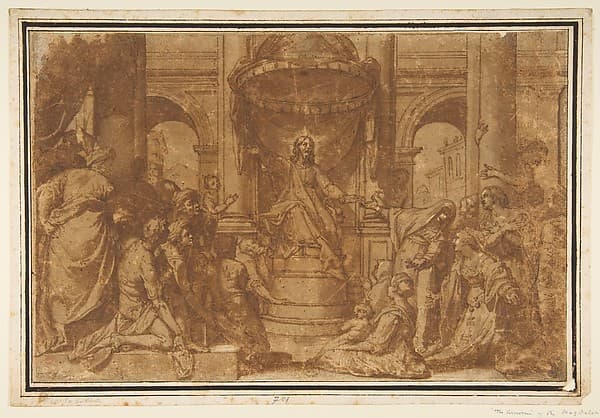
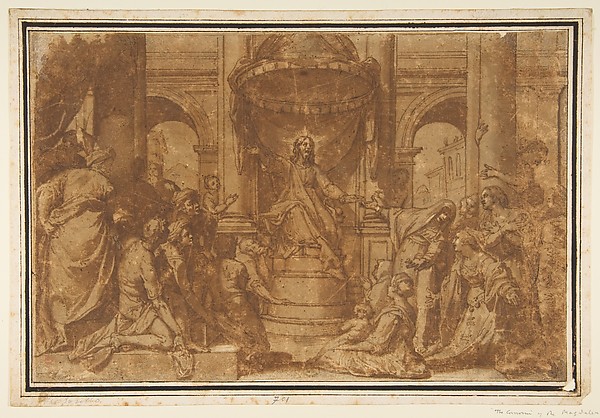
Christ Preaching, drawn by Federico Zuccaro around 1570 in pen and brown ink with brown wash on paper and now in the Metropolitan Museum of Art in New York, is a small preparatory drawing for one of his many painted preaching scenes. The drawing shows Christ standing on a small platform at the upper register addressing a crowd of seated and standing listeners spread across the foreground in postures of attentive listening. The drawing demonstrates Zuccaro's characteristic late-Mannerist compositional density and the rapid confident pen-and-wash technique that the Roman workshop tradition descending from his teacher Taddeo Zuccaro had refined to a high pitch of virtuosity. The sheet is among the principal Zuccaro drawings in any American collection.
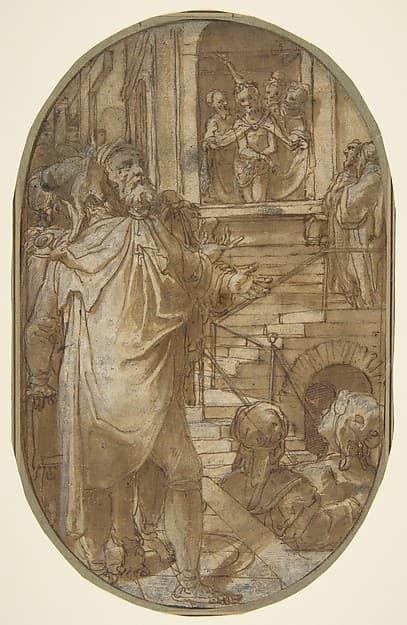
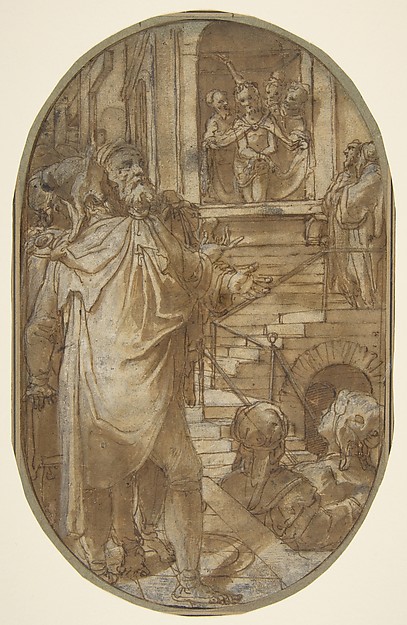
Ecce Homo, drawn by Federico Zuccaro around 1540 (early in his career, in the workshop he shared with his older brother Taddeo) in red chalk on paper and now in the Metropolitan Museum of Art in New York, depicts the moment from John 19 in which Pontius Pilate presents the scourged and crowned-with-thorns Christ to the assembled crowd with the Latin words Ecce Homo (Behold the man). The drawing shows Christ in three-quarter view at the center of the small composition, his hands bound at the wrists, the crown of thorns pressed down on his brow, with two Roman soldiers on either side. The drawing demonstrates the early Zuccaro draughtsmanship in the workshop he and his brother Taddeo ran in Rome through the 1550s and 1560s before Taddeo's early death in 1566 left Federico to direct the firm alone.
met-341646
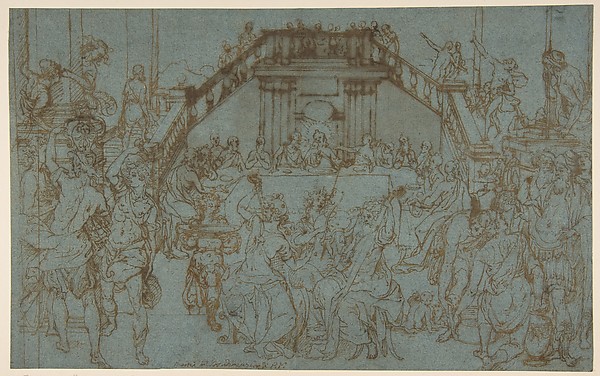
Paradise, drawn by Federico Zuccaro around 1565 in pen and brown ink with brown wash on paper and now in the Metropolitan Museum of Art in New York, is a small preparatory drawing for the great cupola fresco program of Florence Cathedral that Zuccaro completed between 1572 and 1579 after the death of Giorgio Vasari, who had begun the project. The drawing shows the celestial court of the blessed in heaven gathered around the central enthroned Christ in glory, with multiple registers of saints and angels disposed in the dome's curving spandrels. The cupola fresco — the Last Judgment program inside Brunelleschi's great Florence Cathedral dome — is among the largest single late-Mannerist Italian fresco projects, and preparatory drawings like this one are the principal record of the working method that produced it.
met-341618
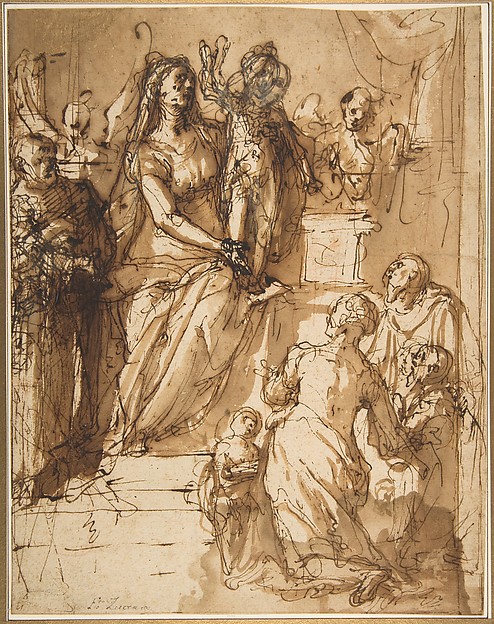
Scene from the Last Judgment, Study for the Florence Cathedral Cupola Fresco, drawn by Federico Zuccaro around 1576 in pen and brown ink with brown wash on paper and now in the Metropolitan Museum of Art in New York, is a more advanced compositional study for one of the segments of the great Florence Cathedral cupola Last Judgment program. The drawing focuses on a single segment of the curving dome surface, working out the disposition of the resurrected dead, the attending angels, and the lower-register hellish figures in a composition that would later be transferred to the dome surface in fresco. The sheet is one of several surviving Zuccaro Florentine cupola studies and a defining document of the late-Mannerist Italian fresco workshop method.
Bible scenes Federico Zuccaro (Zuccari) painted
John
Revelation
Luke