Painter of the Bible
Gerard David
Gerard David was the last great painter of the Bruges school, the artist who carried the Early Netherlandish tradition of Jan van Eyck and Rogier van der Weyden across the threshold of the sixteenth century with all of its devotional gravity intact.

Their faith
Why Gerard David painted Christ
Gerard David was a devout Christian whose artistic journey was deeply rooted in the rich traditions of the Bruges school. Active in the late 15th and early 16th centuries, he dedicated his life to creating sacred art that reflected his faith and devotion. As a member of the Bruges painters' guild, David was not only an accomplished artist but also served as the dean of the guild, indicating his respected position within the community. His works often embody the spiritual gravity of the biblical narratives, showcasing his commitment to portraying the divine through meticulous attention to detail and composition. David's altarpieces, such as the 'Baptism of Christ' triptych, reveal his reverence for scripture and his desire to convey profound religious truths through visual art.
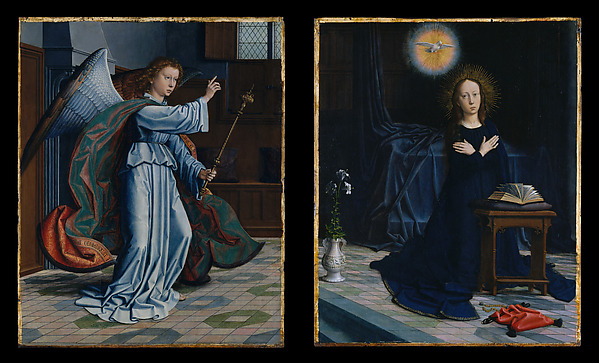
David's faith profoundly influenced his artistic output, leading him to create some of the most significant Christian works of his time. His 'Marriage at Cana' and 'Annunciation' are not merely paintings; they are invitations to contemplate the sacred mysteries of faith. In these pieces, David's careful use of color and composition serves to elevate the viewer's experience, drawing them into the divine narrative. His intimate 'Madonnas with the Soup Bowl' panels exemplify his ability to blend the sacred with the everyday, making the holy relatable and accessible. Through his devotion and artistry, Gerard David continues to inspire viewers today, reminding us of the beauty and depth of faith expressed through the gift of art.
Life & work
Gerard David was the last great painter of the Bruges school, the artist who carried the Early Netherlandish tradition of Jan van Eyck and Rogier van der Weyden across the threshold of the sixteenth century with all of its devotional gravity intact. Born around 1455 in Oudewater, in what is now the Netherlands, registered in the Bruges painters' guild in 1484, and active in the city for the rest of his career, he became dean of the guild in 1501 and held wide standing in the Bruges market until his death there in 1523.
His Christian religious work is concentrated in altarpieces of unusual compositional discipline and chromatic restraint. The Justice of Cambyses diptych (Groeningemuseum, Bruges, 1498), commissioned for the courtroom of the Bruges aldermen and depicting the trial and flaying of the corrupt judge Sisamnes from Herodotus, frames a civic moral lesson in the visual conventions of biblical narrative. His Marriage at Cana (Louvre, c. 1500), the Virgin and Child with Saints (London, c. 1505), the Annunciation (Metropolitan Museum, c. 1506), and the great Baptism of Christ triptych (Bruges, c. 1502–1508) round out the painted corpus.
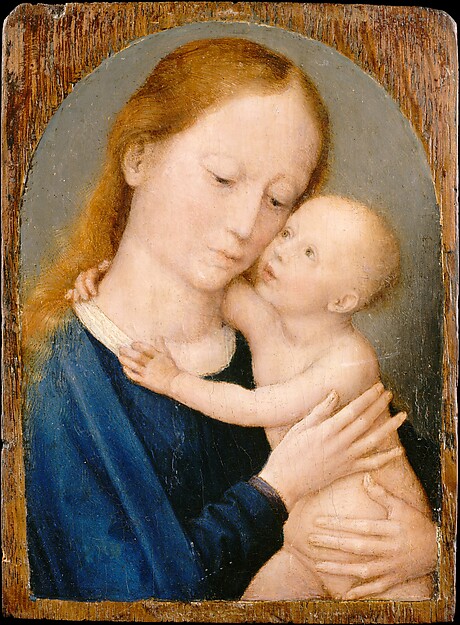
His Madonnas with the Soup Bowl variants — small intimate panels of the Virgin nursing the Child or feeding him with a spoon, with apples, books, and household objects laid on the windowsill behind them — became one of the most-copied compositions in the Bruges export market. Several were sent through the Hanseatic League trade to as far as Norway and northern Germany.
David never traveled to Italy. His style — patient, jewel-colored, technically immaculate, with the deliberate observation of textiles, skin, and landscape that defined the Early Netherlandish school — runs against the contemporary Italianizing tendencies of his Antwerp neighbors. By the time of his death the Bruges market had collapsed under the rise of Antwerp as the new Northern commercial center, and the painted manner he had defended for forty years was already historic. His pupil Adrian Isenbrandt continued the workshop in Bruges into the next generation.
Notable works in detail
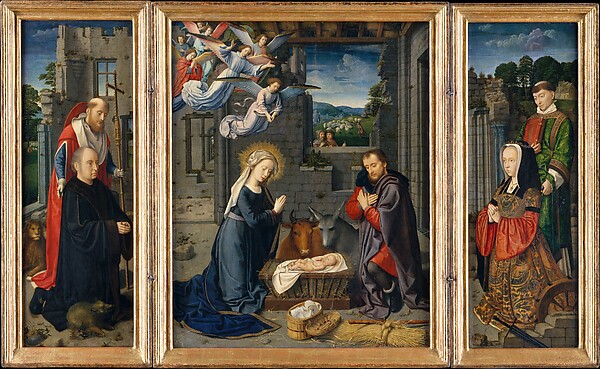
met-436100
The Nativity, painted by Gerard David around 1480 in oil on panel and now in the Metropolitan Museum of Art in New York, depicts the moment of the birth of Christ in the small dwelling at Bethlehem. David stages the scene with characteristic Bruges Early Netherlandish patience: the Virgin kneels in profile with her hands folded in adoration before the newborn Christ Child laid on her cloak in the foreground; Joseph stands at the back of the small thatched stable with a candle illuminating the Christ Child's face; the ox and the ass occupy the rear of the room; small angels descend from the upper-right with banners of greeting. The chromatic palette of saturated crimson, ultramarine, gold, and warm flesh against the soft Northern landscape opening to a low horizon is the unmistakable Gerard David signature.
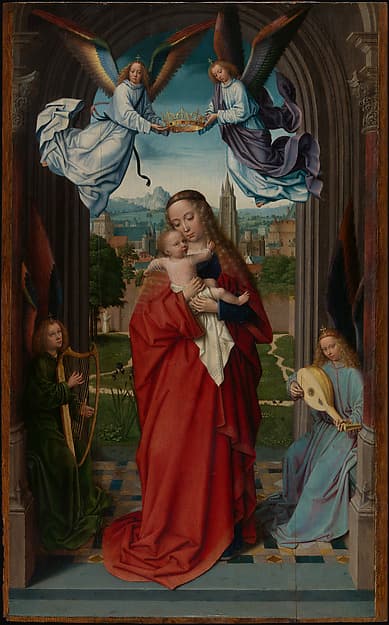
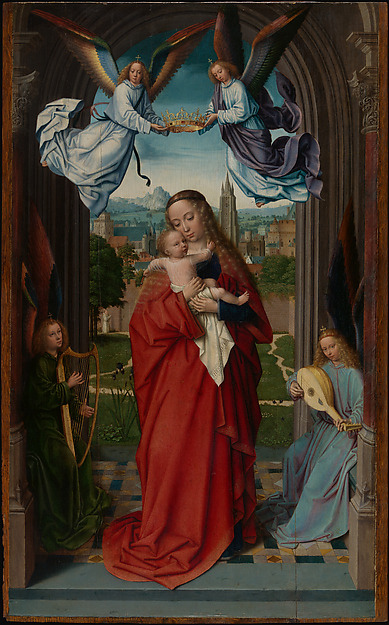
Virgin and Child with Four Angels
Virgin and Child with Four Angels, painted by Gerard David around 1510 in oil on panel and now in the Metropolitan Museum of Art in New York, depicts the iconographic subject of the enthroned Virgin and Christ Child attended by four small music-making angels. David stages the scene in a small architectural interior: the Virgin sits in three-quarter view holding the standing Christ Child upright on her lap; two angels lean in at her shoulders to crown her with a small wreath, while two more angels in the foreground play the lute and the small portative organ. The chromatic palette of deep ultramarine, soft rose, and warm flesh against the dark architectural background is the unmistakable late-Bruges Early Netherlandish signature, and the soft observation of textiles and small surface details is characteristic of David's mature manner.
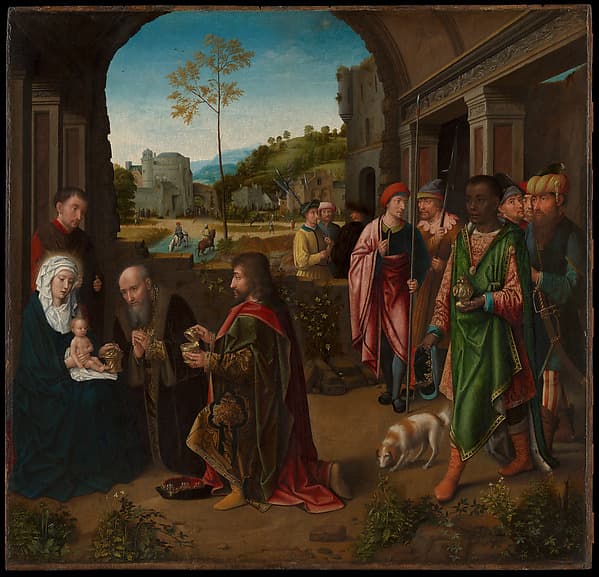
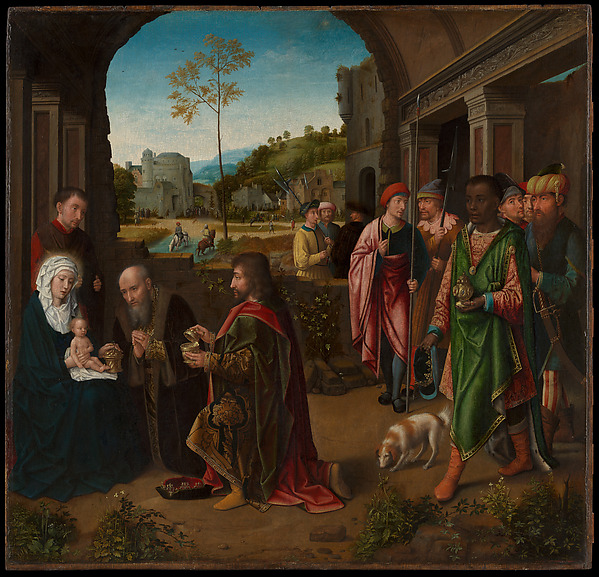
The Adoration of the Magi, painted by Gerard David and his workshop around 1515 in oil on panel and now in the Metropolitan Museum of Art in New York, depicts the visit of the three kings to the infant Christ in the small dwelling at Bethlehem. David stages the scene with characteristic Bruges compositional restraint: the seated Virgin holds the Christ Child upright on her lap on the right; the eldest king kneels in profile in the foreground offering his gift; the second and third kings stand behind in formal attendance; the ox and the ass occupy the rear of the small dwelling, and a small landscape with the Magi's traveling retinue is visible through a window in the deeper background. The painting is among the principal late Gerard David Adorations in any American collection.
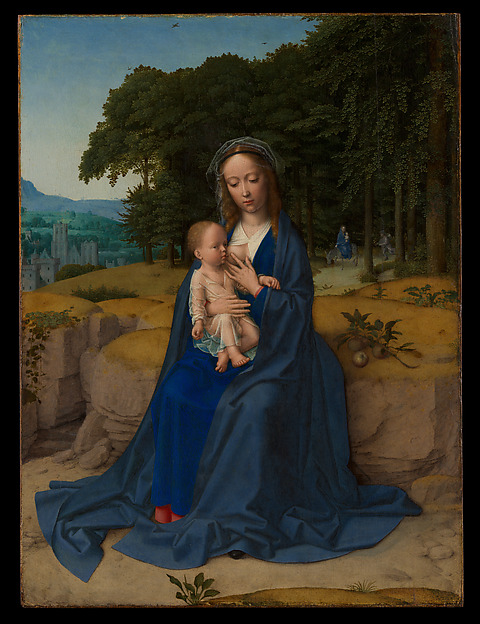
The Rest on the Flight into Egypt
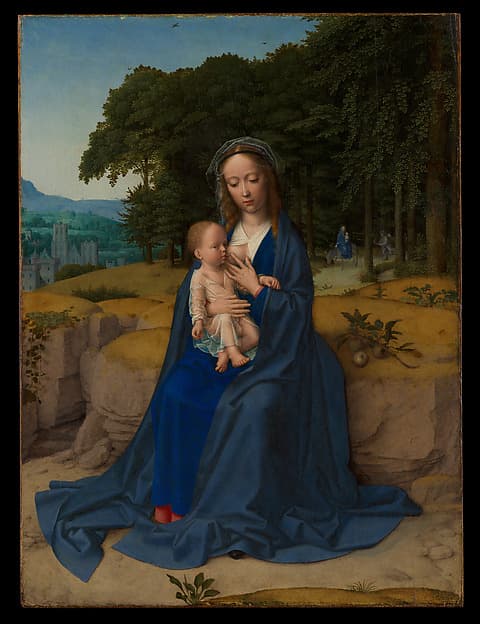
The Rest on the Flight into Egypt, painted by Gerard David around 1512 in oil on panel and now in the Metropolitan Museum of Art in New York, depicts the apocryphal subject of the Holy Family pausing in their flight from Herod's persecution as recorded in Matthew 2. David stages the scene in a quiet Northern landscape: the Virgin sits in profile in the foreground with the Christ Child on her lap, peeling fruit for him; Joseph waits in the background by a small donkey; a small landscape opens to a low horizon behind. The composition is among the most reproduced of David's small devotional panels and a defining example of the Bruges Early Netherlandish workshop tradition that turned the Rest on the Flight subject into a particular specialty for private devotional commissions.